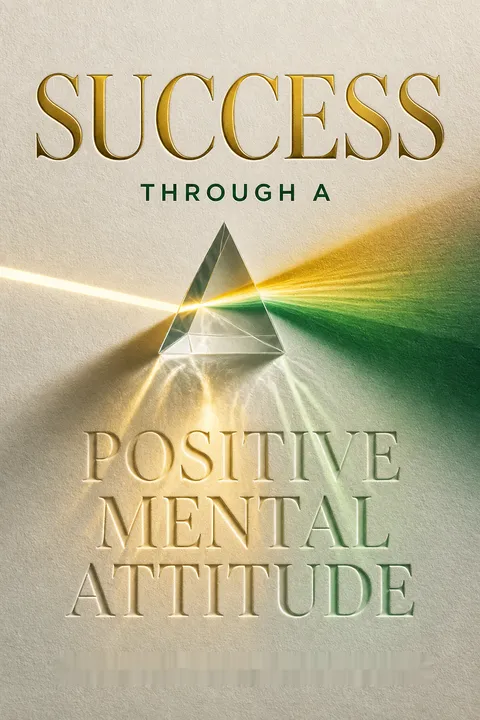


Key Takeaways
Treat attitude as a steering choice, then prove it with action
Attitude directs attention. The book calls a constructive, hopeful, ethical outlook a positive mental attitude, or PMA. Its opposite, a negative mental attitude, narrows what a person notices and discourages useful action. S. B. Fuller, raised in poverty, spent twelve years selling soap and saving before trying to buy the company that supplied him. He had saved $25,000, then persuaded lenders to help him raise the rest. The story makes the authors’ case for desire and persistence, but also shows that success required work, relationships, and access to credit.
Mindset is not magic. The authors present PMA as a force that can attract success and turn adversity into advantage. Their more practical point is that attitude influences what people attempt and how they respond to setbacks. They urge readers to combine it with clear thinking, discipline, initiative, cooperation, health, and persistence.
The useful insight is not that optimism guarantees a favorable outcome. It is that expectations shape attention, effort, and persistence, which can change the odds of success. This is close to the modern idea of self-efficacy: confidence matters most when it supports concrete action. Fuller’s story also exposes a limit in the book’s rhetoric. Poverty is not simply a shortage of desire, and access to lenders is not evenly distributed. Agency matters, but it operates within real constraints.
Name a destination, or you will miss the opportunity at your feet
Purpose organizes effort. The authors call a clear, specific objective a definite purpose. They argue that naming a destination helps people recognize relevant opportunities and take useful steps. Robert Christopher set out to travel around the world with $80. He arranged rides and passage by offering photographs, soil samples, and information in return. He took 84 days, rather than his intended 80, but reached his goal.
Build a route, not a wish. The book’s 17 success principles include purpose, initiative, accurate thinking, self-discipline, cooperation, faith, enthusiasm, learning from defeat, creative vision, and care with health, time, and money. A goal should be written down, given a deadline, and broken into near-term actions. Ambition becomes useful when paired with a workable plan and a willingness to revise it.
A defined goal can act like a search filter: it makes useful information easier to recognize amid ordinary noise. Christopher’s journey illustrates this vividly because he turned existing skills into ways to secure transport. Still, goal-setting is not the same as forecasting. A deadline can focus effort, but an inflexible deadline can also encourage bad risks. The strongest version of the book’s advice treats goals as direction and planning as an ongoing process of adjustment.
When plans fail, search for the missing piece before surrendering
Failure can diagnose. The authors call the overlooked ingredient in an unsuccessful attempt the something more. Their examples show how small changes can matter: the Wright brothers added movable controls that helped a pilot maintain balance, while other inventors had come close to powered flight. The lesson is to examine what a working result requires, rather than treating one failure as proof that the goal is impossible.
Keep testing explanations. The book recommends studying, asking questions, writing down ideas, seeking advice, and following promising insights with action. Alexander Graham Bell’s work is presented as a case where a technical change helped transmit speech. The authors also praise brainstorming, in which a group generates many ideas before judging them. These methods turn vague persistence into a search for a specific improvement.
This is the book at its most engineering-minded. Persistence becomes productive when it includes diagnosis, experiments, and learning from earlier attempts. A failure can reveal a missing condition, but it can also be evidence that a premise is wrong or a project is not worth continuing. The distinction matters. Iteration is not blind repetition. It asks what the result teaches, what evidence would change the plan, and when another approach deserves a trial.
Convert setbacks into experiments instead of verdicts on your ability
Reframe, then investigate. The book urges readers to meet problems with a deliberate search for what can be learned or improved. Its practical method is to define the problem, examine it carefully, ask what advantage might be hidden in the difficulty, and identify an action that could work. This is not a claim that every hardship is secretly beneficial. It is a way to keep discouragement from ending the search too soon.
Test a different response. In 1939, a manager took over a Chicago office building that was only 10 percent occupied. Instead of waiting for better economic conditions, he offered prospective tenants redesigned offices, rent no higher than they already paid, and help with their existing leases. Within a year, the building was fully rented. He treated weak demand as a reason to experiment with the offer.
The story illustrates cognitive reappraisal, the practice of changing how a situation is interpreted so that new responses become possible. The manager did not merely tell himself to feel better. He changed the terms of the problem for potential tenants. That distinction protects the advice from toxic positivity. Some losses are losses, and some obstacles cannot be overcome by attitude. Reframing is most valuable when it opens a practical option, not when it denies pain or unfairness.
Train yourself to notice what routine eyes overlook
Seeing requires interpretation. The authors argue that people can look at something without understanding its significance. In their example, a sparkling outcrop near Darby, Montana, had been visible for years before A. E. Cumley and L. I. Thompson recognized it as potentially valuable beryl. A mineral display helped them connect the unfamiliar rock to a possible use. They then sought expert assessment rather than relying on appearance alone.
Turn curiosity into action. The book recommends asking why something happened, checking assumptions, and seeking knowledgeable advice. It describes George Campbell, who learned to build a full life despite blindness, and Isaac Newton, who asked why an apple fell. The larger principle is that observation becomes useful when people interpret it, test the interpretation, and act on what they learn.
The book’s distinction between looking and seeing anticipates a familiar problem in cognition: perception is not a neutral recording of the world. Prior knowledge helps people notice patterns, as the mineral specimen did for Cumley and Thompson. But the same expectations can also create confirmation bias, making people see what they hope or fear is there. Curiosity therefore needs a second habit alongside attention: checking an interpretation against evidence and other perspectives.
Turn intentions into action with a cue you obey immediately
Reduce the delay. The authors’ self-starter, “DO IT NOW! ”, is a cue to act as soon as a worthwhile task or opportunity becomes clear. They recommend practicing with ordinary responsibilities so that postponement does not become the default response. They also advise carrying paper and a pencil to record ideas before they disappear.
Action builds habit. Kenneth Harmon, a civilian prisoner during World War II, began copying a fellow prisoner’s book before being transferred to a camp. He finished in time and kept the manuscript with him through more than three years of captivity. The authors use his urgency to show that acting promptly can preserve an opportunity. Their broader advice is to repeat a chosen behavior until it becomes easier to initiate.
A memorable cue can bridge the gap between intention and behavior, especially when it is linked to a clear action. In contemporary behavior design, this resembles an implementation intention: deciding in advance what to do when a specific situation arises. The caution is built into the word worthwhile. Immediate action is not always wise. A pause can be essential for high-stakes decisions, emotional conflicts, or risks that deserve careful review.
Use borrowed money only with integrity, repayment, and cycle awareness
Leverage needs a plan. The book calls other people’s money OPM and presents credit as a tool for expanding a business. It describes entrepreneurs who borrowed to acquire companies, develop sales, or build hotels. The authors stress that credit depends on trust: borrowers should disclose problems, honor agreements, and have a credible way to repay.
Debt magnifies outcomes. The book also warns that borrowing can turn dangerous when asset values fall or borrowers ignore economic cycles. For personal saving, it recommends setting aside 10 percent of income and investing with expert advice. For business, the principle is not simply to borrow more. It is to use financing for a specific productive purpose and understand what happens if revenue or asset prices decline.
This is a more balanced financial lesson than the book’s confident celebration of leverage might suggest. Borrowing can accelerate growth, but it also concentrates risk and transfers some control to creditors. A sound plan needs downside scenarios, not only a forecast of success. The book’s insistence on honesty is essential, yet integrity alone cannot make an unaffordable loan safe. Financial judgment requires both character and arithmetic.
Make routine work a stepping-stone toward a goal you chose
Connect tasks to direction. The book’s step-stone theory links repetitive work to a larger purpose. A housewife who found daily chores dispiriting chose a family trip around the world as a goal. She used cleaning time to plan, shopping to explore foods from other countries, and meals to teach her family about places they hoped to visit. The chores stayed repetitive, but their meaning changed.
Check the fit. The authors recommend learning a job well, improving what can be improved, and looking for a future the work can help build. They also acknowledge that a job can be a poor fit. If its cost is too high or the environment is persistently damaging, changing the job or adjusting the situation may be wiser than forcing enthusiasm.
Meaning can make routine effort more bearable, much as craft and purpose can improve engagement at work. The story is persuasive because the woman creates a link between what she does today and a future she values. But this advice should not shift responsibility for every bad workplace onto the worker. Some jobs are underpaid, unsafe, or unfair. Reframing can support agency, but it does not replace the need to change harmful conditions.
Build happiness by giving service, attention, and encouragement
Generosity includes attention. The authors’ “Magnificent Obsession” means making a sustained commitment to help others without demanding praise or payment. Their examples include a wealthy donor who gave anonymously to a boys’ organization and a grieving mother who found purpose through service at a medical center. The idea is not limited to money. A person can offer time, encouragement, kindness, or practical help.
Practice understanding at home. The book links happiness to considerate relationships. It tells of a young man whose conflict with his mother eased when he changed his own responses, and it recommends listening, expressing affection, and trying to understand another person’s viewpoint. The authors also suggest letters as a way to communicate thoughts that may be difficult to express in conversation.
The section joins individual happiness to contribution and relationship, a valuable correction to the idea that contentment comes mainly from acquisition. Prosocial behavior can strengthen connection and give effort a sense of purpose. Yet giving should not be treated as a transaction that guarantees a reward, as the book sometimes implies. Nor should self-sacrifice become an obligation imposed on people who already have too little. Generosity is healthiest when it includes boundaries and genuine choice.
Make guilt useful by repairing harm instead of rehearsing shame
Let remorse guide repair. The authors treat guilt as a signal that an action may have violated a moral standard. They argue that the feeling becomes useful when it leads to responsibility and changed behavior, rather than secrecy or self-punishment. Jim Vaus, who had become involved in criminal work, describes making a decisive break with that life after hearing a religious message that confronted him with its cost.
Take concrete steps. The book’s approach is to acknowledge the wrongdoing, feel genuine regret, seek forgiveness where appropriate, make amends, and use the Golden Rule to guide future choices. It also recognizes that moral decisions can involve competing duties, such as loyalty to a person versus loyalty to an organization. In those cases, it urges readers to examine consequences and conscience before choosing.
The strongest idea here resembles restorative justice: accountability matters most when it includes efforts to repair harm and prevent repetition. That is more constructive than treating guilt as a sentence to suffer forever. A useful distinction is between guilt about an action and global shame about the self. The first can motivate restitution; the second can trap a person in avoidance. Some guilt is also misplaced or produced by coercive standards, so reflection and trusted support matter.
Read for principles, test them, and measure what changes
Turn reading into practice. The authors advise reading a self-help book with a question in mind, marking useful ideas, reflecting on how they apply, and testing them in daily life. They describe Benjamin Franklin’s method of focusing on one virtue at a time and reviewing his conduct regularly. The point is to make ideas part of behavior, not merely collect inspiring phrases.
Use a self-audit. Their Success Quotient Analysis asks readers about purpose, discipline, initiative, teamwork, health, money, and other areas of life. The authors suggest repeating the questionnaire after sustained practice to notice changes. It is best understood as a structured prompt for reflection, not as a validated psychological test or a definitive score of a person’s worth.
The book’s most durable teaching method is active reading: identify a principle, apply it, and review the result. This resembles reflective practice in education and professional training, where improvement depends on feedback rather than exposure to information alone. The questionnaire can make self-examination concrete, but its numerical score gives a stronger impression of measurement than the tool can support. Its value lies in the questions it raises, not the authority of its rating.
Analysis
Published in 1960 by Napoleon Hill and W. Clement Stone, this is a story-driven self-help manual organized around a recurring claim: attitude matters because it shapes action. The authors cycle through business successes, family conflicts, health crises, scientific discoveries, and religious conversions, asking readers to extract a principle from each. The result is less a single theory than a motivational toolkit: clarify a purpose, think accurately, keep learning, act promptly, persist, cooperate, and serve.
Its strongest contribution is practical rather than scientific. The recurring movement from setback to reflection to action gives readers a memorable way to avoid treating discouragement as a final judgment. Its emphasis on written goals, deliberate practice, mentoring, and self-review remains useful. The concrete stories also make abstract advice easier to recall, even when some stories are presented as proof of broader claims they cannot establish.
The book’s optimism has a significant boundary. It sometimes treats poverty, illness, and failure as problems an individual can overcome mainly through attitude. Fuller’s story, for example, also depends on years of labor, relationships, and access to financing. A modern reading should preserve the emphasis on agency without implying that hardship reveals a person’s deficient mindset. Conditions, luck, institutions, and health affect what effort can accomplish.
The authors also make claims about health, subconscious power, and psychic phenomena that should not be confused with established evidence. Positive expectations may support persistence and coping, but they do not replace medical care or guarantee recovery. The most credible version of PMA is therefore not a promise that thought controls reality. It is a discipline for directing attention, choosing a response, and continuing to learn while remaining honest about uncertainty and limits.
Review Summary
Success Through A Positive Mental Attitude is highly regarded by readers for its motivational content and practical principles for achieving success. Many reviewers praise the book's emphasis on developing a positive mindset and its 17 success principles. Readers appreciate the numerous real-life examples and stories of successful people. Some find the language dated but still relevant. The book is often described as life-changing, inspiring readers to take action and overcome challenges. Critics note religious references and repetition of ideas from Hill's earlier works.
People Also Read





Glossary
PMA
Constructive mental attitudePositive Mental Attitude, abbreviated PMA, is the book’s term for an outlook built from qualities such as hope, faith, honesty, courage, initiative, generosity, and practical judgment. The authors present it as a stance that helps people pursue worthwhile goals and respond constructively to difficulty. They pair it with planning and action, although they sometimes overstate its power to determine outcomes.
NMA
Negative mental attitudeNegative Mental Attitude, abbreviated NMA, is the book’s term for patterns of thought and behavior that discourage constructive effort. The authors associate it with fear, prejudice, inertia, resentment, and pessimistic assumptions. In their framework, NMA can cause people to overlook opportunities or abandon goals. The term is broad and rhetorical rather than a clinical psychological category.
17 success principles
Achievement principles checklistThe book’s 17 success principles form a broad checklist for pursuing goals. They include PMA, definite purpose, initiative, accurate thinking, self-discipline, teamwork, faith, enthusiasm, learning from defeat, creative vision, and managing time, money, and health. The authors advise readers to analyze both successes and failures through these principles, since different goals may require different combinations.
Inspirational dissatisfaction
Discontent turned into progressInspirational dissatisfaction is the authors’ term for discontent that prompts constructive change rather than resentment or defeat. It begins with recognizing that a situation is unsatisfactory, then uses that recognition to set a goal and take action. The book contrasts this response with negative dissatisfaction, which dwells on frustration without producing a useful next step.
something more
The missing success ingredientThe authors use “something more” for an overlooked element that can turn an unsuccessful attempt into a workable one. It may be a new technique, a missing resource, better information, or a different combination of existing parts. Their examples from invention emphasize continued investigation and adjustment, not simply repeating the same effort.
DO IT NOW!
Immediate-action cue“DO IT NOW!” is the book’s self-starter for interrupting procrastination. The reader is encouraged to repeat the phrase when a useful action becomes clear, then follow it with behavior. The authors recommend practicing on ordinary tasks so prompt action becomes habitual. It is a motivational cue, not a rule that every decision should be made without reflection.
self-suggestion
Deliberate self-directed promptingSelf-suggestion is the book’s practice of deliberately repeating a chosen phrase, idea, or aim to influence one’s own attention and behavior. The authors recommend using it to reinforce qualities such as courage, honesty, or enthusiasm. They distinguish deliberate self-suggestion from automatic habits of thought, which they call autosuggestion, though their account of the subconscious is not a modern clinical model.
autosuggestion
Automatic mental influenceThe authors use autosuggestion for thoughts and impressions that influence a person without deliberate, conscious repetition. They describe the subconscious as absorbing habits, memories, and repeated messages, which can shape later reactions. This usage reflects early twentieth-century self-help and psychological vocabulary. It should not be read as a precise account of how memory or unconscious mental processes work.
Master Mind alliance
Harmonious shared effortA Master Mind alliance is a cooperative relationship in which two or more people coordinate knowledge and effort toward a definite purpose. The book emphasizes harmony and mutual contribution, rather than simply assembling a group. It presents such alliances as useful in business and personal achievement, including examples where partners combine complementary skills or provide advice and support.
Magnificent Obsession
Committed service to othersA Magnificent Obsession is the book’s name for a sustained commitment to help others without seeking recognition or direct reward. It can involve money, time, skill, encouragement, or participation in a cause. The authors argue that service gives purpose and can benefit both giver and recipient, though its value does not depend on receiving a personal reward in return.
OPM
Other people’s moneyOPM means other people’s money, particularly funds borrowed or invested to finance a business or other productive activity. The book presents credit as a way to expand beyond one’s own savings, provided the borrower acts honestly and has a plausible repayment plan. It also warns that debt can magnify losses when markets or business conditions turn unfavorable.
cosmic habit force
Application of universal lawCosmic habit force is the authors’ term for the use of a natural or universal principle, whether or not the person applying it understands the principle. They use examples such as gravity and physical laws to illustrate cause and effect. The concept is expansive and sometimes speculative, joining scientific laws with psychological and spiritual claims.
Activity Vector Analysis
Person-job fit assessmentActivity Vector Analysis, or AVA, is a personnel assessment described in the book as a way to compare an individual’s behavioral tendencies with a job’s requirements. The authors say that matching the two can help with hiring, management development, and reducing turnover. The book presents AVA as a practical tool, but does not supply enough evidence to establish the accuracy of its claims.
Success Quotient Analysis
Self-review questionnaireSuccess Quotient Analysis is the book’s questionnaire for reviewing habits and abilities related to its 17 success principles. Questions cover purpose, discipline, teamwork, initiative, health, and money management. The authors assign a numerical score and recommend repeating the exercise after practice. It is best treated as a structured self-reflection tool, not a validated psychological measure.
step-stone theory
Routine linked to a goalThe step-stone theory is the book’s method for making repetitive work feel connected to a desired future. A person identifies a meaningful goal, then finds ways current tasks can contribute to it. The authors illustrate this with a woman who linked household chores to planning an international family trip. The idea can create meaning, but does not make harmful working conditions acceptable.
FAQ
What's Success Through a Positive Mental Attitude about?
- Focus on PMA: The book emphasizes the importance of maintaining a Positive Mental Attitude (PMA) as a key to achieving success in various aspects of life, including personal and professional endeavors.
- 17 Success Principles: It introduces 17 principles that guide readers in transforming their mindset and actions towards achieving their goals.
- Real-Life Examples: The authors, Napoleon Hill and W. Clement Stone, share numerous stories of individuals who have successfully applied these principles, illustrating the practical application of PMA.
Why should I read Success Through a Positive Mental Attitude?
- Transformative Impact: Many readers, including notable figures, have credited the book with changing their lives and perspectives, making it a valuable resource for personal growth.
- Proven Techniques: The book provides practical techniques and methods for self-motivation and personal development, making it a valuable resource for anyone looking to improve their life.
- Empowerment: Reading this book can empower you to take control of your thoughts and actions, leading to a more fulfilling and successful life.
What are the key takeaways of Success Through a Positive Mental Attitude?
- PMA vs. NMA: The book contrasts Positive Mental Attitude (PMA) with Negative Mental Attitude (NMA), emphasizing that PMA attracts success while NMA repels it.
- Importance of Goals: It stresses the necessity of having a definiteness of purpose, which is crucial for achieving any worthwhile goal.
- Action is Essential: It highlights the importance of taking action and not just thinking positively; "You can attract happiness with PMA," but you must also act on it.
What are the best quotes from Success Through a Positive Mental Attitude and what do they mean?
- “You are a mind with a body.”: This quote emphasizes the idea that our thoughts and mental attitudes significantly influence our physical actions and overall life outcomes.
- “What the mind of man can conceive and believe, the mind of man can achieve with PMA.”: This encapsulates the core message of the book, suggesting that belief in oneself and a positive mindset are essential for achieving success.
- “Every adversity has the seed of an equivalent or greater benefit.”: This quote encourages readers to find the silver lining in challenges, reinforcing the idea that difficulties can lead to growth and opportunity.
What is PMA and how can I apply it from Success Through a Positive Mental Attitude?
- Definition of PMA: PMA stands for Positive Mental Attitude, characterized by optimism, hope, and a focus on solutions rather than problems.
- Daily Practice: The book suggests incorporating PMA into daily life through affirmations, visualization, and maintaining a positive outlook, especially in challenging situations.
- Self-Motivators: Readers are encouraged to use self-motivators, such as “DO IT NOW!” to prompt immediate action towards their goals, reinforcing the habit of acting positively.
How does Success Through a Positive Mental Attitude suggest I deal with problems?
- View Problems Positively: The authors encourage readers to see problems as opportunities for growth, stating, “So you’ve got a problem? That’s good!”
- Ask Questions: They recommend asking yourself specific questions about the problem to uncover potential benefits and solutions, such as “What’s good about it?”
- Divine Guidance: The book advises seeking divine guidance and engaging in thinking time to analyze and define the problem clearly.
What are the 17 success principles outlined in Success Through a Positive Mental Attitude?
- List of Principles: The principles include PMA, definiteness of purpose, going the extra mile, accurate thinking, self-discipline, the master mind, applied faith, pleasing personality, personal initiative, enthusiasm, controlled attention, teamwork, learning from defeat, creative vision, budgeting time and money, maintaining sound physical and mental health, and using cosmic habit force.
- Application: Each principle is designed to be applied in daily life to foster success and personal development.
- Self-Analysis: The book encourages readers to analyze their use of these principles regularly to identify areas for improvement.
How can I motivate myself according to Success Through a Positive Mental Attitude?
- Use Self-Suggestion: The book emphasizes the power of self-suggestion, encouraging readers to repeat positive affirmations and visualize their goals.
- Identify Motivating Factors: Understanding the ten basic motives that inspire human action can help individuals find what drives them personally.
- Take Action: The authors stress the importance of taking immediate action when motivated, using the self-starter phrase “DO IT NOW!” to combat procrastination.
How can I motivate others based on the teachings of Success Through a Positive Mental Attitude?
- Express Faith in Others: The book suggests that having faith in others can significantly boost their confidence and motivation, as illustrated by the story of Thomas Edison and his mother.
- Use Letters for Motivation: Writing letters can be an effective way to communicate encouragement and advice, allowing the recipient to reflect on the message.
- Lead by Example: Demonstrating PMA in your actions can inspire others to adopt a similar mindset, as seen in the story of W. Clement Stone and his sales team.
What is the significance of the concept of “cosmic habit force” in Success Through a Positive Mental Attitude?
- Definition of Cosmic Habit Force: Cosmic habit force refers to the application of universal laws and principles that govern success and behavior, whether known or unknown.
- Power of Habits: The book emphasizes that habits shape our actions and outcomes, and by understanding cosmic habit force, individuals can align their habits with their goals.
- Practical Application: Readers are encouraged to consciously develop positive habits that support their success, leveraging the power of cosmic habit force to achieve their objectives.
How does Success Through a Positive Mental Attitude address the concept of failure?
- Learning from Failure: The authors encourage readers to view failure as a learning opportunity rather than a setback.
- Resilience: Developing resilience and the ability to bounce back from failures is a key theme in the book.
- Mindset Shift: The book advocates for a mindset shift that allows individuals to see failures as stepping stones to success rather than insurmountable obstacles.
What is the significance of the "Do It Now!" principle in Success Through a Positive Mental Attitude?
- Immediate Action: The "Do It Now!" principle encourages readers to take immediate action toward their goals rather than procrastinating.
- Overcoming Inertia: It helps combat inertia and the tendency to delay important tasks, fostering a proactive mindset.
- Creating Momentum: By acting now, you create momentum that can lead to further actions and ultimately success.
About the Author
Other books by Napoleon Hill







Download PDF
Download EPUB
.epub digital book format is ideal for reading ebooks on phones, tablets, and e-readers.








