

Plot Summary
A Wounded Guide Arrives
A exhausted cavalry detail reaches Weymarn's Crossing with Keefe Calhoun, its wounded guide, sagging over his saddle. Lieutenant Benson has dismissed him after Calhoun warned an Apache camp of the soldiers' planned attack.
Benson burned the camp anyway, though it held only elders, women, and children. Their families returned, found their shelter destroyed, and ambushed the cavalry that night. One soldier died; Calhoun and Trooper Ryan were hurt. At the Crossing, the townspeople shelter the wounded in Cap Thompson's wash house, where Cap's daughter Hallie treats them.
Benson leaves Calhoun behind and hires another guide to pursue Maco, an Apache leader who has escaped Fort Kelso. The town is now waiting for a conflict Calhoun believes white soldiers helped create.
The opening makes violence cumulative rather than mysterious: a military order produces a warning, the warning is ignored, and the retaliation follows the destruction of a vulnerable camp. Calhoun's refusal to aid an attack is not presented as abstract virtue; it costs him his position and leaves him wounded among people who fear the consequences. Benson, by contrast, treats obedience as proof of authority, even when it makes his mission less effective. The smoke of the title belongs to a world where news travels quickly, but responsibility travels less readily. The Crossing inherits the damage before it knows its cause.
The Hoe Handle Fight
While recovering, Calhoun learns that the Army may not pay for his care, and Cap worries that feeding him will deepen the Thompsons' debts. Hallie offers him food and tends his wound despite her father's hard bargaining.
Calhoun also sees how much work she carries, from laundry to baking, while her quiet fiancé, Sam Avery, helps without challenging the arrangement. When Ryan gets drunk and attacks Calhoun and Will Weymarn, Calhoun fights from the ground with a hoe, leaving Ryan unconscious.
Rather than return to Cap's wash house, he asks Weymarn for work and begins tending the saloon. He meets Weymarn's wife, Belle, who has built a precarious respectability after an earlier life in a Silver City saloon, and sees a woman whose marriage offers shelter but not uncomplicated freedom.
The hoe fight establishes Calhoun's defining competence in an unusually compromised form: injured, nearly immobile, and forced to use whatever is within reach. His refusal to be a passive burden leads him into Weymarn's orbit, where employment becomes both refuge and exposure. Meanwhile, Hallie's labor and Sam's helpfulness conceal a relational imbalance. Sam contributes, but his willingness to let Hallie shoulder the future also leaves her unasked and unseen. Belle's careful arrangement with Weymarn offers a parallel, more experienced version of that compromise. The town's domestic economy is as consequential as its gunfights: who feeds whom determines who can stay, work, and choose.
Ryan's Arm on the Porch
Weymarn sends the injured Ryan on a secret errand, offering him money to carry a message to Santiago, a young Apache connected to Maco. Calhoun does not witness the arrangement, but he notices Ryan leave and soon finds the trooper's severed arm on the store veranda, a silver dollar placed in its hand.
Weymarn tries to direct the grisly discovery out of sight, then denies any connection to Ryan. Calhoun observes that Ryan was out of uniform when he disappeared and later finds his cavalry clothes hidden in the storeroom.
Meanwhile, Wilkie Brown, one of Weymarn's ranch hands, lets slip that he has done dangerous, secret work. Weymarn brings Wilkie's body back and suggests Apaches killed him, but quietly warns Cap Thompson not to repeat what Wilkie told him.
The clues arrive as material discrepancies rather than confessions: a missing uniform, a concealed journey, a silver dollar, a body placed where townspeople must see it. Calhoun reads objects as evidence because the people who control the Crossing's stories have reasons to distort them. Weymarn's public account is designed to keep the town from retaliating, but his private warning to Cap suggests that concealment serves more than public order. The severed arm converts a distant political conflict into an intimate threat, while its placement makes the town a forced audience. The mystery is therefore about who can interpret violence, and whose interpretation becomes official.
Tracks Across the Mesa
After Weymarn tells Calhoun that Apaches killed Wilkie, Calhoun decides the story is meant to stop him asking questions. He borrows his horse through Sam and follows the buckboard tracks to Wilkie's bloodstained resting place, then searches the surrounding mesa and canyon.
The traces show that a rider used Weymarn's buckboard team to reach Wilkie, killed him, and returned his body to the road to stage an Apache ambush. Calhoun suspects Weymarn and rides to the reservation, where his old friend Mahtla confirms that Weymarn holds Maco and has tried to trade him to Santiago's band for horses and cattle.
The band could not meet the price. Ryan's mission, Wilkie's knowledge, and Weymarn's lies now converge: Calhoun has identified the secret behind the killings, though he still lacks proof of what Weymarn will do next.
Calhoun's tracking turns the landscape into an argument that can contradict a powerful man's account. The tracks do not simply solve a murder; they expose how a lie can be manufactured from the same ground that holds the truth. Mahtla's confirmation also complicates the conventional boundary between law and outlawry. Weymarn's connection to Maco is not a lawful arrest or a humane safeguard, but a private bargain that treats a person as exchangeable property. Calhoun's friendship with Mahtla makes the revelation possible, yet Mahtla risks his safety by speaking. Trust here is not sentimental; it is a form of evidence shared across a dangerous divide.
Bolton Waits at the Corral
Calhoun returns from the reservation and learns that Weymarn has discovered he secretly rode out to investigate Wilkie's death. Weymarn recruits Wes Bolton, his most dangerous ranch hand, to kill Calhoun after dark. But Sam has innocently revealed Calhoun's ride, and Calhoun recognizes Bolton waiting near the corral.
He hides his gun, draws Bolton into a confrontation over his own horse, and shoots first when Bolton reaches for his weapon. With Weymarn now certain that Calhoun is a threat, the detective work cannot continue quietly.
Hallie has also ended her long, uncertain engagement to Sam, telling him that she has not wanted the marriage for some time. When she explains that a small cavalry escort is carrying the Fort Kelso payroll, Calhoun realizes Weymarn can use the gold to buy Maco from Santiago.
The corral encounter is a collision between Weymarn's reliance on intermediaries and Calhoun's ability to read intention before a weapon clears leather. Sam's disclosure is not betrayal; his ordinary candor becomes dangerous because he does not understand the stakes. Hallie's break with Sam likewise grows from accumulated neglect rather than a sudden romantic impulse. Calhoun's presence helps her recognize that she has been living inside a decision made years earlier and never renewed. These personal and criminal plots meet when she supplies the payroll information. Her knowledge changes Calhoun's strategy, while her choice about marriage begins to change the future she can imagine.
The Warning Ignored
Weymarn has learned that only six cavalrymen, Lieutenant McKelway, and the paymaster are escorting the payroll from Silver City. Calhoun rides after them and warns McKelway that Santiago's Apache band may attack for the money, which could fund horses and supplies for a flight toward Mexico.
Calhoun will not reveal how he learned this, and McKelway dismisses the warning as an unsupported rumor. He refuses to seek reinforcements or hire civilian guides, then camps at an exposed, abandoned ranch with his detail.
At dawn, Apaches attack the sleeping soldiers. McKelway is killed, and the escort is overwhelmed. Calhoun's warning could not prevent the ambush because the officer's pride and fear of being blamed for unnecessary spending outweighed the risk he was meant to assess.
McKelway's refusal is not simple ignorance. Calhoun offers a warning without a source, while McKelway has institutional incentives to treat undocumented information as liability. Yet the scene shows how procedure can become a refuge from judgment: McKelway protects his career from a hypothetical reprimand and leaves his men exposed to a real attack. The contrast with Calhoun is not that one man possesses certainty and the other does not. Calhoun acts under uncertainty because he understands the terrain and the consequences of inaction. The ambush makes the cost of bureaucratic caution concrete, while also demonstrating that sound intelligence cannot help people unwilling to receive it.
Gold Beneath the Platform
After warning McKelway, Calhoun returns to the Crossing at night and tells Hallie that he means to find Maco before Weymarn can deliver him to Santiago. He admits his feelings for Hallie, and she chooses him freely, while Cap objects to the danger Calhoun brings to their home. Calhoun then hides beneath the trading post's loading platform, planning to follow Weymarn when he rides to Maco.
During the night, he hears movement inside the store and discovers four sacks filled with gold coins. The payroll has reached Weymarn, confirming that the escort was attacked and that the money is being used as ransom. Calhoun leaves before Weymarn can find him, rides into the mountains, and watches for the man who can lead him to Maco.
The loading platform turns concealment into a literal position beneath the town's commerce. Calhoun is hidden under the place where goods pass through, listening as the violence of the larger plot enters the store in the form of gold. The sacks prove that the attack was not merely a rumor, but the proof arrives too late to protect the soldiers. At the same time, the scene gives Hallie a choice that contrasts with the transactional bargains around her: she does not trade security for a marriage she no longer wants. Calhoun's promise carries risk, but it recognizes her as a participant in the future rather than a dependent to be managed.
The Mine Shaft Opens
Calhoun follows Weymarn into the mountains and discovers that two Apache riders are trailing him. The trail ends at an abandoned mine, where Weymarn and a helper lower a ladder into the shaft. Maco climbs out, wounded and limping, after Weymarn has kept him hidden there.
As Weymarn refuses Maco a horse, one Apache attacks and drives a lance through him. Weymarn's helper shoots that attacker, then kills the second as he charges. Maco seizes the second Apache's rifle and shoots the helper in the back.
Calhoun emerges and orders Maco to surrender, but Maco shoots at him and tries to escape. Calhoun wounds him, then fires again when Maco continues to fight. Maco falls dead, ending the immediate contest for his release and leaving Calhoun to bring Weymarn's body back.
The mine makes Weymarn's bargain visible: Maco has been reduced to a wounded body held underground, while the ladder and horse determine whether he can leave. But once the shaft opens, no one controls the terms. The Apache pursuers, Weymarn's hired helper, Maco, and Calhoun act on incompatible loyalties, and violence destroys the possibility of a clean exchange. Calhoun's final shot is not a triumphant capture. It is a decision that Maco's attempt to keep fighting will not be allowed to become another raid. The scene resists a simple victory narrative: Weymarn's greed helps produce the deaths, and Calhoun survives by accepting the terrible cost of stopping the cycle.
Hallie Chooses Her Future
Calhoun rides back to Weymarn's Crossing with the dead trader's body tied across Weymarn's horse. Belle sees her husband's horse and understands the loss before Calhoun explains that Maco killed him.
Calhoun later makes clear that Weymarn brought the danger on himself, though the stolen payroll and the full story remain to be explained. He leaves the gathered townspeople and heads for the Thompsons' home. Hallie comes out to meet him, no longer waiting for a man who might or might not return.
Calhoun reminds her that he intends to stay with her, and she confirms that she had already meant to tell him the same. Their promise offers a personal resolution after the town's web of bargains and violence, without pretending that the wider conflict has been settled.
The ending closes the personal arc more firmly than the political one. Calhoun returns with physical proof of Weymarn's downfall, but the narrative does not stage a public accounting for the gold or a durable settlement between the town and the Apache community. That incompleteness matters: ending a violent episode is not the same as repairing the conditions that produced it. Hallie's response, however, is decisive. She has stopped treating marriage as a distant obligation and now meets Calhoun as someone who has chosen her own direction. Their reunion is modest in scale, but it replaces the town's coercive exchanges with mutual commitment.
Analysis
Summer of the Smoke builds its frontier conflict through a chain of decisions that each side can describe as necessary. Benson attacks a camp because he wants to pursue Maco; the camp's destruction helps provoke an ambush; Weymarn exploits the resulting instability for profit; and the town's anger threatens people who had no part in either plan. The novel's strongest challenge to frontier myth is causal: violence does not emerge from an unknowable wilderness but from choices made by identifiable people, often under the cover of duty, fear, or commerce.
Calhoun serves as the counterweight because he treats uncertainty as a reason to investigate rather than a license to accuse. He reads physical evidence carefully, seeks information from Mahtla without demanding that his friend take reckless risks, and warns McKelway even when he expects dismissal. His practical intelligence is also moral intelligence. He understands that a false story about Apache violence can make innocent people targets, just as surely as a military order can.
The book also locates power in ordinary arrangements. Hallie's labor keeps the Thompson household functioning, while Cap's dependence restricts her choices. Sam's kindness does not make him a suitable partner when he assumes their engagement can continue without attention. Belle's marriage offers security but cannot erase the past or the vulnerability that comes with her reputation. Against Weymarn's bargains, Calhoun and Hallie's final commitment matters because it is chosen openly rather than imposed by debt, fear, or convenience.
The ending resolves the immediate contest for Maco but not the larger political conflict, and that restraint is significant. The return of Weymarn's body does not undo the soldiers' deaths, the town's prejudice, or the conditions that made private ransom seem possible. The novel's final hope is therefore intimate rather than utopian: two people begin a life together after surviving a landscape where nearly every other relationship has been treated as leverage.
Review Summary
Characters
Keefe Calhoun
The principled trackerCalhoun is a seasoned guide and tracker whose calm manner can make him seem indifferent, though his decisions reveal a strong resistance to needless violence. He warns Benson before the attack on the Apache camp, refuses to treat retaliation as proof that the Apaches are naturally savage, and takes personal risks to prevent a wider conflict. His practical intelligence is grounded in close observation: tracks, clothing, and a horse's movements tell him what people conceal. Calhoun is also slow to claim emotional needs, but his growing attachment to Hallie draws him into imagining a life beyond the dangerous work that has defined him.
Hallie Thompson
The overburdened caretakerHallie is Cap Thompson's daughter, a young woman whose washing, baking, and nursing keep her household afloat. She is gentle without being helpless: she tends Calhoun's wound, worries about the threat beyond the Crossing, and can stand her ground when she decides a matter is hers to decide. Her engagement to Sam reflects years of habit and family circumstances more than active desire. Calhoun's attention helps her see the difference between being useful to others and being genuinely chosen. Hallie is driven by a longing for safety and affection, but she is also capable of making a difficult choice when those needs conflict.
Will Weymarn
The calculating traderWeymarn owns the Crossing's trading post and saloon, as well as businesses that make many local residents dependent on his money and employment. He is forceful, observant, and skilled at presenting self-interest as practical necessity. His dealings with the Apaches are not driven by a coherent political cause; he looks for profit and leverage, even when his schemes expose the town to danger. Weymarn can be generous when generosity serves his interests, but he expects loyalty from the people who work for him. His confidence in controlling both people and information makes him a potent threat to Calhoun.
Belle Weymarn
The guarded storekeeperBelle works in the store and is Weymarn's wife. Before settling at the Crossing, she lived and worked in a Silver City saloon, an experience that taught her how quickly a woman's reputation can outweigh her own account of herself. She values the steadiness Weymarn provides, yet she recognizes the emotional cost of their arrangement and the limits of the respectability it offers. Belle is perceptive about men who see her as an opportunity rather than a person. Her restraint is not passivity; she weighs what she can safely acknowledge and what she must keep to herself.
Cap Thompson
The self-protective fatherCap is Hallie's father, a failed businessman who relies on her labor while presenting himself as too injured for regular work. He is suspicious, financially anxious, and often more concerned with what a guest owes than what his daughter gives. His bluster covers a keen if opportunistic interest in other people's secrets, and that curiosity brings him close to Weymarn's dangerous business. Cap's history of loss helps explain his fear, but it does not excuse the way he leaves Hallie to carry the household.
Sam Avery
The dependable fiancéSam is a quiet freighter who helps Hallie with the wash and shares her modest household. He is kind, steady, and willing to work, but his contentment with an uncertain future leaves Hallie to shoulder both the labor and the decisions. His honesty is sincere, though he does not always understand how his words affect others. Sam's relationship with Hallie reveals how affection can become a habit that neither person has recently examined.
Maco
The fugitive Apache leaderMaco is a young Apache renegade whose leadership draws restless young men toward resistance. His escape from Fort Kelso intensifies fear on both sides of the reservation boundary. He is wounded during the escape and possesses a history of dealings with Weymarn, who has supplied him with weapons. Maco's political value to Santiago's band makes him the object of a private bargain, but he is not merely a token in someone else's scheme. His ambition, reputation, and capacity for violence make him both a leader to his followers and a danger to the fragile peace around the Crossing.
Trooper Ryan
The disillusioned soldierRyan is a cavalry trooper recovering from an injured arm. He is surly, resentful of authority, and increasingly drawn to whisky, which makes him vulnerable to promises of quick money. His brief stay at the Crossing places him between military duty and the private interests of men who know how to exploit his frustration.
Wilkie Brown
The frightened ranch handWilkie works for Weymarn and knows more about the rancher's secret business than is safe. He is a straightforward man whose fear grows from a dangerous assignment, not from an inability to understand the threat. A night visit to Cap exposes his unease and leaves others trying to interpret what he has revealed.
Santiago
Maco's ambitious lieutenantSantiago is Maco's young lieutenant, friend, and blood relative. He shares Maco's hostility to the agency's authority and is described as a formidable, ruthless figure, though less calculating and enduring than Maco. Weymarn believes Santiago's desire to recover Maco can be used to secure wealth and supplies.
Mahtla
Calhoun's Apache allyMahtla is Calhoun's old friend on the reservation and a family man whose wife is Alope. He has chosen peace and work on the reservation, but he understands the risks of speaking about the younger rebels. His trust in Calhoun is grounded in years of shared experience, and his carefully limited information helps Calhoun understand what is happening without making Mahtla a simple informant.
Lieutenant Benson
The reckless commanderBenson leads the cavalry detail pursuing Maco and values obedience over Calhoun's judgment. His decision to attack an Apache camp despite Calhoun's warning brings immediate consequences for his men and for the town they leave behind.
Lieutenant McKelway
The cautious paymaster escortMcKelway is an experienced officer assigned to escort the Army payroll. He is content with routine military service and resists Calhoun's warning because he cannot verify its source. His concern about the consequences of requesting extra protection shapes his judgment.
Wes Bolton
Weymarn's hired gunBolton is a volatile ranch hand whom Weymarn keeps away from town because of his capacity for violence and trouble with drink. He is useful to Weymarn precisely because he can be sent to do what the trader wants to keep at a distance from himself.
Plot Devices
Apache smoke signals
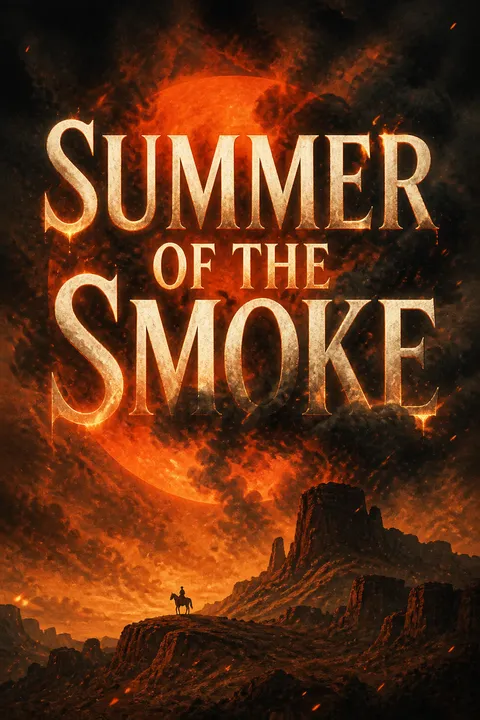
The fast-moving warning systemSmoke carries news across the mesas and mountains faster than the isolated settlement can receive official information. The rumor that Maco has escaped reaches Weymarn's Crossing before the townspeople are sure it is true. Later, the community's fear grows through fragments: Ryan vanishes, his arm appears at the trading post, and Wilkie's death is interpreted as an Apache warning. The smoke signals establish that the frontier is not an empty space between towns. It is a connected landscape where communities communicate, though white residents often misread what that knowledge means.
Tracks and traces
The landscape as evidenceCalhoun's tracking skill allows the land to contradict Weymarn's explanations. He studies horse shoes, buckboard marks, boot prints, and blood to reconstruct how Wilkie was killed and how the body was moved. Later, he follows Weymarn's trail into the mountains and identifies the abandoned mine where Maco is being held. Tracking is more than a practical skill in the story. It is a method of resisting the stories told by men who have the money or authority to make their version seem true.
Maco as ransom
A captive turned bargaining chipWeymarn's knowledge of Maco's political value becomes the engine of his private schemes. He holds the wounded Apache leader and tries to exchange him for horses and cattle from Santiago's band. When that offer fails, Weymarn sees the Army payroll as a larger source of ransom money. The device links the fugitive's personal freedom to the town's commercial and military networks, showing how one man's captivity can invite danger far beyond the mine where he is concealed.
The Army payroll
A lure for the final bargainThe payroll gives Weymarn a new way to turn Maco's captivity into profit after Santiago's band cannot provide the requested stock. Calhoun learns that a small escort is carrying the money and warns Lieutenant McKelway, who refuses to change his plans. The sacks of gold discovered in the trading post confirm that the escort was attacked and that the money has reached Weymarn. This device connects military negligence to private greed, with the cost paid by soldiers and the people caught between them.
Download PDF
Download EPUB
.epub digital book format is ideal for reading ebooks on phones, tablets, and e-readers.








