

Key Takeaways
Arrange the contest so customers choose you before rivals can force a fight.
Win before contact. Sun Tzu’s central strategic idea is to shape conditions so a direct clash becomes unnecessary. Michaelson distinguishes strategy, choosing the right contest, from tactics, executing well once contact begins. Holiday Inn built early success near highways and outside established city centers, where it could serve travelers without meeting entrenched hotel chains head-on. Philippine chain Jollibee studied McDonald’s expansion abroad and established itself locally before McDonald’s arrived.
Choose value over combat. The goal is not simply to defeat a competitor. It is to meet customer needs in a way that makes the competitor’s strongest response less relevant. Michaelson’s business examples repeatedly favor a distinctive niche, an indirect route, or a better-prepared entry over a costly frontal assault.
This principle resembles strategic positioning in game theory: the best move can change the choices available to everyone else, rather than merely improve performance within the existing contest. It also fits market creation, where firms make new kinds of value legible to customers instead of fighting over the same buyers. The limit is important: business is not always zero-sum. A rival can be a supplier, complement, or future partner, and customers are not territory to be captured. The military metaphor is useful when it sharpens focus, but dangerous if it turns every relationship into a campaign.
Assess five conditions before committing: mission, environment, market, leadership, and operating rules.
Map the situation first. Sun Tzu’s Five Constant Factors are moral influence, weather, terrain, commander, and doctrine. Michaelson translates them for managers as shared purpose, outside forces, the marketplace, leadership, and guiding principles. Together, they prompt a leader to examine not only internal strengths, but also the conditions that can make a plan succeed or fail.
Look beneath the symptoms. A pharmaceutical company noticed declining product development. Reviewing its 25 most profitable drugs showed that two people had initiated 10 of them, and both had moved out of development roles. The apparent problem was a weak pipeline; the underlying problem was the loss of key contributors. An assessment should expose causes and opportunities, not merely confirm what executives already believe.
The five-factor lens is valuable because it resists the common habit of explaining results through one favored cause, such as leadership, talent, or competition. It encourages a systems view: purpose, context, capability, and rules interact. That is close to causal analysis in operations research, where changing a visible metric without locating the bottleneck can waste effort. The framework is a prompt, not a validated forecasting model. Its usefulness depends on asking questions that could disconfirm the current story, especially when leaders control which evidence reaches them.
Concentrate resources where your advantage meets a competitor’s weakness.
Create an unequal contest. Michaelson calls this Relative Superiority: concentrating limited resources so that, at a decisive point, your position is stronger than the opponent’s. Sun Tzu gives battlefield ratios as rough guidance, not business formulas. The managerial lesson is that a smaller organization should not try to match a larger rival everywhere. It should find a segment where it can offer more relevant value, better service, or a distinctive product.
Powell’s Books illustrates the logic. Facing national bookstore chains, the Portland retailer emphasized an enormous selection, including 200,000 new titles and 300,000 used books, with new and used editions side by side. Its multiple specialty locations and kiosks also connected readers to the main store. The advantage came from concentrating on selection and discovery, not copying a chain’s exact model.
This is a theory of focus, but also of opportunity cost. Every decision to reinforce one position leaves another less defended, so concentration requires choosing what not to pursue. Modern portfolio thinking makes the same point: resources spread evenly across initiatives often produce a collection of underpowered bets. Yet specialization can become a trap if the niche shrinks or the customer’s definition of value changes. The strongest form of concentration is therefore not stubborn loyalty to one product, but sustained investment in a capability that can serve a well-understood need.
Fund the whole campaign, then move fast enough to preserve momentum.
Speed needs staying power. Sun Tzu warns that prolonged campaigns consume money, equipment, morale, and attention, while inadequate resources can make even a sound plan collapse. Michaelson applies the warning to start-ups that run out of capital before building a dependable customer base, and to established firms that underinvest in future products. A campaign needs enough people, skill, money, and operating capacity to survive its expected duration.
Move, measure, adjust. Speed does not mean rushing blindly. A turnaround manager in the book’s practical examples began process improvements in small pilot areas rather than waiting for exhaustive conference-room planning. The team learned from shop-floor results and adjusted. That approach pairs a clear direction with quick feedback, avoiding both reckless haste and the slow drain of endless preparation.
The combination of adequate reserves and rapid action is more subtle than a simple call to move quickly. In project management, a plan that ignores capacity creates hidden queues, burnout, and fragile delivery; a plan that waits for certainty can miss the useful window. Small pilots can reduce that tension by making action informative. But speed is not inherently virtuous. It can amplify a bad assumption, and some decisions carry regulatory, safety, or human costs that demand deliberate review. The relevant question is whether delay improves judgment enough to justify its cost.
Seize the initiative by choosing where competitors must respond.
Make the other side react. Taking the initiative means shaping the timing and location of the contest instead of allowing a rival to dictate them. Michaelson’s examples include Southwest Airlines delaying announcements of new routes so competitors had less time to prepare, and ESPN building a distinct identity around devoted sports fans rather than simply offering a schedule of events. In each case, the organization developed a position that was harder to answer with an ordinary copycat response.
Surprise is a timing advantage. The book treats secrecy and misdirection as ways to make a competitor recognize a move too late to respond effectively. It also draws a clear ethical boundary: confuse competitors, not customers. Initiative should serve a real customer advantage, not merely produce drama or provoke a rival.
The deeper idea is control over the pace of interaction. In negotiation and competitive strategy, forcing a counterpart to spend attention on your chosen problem can create room to act elsewhere. Surprise can also protect innovation from premature imitation. Still, secrecy has costs: it can limit collaboration, confuse employees, and damage trust if it conceals material facts from customers or partners. The useful distinction is between withholding a competitive plan and misleading people who rely on truthful information. Initiative is strongest when it creates value, not when it is merely theatrical.
Keep tactics fluid when contact reveals your plan no longer fits.
Treat plans as provisional. Michaelson separates enduring strategic principles from tactics, which must change with conditions. A plan is an initial judgment about reality, not a command to ignore new evidence. The book compares flexible action to water finding a route around obstacles: avoid a rival’s strength and redirect effort toward an opening.
Adapt at the point of action. Mervyn’s department stores used a mobile team of experienced staff to address staffing problems, market swings, and unexpected openings. The team assessed each situation and moved where it was most useful. In contrast, the book notes that lengthy product testing can give competitors time to copy and launch first. The lesson is to build enough structure to act coherently, while keeping room to revise methods as evidence changes.
This resembles adaptive management, a method used in complex settings where decisions are made, outcomes are observed, and policy is revised rather than treated as final. The approach is especially useful when feedback arrives quickly and mistakes are reversible. It is less appropriate when experimentation could cause serious harm or when a stable process is essential for safety. Flexibility also needs a fixed reference point: without a clear objective, adaptation can become restless improvisation. The manager’s task is to distinguish changing the route from abandoning the destination.
Give authority to people closest to conditions, not distant headquarters.
Stop managing by remote control. Michaelson uses “High-Level Dumb” for decisions made by senior leaders who lack firsthand knowledge of the situation. When executives issue operational directions without understanding local conditions, they can confuse teams, override useful expertise, and slow a response. The book’s contrast between orders and instructions is helpful: an order requires immediate compliance, while an instruction expresses intent and allows adjustment when circumstances make it impractical.
Delegate with boundaries. Decentralization works when people understand the objective, know what they may decide, and can communicate results. It does not mean abandoning coordination. The commander sets direction and provides support; informed local leaders choose how to act. Michaelson warns that modern communication can make it tempting for one executive to monitor everything, creating overload at the top and dependence below.
This is a practical argument for subsidiarity: decisions should sit at the lowest level that has the information and competence to make them. It can increase speed and use local knowledge that centralized dashboards miss. The tradeoff is uneven judgment, so delegation needs training, clear constraints, and mechanisms for sharing learning. Excessive autonomy can fragment a company just as excessive control can paralyze it. A useful test is whether headquarters adds context or merely demands updates and re-approves decisions already made by people nearer the work.
Pair humane treatment with consistent standards, not fear alone.
Clarity creates trust. The book opens with the famous, but historically disputed, story of Sun Tzu drilling 180 palace women. They laughed after receiving commands; he repeated the instructions, then held their leaders responsible for disobedience. The management lesson is that a leader must make expectations unmistakable before blaming others for failure. The story’s punishment of the king’s favored concubines is not a humane model for management, and its uncertain authenticity matters.
Make standards fair. Michaelson argues that people need both respect and accountability. At Burger King, Herman Cain used the “Happy B.E.E.’s” to make friendly service expectations memorable: staff were to leave bad moods behind and make eye contact with customers. Clear standards allow praise or correction to be tied to observable behavior instead of favoritism or a manager’s shifting mood.
The strongest lesson is procedural fairness: people are more likely to accept accountability when expectations are legible and applied consistently. Organizational psychology distinguishes compliance from commitment. Threats may produce the first, but trust, competence, and a sense of justice are more likely to support the second. The concubine story dramatizes clarity and authority, yet its violence can obscure the point and normalize coercion. In modern organizations, correction should improve the work and preserve dignity. Discipline without humanity breeds concealment; humanity without standards can feel arbitrary.
Use victories to retain talent, customers, and capabilities, not just market share.
Convert gains into strength. Sun Tzu’s campaign logic includes taking useful supplies and capabilities from a defeated opponent rather than destroying them. Michaelson translates this into retaining skilled people after an acquisition, recognizing employees after a win, and building repeat customer relationships. One executive quoted in the book emphasized keeping the managers who had built an acquired business, since they understood its customers and culture.
A sale is not the finish. A container manufacturer’s sales manager attributed 58 percent of business to long-term customer partnerships. The book also describes Hewlett-Packard changing work arrangements to better support employees’ personal responsibilities; its reported turnover was 5 percent, compared with an industry average of 17 percent at the time. Gains last when customers and employees have reason to stay.
This insight treats victory as an asset-integration problem, not a scoreboard. In mergers, customer retention and the transfer of tacit knowledge can matter more than cost savings visible on day one. Relationship marketing makes a related point: repeat transactions can be more valuable than repeatedly replacing lost customers. But loyalty cannot be commanded or purchased indefinitely. It depends on ongoing performance and fair exchange. The figures in the book are historical examples, not current benchmarks; their durable message is that a win that destroys the people and relationships behind it may be a short-lived one.
Buy intelligence, verify signals, and protect information rivals could exploit.
Know the situation, not just the story. Michaelson treats intelligence as a continuous process of gathering, checking, and interpreting information about customers, competitors, and the organization itself. Ford’s development of the Taurus included collecting more than 1,400 customer and dealer preferences; about half were incorporated into the car. The example shows how listening can turn research into product choices rather than a report that sits unused.
Organize what you learn. Information can be abundant and still misleading. Managers should visit the places where products are used, compare what rivals do with what they leave undone, and test assumptions against evidence. The book also advises protecting sensitive plans through controlled access and careful handling of documents. In business, the aim is lawful market understanding, not treating customers as enemies or copying covert military methods.
Information has value only when it changes a decision. This is a central problem in intelligence analysis and organizational learning: more data can increase confidence without increasing accuracy, particularly when leaders seek evidence that supports a settled plan. Triangulating customer interviews, observed behavior, and operational results can reduce that risk. Counterintelligence also has a legitimate modern counterpart in privacy and information security. The balance is to protect genuinely sensitive material while avoiding a culture so secretive that employees cannot coordinate or surface inconvenient facts.
Analysis
Michaelson’s book is best understood as a translation of strategic habits, not a complete business operating system. Its sequence moves from assessment and preparation through resource use, positioning, leadership, and intelligence. Across the chapters, one recurring move is to replace the question, “How do we beat the rival head-on?” with a more useful set: What does the customer value? Where can this organization become unusually strong? What information would change the plan? This shift gives the book its coherence despite the chapter-by-chapter format.
The most persuasive ideas are those that connect strategy to operating reality. A niche is not a slogan unless the organization can deliver it. Speed is not an advantage if the firm lacks the resources to sustain execution. Delegation is not empowerment if people lack training or clear authority. The book repeatedly insists that strategy and tactics must work together, a corrective to plans that look elegant at headquarters but fail at the point of customer contact.
The military analogy is also the book’s main limitation. It makes concentration, timing, and disciplined execution memorable, but it can encourage managers to imagine ordinary competition as warfare. Customers are not enemies, and many durable business outcomes depend on cooperation with suppliers, employees, regulators, and even competitors. The book itself sometimes softens this frame through customer focus and win-win initiatives, but readers must keep that distinction explicit.
Its evidence also needs historical context. The corporate cases and performance figures largely reflect the business world of the 1990s, so they illustrate principles rather than establish present-day benchmarks. The author acknowledges that translations vary, and the opening concubine story is identified as historically uncertain. That uncertainty reinforces a broader lesson: vivid stories can aid memory, but should not be mistaken for proof. Used as a prompt for judgment rather than a formula, Sun Tzu’s framework remains a strong guide to choosing contests, allocating attention, and learning before commitment becomes expensive.
Review Summary
Sun Tzu's The Art of War applied to business receives mixed reviews. Some readers appreciate the adaptation of ancient war strategies to modern management, finding it insightful and entertaining. Others criticize the book for oversimplifying complex concepts and providing insufficient depth in business examples. Critics argue that comparing business to warfare is inappropriate, while supporters value the strategic principles. The book's compactness is seen as both a strength and weakness. Overall, readers find it a quick overview of Sun Tzu's ideas in a business context, but opinions vary on its practical value.
People Also Read









Glossary
Five Constant Factors
Five conditions shaping outcomesSun Tzu’s five conditions for assessing a conflict: moral influence, weather, terrain, commander, and doctrine. Michaelson adapts them for business as shared purpose, outside forces, the marketplace, leadership, and guiding principles. They provide a checklist for comparing the situation of an organization and its competitors before committing resources.
Relative Superiority
Local advantage through concentrationThe ability to become stronger than a competitor at a decisive point, even when the organization is smaller overall. Michaelson applies the idea through focused resources, segmentation, alliances, quality, or a distinctive service. It is not a claim of permanent dominance; it is an advantage created in a particular market, customer segment, or moment.
Normal and extraordinary forces
Direct effort and winning moveA distinction between the force that engages an opponent directly and the force that creates the decisive advantage. Michaelson applies it to business as ordinary operations that establish presence and an unusual or indirect effort that differentiates the organization. The two can be combined in many ways, rather than treated as fixed departments or tactics.
Estimate of the Situation
Structured situational assessmentA process for identifying the mission, examining conditions, considering possible actions, comparing their advantages and risks, and selecting a course. Michaelson presents it as a way for managers to make decisions at different speeds, from a rapid assessment of an immediate problem to a more extensive review before a written plan.
High-Level Dumb
Decisions made without local knowledgeMichaelson’s label for senior-level direction given without adequate understanding of conditions where the work occurs. It can result in impractical orders, micromanagement, and the rejection of useful information. The term argues for leaders to gather firsthand knowledge and delegate operational decisions to people who understand the immediate situation.
FAQ
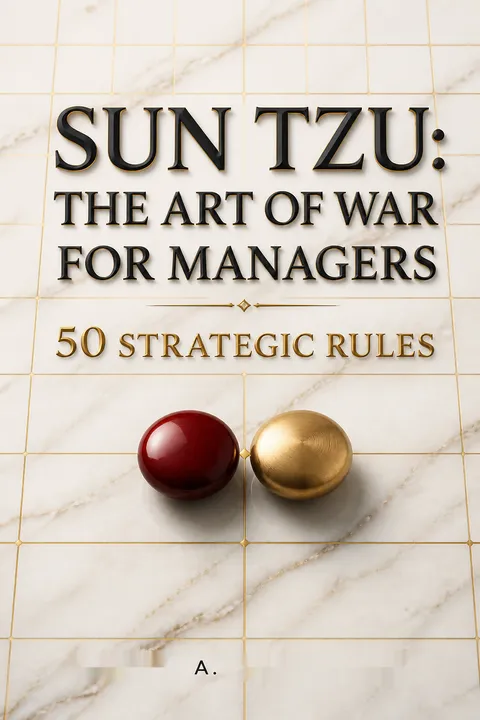
What is "Sun Tzu: The Art of War for Managers; 50 Strategic Rules" by Gerald A. Michaelson about?
- Modern Application of Sun Tzu: The book adapts Sun Tzu’s ancient military strategies for contemporary business management, offering 50 strategic rules for managers.
- Dual Structure: It presents a new translation of The Art of War, followed by detailed managerial commentary and practical business examples.
- Focus on Strategy and Tactics: The book distinguishes between strategy (“doing the right thing”) and tactics (“doing things right”), showing how both are essential for business success.
- Actionable Insights: Each chapter breaks down Sun Tzu’s principles into specific, actionable rules for leaders and organizations.
Why should I read "Sun Tzu: The Art of War for Managers; 50 Strategic Rules" by Gerald A. Michaelson?
- Timeless Wisdom for Business: The book translates ancient strategic wisdom into practical advice for today’s managers and leaders.
- Real-World Examples: It provides numerous case studies and business anecdotes, making the lessons relevant and easy to apply.
- Competitive Edge: Learning to “win without fighting” and focus on strengths gives readers a strategic advantage in business.
- Broad Applicability: The principles are useful for managers at all levels, from startups to large corporations, and across industries.
What are the key takeaways from "Sun Tzu: The Art of War for Managers; 50 Strategic Rules"?
- Assessment Before Action: Thoroughly assess conditions and compare attributes before making decisions or launching initiatives.
- Concentrate Strengths Against Weaknesses: Focus resources where you have the greatest advantage, rather than spreading yourself thin.
- Win Without Fighting: The highest form of strategy is to achieve objectives without direct confrontation.
- Flexibility and Adaptation: Tactics must be adapted to changing circumstances; rigidity leads to failure.
- Intelligence and Information: Invest in intelligence resources and use information to focus efforts and outmaneuver competitors.
How does Gerald A. Michaelson adapt Sun Tzu’s strategies for modern managers in "The Art of War for Managers"?
- Manager’s Commentary: Each Sun Tzu principle is followed by a detailed explanation of its relevance to business, with modern examples.
- Strategic Rules: The book distills each chapter into 3-6 strategic rules, making ancient wisdom actionable for managers.
- Business Parallels: Michaelson draws direct parallels between military concepts (like terrain, morale, and deception) and business realities (marketplace, company culture, and competition).
- Practical Applications: The book includes a section where managers share how they’ve applied Sun Tzu’s rules in real business situations.
What are the most important strategic concepts covered in "The Art of War for Managers; 50 Strategic Rules"?
- Laying Plans: Emphasizes the importance of assessment, comparison, and strategic turns before acting.
- Waging War: Stresses marshalling resources, making time an ally, and ensuring everyone profits from victories.
- Attack by Stratagem: Advocates for winning without fighting, using strength against weakness, and avoiding “high-level dumb” decisions.
- Use of Energy: Focuses on building sound organizational structures, applying extraordinary force, and coordinating momentum and timing.
- Intelligence and Counterintelligence: Highlights the necessity of investing in intelligence and protecting your own information.
How does "The Art of War for Managers" define and differentiate between strategy and tactics?
- Strategy as “Doing the Right Thing”: Strategy involves setting direction, vision, and objectives based on thorough assessment and planning.
- Tactics as “Doing Things Right”: Tactics are the specific actions and methods used to implement strategy and achieve objectives.
- Where They Intersect: Strategy stops at the headquarters door (planning), while tactics begin with contact with the customer (execution).
- Importance of Balance: Excellent strategy can sustain tactical failures, but great tactics rarely overcome a poor strategy.
What practical advice does Gerald A. Michaelson give for managers to "win without fighting" in business?
- Find Non-Confrontational Strategies: Seek ways to achieve objectives without direct competition, such as targeting underserved markets or niches.
- Indirect Approaches: Use creative, indirect methods to capture market share or disrupt competitors.
- Focus on Customer Needs: Define opportunities based on customer needs rather than simply reacting to competitors.
- Plan for Victory Before Battle: Ensure your strategy is so strong that success is likely before any confrontation occurs.
How does "The Art of War for Managers" recommend managers use intelligence and information for competitive advantage?
- Invest in Intelligence Resources: Allocate time and money to gather relevant market and competitor information.
- Establish Active Intelligence Systems: Create processes for collecting, filtering, and disseminating information throughout the organization.
- Benchmarking and Observation: Study both your own operations and competitors to identify strengths, weaknesses, and opportunities.
- Practice Counterintelligence: Protect your own information and be wary of sharing sensitive data, even internally.
What does "The Art of War for Managers" say about leadership and the faults that can undermine it?
- Five Dangerous Faults: Recklessness, cowardice, quick temper, delicate honor, and over-compassion can ruin a leader and their organization.
- Importance of Self-Knowledge: Leaders must understand their own strengths and weaknesses as well as those of their team.
- Decentralization and Trust: Effective leaders delegate authority, build mutual trust, and empower subordinates to make decisions.
- Consistency and Discipline: Leaders should apply standards fairly and maintain discipline to build allegiance and morale.
How does "The Art of War for Managers" address the need for flexibility and adaptation in business?
- No Fixed Tactics: There are no constant strategies; tactics must change according to circumstances and the competitive environment.
- Water Metaphor: Just as water adapts to the shape of the land, managers must adapt their tactics to the situation.
- Avoid Rigidity: Being predictable makes you vulnerable; flexibility allows you to exploit opportunities and avoid threats.
- Continuous Learning: Encourage ongoing assessment, feedback, and willingness to revise plans as needed.
What are some of the best quotes from "The Art of War for Managers" and what do they mean?
- “To subdue the enemy without fighting is the supreme excellence.” – Achieving objectives without conflict is the highest form of strategy.
- “Know the enemy and know yourself, and you can fight a hundred battles with no danger of defeat.” – Success depends on self-awareness and understanding your competition.
- “Use the normal force to engage; use the extraordinary to win.” – Routine efforts maintain position, but extraordinary actions create breakthroughs.
- “A victorious army wins its victories before seeking battle; an army destined for defeat fights in the hope of winning.” – Preparation and planning are the keys to consistent success.
How have real managers and organizations applied the lessons from "The Art of War for Managers" in practice?
- Strategic Focus: Companies like Home Depot and Lucent Technologies have succeeded by concentrating resources and focusing on core strengths.
- Niche Marketing: Businesses have carved out profitable niches by targeting underserved segments, as advised in the book.
- Rapid Execution: Organizations have improved performance by making time an ally and acting quickly on opportunities.
- Intelligence and Adaptation: Managers have used benchmarking, customer feedback, and competitive intelligence to adapt strategies and outmaneuver rivals.
- Teamwork and Morale: Leaders have built strong, disciplined teams by applying Sun Tzu’s principles of leadership, discipline, and coordinated effort.
Download PDF
Download EPUB
.epub digital book format is ideal for reading ebooks on phones, tablets, and e-readers.








