

Key Takeaways
Before calling someone an idiot, ask what their behavior is trying to achieve.
A manager’s blind spot. The book begins with Sture, a successful business owner who described employees across several departments as fools. Staff avoided him, bad news stopped reaching him, and a warning light at reception told people whether he was in the building. When the author asked who had hired these supposedly useless employees, Sture threw him out. The question exposed a larger problem: Sture treated behavior unlike his own as incompetence.
Difference is not defect. The book’s central advice is to replace snap judgments with curiosity about how another person approaches work, relationships, decisions, and change. A blunt colleague may be trying to move a task forward; a cautious one may be trying to prevent an avoidable mistake.
What gives the opening story its force is the organizational cost of contempt. Once employees fear the boss, they manage his reactions instead of sharing information, and the leader loses the very feedback needed to make good decisions. This resembles the fundamental attribution error: people often explain another person’s actions through character while overlooking context. Yet understanding motives should not excuse harmful conduct. The useful distinction is between interpreting behavior generously and accepting its consequences uncritically. Curiosity improves diagnosis; clear standards still govern what behavior is acceptable.
Use the four colors as a communication map, never as a verdict on character.
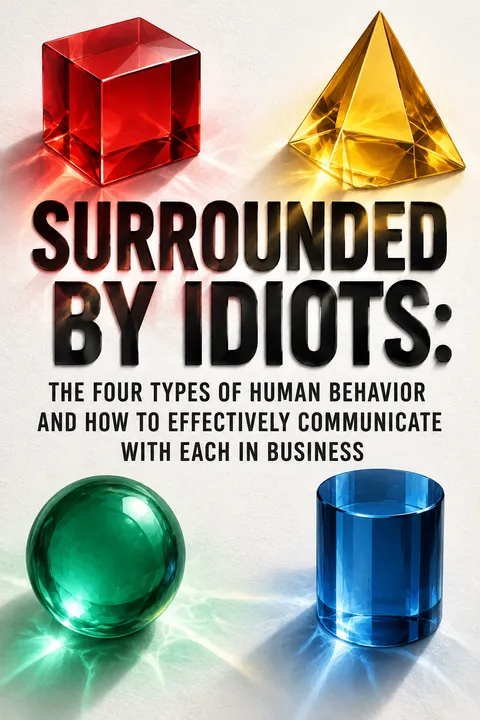
A shorthand for behavior. Erikson’s DISA system describes four broad communication patterns: Red for dominance, Yellow for influence and sociability, Green for steadiness and accommodation, and Blue for analysis and precision. The related DISC label uses Compliance where DISA uses Analytic ability. The colors are intended as a practical vocabulary for noticing differences, not as a complete account of a person. The book reports that about 80 percent of people show two dominant colors, about 5 percent one, and the rest three.
Context changes behavior. The book distinguishes a person’s deeper values and habits from moderated behavior, the version shaped by the situation. A person may act differently at work, at home, or under pressure. Erikson presents the model as a simplified tool, and cautions that people are more complex than any chart.
A compact typology can help people notice mismatched expectations without requiring specialist language. Its danger is equally plain: labels can harden into stereotypes, especially when a listener treats a color as an explanation rather than a hypothesis. Personality research commonly favors dimensional models, which describe traits by degree instead of sorting people into a few boxes. The practical compromise is to use the colors as opening questions: Does this person want speed, connection, stability, or evidence in this moment? Then check the impression against what the person actually says and does.
Give Reds the headline, a meaningful choice, and a reason to slow down.
Speed and control. Red behavior, in the book’s model, is direct, competitive, task-focused, and comfortable making quick decisions. A Red may value momentum more than discussion and can sound harsher than intended. Erikson recounts a company leader who ended a phone call almost immediately after learning there was no business question to resolve. To him, extra pleasantries had no purpose; to a new employee, the abruptness felt alarming.
Make the exchange useful. Start with the result or decision needed, keep the explanation concise, and bring relevant facts. Reds may push for action before others have caught up, so make the cost of rushing visible: missed risks, rework, or a team left behind. Directness does not require tolerating shouting or disrespect. A clear boundary can protect both the relationship and the work.
This advice reflects a broader principle of cognitive fluency: information is easier to use when its structure matches the listener’s immediate goal. A results-first summary helps a fast decision-maker orient before details arrive. The counterweight is procedural discipline. Speed can look like competence even when it produces preventable errors, so teams should separate reversible choices, which can be made quickly, from consequential decisions that deserve review. Direct communication is most effective when paired with explicit limits on intimidation, not when bluntness is treated as a license.
Keep Yellows engaged, then convert their lively ideas into written commitments.
Energy before structure. Yellow behavior is presented as social, optimistic, expressive, and inventive. Yellows can energize a group and spot possibilities others miss, but may lose interest in details, follow-up, or tasks that feel routine. In one meeting observed by Erikson, a sales manager spoke for 69 percent of the time despite owning only one of nineteen agenda items. The story shows how enthusiasm can unintentionally crowd out colleagues.
Capture the next step. A warm atmosphere may help a Yellow participate, but it is not a substitute for execution. End a discussion by recording who will do what and by when. Confirm important agreements in writing and check progress without assuming a missed deadline means bad intent. The aim is to preserve the creative contribution while giving the idea a route into completed work.
The distinction between generating ideas and implementing them is useful well beyond personality typing. Teams often benefit from separating expansive brainstorming from later evaluation, because premature criticism can narrow exploration while unstructured enthusiasm can leave plans unfinished. Written commitments serve as cognitive offloading: they move prospective tasks out of memory and into a shared system. Still, talkativeness or disorganization should not be presumed from a color label. Clear agendas and notes improve collaboration for many people, including those who are not especially outgoing.
Give Greens predictability and a safe opening to disagree.
Quiet is not consent. Green behavior is described as patient, dependable, considerate, and attentive to relationships. Greens may help readily and listen closely, but avoid confrontation and can struggle when plans change without explanation. Their silence in a meeting may reflect caution or a wish to preserve harmony, not agreement. The book warns that unspoken objections can surface later as private complaints or resistance.
Make dissent easier. Explain changes in manageable steps, clarify who is responsible for what, and invite concerns without putting someone on display. Ask a Green directly for a view, then leave enough time for an answer. A useful question is what might make the proposed plan difficult, rather than whether everyone agrees. This makes disagreement part of the work instead of a personal rupture.
The emphasis on psychological safety is well placed. In teams, people are more likely to disclose concerns when they believe speaking up will not invite humiliation or retaliation. Predictable processes can also lower the social cost of dissent: written feedback, structured turn-taking, and private check-ins give quieter members a route into discussion. But accommodation should not become a permanent excuse for avoiding hard conversations. A respectful environment is not one without conflict; it is one where disagreement can be stated early and handled without punishment.
Give Blues evidence, precision, and a clear deadline for deciding.
Care before speed. Blue behavior is associated with analysis, accuracy, caution, and attention to rules or details. A Blue may prefer a documented case to an energetic pitch, and may want to inspect the decision process as carefully as the result. Erikson describes a company chief who kept asking for more material about a leadership program: the proposal grew from a dozen pages to hundreds, yet the decision remained pending. The process itself had become the focus.
Bound the analysis. Prepare accurate information, distinguish known facts from uncertainties, and answer questions directly. Then define what information is sufficient and when a decision must be made. This respects quality without allowing research to expand indefinitely. If a choice is reversible, a small test can provide evidence more efficiently than another round of speculation.
The Blue profile highlights a genuine organizational tension: careful review catches defects, while unbounded review delays learning and action. High-reliability fields often use checklists and verification because small oversights can have outsized consequences. The same habits can become counterproductive when applied indiscriminately to low-risk choices. Decision quality depends partly on matching the depth of analysis to the cost of being wrong. A deadline is most credible when paired with a decision rule, such as the minimum evidence needed or the conditions that would trigger a later revision.
Adapt your delivery without pretending to become someone else.
Flexibility is a skill. The book represents observable behavior as a function of personality and surrounding factors. People adjust, often without noticing, to roles and settings; deliberate adaptation simply makes that adjustment more thoughtful. At a workshop, a Yellow participant objected that categorizing people and changing one’s style could become manipulation. The author took the concern seriously: adapting communication should help the other person understand, not trick them into compliance.
Treat clues as clues. The book also describes posture, gaze, gestures, personal space, and writing style as possible signals. It repeatedly acknowledges that context and culture matter. A quiet email or crossed arms cannot reliably reveal a person’s type by itself. Practice observing patterns, ask what the other person prefers, and revise the guess when new evidence appears.
This is the book’s most ethically important distinction: audience awareness is not inherently deceptive. Teachers, doctors, and managers routinely change how they explain the same information to make it usable for different people. The ethical test is whether adaptation preserves the recipient’s agency and the truth of the message. Nonverbal interpretation needs special restraint. Research on deception and body language does not support treating one gesture or gaze pattern as a dependable lie detector. Patterns can guide a question, but they cannot substitute for evidence.
Make feedback specific, private when needed, and matched to the listener.
Behavior beats labels. Erikson’s feedback advice varies with the person receiving it. A Red may respond best to concrete effects and facts; a Yellow may need a focused agenda and patient repetition; a Green may need a private, gentle conversation that still states the issue plainly; a Blue may expect detailed evidence, often in writing. Across all four, the conversation should identify what happened and what needs to change, rather than declaring someone selfish, lazy, or impossible.
Close the loop. Ask the other person to summarize the agreement and specify the next action. Then follow up. The book’s stories show why: praise delivered publicly embarrassed one highly reliable Green employee, while a Yellow friend initially heard criticism of excessive talking as criticism of his stories. Matching the manner of feedback to the listener can keep the substance from being lost.
This approach aligns with behaviorally anchored feedback: observable actions are easier to discuss and change than global judgments about personality. It also recognizes that feedback is a two-way information problem. The speaker may believe a point was clear while the listener hears an attack, a vague hint, or a different request. Asking for a recap checks shared understanding. Privacy, however, should be chosen thoughtfully. Public recognition can motivate some people and discomfort others, so asking about preferences is more reliable than inferring them from a profile.
Build teams from complementary strengths, not from people who all think alike.
One style cannot do everything. The book argues that groups benefit from different approaches: someone generates possibilities, someone drives decisions, someone sustains cooperation, and someone checks quality. In Erikson’s workshop exercise, homogeneous groups displayed predictable imbalances. The Red group rushed, finished early, and solved the wrong problem. The Yellow group made an entertaining presentation but did not complete the task. The Green group struggled to voice disagreement, while the Blue group analyzed details without reaching a timely answer.
Design the handoffs. Diversity alone does not guarantee good work. A group needs a shared understanding of the assignment, clear roles, and a way to surface disagreement. The model’s suggested pairings are starting points, not hiring rules. A team with varied strengths can catch more errors and generate more options, provided members translate between their different priorities.
The workshop makes a memorable case against confusing similarity with compatibility. Cognitive diversity can broaden a team’s search for solutions, but it can also raise coordination costs. Research on team performance generally suggests that diversity is not an automatic advantage; its value depends on leadership, task design, and whether members can integrate competing information. The practical insight is therefore not simply to assemble four colors. It is to make the sequence explicit: define the problem, explore options, decide, execute, and review.
Treat stress as an amplifier, then change the conditions feeding it.
Pressure makes patterns louder. Erikson defines stress as experiencing demands or expectations that exceed what a person feels able to manage. In his model, strain tends to intensify familiar responses: Reds may become more controlling, Yellows more attention-seeking or scattered, Greens more withdrawn, and Blues more pessimistic or exacting. The same workload can feel different depending on health, past experience, and the current situation.
Look for the trigger. The book recommends noticing what drains each person: lack of control or progress for a Red, isolation or relentless routine for a Yellow, insecurity or sudden change for a Green, and disorganization or unsupported risk for a Blue. These are prompts for conversation, not diagnoses. Ask what pressure is coming from, then adjust the workload, information, support, or decision process where possible.
Stress is not merely a private weakness; it often reflects a mismatch between demands, resources, and control. That makes the environmental focus valuable: managers can change deadlines, clarify roles, or provide support rather than asking people only to toughen up. The color descriptions are best understood as possible patterns, not reliable predictions. Sleep, health, caregiving, workplace power, and many other conditions shape reactions. A person’s behavior under pressure deserves attention, but it should not be used to reduce a complex problem to a personality label.
Analysis
Surrounded by Idiots is a practical communication guide built around a simple provocation: the colleague who seems unreasonable may be using a different definition of useful, safe, or respectful. Its most durable contribution is not the color vocabulary itself, but the instruction to notice the listener’s priorities and adjust the delivery. The opening story of Sture shows the organizational stakes. Contempt isolates a leader from information, while curiosity can reveal why ordinary interactions repeatedly fail.
The four-color scheme makes those differences memorable. Red emphasizes pace and results, Yellow connection and possibility, Green stability and cooperation, and Blue accuracy and process. The examples make the categories vivid, and the advice is often operational: lead with the answer for a results-focused colleague, document commitments, invite quiet dissent, or set limits on analysis. The book also stresses that behavior shifts with setting and pressure, which prevents its model from being wholly deterministic.
Its main limitation is that memorable categories can become self-confirming stereotypes. The text sometimes makes broad claims about what a color does, including assertions about listening, risk, or temperament, without demonstrating that the categories predict behavior reliably. A personality label can also distract from more consequential explanations, such as incentives, workload, authority, culture, or inadequate training. Nonverbal signs are especially easy to overread; no isolated posture or gaze proves intent.
The most responsible use is therefore provisional and interpersonal. Treat a color impression as a hypothesis, test it by asking what the person needs to do good work, and update the hypothesis when it fails. Use the framework to vary communication, not to sort people into permanent boxes or excuse conduct. That approach retains the book’s useful insight while protecting against its simplest misuse: deciding that a complicated person has been explained by one color.
Review Summary
Reviews for Surrounded by Idiots are mixed, averaging 3.7/5. Many readers appreciate the accessible introduction to the DISC personality model, finding it fun and practical for understanding communication differences. Common criticisms include repetitiveness, oversimplification, and lack of scientific references. Several reviewers note the book could have been significantly shorter. Positive feedback highlights real-world applicability, particularly in workplace settings. Some feel it reads like horoscopes, while others find genuine value in its framework for adapting communication styles to different personality types.
Glossary
DISA system
Four behavior patternsA communication model organizing behavior into four broad patterns associated with colors: Dominance, Inducement, Submission, and Analytic ability. The book uses Red, Yellow, Green, and Blue as accessible labels for these patterns. It presents DISA as a practical way to discuss differences in communication, not as a complete description of personality.
DISC system
Related four-pattern modelA commonly used name for a four-pattern behavior model closely related to DISA. In the book’s account, the final letter refers to Compliance rather than DISA’s Analytic ability. Both labels refer to a framework for describing broad communication tendencies, though assessment tools and interpretations can vary.
Core behavior
Behavior without outside pressureThe book’s term for how a person would ideally act when not responding to external demands. It is shaped by core values and attitudes. Because people are rarely free of situational influences, the author treats core behavior as a useful contrast with the behavior others observe in a particular setting.
Moderated behavior
Behavior shaped by contextThe behavior a person displays after interpreting the surrounding situation and adjusting, consciously or otherwise, to its demands. The book uses this term to explain why someone may appear different at work, at home, or with particular people. It is not necessarily false behavior; it is behavior influenced by context.
Driving forces
Motives behind effortThe book uses this phrase for the personal motivations that influence what people pursue and how much effort they invest. These motives can shape behavior alongside communication style, and a person may behave differently when a task connects strongly to what matters to them. The book notes that this motivational dimension is outside its main focus.
Four temperaments
Ancient behavior categoriesA historical scheme associated with Hippocrates that describes four temperaments: choleric, sanguine, phlegmatic, and melancholic. Erikson connects these with the book’s Red, Yellow, Green, and Blue patterns, respectively. The original explanation linked temperament to bodily fluids, a historical theory rather than a modern biological account.
Download PDF
Download EPUB
.epub digital book format is ideal for reading ebooks on phones, tablets, and e-readers.








