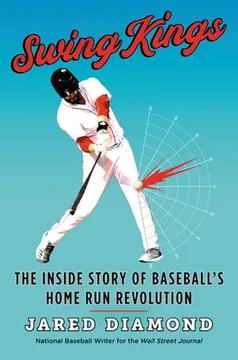


Key Takeaways
Treat talent as improvable: the right instruction can raise a hitter’s ceiling.
A mystery becomes a thesis. At 15, Jared Diamond hit three enormous fly balls in one game, then could not repeat the swing that produced them. His lost “magic” echoes the book’s central argument: reaching the majors does not mean a player has exhausted his potential. J. D. Martinez and Justin Turner, both struggling to establish themselves, rebuilt their swings with independent coaches and became stars. Martinez went from being released by Houston to hitting 43 home runs for Boston in 2018. Turner went from a fringe utility player to a cornerstone of the Dodgers.
Potential needs instruction. Their stories challenge baseball’s assumption that a player’s ability is fixed by his late twenties. The revolution is not simply about finding overlooked talent. It is about teaching established athletes to do more with the talent they already have.
What’s compelling is the shift from sorting people by presumed potential to asking what development could unlock. That question appears in education, rehabilitation, and organizational learning: performance reflects both capacity and the conditions under which capacity is trained. The book’s cases make the distinction vivid because the players were not beginners; they were professionals whose existing methods had stopped working. Still, better instruction cannot erase limits in health, perception, or athletic ability. The strongest claim is not that everyone can become a star, but that a career plateau should not be mistaken for proof that improvement is impossible.
Match the bat to the pitch’s path instead of chopping down at the ball.
The ball arrives downhill. A pitcher releases the ball from a mound, so its path toward home plate slopes downward. Ted Williams argued that a modestly upward swing can follow that path for longer, giving the hitter more opportunity to make solid contact and drive the ball into the air. The coaches in the book describe a related move called the lag position: the bat’s barrel stays behind the hands before accelerating through the hitting zone. This is not simply an exaggerated uppercut. The point is to get the barrel behind the pitch early and keep it traveling along the pitch’s plane.
Old cues misled hitters. Instructions to swing down or bring the knob directly to the ball often failed to describe what successful hitters actually did. Their swings produced lift through a more complex sequence.
The useful distinction is between a movement’s visible result and the sequence that creates it. A hitter can be told to think “short” or “level” while his body makes a more dynamic motion; mental cues are not anatomical diagrams. This is familiar in skilled movement, from music performance to surgery, where simplified instructions can help execution without accurately describing the mechanics. The book’s argument is persuasive as a correction to rigid downward-swing teaching, but it should not be reduced to “always swing up.” Pitch location, timing, and the hitter’s own movement pattern still matter.
Use slow-motion video to test what skilled performers actually do.
Observation beats memory. In the early 1970s, Craig Wallenbrock began filming professional hitters and reviewing their swings. He saw that elite hitters did not move the bat the way they described it. They kept the barrel back and brought it through the hitting zone with a fast, compact arc. The players themselves often insisted they were doing something else. Decades later, Bobby Tewksbary had a similar revelation while studying video of Albert Pujols. The footage showed Pujols’s hands moving backward at a point when Tewksbary expected them to move forward.
Make the invisible visible. Video let coaches inspect a movement frame by frame, compare it with a player’s account, and identify specific changes rather than relying only on feel. That evidence became the foundation for new instruction.
Slow-motion video is powerful because it corrects a basic limit of introspection: fast actions are difficult to perceive accurately while performing them. The same principle supports video review in dance, athletics, and clinical skills training. But footage is not self-interpreting. Camera position, frame rate, and the choice of examples can shape what a coach thinks is important. The book’s strongest method combines observation with repeated practice and player feedback, rather than treating a clip of a famous hitter as a complete prescription for everyone.
Judge a swing against the game’s conditions, not baseball tradition alone.
“Good hitting” has changed. In baseball’s early years, ground balls could be more useful than fly balls. Gloves were crude or absent, fields were rough, and some rules counted a ball caught on one bounce as an out. Grounders created difficult plays, while many balls hit in the air were easy outs. Babe Ruth helped make power hitting the sport’s great attraction. Later, Charley Lau’s contact-focused teaching suited an era when artificial turf and large stadiums rewarded balls on the ground. Ted Williams, meanwhile, had already argued for an upward swing in his 1970 book, but his advice took decades to gain broad acceptance.
Context changes the payoff. Defensive shifts, ballpark design, equipment, and the baseball itself all affect which outcomes are valuable. An old instruction can be sensible for one version of the game and limiting in another.
This history makes coaching look less like a contest between timeless truths and foolish mistakes, and more like adaptation to changing incentives. Baseball’s ground-ball orthodoxy grew from real conditions, just as the modern power approach responds to different ones. That perspective is useful beyond sport: professional norms often preserve solutions after the problem has changed. Yet a strategy can be statistically productive without being the only valuable style. Historical context explains why instruction shifts; it does not settle whether the newest version of the game is more enjoyable or sustainable.
Reconsider habits that once earned success but now keep you stuck.
Past success can become a trap. J. D. Martinez had hit at every level, so it was hard to accept that his swing might be holding him back. His production declined in the majors, and the Astros’ hitting coach told him the mechanics were too complicated and unreliable. Jason Castro’s sudden improvement gave Martinez a reason to investigate another approach. Justin Turner faced a different barrier: coaches had long told the smaller, lighter hitter to avoid trying for power. After watching Marlon Byrd hit with a new swing, Turner began to question that limit.
The risk was real. Both players feared losing playing time or being labeled uncoachable. They made changes when the old way no longer offered a convincing path forward, not because change was comfortable.
The stories capture a hard feature of expertise: yesterday’s competence can make today’s revision feel irrational. People protect methods that once worked because abandoning them threatens both identity and status. In career decisions, the relevant test is not whether a familiar approach once succeeded, but whether it still fits current demands. At the same time, dissatisfaction alone does not prove a new method is better. Martinez and Turner had to experiment, watch results, and persist through uncertainty. Their courage mattered, but so did access to skilled guidance.
Turn a new movement into a repeatable skill through patient, specific practice.
Change feels awkward first. Justin Turner spent months working with Doug Latta and Byrd, often training for hours each day. He adjusted his stance, hands, leg movement, and bat path. His body kept returning to its familiar patterns, and the new swing sometimes felt unnatural. Chris Colabello similarly needed more than a new idea. A drill from coach Chip Plante helped him begin his swing with the intention to attack, while stopping cleanly when he recognized a bad pitch. In a game against James Leverton, Colabello used the approach to hit a home run and a double in successive at-bats.
Practice builds control. The goal was not to imitate a single highlight but to make the movement stable enough to use against live pitching, under pressure, and while deciding whether to swing.
This is a motor-learning problem as much as a mechanics problem. A familiar action is efficient because it has been repeated; a replacement can initially feel worse even when it is more promising. Exaggerated drills and immediate feedback can help a learner notice a movement that ordinary practice hides. The useful lesson is to evaluate the process across many attempts, not judge it from one uncomfortable session. But practice volume alone is no guarantee. Repetition can reinforce a bad pattern too, which is why good feedback and the ability to adjust are essential.
Treat swing changes as a tool, not a guarantee of success.
Mechanics are only part of hitting. The book includes players whose results improved after changing their swings, but also players who struggled after working with a particular coach. Kole Calhoun had a poor stretch after training with Richard Schenck, while Ian Happ said he pushed the rearward bat movement so far that it created new problems. A hitter still has to recognize pitches, stay healthy, and make decisions under pressure. The stories of Marlon Byrd and Chris Colabello also complicate the account: both had major-league suspensions for banned substances, and both maintained that their positive tests did not reflect intentional cheating.
Credit requires caution. Their changed mechanics can be seen on video, but a career’s rise or fall rarely has one provable cause. Technique, health, opportunity, and uncertainty all contribute.
This is where the book’s success stories need the discipline of causal inference. A player improves after an intervention, but that sequence alone cannot establish how much the intervention caused; selection effects, changing roles, and ordinary performance variation also matter. Failed cases are therefore not distractions. They help identify the limits of a method and guard against turning a useful teaching approach into a universal law. The book is strongest when it distinguishes observable mechanical change from the harder claim that one coach or one adjustment explains an entire career.
Use launch-angle data to diagnose contact, not dictate a perfect swing.
Measure the result carefully. Statcast made launch angle, the vertical direction of a batted ball as it leaves the bat, easier to track. The book reports that from 2015 to 2019, balls hit on the ground produced a .247 average and .269 slugging percentage, while balls hit in the air produced a .406 average and .787 slugging percentage. Those figures do not mean every fly ball is good; weak pop-ups are easy outs, and hard line drives are valuable. Physics research discussed in the book suggests that powerful contact is most productive when a hitter’s hardest-hit balls arrive at launch angles suited to long drives.
Do not chase a number blindly. The coaches argue that launch angle is an outcome of sound movement, not a magic instruction. Data can reveal a problem, but instruction must help a hitter solve it.
Measurement can improve coaching by replacing vague impressions with observable outcomes. It also invites a familiar danger from management science: once a metric becomes a target, people may optimize the number while damaging the broader skill. A hitter who simply tries to lift every pitch may produce harmless pop-ups or expose new weaknesses. The useful sequence is diagnosis, instruction, and reassessment, with the data serving as feedback rather than authority. This approach also makes room for individual differences, since the same target may not fit every body or swing.
Choose coaches for their teaching and evidence, not their playing résumé.
Expertise can come from outside. Craig Wallenbrock never played beyond college, and Robert Van Scoyoc had a modest playing career. Yet both became influential because they studied video, developed ways to explain mechanics, and helped players improve. Their work eventually reached major-league teams. By 2019, 13 major-league hitting coaches had not played in the majors, and four had never played in the minors. The change echoes the earlier analytics shift: organizations began to value specialized knowledge over conventional credentials.
Explanation matters. Ted Williams understood hitting deeply but could frustrate students by demonstrating a swing without explaining how to reproduce it. The book’s most effective instructors translate observation into drills, clear feedback, and concepts players can eventually apply on their own.
The story challenges credentialism without pretending credentials are worthless. A playing career may provide embodied knowledge, but it does not automatically confer diagnostic skill or the ability to teach. In many technical fields, expertise is distributed: practitioners, analysts, and instructors contribute different forms of understanding. The important test is not a coach’s origin story but whether the coach can explain a claim, make it testable, and adapt when a player does not respond. Outsiders can refresh a closed system, though they still need accountability and collaboration.
A power boom can raise scoring while making baseball less varied.
The revolution has a cost. Major League Baseball recorded 6,776 home runs in 2019, alongside record strikeouts and fewer singles. That season, 35 percent of plate appearances ended in a home run, strikeout, or walk, and games averaged 3 hours and 10 minutes. About 45 percent of runs came from home runs. The new swing approach was one part of the surge; the baseball itself also mattered. A study discussed in the book attributed roughly 60 percent of the home-run increase to reduced air resistance and the remainder to player behavior.
Better performance is not the same as better entertainment. The author’s closing question is therefore larger than swing mechanics: if the most effective strategy produces more all-or-nothing at-bats, does it make the sport more compelling? Fans and players do not agree on the answer.
The book resists a simple celebration of innovation by showing that local optimization can change an entire system. A hitter improves by seeking power; teams copy the strategy; the league’s balance shifts toward homers, walks, and strikeouts. This is a collective-action problem: each club has reason to pursue the edge even if the resulting product feels repetitive to some fans. The distinction between competitive efficiency and audience value is crucial. Baseball can be more scientifically optimized while still needing rules, equipment, or incentives that preserve variety and pace.
Analysis
Swing Kings is both a history of changing baseball instruction and a story about how outsiders earn credibility in a closed profession. Its central achievement is to make a technical dispute legible through individual careers: J. D. Martinez’s decline, Marlon Byrd’s unlikely return, Justin Turner’s reinvention, and Aaron Judge’s work with Richard Schenck. The narrative shows how video exposed a gap between what hitters believed they did and what their bodies actually did, then traces how a once-marginal approach moved into major-league organizations.
The book’s account is persuasive because it does not make the change a lone genius’s discovery. Ted Williams had described the value of an upward path decades earlier; Wallenbrock, Latta, Tewksbary, and others developed ways to observe, teach, and test it. Their influence depended on players willing to experiment, and on institutions becoming less attached to former-player credentials. This is a story of knowledge diffusion as much as biomechanics.
Its evidence is strongest for the existence of mechanical changes and the plausibility of their benefits. It is weaker when success stories invite a direct causal conclusion. A player’s output can change because of health, opportunity, aging, opponent adjustments, or ordinary variation, and the book acknowledges cases where instruction did not work. The contrast between Byrd and Colabello’s swing transformations and their drug suspensions further complicates public attribution without disproving that their mechanics changed.
The larger lesson is not that every hitter should copy an uppercut or pursue a particular launch angle. It is that a craft can stagnate when authority substitutes for observation, and that evidence becomes useful only when someone can convert it into learnable action. Baseball’s power surge demonstrates both sides of that principle: technical progress can raise individual performance, while widespread adoption can narrow the collective experience of the game. The book leaves readers with a productive tension between improving what a system can do and deciding what the system should be for.
Glossary
fly-ball revolution
Shift toward airborne contactThe broad change in baseball hitting toward producing more balls in the air, especially hard line drives and home-run trajectories, rather than prioritizing ground balls. The shift grew from new instruction, video analysis, and tracking data, but also coincided with changes to the baseball itself. It describes a change in strategy and practice, not a single coaching method.
lag position
Barrel held behind handsA point in the baseball swing when the barrel remains behind the hitter’s hands as the body begins to rotate and the bat accelerates. Coaches in the book regard this position as a key difference between many elite swings and a direct, forward push of the hands. It helps the barrel enter the hitting zone on a path suited to the pitch.
launch angle
Ball’s upward exit directionThe vertical angle at which a batted ball leaves the bat. Statcast made it possible to track this measurement across major-league games. Launch angle helps describe whether contact produces a ground ball, line drive, or fly ball, but it does not measure contact quality by itself. A high or low value can be useful or unproductive depending on the ball’s speed and trajectory.
Statcast
MLB tracking technologyMajor League Baseball’s player and ball tracking system, introduced in 2015, using radar and high-speed video to measure events that had been difficult to quantify. It provided data such as exit velocity and launch angle, helping teams assess how balls were struck. Statcast supplies measurements for analysis; it does not independently explain how a hitter should change a swing.
linear hitting
Straight-path hitting approachA traditional style of hitting instruction associated in the book with Charley Lau. It emphasizes movements such as taking the hands directly toward the ball and sending the bat on a comparatively straight path. The method produced successful hitters in its era, when contact and ground balls could be rewarded by field conditions and strategy, but its assumptions became less suited to the modern emphasis on power.
launch quickness
Fast swing initiationRichard Schenck’s term for minimizing the delay between a hitter’s decision to swing and the bat’s actual launch. His command drill asks a hitter to prepare in a loaded position and start the swing immediately on a cue. Schenck argues that unnecessary movement between deciding and acting can give pitchers time to exploit a hitter’s timing.
generalized motor program
Stored pattern for movementA motor-learning concept discussed by movement expert Will Wu. It describes a generalized pattern in the brain that organizes a class of actions, with adjustable parameters for variations such as speed or force. A major change to a hitter’s swing may require learning a new movement pattern rather than merely adjusting a familiar one, which helps explain why a technically promising change can feel difficult at first.
Download PDF
Download EPUB
.epub digital book format is ideal for reading ebooks on phones, tablets, and e-readers.








