

Plot Summary
Pergamena pod mostom
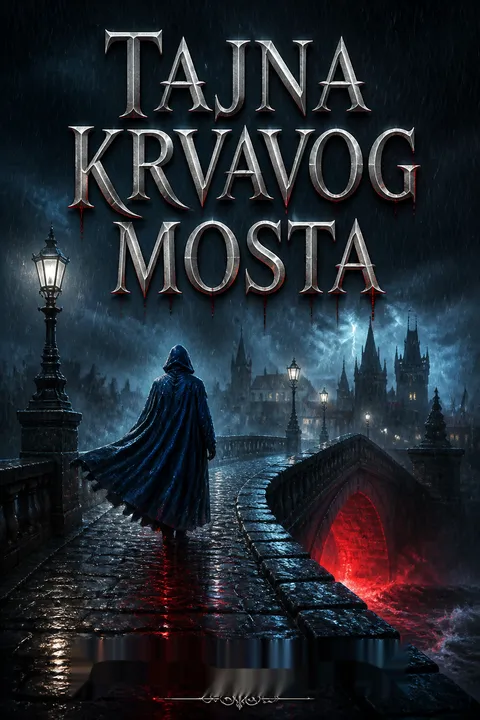
A violent storm drives three cloaked strangers into Matijak’s mill beside Zagreb’s Krvavi most. By morning, one is dead beneath the bridge, his heart pierced and a Latin warning pinned to his chest: he is the first of nine men marked for punishment. The miller and his companions recognize the dead man’s unusual blue cloak as belonging to one of their guests.
The other two visitors, a woman and a silent man, have vanished through an open window. Then a sealed, abandoned house across the bridge glows with blue light, and a veiled woman traces three crosses at its window. The killing now seems tied to an old civic curse, a hidden enemy, and the city’s divided past.
The mystery begins by making public space feel unsafe. A bridge once stained by civic violence becomes the chosen stage for a new, carefully announced campaign, while the blue light invites people to replace evidence with superstition. That confusion matters: the warning names a limited group, but no one knows what binds its members. The story sets reason against rumor from its first pages. Matijak’s mill, the abandoned house, and the bridge also create a compact geography in which ordinary neighbors can witness extraordinary crimes, yet still misread what they see.
A Borrowed Uniform
At the Grič monastery, young friar Anzelmo defies the drunken guardian, who has imprisoned a servant girl after she rejected his advances. The guardian tricks Anzelmo into a barred underground cell by promising that a woman he loves is waiting below. In the darkness, the prisoner, Stanka, finds the hidden release and frees them both.
Anzelmo’s unknown beloved, Beata, gives Stanka food, then arranges work with her friend, Baroness Katarina Lehotska. Because Katarina needs a male escort in public, Stanka accepts a risky disguise as her nephew, Polish officer Stanko Gotta. The disguise offers shelter and a future, but it also makes Stanka’s identity a secret on which several people’s trust will depend.
Stanka’s disguise begins as practical survival, not playacting. After poverty and imprisonment strip her of safety, a male identity gives her access to movement and protection unavailable to a lone young woman. The arrangement carries a psychological cost: she must learn to perform confidence while keeping her own needs hidden. Anzelmo’s deception also establishes a pattern in which authority figures use confinement and false promises to control vulnerable people. Yet the episode gives Stanka agency at once. She notices the release mechanism and saves the friar as well as herself, making her first decisive act a rescue.
The House of Makar
At a gathering after Mernay’s funeral, Grof Jurica Meško questions Baron Makar about the abandoned house near Krvavi most. Makar recounts how, years earlier in Venice, he seduced the flower seller Giulia and was forced by her vengeful fiancé to marry her after a fight left her brother dead. In Zagreb, their marriage curdled into mutual hatred.
Makar says he sent Giulia away to a convent after discovering her adultery, but Meško reveals that his father heard cries from the sealed house and believed she had been left to die below it. Makar produces letters supposedly proving she lives in Milan. Later, Meško follows Makar back to the house, finds a secret cellar, a buried skeleton, and evidence of a second killing.
Makar’s account complicates the moral ledger without clearing him. He describes coercion and humiliation, but his response to them is to turn Giulia into an object to be managed, hidden, and blamed. Meško’s father’s report of cries beneath a sealed house makes the letters suspect rather than conclusive. The cellar discovery shifts the mystery from private scandal to organized violence: the house is not merely haunted in local imagination, it is physically connected to concealed deaths and secret movement. Meško’s investigation begins as filial loyalty to his father’s memory and becomes a challenge to the respectable stories powerful men tell about themselves.
Stanko Joins Meško
Katarina introduces Stanko to Zagreb’s aristocratic circle as her Polish nephew, and the quiet young officer quickly attracts notice. Meško finds him thoughtful and unusually sober among men who spend their days drinking, gambling, and feasting. Their friendship deepens after Stanko challenges Meško to look for a purpose beyond indulgence.
Meanwhile, Meško’s newly arrived aunt Lidija tells him she was cast out by her family after bearing a child and has returned to find the man who once betrayed her. Masked robbers break into Meško’s house and frighten Lidija; she recognizes one as her former lover but refuses to name him. Soon she vanishes, and Meško finds a jeweled dagger that may connect her lover to the robberies.
Stanko unsettles Meško not by condemning him but by showing that his own habits have become a substitute for choice. Their friendship gives Meško a model of attention and restraint that his aristocratic circle lacks. At the same time, Lidija’s story brings private sexual history into the public mystery: she protects the man she loves even when that silence obstructs justice. The dagger becomes a material clue, but it also links love to concealment. The novel repeatedly asks whether loyalty is a virtue when it shields harm, or a trap when it prevents someone from naming what happened.
Keglević Falls Second
At a celebration for Rijeka’s return to Croatian administration, Zagreb’s elite dance beneath elaborate decorations while Stanko performs and Meško watches Katarina command the room. A warning trumpet interrupts the festivities.
The guests hurry to Krvavi most, where a second nobleman lies dead with his heart pierced, the same blue cloak over him and another message promising seven further punishments. Meško identifies the victim as Grof Icek Keglević, whom he had spoken with only hours earlier.
The first murder can no longer be dismissed as robbery or a one-off revenge. The identical method, cloak, and numbered threat suggest a deliberate sequence, while the public celebration’s sudden collapse makes the danger impossible for the aristocrats to ignore.
The murder interrupts a ceremony celebrating political restoration, setting public pride against private vulnerability. The repeated cloak and numbered warning make the killer’s method theatrical, but the dead body gives that theater a material consequence. Meško’s recent conversation with Keglević compresses the distance between social life and death: a man can leave a dance, enter a rumor, and appear beneath a bridge before dawn. The scene also exposes the elite’s dependence on spectacle. They can stage magnificence for a crowd, yet have no reliable account of who is moving among them or why.
A Shot in the Dark
A letter lures Meško into the woods with instructions to place the jeweled dagger at a marked tree. He takes armed servants and posts them as guards, but the attackers mistake one servant wearing Meško’s cloak for the grof and shoot him. Stanko rushes into the darkness to help, then later spots a masked figure climbing toward Meško’s balcony.
Meško fires, only to be shot himself when he goes into the garden. Stanko orders the household to summon a doctor and tends Meško through his unconsciousness. When Meško wakes, Stanko’s relief is too fierce to conceal. Their friendship has become the place where each risks his safety for the other, though neither yet speaks plainly about the feelings gathering beneath that loyalty.
The trap works by exploiting appearances: the killer targets a cloak rather than a face, and an innocent servant pays for Meško’s visibility. Stanko responds with practical courage, taking command when Meško cannot act. His care makes intimacy concrete through labor rather than declarations. The episode also distinguishes Meško’s old bravado from genuine responsibility. He has armed guards, but his curiosity still draws others into danger. The attack turns their bond into a mutual obligation, while Stanko’s concealed identity makes that closeness increasingly precarious.
Nine Names in Ink
Searching his family papers, Meško finds the continuation of his grandfather’s diary and learns that nine grandees, including Mernay, Keglević, Makar, Patačić, Vojnić, and his own father, once barred a poor nobleman named Klemenčić from their homes and denied him a duel. The discovery gives the nine-death threat a possible motive.
At a dinner, a jewel from the stolen regalia appears among the guests, and the judge finds more of the missing treasure in the pocket of Ivan Klemenčić, a small landholder. The grandees declare him guilty. Meško objects to torture, but the judge has Klemenčić’s hands burned and crushed. The prisoner refuses to confess, then escapes when masked allies break into the jail during a riot.
The diary shows how a collective act of social exclusion can become a durable injury, but it does not prove that the excluded man is the killer. The grandees prefer a convenient suspect, especially one whose lower status makes disbelief easy. Meško’s opposition to torture marks a genuine ethical boundary within a corrupt system, although he still suspects Klemenčić. The planted or unexplained jewels deepen the problem: evidence can be made to support power rather than truth. The escape transforms the inquiry from court procedure into open pursuit and leaves the guilty identity unresolved.
The City Turns on Nobles
As Anzelmo preaches that the grandees’ feasts have brought divine punishment, citizens gather at the Manduševac well and blame aristocratic imports for ruining local trades. Three crosses appear on public buildings, and a crowd attacks the Patačić and Vojnić residences. Meško disguises himself as a purgar, persuades the mob to spare the nobles and take them to church for an oath, then escapes the ensuing military cordon.
During the confusion, the gang frees Klemenčić from jail. When the judge later says the prisoner escaped, Meško suspects the riot was arranged to cover the rescue. The crisis reveals that the murders are feeding genuine class anger, even as criminals exploit it for their own purposes.
The unrest is neither a simple uprising nor mere manipulation. The citizens’ complaints about imported goods and aristocratic spending are specific and economically grounded, while Anzelmo’s supernatural explanation redirects frustration toward fear. Meško succeeds because he speaks to the crowd’s practical grievance rather than treating them as a faceless threat. Yet the rescue of Klemenčić during the military response shows how easily a real grievance can become cover for a separate conspiracy. Public trust is damaged from both directions: elites neglect the people, and leaders exploit their anger.
A Letter From the Lake
At Trakošćan, Meško becomes engaged to Katarina and tells Stanko that they will soon be family. Believing he has lost both his place in Meško’s life and the woman he loves, Stanko leaves a letter confessing his identity and despair, then rows onto the lake and jumps into the water. Đuro Ottenfels dives after him and brings him ashore.
Meško finds the letter but delays reading it when Stanko begs him not to. He eventually realizes that Stanko’s grief is love for Katarina, and promises not to abandon him. Stanko survives, but his confession makes the friendship more painful: Meško now knows that his own happiness has been purchased at the cost of the person he trusts most.
The lake turns concealed feeling into bodily danger. Stanko cannot keep living beside a future he believes has excluded him, so he chooses the water rather than another attempt at disclosure. Ottenfels’s rescue is crucial, but it does not resolve the emotional crisis. Meško’s decision to respect the unopened letter shows tenderness, yet his eventual inference cannot undo the suffering that secrecy has caused. The scene asks whether friendship can remain innocent once desire enters it, particularly when one person controls the social and material conditions the other depends on.
The Vražje Gorge
At a later Trakošćan gathering, Ružica Vojnić takes Stanko to the Vražje ždrijelo, a ravine deep enough to make a fall seem final. A masked robber interrupts when Ružica suddenly pulls Stanko toward the edge. He holds Ružica as a hostage and forces Stanko to guide him into the castle, where he steals the Drašković family ring and other valuables.
A second robber then helps carry Ružica away. Stanko and Đuro Ottenfels pursue them across the lake; Ottenfels is wounded, but together they drive one attacker into the ravine and recover Ružica. The surviving robber escapes. In the following confusion, Pavao accuses Stanko of theft, giving Katarina and the judge a pretext to isolate him.
The gorge makes emotional despair and physical danger occupy the same landscape. Ružica’s sudden movement toward the edge is dangerous, but the robber’s intervention does not make her safe; he turns her into leverage. Stanko’s forced complicity in the theft demonstrates how an honorable action can be framed as criminal when the powerful control the account of events. The ring links the robbery to family legacy, while its theft will later implicate a larger network. Ottenfels’s wound also shows that rescue has a cost rather than functioning as effortless heroism.
Poison Behind the Door
After Pavao and Katarina accuse Stanko of stealing from the castle, Judge Žigrović locks him in his rooms and arranges a journey to a windowless prison tower. In private, the judge proposes poisoning the prisoner and staging the death as suicide. Katarina appears to accept his plan, then brings Stanko a supposedly reconciliatory meal laced with poison.
Stanko recognizes the danger, eats and drinks enough to make the deception plausible, changes into a servant’s clothing, and slips away through the castle’s secret passages. The judge and Katarina later find an empty bed and his uniform, and assume he has escaped only a short distance or died from the poison. Their false certainty will let Meško believe Stanko is dead.
The episode makes respectable authority more frightening than the masked gang: the judge uses legal custody to create a private execution, while Katarina uses the language of forgiveness to conceal poison. Stanko survives through observation and performance, turning the disguise that once protected her into a tool of escape. The false report of death shows how easily appearances can become accepted fact when powerful people prefer a convenient conclusion. The scene also sharpens the novel’s recurring contrast between public virtue and private conduct.
A Ghost in the Castle
Believing Stanko lost, Meško searches Trakošćan’s hidden corridors with Pavao and the old Count Drašković. A white figure has visited his room, left katarinčice and a message, then vanished through a concealed cupboard. The group finds a tunnel connecting the bedroom to an abandoned tower and later discovers a body in the underground passages, dressed in baronial velvet like the clothes Stanko wore when he disappeared.
Meško assumes the corpse is his friend. He also discovers that the white visitor is connected to the Drašković family’s past, though her face and purpose remain concealed. The castle’s architecture now holds both the mystery of Stanko’s fate and a secret history of illicit encounters.
The hidden passages turn the castle into a structure of divided knowledge. What appears sealed is connected; what appears dead may be moving elsewhere. Meško’s assumption about the body is understandable because clothing substitutes for identity, but that error exposes how grief can make an uncertain clue feel conclusive. The white visitor’s repeated use of hidden doors also echoes Stanka’s reliance on secret routes to survive. The castle thus makes concealment physical: desire, guilt, and danger all travel through spaces excluded from the official household.
Meško in the Robbers’ Cave
While hunting in Maceljska gora, Meško is seized by masked men and taken to a cave, where their leader claims to be Klemenčić and threatens to kill him for sending the nobleman to the gallows. The captive sees the gang prepare to murder a robbed livestock trader. Elvira, one of the band’s women, offers to delay his death, and Meško persuades her to help him escape.
When the robbers gather near a store of gunpowder, he throws a barrel into the fire and flees through a hidden passage during the explosion. A mountain hermit shelters him and helps him return toward Trakošćan. The false Klemenčić’s polished speech and political knowledge leave Meško suspecting that the real organizer is someone more powerful.
The cave converts political conflict into a literal economy of bodies: the gang takes money, kills witnesses, and treats Meško as a future corpse. Its leader’s use of Klemenčić’s name exploits the earlier public narrative and keeps the real man’s identity obscured. Meško survives not through force alone but by reading Elvira’s desire for a different life and turning that desire into cooperation. His escape by explosion is a moment of agency, yet it does not settle who commands the gang or why the violence is so carefully organized.
The Masked Rescue
At the Židovski brijeg, Meško and his companions follow a ransom plan meant to recover Ružica from the robbers. Pustinjak Adam guides them to the meeting place, and Meško’s men capture two masked suspects after Ružica is released. One insists he is Klemenčić, but his identity remains doubtful.
Meško sees another clue in the ring stolen from the Drašković castle and in the gang’s knowledge of the nobles’ movements. Ružica returns safely, while Ottenfels’s love for her remains painful and unresolved. The capture brings no clean victory: the actual mastermind has not been secured, and the captured men may be decoys. Meško continues to suspect that a respectable face hides the leader.
The rescue succeeds tactically but fails to close the investigation. The gang’s willingness to trade a hostage for money suggests an organized enterprise, while the false name attached to one prisoner warns that identity itself has become a weapon. Meško’s suspicion is therefore rational rather than paranoid: evidence has repeatedly been planted, stolen, or misread. Ružica’s return also exposes the cost of romantic idealization. Ottenfels can save her life, but he cannot make her love him, and his devotion continues without guarantee of reciprocity.
The Ban’s Bloody Claim
When the grandees gather to choose a successor to Ban Nadaždi, many support Makar because his piety and court connections seem useful. Meško publicly rejects him, accusing him of killing his wife and warning that his respectable image masks the criminal organizer behind the murders. He produces Giulia’s skull, jewelry, and the note found in Makar’s cellar.
Makar counters with letters supposedly from Giulia in Milan and brings forward a nun who claims to be his living wife. The evidence divides the nobles, but Makar’s political ambition is exposed as inseparable from the mystery. At a later gathering, Meško recovers the Drašković ring from Katarina’s possession and recognizes it as the family heirloom entrusted to Pavao’s secret lover.
The struggle over the ban’s office turns a murder inquiry into a public contest over legitimacy. Makar’s piety, wealth, and court influence function as political capital, while Meško’s evidence is powerful but vulnerable to counterfeiting and social disbelief. The nun’s appearance does not settle Giulia’s fate; it reveals how easily a body, document, or title can be staged to protect authority. The ring adds a more intimate clue to the broader thefts. The chapter’s tension comes from the gap between what Meško knows and what he can prove before men invested in Makar’s reputation.
The Borrowed Name Returns
After Meško returns to Zagreb, he catches a disguised stranger watching his house and discovers Stanka alive. She explains how she escaped Trakošćan through hidden passages, survived under a false appearance, and avoided the poison and accusations meant to destroy her. Meško learns that she was never the thief: she saw the mysterious woman take the Drašković jewels and was framed by Pavao and Katarina.
The revelation changes the meaning of their friendship. Meško admits that his devotion to Stanka has become love, while she, worn down by suspicion and hardship, has stopped believing she can trust him. He asks her to remain, protects her from the judge, and brings her into his investigation of Makar and the gang.
Stanka’s return corrects the story’s most devastating false conclusion, but survival has not restored trust. Her disguise allowed her to escape, yet it also enabled other people to define her as a thief and a dead man. Meško’s recognition arrives late, after she has learned to endure without his protection. Their changing roles matter: he once treated her as a male confidant, while now he must confront the woman he loved without knowing it. The reunion is therefore not a simple reward; it begins a harder negotiation between truth, care, and the damage caused by silence.
The Fire at Varaždin
During the Pinta’s extravagant gathering, Meško recognizes the gang’s methods in the stolen regalia and the attacks on nobles. A fire races through Varaždin, destroying hundreds of homes and driving terrified residents toward the Drava. Meško carries the unconscious Stanka through the flames, then turns back to guide refugees away from the river and prevent a deadly crush at the boats.
The disaster leaves the city in ruins and deepens his resolve to use his wealth and standing for practical help. When he later discovers Stanka is a woman, he keeps her confidence, while she continues to fear Katarina and the judge. Their bond shifts from chosen companionship toward openly acknowledged love.
The fire is a public catastrophe that strips away the grandees’ protective architecture. Meško’s response is not merely heroic rescue: he also directs frightened people away from a second danger, the crush at the river. His conduct contrasts with the aristocratic spectacle of the Pinta, where abundance has been mistaken for social health. The fire turns his developing moral seriousness into action, while Stanka’s survival again depends on remaining unreadable to those who would control her. Their affection grows amid practical danger rather than idealized courtship.
Katarina’s Last Bargain
Meško’s investigation exposes the judge’s bargain with Makar: Žigrović helped conceal crimes in exchange for noble status and Klemenčić’s confiscated estate. Makar’s gang, thefts, and false claim to the name Klemenčić are brought into the open, while his attempt to seize the ban’s office fails under Meško’s accusations and evidence.
Katarina’s separate schemes unravel as Meško discovers that she used Stanka’s disguise to gain access to him and later tried to remove her when she became a rival. The authorities and grandees can no longer treat the murders as a private feud or a supernatural curse. Meško turns from suspicion to an open demand for justice, though the story’s final reconciliation centers on Stanka.
The resolution reveals that corruption is not confined to a single villain. Makar’s criminal enterprise depends on Žigrović’s legal authority, while Katarina manipulates the same social structures for access, status, and survival. Their schemes work because reputation substitutes for evidence: the pious baron appears trustworthy, and the disguised woman appears culpable. Meško’s insistence on proof marks a departure from aristocratic convenience, but the novel does not offer a tidy legal accounting for every crime. Its moral resolution is clearest in the relationships it chooses to repair.
When Lilies Bloom
After the violence and deception are exposed, Meško and Stanka marry. The final image returns them to the country estate where he has begun to work rather than squander his inheritance. Spring flowers cover the garden, and neighbors gather to welcome the couple.
Stanka is no longer hiding inside the role of a young officer, and Meško no longer treats friendship as a substitute for naming his feelings. Their union answers the opening’s atmosphere of secret killings with a public household built through mutual trust. The story closes by showing the pair remembered in local family stories, their once-unlikely bond becoming part of the region’s shared memory.
The ending deliberately replaces the novel’s recurring images of sealed houses, underground rooms, and false identities with an open garden and a recognized marriage. Meško’s change is material as well as emotional: he works his estate instead of living through endless feasts. Stanka’s survival no longer depends on disguise, and her love can be acknowledged without the protective fiction of kinship. Yet the final domestic harmony does not erase the harms that preceded it. It offers a chosen life after prolonged coercion, not proof that the social world responsible for that coercion has been remade.
Analysis
The novel makes reputation a kind of currency. The grandees spend it freely, the judge sells it, and the women at the center of the story are threatened with losing it whether they speak or remain silent. Makar’s piety helps him approach political power; Katarina’s beauty and social skill let her maneuver through a world that limits women’s choices; Stanka’s disguise gives her mobility, but makes her vulnerable to accusations that are hard to refute. Against them stands Meško, whose development begins when Stanko asks him to imagine a life organized around more than feasting and begins to mature when he treats the poor, protects the falsely accused, and seeks evidence rather than accepting status as proof of character.
The mystery’s machinery mirrors this social instability. Secret tunnels connect spaces that respectable society wants to keep separate, while cloaks, uniforms, letters, rings, and false names make identity uncertain. The recurring blue cloak creates a public pattern, but the community repeatedly mistakes signs for proof. The actual violence depends on people who can manipulate what others see: Makar borrows the name of an enemy, Katarina manages appearances, and the judge turns law into private service. The book therefore treats investigation as a moral practice. To find the culprit, Meško must question not only the evidence but also his own desire to believe the people he loves.
Love here is neither a cure for injustice nor a purely private refuge. Stanka’s devotion helps awaken Meško, but it also places her in danger; Meško’s late recognition cannot undo her imprisonment, hunger, and despair. Their eventual marriage matters because it follows the collapse of the roles that separated them, not because it erases what happened. The final movement toward work, home, and shared life offers an alternative to the aristocratic cycle of consumption and display. The novel’s lasting question is not simply who committed the murders, but who gets believed, who is permitted to define another person, and what responsibility follows when privilege makes deception easy.
Review Summary
Tajna Krvavog mosta receives overwhelmingly positive reviews, praised for its engaging plot, historical setting, and well-developed characters. Readers appreciate Zagorka's writing style, the blend of romance, mystery, and social commentary, and the vivid portrayal of 18th century Zagreb. Many consider it a masterpiece of Croatian literature, with some rereading it multiple times. While a few critics find it overly long or simplistic, most readers are captivated by the intertwining storylines and the main characters, particularly Jurica Meško and Stanka.
People Also Read


Characters
Jurica Meško
The reluctant reformerA wealthy Croatian count whose idle, pleasure-seeking life is challenged by the people and crimes around him. Meško is curious, bold, and unusually willing to speak with ordinary citizens, but he often confuses confidence with understanding. Friendship with the reserved young officer Stanko gives him a model of loyalty and purpose that his aristocratic companions rarely provide. His investigations force him to question both inherited authority and his own appetite for easy pleasure. Beneath his swagger is a strong capacity for shame, tenderness, and practical responsibility, qualities that become increasingly important as the mystery threatens the people he cares about.
Stanko Gotta
The guarded young officerPresented in Zagreb as Baroness Katarina Lehotska’s Polish nephew, Stanko is a young officer whose quiet reserve contrasts with the boisterous aristocratic world he enters. He is intelligent, observant, and unusually capable of compassion, especially toward Meško, whom he tries to draw away from a wasted life. Stanko’s apparent shyness hides considerable nerve; he can act decisively under pressure and endure more than others realize. His divided public and private life shapes his relationships with Meško, Katarina, and Ružica, while his longing for safety and affection makes him vulnerable to people who control his livelihood.
Katarina Lehotska
The dazzling schemerA beautiful, socially skilled Polish baroness living in Zagreb while her husband is believed to be imprisoned. Katarina enjoys company, admiration, and the freedom to move through aristocratic society, even as she insists on her respectability. She uses charm as both pleasure and protection, understanding how quickly gossip can damage a woman’s standing. Her apparent composure conceals a fear of losing control over her future and a talent for redirecting other people’s judgments. She is generous when it serves her loyalties, but can become calculating when her security or romantic ambitions are threatened.
Barun Makar
The polished predatorA wealthy, fashion-conscious baron whose conspicuous piety and polished hospitality win him a place in elite society. Makar is practiced at managing appearances and at turning personal injury into justification for control. His stories about his marriage to Giulia reveal a man who treats women’s choices as affronts to his authority, while his political ambitions depend on friends willing to advance his reputation. He is patient, theatrical, and dangerous precisely because he understands that a respectable surface can shield behavior others would condemn if they saw it plainly.
Ivan Klemenčić
The excluded noblemanA provincial nobleman whose place in Zagreb’s aristocratic circle is undermined by a humiliating rejection from nine grandees. Proud and self-contained, he has spent years working to establish an independent life among people who continue to judge him by status and old grievance. His name becomes entangled with murder, robbery, and political fear, making it difficult to separate the man from the stories told about him. Klemenčić is not easily softened by pity; he values dignity and remembers every door that was closed against him.
Ružica Vojnić
The searching daughterBaron Vojnić’s thoughtful daughter, Ružica is observant, emotionally intense, and dissatisfied with the roles chosen for her. She forms a deep attachment to the young officer Stanko and has the courage to act when others are in danger. Her feelings do not make her passive: she challenges people who presume to define her and remains capable of tenderness even after disappointment. Ružica’s relationship with her mother complicates her sense of trust, while her bond with Stanko gives her a rare space to speak without performance.
Đuro Ottenfels
The wounded loyalistA young count who has loved Ružica since childhood and struggles to accept that her feelings may have changed. Ottenfels is impulsive and proud, yet his devotion is genuine enough to put him at risk for her. He moves easily among the grandees but is less secure in matters of love, where jealousy can overwhelm judgment. His friendship with Meško survives disagreement, and his readiness to help others shows that his vanity is not the whole of his character.
Pavao Drašković
The conflicted heirThe young heir to the Drašković estate, Pavao is charming, impulsive, and conscious of his family’s expectations. He is capable of loyalty to Meško but can act hastily when desire or fear takes hold. His romantic entanglements bring him into conflict with his own sense of honor, while the family’s old ring and hidden passages make his private choices part of a wider public mystery. Pavao wants to be treated as a man in his own right, even when he has not yet learned to govern his impulses.
Žigrović
The compromised judgeZagreb’s wealthy city judge, Žigrović performs strict morality in public while treating the law as something he can bend for private advantage. He longs for noble status and for the affection of beautiful women, and those ambitions make him susceptible to powerful patrons. His self-image as a guardian of order conflicts with his willingness to intimidate, manipulate, or serve those who can reward him. He is not a mastermind so much as a man who mistakes access to authority for virtue.
Anzelmo
The zealous friarA handsome, forceful monk whose public sermons condemn the grandees’ excesses. Anzelmo’s religious language carries genuine intensity, but his private attachments and appetite for control complicate his image of sanctity. He moves between the monastery and the city’s hidden passages, where his authority over vulnerable people is greater than it appears. His conflict between spiritual ambition, jealousy, and worldly desire makes him an unstable figure, capable of both rescue and danger.
Lidija Meško
The returning auntMeško’s estranged aunt, Lidija returns to Zagreb after years of exile and carries a history of abandonment, family shame, and unresolved love. She is lively and socially bold, but beneath her humor lies a powerful attachment to the man who once betrayed her. Her refusal to name him protects her feelings while frustrating Meško’s investigation. Lidija’s story shows how a woman’s reputation can be used to punish her long after the men involved have returned to respectable society.
Elvira
The robber’s accompliceA young woman living among the robbers, Elvira is adaptable, sharp-eyed, and drawn to the security that wealth might offer. She survives by reading the desires of dangerous men and shifting her loyalties when an opportunity appears. Her attraction to Meško makes her a source of help, though not a consistently reliable one. Elvira’s life among the gang suggests how poverty and dependence can narrow a person’s choices without entirely erasing her capacity for decision.
Pustinjak Adam
The forest witnessA hermit living in the Zagorje woods, Adam distrusts the aristocracy after suffering under its power. His harsh judgments grow from personal grievance, yet he is also capable of sheltering the hunted and helping Meško pursue the robbers. Adam’s seclusion gives him access to routes and rumors unavailable to the grandees. He remains difficult to read: part witness, part guide, and part man whose sense of justice is entangled with old resentment.
Franjo Patačić
The extravagant hostA sociable, generous grandee famous for elaborate meals, expensive fashions, and an appetite for pleasure. Patačić is not a reformer, but his warmth and loyalty make him a genuine friend to Meško. He knows how to turn a gathering into theater and enjoys being the center of it, yet he is not blind to every danger around him. His lavish household embodies the culture that makes the city’s class resentments visible.
Matijak
The miller’s witnessA sturdy miller living beside Krvavi most, Matijak is practical, outspoken, and alert to what happens on the riverbank. He shares the common people’s suspicion of aristocratic extravagance but is not incapable of recognizing kindness across class lines. His mill becomes an early meeting place for witnesses and rumors, while his willingness to help Meško makes him a valuable link between the city’s social worlds.
Barun Vojnić
Ružica’s protective fatherA proud nobleman and Ružica’s father, Vojnić is protective of his daughter and concerned with family honor. He moves within the same competitive social world as the grandees, yet his attachment to Ružica gives his actions a more personal urgency. His household reflects the period’s strict expectations for women and the bargains men try to make around marriage.
Giulia
Makar’s Venetian wifeA young Venetian flower seller whose beauty and vulnerability draw Makar into a coercive marriage. Giulia is not simply a romantic prize: she resists the men who try to decide her future and seeks affection in a life that has already been constrained by force. Her story reaches Meško through Makar’s account, disputed letters, and physical clues, so her own voice is largely absent from the society that judges her.
Beata
The hidden benefactorAn enigmatic woman connected to Anzelmo and to the underground passages beneath the city. Beata acts decisively when a vulnerable stranger needs food, shelter, and a way out, yet she keeps her own identity and movements concealed. Her guarded kindness contrasts with the coercion practiced by several religious and aristocratic figures. She understands that secrecy can be both a weapon and a means of survival.
Plot Devices
The blue cloak and warnings
Marks the nine threatened menThe murderer wraps victims in a distinctive blue cloak and leaves a written warning identifying each as one of nine men due for punishment. The repeated cloak and numbered messages make separate killings appear part of a single campaign and direct suspicion toward the grandees’ shared past. Because the cloak is stolen, moved, and later associated with other crimes, it also creates opportunities for misdirection. The device binds the mystery to Krvavi most and turns the bridge’s history of civic bloodshed into an active part of the investigation.
Stanko’s disguise
Creates cover and dangerStanka adopts the identity of Polish officer Stanko Gotta so she can work and travel under Katarina’s protection. The disguise gives her a public role and permits her to enter male social spaces, including Meško’s circle. It also creates dramatic irony: Meško trusts the person he believes to be a young man, while Stanka must protect both her identity and her growing attachment. The disguise is not merely a trick; it is a response to limited options for a poor, unattached woman.
The hidden passages
Connect homes, cells, and escapeSecret routes under the Grič and beneath Trakošćan link rooms that appear sealed to the people above. They let prisoners escape, strangers enter unnoticed, and the white-clad visitor vanish from Meško’s room. Their existence makes the setting part of the plot’s machinery: walls and floors conceal relationships as effectively as characters do. The passages also permit false conclusions, since a missing person may have left by a route no witness knows to look for.
The Drašković ring
Connects romance to theftThe family ring is both an heirloom and a pledge used in a secret courtship. Its distinctive crest lets Meško connect the castle thefts to the masked woman in the tower, while its presence among Katarina’s possessions makes private desire part of the public investigation. The ring’s movement between characters is more than a clue about property: it records promises, secrecy, and the way romantic power can be used to compel another person.
The nine-name grievance
Gives revenge a public historyMeško’s grandfather’s diary reveals that nine grandees once ostracized a provincial nobleman and denied him a duel. The discovery appears to supply a motive for the murders, but it does not prove that the disgraced man is the killer. The device ties present violence to inherited class structures and shows how an old collective decision can be remembered as a personal sentence. Because a criminal later uses the name Klemenčić, the grievance becomes both a genuine historical wound and a convenient cover.
Grička vještica Series

Download PDF
Download EPUB
.epub digital book format is ideal for reading ebooks on phones, tablets, and e-readers.








