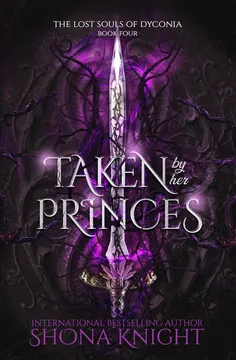


Plot Summary
The Wrong Princess
Freya Highcrest falls asleep in her California apartment after working on a song, then wakes in an unfamiliar pink bedroom dressed in medieval clothing. Five armed men break in, call her their wife, and prepare to take her from the castle. Freya insists she does not know them, but the men interpret her confusion as another provocation.
Their eldest, Arlo, carries her outside and explains that she is overdue to fulfill an agreement: after a year living apart, she must bear the princes’ children. Freya has no memory of making such a promise. She recognizes that the men believe they have found someone familiar, while she has been dropped into a life that belongs to a stranger.
The opening makes identity a practical emergency before it becomes a metaphysical question. Freya is not simply unfamiliar with the castle; the people around her possess a history with her that she cannot access, and they treat their version of that history as binding. Their language of agreement and duty turns her body into a political resource before anyone asks what she wants. Her insistence on ordinary facts, her apartment, her work, her memory, becomes the first defense she can make against a world that has already decided who she is.
A Marriage by Contract
The princes expect Freya to ride well, but Arlo sends her off on horseback before she can explain that she has never ridden. She falls, dislocates her shoulder, and is left to endure hours of pain before Grayson notices the injury and resets it. Around the campfire, the brothers explain that their parents arranged their marriage to unite two royal families.
Freya’s parents and brothers were killed shortly before the wedding, and she agreed to marry the princes only after bargaining for a year alone. The Freya they remember rejected them, insulted them, and said she could not love men. Their account makes the hostility less mysterious, but leaves Freya horrified by the future they still expect her to accept.
The injury makes the gap between the two Freyas bodily visible. The princes interpret her inexperience as manipulation because their memories have hardened into evidence; Freya experiences their certainty as another form of abandonment. Grayson’s practical care complicates that division, showing that compassion can emerge before belief does. The marriage arrangement also exposes the political logic beneath the romance: royal duty has already converted grief into a contract, and the brothers regard that contract as more reliable than the person standing before them.
Ogres in the Woods
When Freya tells the princes she will not be forced to bear their children, Arlo answers with a threat that she takes as a promise of sexual violence. She bolts into the forest, where Arlo catches her near a pack of ogres and carries her back to camp. The danger makes his apology more credible than his earlier swagger, though Freya still plans to escape when she can.
The next day Talon gives her a calmer ride and asks about her music. Freya sings one of her own songs, startling him with a voice and emotional openness he never associated with the woman he married. His surprise begins to unsettle the brothers’ conviction that her new behavior is only an act.
Fear moves in two directions here. Freya fears the princes’ power over her body, while the princes fear that her apparent change is another way to control them. The ogres briefly reorder those fears: outside the camp, the brothers become protectors rather than captors, yet that protection does not erase the coercive arrangement that brought her there. Talon’s response to her singing matters because it offers evidence that cannot be reduced to manners. Her creativity gives him a glimpse of an interior life their old assumptions had excluded.
The White Water Snake
At a forest pond, Freya bathes while Cash guards her. A huge pale snake seizes her underwater and bites her thigh. Cash dives in, kills it, and carries her ashore with its head still caught in her leg. Grayson removes the teeth, but Freya cannot feel her limb, so Arlo rushes the group to a village for illegal magic-infused healing cream.
The treatment forces the venom from her body in a violent, painful spell, and Freya collapses afterward. When she wakes, Cash is beside her. His rescue has shifted something in him, but he still accuses her of pretending to be changed. Freya tries to escape the inn on her weakened leg rather than remain in a place where she feels unwanted.
The snake turns the princes’ abstract obligation to protect Freya into a series of costly actions: Cash risks himself, Arlo spends money without bargaining, and Grayson uses a remedy that exposes them to legal danger. Their care is no longer theoretical, though none of them yet knows how to reconcile it with resentment. For Freya, survival does not automatically produce trust. She has been rescued and tended, but still hears that her own account of herself is a lie, so flight remains more imaginable than dependence.
The Cart of Thieves
Unable to walk properly, Freya slips out of the inn and hides in a merchant cart, hoping it will carry her away from the princes. Instead, its owners are thieves. When they discover her, their leader, Hudson, recognizes her as a princess and decides to exploit her before returning her for ransom. He strikes and pins her down, beginning an attempted assault.
The princes track the cart after learning she has fled. Pyke reaches her first, and Arlo kills Hudson as the brothers defeat the other attackers. Freya is shaken and dissociated; Pyke cradles her, sings until she recognizes him, and carries her away. This rescue makes the princes’ protection feel personal, even as Freya remains frightened and unsure whom to trust.
Freya’s escape is not reckless so much as an attempt to recover authorship over her own movement. The cart promises a route out, but places her in another hierarchy where men decide what her body is worth. The attack echoes the coercion she feared from the princes while distinguishing them from it through their actions: they intervene without demanding anything in return. Pyke’s song offers a form of care that does not require Freya to explain herself. His voice reaches her where argument and reassurance cannot.
A Kiss as Evidence
As the journey continues, the brothers keep measuring Freya against the cruel, distant woman they remember. Pyke finally challenges her claim that she is different, asking her to kiss them as proof of attraction. Freya kisses Talon, Grayson, Cash, and Pyke, discovering an intimacy she has never experienced; Arlo refuses, insisting he cannot trust her.
Talon comforts her after the rejection and privately tells her he believes her. He shares her bed, holding her while she cries. The kisses do not settle the question of her identity for the others, but they change the emotional terms of the journey. Freya now wants closeness as much as she wants escape, and the princes begin to feel the cost of keeping her at a distance.
The kiss test is an attempt to turn desire into proof, as if the body could settle a dispute about memory. It does not produce certainty; instead, it creates new vulnerability. Freya’s first experience of intimacy becomes entangled with the need to convince men who have already judged her. Arlo’s refusal preserves his defenses, while Talon’s comfort offers the first relationship in which she is believed without having to perform evidence. The scene marks a shift from forced proximity toward chosen proximity, though the power imbalance remains unresolved.
The Song That Heals
Bandits catch the group on the road and threaten Freya. Arlo steps between her and a sword, taking a serious wound. While his brothers try to stop the bleeding, Freya places her hands over the injury and sings a healing spell. The wound closes, but the pain transfers into her, and she collapses.
The princes realize she has a magical healing ability, something their kingdom treats with suspicion. Freya wakes to find Talon holding her and admits she feared the others would reject her if they knew. Talon promises his acceptance, while the brothers begin to reconsider their belief that she is playing a part. Arlo’s survival turns Freya’s secret into an act of trust rather than a weapon.
Freya’s magic follows the same emotional pattern as her music: she uses her voice to reach another person, but healing exacts a cost from her own body. Her choice to save Arlo despite his cruelty breaks the logic of revenge and makes her values legible through action. At the same time, the revelation exposes her to the kingdom’s prejudice against magic users. The brothers’ response now matters beyond romance. They must decide whether their protection extends to a woman whose difference could threaten their standing.
The Note in Pink
At a hunting cabin, the princes begin spending time with Freya as a partner rather than a prisoner. Talon shares music with her, Grayson makes her shoes, and the brothers grow more intimate with her at her pace. While looking for her comb, Freya finds a note in the dress she wore when she arrived.
A self-described fairy godmother explains that Freya and the other woman with her name were born into the wrong worlds, and that their souls have been switched; Freya belongs in Dyconia and cannot return to California. The note also identifies the princes as her soulmates. Freya tells Talon, who accepts the revelation and reassures her that she will not be sent away. She keeps the secret from his brothers for the moment.
The note converts Freya’s disorientation into a story with an explanation, but it does not make her situation easy. A supernatural correction has placed her in a world she does not know, with no route back to the life she remembers. The soulmate claim offers belonging while carrying its own pressure: destiny can sound like comfort or another imposed contract. Freya shares the truth first with Talon because he has earned her trust through consistent belief, not because he holds the highest rank among the brothers.
An Arrow at Home
Near the princes’ home, archers ambush the group. Cash throws himself over Freya and takes an arrow through his back. When they reach the castle, Freya refuses to let the royal family’s presence stop her from helping him. She removes the arrow and sings her healing spell in the open courtyard, closing the wound while taking its pain into herself.
The kings and queen witness her magic, and Freya passes out from the strain. Cash’s mother, who had seemed distant, reveals her fear for her son; Cash answers that he loves Freya and wants to see her. Their return brings Freya into the royal household, but it also makes her unusual power and the princes’ attachment impossible to hide from those around them.
Freya’s decision to heal Cash publicly repeats her earlier choice with Arlo, but the audience has changed. What was once a secret between companions becomes a political fact before the royal family and court. She acts before calculating the consequences, which makes her compassion both her strength and a source of danger. Cash’s declaration of love also reframes the family’s emotional hierarchy: affection that the princes’ mother assumed belonged only to their parents now includes Freya, whether the court has prepared for that bond or not.
A Knife at the Window
While the princes speak with their parents, an assassin climbs through Freya’s bedroom window and attacks her. Royal guards stop him before he can kill her, but the assault triggers memories of the bandits who had trapped her in the forest. Arlo returns to find her panicking in the corner and holds her until she recognizes him.
The princes treat her injuries and stay close while she recovers. Freya tells Arlo she loves him, and he finally says the same without hiding behind anger. The attack proves that the castle is not automatically safe, yet the brothers respond as a united household. Freya’s growing trust in them becomes visible in the way she asks them to remain beside her.
The attempted killing makes safety more than a change of location. Freya has escaped the forest, but violence can follow her into the rooms meant to shelter her. Her panic is not a failure of courage; it is the accumulated consequence of repeated assaults and near misses. Arlo’s presence becomes meaningful because he does not ask her to be calm before he comforts her. Their mutual declaration of love begins to repair their relationship, though it does not erase the deception still waiting to surface.
The Lie Behind the Door
After the castle attack, the princes discuss making their marriage to Freya official. Left with guards, she eats with Elora, the princes’ resentful sister, who tells her the brothers never believed her and only acted kindly to secure an heir. Freya refuses to trust Elora’s version alone, but follows the sound of the princes speaking with their parents.
There she hears Arlo confirm that the brothers initially pretended to believe her so she would be more compliant. He explains that their feelings changed, but Freya leaves before she can hear more. She takes a cloak, boots, a sword, and a switchblade, then slips through a side gate. The men who had become her refuge now seem capable of repeating the coercion she feared.
The betrayal lands because it exploits the exact wound the story has been trying to heal: Freya has repeatedly been promised acceptance, then rejected when others decide they know her better than she knows herself. The princes’ motives changed, but their early strategy still made her trust vulnerable to manipulation. Elora’s cruelty is effective because it gives Freya a partial truth in its most damaging form. Her decision to leave is not simply a misunderstanding; it is a response to evidence that the brothers did, at first, treat belief as a tactic.
Poison on the Road
Freya spends days walking toward the hunting cabin, cold, hungry, and unsure of the road. She eats unfamiliar purple berries that poison her, then collapses and is taken by a band of outlaws who intend to use her as a new captive. The princes find her tied to a tree. To get her out without provoking the whole camp, Talon and Cash pretend to be drunk travelers while the others prepare an escape.
Freya is feverish and hallucinates magical creatures, then mistakes her rescuers for comforting inventions. Grayson recognizes the berries she swallowed and prepares an antidote at the cabin. Freya survives, but does not yet accept that the men beside her are real or that she is ready to return to them.
The wilderness strips Freya of the protections she had begun to associate with the princes, while her poisoning distorts the line between danger and comfort. Her hallucinations are whimsical on the surface, but they reveal how badly she wants company: even imaginary versions of the men feel preferable to isolation. The outlaws’ plan to keep her captive echoes the body-as-property logic of the marriage arrangement, making the rescue urgent without making reconciliation automatic. Grayson’s knowledge saves her, but trust must still be rebuilt after the medicine takes effect.
Forgiveness, Not Forgetting
Once Grayson’s antidote clears Freya’s hallucinations, she insists the princes give her time before discussing the lie she overheard. They agree to focus only on her recovery. When she is stronger, they explain that their deception began as a way to manage a woman they thought they knew, but their feelings became genuine; Talon admits he had believed her early on.
Freya does not forgive them at once. Pyke trains her with a blade and carves her name into his chest as a private act of repentance. Talon makes her a bow, Cash brings her music paper and custom underwear, Grayson writes her a song, and Arlo offers a clumsy one of his own. Their concrete efforts help Freya trust that their love is no longer a bargain.
Repair here depends less on a single apology than on repeated, tailored acts of attention. The gifts matter because each prince remembers a specific need: safety, music, clothing, or the wish to be understood. Pyke’s self-inflicted mark is more ambiguous, turning remorse into a bodily spectacle that Freya must refuse to manage for him. The brothers’ promise to give her time is essential; forgiveness becomes possible only when she is not pressed to provide it on command. Their reconciliation does not erase the original lie, but gives Freya evidence of changed behavior.
Elora’s Confession
On the return journey, archers attack again and an arrow strikes Freya in the thigh. The princes rush her to the castle, where she heals the wound with her song before the royal family. Elora storms in and accuses Freya of lying, then reveals that she arranged the troll attack that killed Freya’s parents and brothers to hide her own attraction to women.
She also admits hiring assassins to kill Freya. The guards take Elora to the dungeon while the queen apologizes for her daughter’s actions. Freya asks for the royal family’s blessing to marry the princes, not revenge against Elora. The confession explains the cruelty surrounding her arrival and gives the family a clear danger to confront.
Elora’s confession changes the meaning of Freya’s bereavement: the deaths that shaped her marriage bargain were not an impersonal tragedy but the result of a relative’s attempt to conceal herself. That motive does not excuse the violence, yet it reveals how a restrictive political order can turn private fear into public harm. Freya’s choice to ask for acceptance rather than retaliation distinguishes justice from vengeance. The family’s response must now address both Elora’s crimes and the pressures that made secrecy seem safer than honesty.
Home at Last
Back in the castle, Freya wakes repeatedly to nausea and realizes that her illness is morning sickness. The princes celebrate her pregnancy, but Arlo makes clear that he wants her as his wife regardless of whether she bears children. They propose again, this time as the family Freya has chosen rather than as heirs enforcing an old bargain.
She accepts, and the brothers arrange a private wedding with their parents and closest friends. Freya’s music has a place in their new suite, and she is no longer expected to leave after producing children. The story closes its central emotional question by replacing a coerced cycle of childbirth and separation with a future built on consent, mutual care, and the family Freya had long wanted.
Pregnancy initially resembles the old contract’s desired outcome, but the meaning has changed because Freya now chooses the relationship and the life around it. Arlo’s insistence that she matters apart from her reproductive capacity directly answers the opening threat. The private wedding also rejects the public spectacle of royal duty in favor of a chosen circle. The resolution is not that destiny eliminates conflict, but that affection becomes ethically meaningful when the characters can name what they want and refuse what they do not.
Epilogue
At the private wedding, a new Elora appears in the dungeon, dressed in unfamiliar clothes and speaking as if she has just arrived from Freya’s world. She says she was switched into this realm and carries an apology from the fairy godmother.
The final supplementary scene looks back to that fairy godmother’s hurried work: she helped the original Dyconian Freya escape an unwanted marriage, drugged the California Freya, and sent her through the Enchanted Veil to exchange their lives. The women’s swapped souls were meant to return to their proper worlds, though neither journey began with informed consent.
The epilogues widen the novel’s private romance into a pattern of women crossing between worlds when their lives become unbearable. The fairy godmother’s intervention gives Freya’s displacement a design, yet the method is ethically uneasy: she acts to save one woman by drugging and transporting another without permission. The final Elora reveal suggests that the same mechanism has begun another story, while also complicating the apparent neatness of a destined match. In this book, belonging may be cosmically arranged, but trust still has to be earned through choices made after arrival.
Analysis
The novel makes mistaken identity a test of how people treat evidence. The princes trust memory because it is shared and politically useful; Freya trusts her own experience because it is the only stable ground she has. Neither position is emotionally neutral. Their certainty protects them from revisiting an unwanted marriage, while her insistence on being believed protects a self repeatedly rejected by caregivers. The story’s central repair therefore depends on behavior rather than argument: the princes must learn Freya through acts of care, and Freya must decide whether those acts outweigh their early deception.
The repeated rescues create a productive tension. The princes protect Freya from ogres, bandits, poison, and assassins, yet their original claim over her comes from a contract about her reproductive future. Protection can look like possession when the protected person has no meaningful choice. The novel gradually distinguishes the two through consent, especially when the brothers accept Freya’s need for time and she later chooses intimacy and marriage herself. Her healing magic sharpens the distinction: she can save the men, but each act costs her, so care is never abstract or free.
Music carries both identity and agency. Freya’s songs let her express desire before she can trust speech, and her healing spells transform that private art into public power. Her voice brings people back from injury, but it also exposes her to social stigma. The romance’s resolution is strongest when it treats belonging not as destiny’s automatic gift, but as an ongoing practice of listening, repair, and chosen closeness. The final Elora reveal complicates that closure by showing that world-crossing can rescue, displace, and unsettle at once. A life may be assigned by magic, but a home still has to be made.
Review Summary
Taken by her Princes receives an overall 4.06 rating, with readers praising the enemies-to-lovers dynamic, top-tier groveling, and well-developed individual relationships between Freya and her five princes. Talon emerges as a fan favorite for believing Freya first. Many appreciate the emotional depth, hidden magic, and Freya's resilient character. Common criticisms include repetitive plot elements, thin worldbuilding, anachronistic dialogue, and some discomfort with how the men initially treat Freya. Most readers found the journey rewarding despite early tension.
Characters
Freya Highcrest
The displaced songwriterFreya is an introverted musician who owns a small clothing shop and has spent much of her life expecting people to reject her. Repeatedly returned by foster families, she learned to hide the unusual ability she associates with losing acceptance. In Dyconia, she meets hostility with curiosity, humor, and a persistent effort to understand the people around her. Her songwriting gives her a language for feelings she struggles to express directly, while her instinct to help the injured can override her fear of being hurt herself. She longs for a family, but does not mistake belonging for obedience; she wants care that leaves room for her choices.
Arlo Silverthorn
The guarded eldest princeArlo is the eldest of the five princes and their most commanding presence. He is accustomed to taking charge, especially when danger threatens, but anger often arrives before curiosity. His resentment toward Freya comes from the rejection he believes she gave his family, and he treats control as a way to protect himself from being hurt again. Beneath that severity is a strong sense of duty and a desire to keep those he loves safe. He responds most honestly when action is required, though learning to speak with tenderness proves harder than facing a blade.
Cash Silverthorn
The wounded charmerCash is a prince whose humor and charm usually make him the social center of his brothers. Rejection has made him more guarded than he wants to admit, and his silence can conceal hurt more effectively than his jokes do. He is attentive to practical needs and quick to act when Freya is in danger, but his changing warmth can leave her unsure where she stands. Cash wants to be valued for more than his ability to entertain others. His softer, generous side appears most clearly when he listens closely and turns what he has learned into care.
Pyke Silverthorn
The watchful strategistPyke is observant, controlled, and difficult to read. He studies people for inconsistencies and is often the first brother to recognize a shift in someone’s behavior, though suspicion can make him mistake vulnerability for strategy. His skill with blades reflects a preference for preparation and precision. Pyke’s guarded manner hides a strong need for connection, one he rarely expresses without first testing the other person. When he does offer tenderness, it is deliberate and intense, shaped by his fear of trusting someone who may leave.
Grayson Silverthorn
The steady healerGrayson is a prince who notices what others overlook, from Freya’s injured shoulder to the shifts in her mood. He is practical, patient, and more inclined to ask what happened than to assume he already knows. His calm presence often softens the brothers’ harsher impulses, though he can also hesitate when certainty feels safer than compassion. Grayson values craft and useful knowledge, whether treating injuries or making something by hand. He is drawn to quiet forms of intimacy, where attentiveness can say what he is not yet ready to put into words.
Talon Silverthorn
The openhearted youngestTalon is the youngest prince, quick with jokes and unusually willing to approach Freya without first demanding proof. His warmth does not mean he forgets past hurts; he simply believes affection is worth the risk of being disappointed. He asks questions, shares his interests, and uses music and touch to create closeness. Talon is more emotionally direct than his brothers, which makes him both a source of reassurance and a fierce defender when they behave cruelly. He wants a family built on affection rather than mere royal obligation.
Elora Silverthorn
The resentful princessElora is the princes’ younger sister and the northern princess whose position shields her from many responsibilities. She is sharp-tongued, entitled, and practiced at turning a conversation to her advantage. Her brothers regard her as difficult to trust, while her parents continue trying to guide her toward a suitable marriage. Elora’s comfort with privilege contrasts with the duties imposed on her brothers, and her resentment often surfaces as contempt for the choices they make.
The Queen and Four Kings
The royal parentsThe queen and her four husbands rule the North and raised the five princes within a demanding royal household. They value continuity, political stability, and the preservation of their family line, which helps explain the arranged marriage they endorsed. Their formal authority can make their sons feel managed rather than understood, but concern for their children exists beneath that distance. They also struggle to balance Elora’s freedom with their expectation that she eventually marry.
The Fairy Godmother
The secretive realm guideA magical intermediary who works between realms, the fairy godmother is resourceful and hurried when events demand action. She treats extraordinary crossings as practical problems, but her confidence in her own judgment can override the consent of the people she means to help.
The Other Freya
The absent royal brideThe woman the princes remember as their bride shares Freya’s name and appearance but has a different history with them. Her absence shapes the brothers’ expectations and makes their first judgments of the woman before them especially difficult to dislodge.
Draven, Arrow, and Blaze
The royal guard trioThese three knights serve the royal family and protect the princes’ household. Draven, Arrow, and Blaze help secure the castle and respond when danger reaches Freya, bringing practical loyalty to a court where trust is often complicated.
Plot Devices
The Enchanted Veil
The realm-crossing passageThe Enchanted Veil links Dyconia with the human world and allows the fairy godmother to move people between them. Its existence explains why Freya wakes in a life she does not recognize and why the woman the princes remember is absent. The passage does not give Freya a simple way home; the note she finds says the exchange is permanent. By making the crossing a deliberate intervention rather than a random accident, the Veil reframes Freya’s displacement as part of a larger correction, while leaving questions about consent and the fairy godmother’s authority.
The Soulmate Bond
A felt pull toward belongingFreya and the princes experience a physical and emotional pull toward one another, a sense of incompleteness when separated and comfort when close. The note in Freya’s dress gives this sensation a name, but it does not create their affection or resolve the conflict between them. The bond sits beside the arranged marriage rather than replacing it: one is presented as destiny, the other as political obligation. The story tests whether a destined connection can become a relationship chosen freely, particularly after the princes have used deception and Freya has reason to distrust them.
Healing Through Song
Music carries restorative magicFreya can heal serious injuries by singing, but the magic transfers pain and exhaustion to her. This power connects her private identity as a songwriter with her instinct to care for others, turning music from a hoped-for vocation into a consequential act. She first reveals the ability when Arlo is gravely wounded, then uses it again before the royal court to save Cash. Because magic users face stigma, every use also forces Freya to weigh another person’s survival against the danger of exposing herself. The spell’s cost prevents healing from becoming an effortless solution.
Magic-Infused Cream
A remedy against venomThe princes buy illegal healing cream after a white snake bites Freya and leaves her leg paralyzed. Unlike Freya’s song, the cream treats the wound without requiring her to absorb the injury, though the body’s expulsion of venom is intensely painful. Grayson applies it at the village inn, and the treatment restores her leg. The remedy establishes that magic can be stored in practical objects, while its scarcity and legal status make it a desperate choice rather than a routine cure. It also gives the brothers their first costly opportunity to care for Freya without demanding anything in return.
The Marriage Agreement
Duty presses against consentThe original arrangement requires Freya to return to the princes, bear heirs, and leave again between pregnancies. It was negotiated after her family’s deaths and reflects the dynastic logic governing both royal houses. When Freya arrives with no memory of agreeing to it, the contract becomes the source of the brothers’ authority and her fear. Its terms give the story a concrete conflict beyond romantic attraction: Freya must decide whether a family can be built through obligation, while the princes must confront the difference between having a claim and being wanted. The agreement ultimately gives way to a relationship Freya chooses.
Download PDF
Download EPUB
.epub digital book format is ideal for reading ebooks on phones, tablets, and e-readers.








