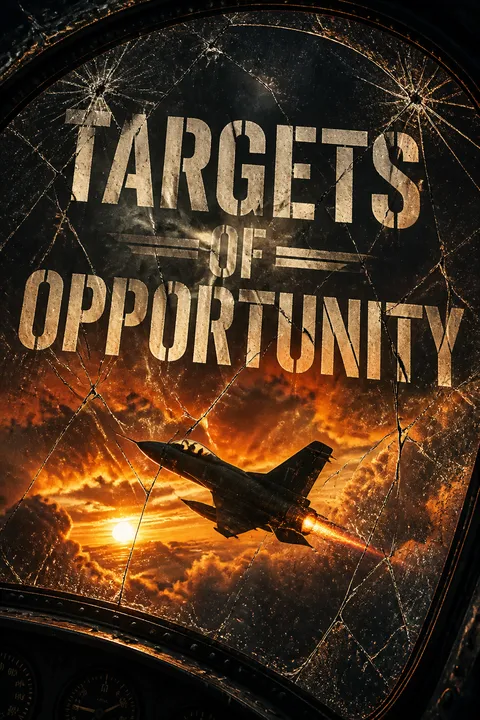


Plot Summary
Rain, Rescue, and a Fatal Return
At Da Nang, Marine Captain Brad Austin and his radar officer, Randy Wyatt, race into a rain-choked valley to protect trapped reconnaissance Marines. Brad drops bombs and napalm close to the stranded helicopter, giving its crew time to evacuate the survivors. On the way home, communications fail, and Brad follows his wingman, Stew Robinett, through cloud and darkness.
Robinett’s Phantom strikes a mountain just below its summit and explodes. Brad gets his damaged, nearly fuel-starved fighter back to Da Nang by following the coastline, but the loss leaves him searching for an explanation. Before grief can settle, orders remove him from his squadron and send him to Bangkok, where an unexplained assignment awaits.
The opening makes competence inseparable from uncertainty. Brad can improvise under fire and bring a crippled aircraft home, but those skills cannot explain why Robinett died or protect him from decisions made elsewhere. His rescue mission establishes his instinct to accept danger for fellow Marines, while the fatal return introduces the book’s recurring imbalance: pilots bear immediate physical risk, but distant authorities control the conditions. His reassignment converts private grief into a plot mechanism. The story begins not with a grand strategy, but with a capable man whose battlefield independence has made him valuable to people he has not yet met.
The Vanishing Captain
In Bangkok, CIA officer Hollis Spencer offers Brad a voluntary test-pilot assignment but withholds what he will fly. Refusal would return him to another Da Nang squadron; acceptance sends him to California under a false identity, with his military record hidden and the government prepared to list him missing if he dies.
Brad accepts, partly because the work intrigues him and partly because it offers a reprieve from combat. At Miramar he unexpectedly meets his old navy friend Nick Palmer, who has received the same offer. They recognize that the secrecy is real, but neither knows its purpose. Brad also calls his girlfriend, Leigh Ann Ladasau, and asks her to keep his return to America secret.
The recruitment turns Brad’s willingness to take risks into the very quality that makes him exploitable. He is given a choice, but the terms conceal the moral scale of what he is choosing: a civilian cover, a hidden service record, and no public accountability if he disappears. Reuniting him with Nick creates trust inside a project designed to deny its participants a stable identity. Leigh Ann’s call provides a counterweight to the covert world. Brad wants intimacy and continuity, yet his first act after accepting the assignment is to ask her to participate in his silence.
A MiG Takes Flight
Spencer gathers Brad, Nick, Texas-born Lex Blackwell, and test pilot Grady Stanfield at a secluded California airfield. He reveals that they will evaluate a Soviet-built MiG-17 acquired through a covert exchange. Grady makes the first flight and discovers that the aircraft becomes dangerously unstable at high speed, nearly losing control when its wing rolls and its nose drops.
The others learn its crude systems and awkward ground handling before taking their own turns. Brad’s first flight brings a new emergency: a broken throttle linkage leaves the engine stuck at full power. He circles over the airfield, lowers the gear and flaps, shuts off fuel, and lands just short of the runway’s end. The team grounds the MiG for repairs.
The MiG is both a machine and a cultural argument. American pilots expect engineering to protect them; the MiG demands bodily judgment, forcing them to learn its limits through strain and near-disaster. Brad’s landing demonstrates that instinct can compensate for faulty equipment, but the narrow margin of survival refuses to romanticize that skill. The secrecy of the project also has a physical counterpart: the aircraft itself is foreign, poorly understood, and patched into a new purpose. From the outset, the operation depends on adapting a weapon without ever making its users fully safe.
A Test Pilot's Close Call
As the team begins aerial-combat practice, Grady and Nick duel in a Crusader and the MiG. Grady’s fighter takes a bird through its canopy and engine during a low pass. He ejects, but hits the ground badly and is rushed into surgery in critical condition. Brad stays with him at the hospital before flying a borrowed Phantom back to the test site.
The crash strips away the reassuring distinction between controlled testing and combat: even a familiar aircraft can become lethal in seconds. Meanwhile, Brad and Nick continue learning the MiG’s turning behavior, and Brad proves that he can make the smaller fighter challenge a Phantom in close combat.
Grady’s accident changes the project’s emotional temperature. Until then, danger can be discussed as a technical problem, complete with speed limits and checklists. A pilot lying injured after a routine training flight makes the risk immediate and personal. Brad’s decision to remain at the hospital, then return to the work, reveals both loyalty and the professional reflex that keeps pilots moving before they have processed fear. The sequence also exposes a troubling contradiction: the operation recruits combat veterans for their instincts, then places them in unfamiliar equipment whose hazards are still being discovered.
The Enemy's MiG
Spencer finally explains Operation Achilles: the pilots will take the MiG to a hidden base in Laos, enter North Vietnam from the west, and attack selected enemy pilots while American air strikes draw MiGs into the sky.
They will pose as Soviet advisers if captured, using false papers, altered helmets, and rehearsed Russian phrases. Air America helicopters will attempt rescues, although the United States will deny the operation. Spencer’s assistant, Allison van Ingen, has already been testing the pilots’ discretion.
Lex, drunk at a cookout, told her that they were evaluating a CIA MiG; Brad had also violated instructions by seeing Leigh Ann. Spencer reprimands both. Allison reveals her true role as a security specialist, and Brad begins to understand that charm and surveillance have been part of the same encounter.
The revelation turns the earlier recruitment into a bargain with sharper edges. The pilots are not merely studying an enemy aircraft; they must inhabit the enemy’s identity and accept that their own government may disown them. False papers and Russian phrases become emergency tools, but they also dramatize how completely the mission separates a person from his public self. Allison’s double role unsettles Brad because he has mistaken professional observation for personal interest. At the same time, the breach by Lex shows that secrecy is not simply imposed from above. It depends on fallible people regulating their own loneliness, pride, and appetite for approval.
Laos Has No Safe Edge
The team moves the disassembled MiG to Wattay Airport, then flies it to Alpha-29, a concealed strip in northeastern Laos close to North Vietnam. Brad and Nick study the narrow runway, its surrounding mountains, and the improvised rescue plan.
On a familiarization flight, Chase Mitchell and Rudy Jimenez take them over nearby Communist positions. Ground fire tears into their helicopter, kills its engine, and forces Mitchell to crash in the jungle.
The four men leave the wreck before it burns and try to reach the airfield through dense growth, where enemy troops close in. Brad shoots a scout and helps the group fight its way toward the perimeter. The episode exposes how little distance separates their secret base from the forces surrounding it.
The crash makes geography an active antagonist. Alpha-29 is hidden from the sky, but secrecy has not made it secure; the base sits inside a landscape occupied by people who can hear, watch, and wait. Brad’s response is practical rather than triumphant: he navigates, fires when necessary, and keeps the group moving. The episode also tests the rescue arrangement before the MiG missions begin, revealing that extraction depends on pilots who may themselves be shot down. The operation’s maps promise control, but the jungle converts every route into uncertain ground.
The Ace Beside Him
Brad’s first mission takes him into a strike over Phu Ly. He waits low while American aircraft attack, then enters the confusion and finds MiG-17 number 3014, marked with red stars and identified as an enemy ace. The pilot mistakes Brad for a fellow MiG when their radios fail to connect. Brad falls into position behind him and shoots him down, then escapes when two American Phantoms mistake his aircraft for an enemy target.
He uses an unexpected radio warning to make them break away, but the transmission is recorded and raises questions. Brad returns to Alpha-29 with a malfunctioning brake and a difficult landing. He has scored a kill, yet the mission has exposed the danger of being mistaken for either side.
Brad’s first kill is not a clean victory. He succeeds because the enemy pilot trusts the appearance of a familiar aircraft, and because the Americans cannot tell that the MiG is theirs. The same deception that makes the operation possible also places Brad between two forces capable of killing him. His choice to shoot the pilot from behind troubles him, even as he recognizes the logic of combat. The recorded warning extends the consequences beyond the cockpit: a moment of survival may become evidence. The mission therefore tests not only Brad’s flying, but his capacity to live with actions that will never be publicly acknowledged.
The MiG Is Recognized
Nick takes the MiG into a later strike and meets several North Vietnamese fighters. He downs one MiG-17, but its flight leader sees the attack and turns on him. Nick’s cannons jam, and enemy fire damages the aircraft before he escapes. With the weather closing over Alpha-29, Brad guides him down using the sound of the helicopter and a flare, improvising an instrument approach that ends with Nick sliding into a stream.
The damage requires repairs, and the MiG’s adversaries now have reason to suspect that the strange aircraft is not one of their own. Brad argues that the original plan of hunting named aces is too difficult in combat’s confusion and urges a broader strategy.
Nick’s sortie marks the point at which the disguise stops being dependable. A mistaken identity can buy a moment, but the surviving flight leader has watched a MiG attack another MiG and can carry that anomaly into the enemy’s command system. Nick’s escape is a triumph of improvisation, yet his landing shows how quickly tactical success becomes a new emergency. Brad’s proposed shift from selective hunting to opportunistic attacks reflects a pilot’s preference for what can be executed under pressure over what looks precise on a planning chart. It also raises the stakes: a less selective mission may do more damage, but will be harder to conceal.
A Letter and a Lie
During a repair stop in Vientiane, Brad and Allison dine together and spend the night as lovers. At the same time, Leigh Ann’s letter reaches the hotel: she apologizes for their earlier quarrel, says she wants to join Brad in Laos, and tells him she is pregnant, though he has not yet read that final fact.
Brad reads her letter after returning to Alpha-29 and decides to ask her to marry him. He tells Allison that his future is with Leigh Ann. Allison, who has believed their connection might become permanent, slaps him and leaves. Before the pilots can settle their private lives, Spencer confirms that the CIA has approved Brad’s proposal to strike enemy airfields with the MiG.
The personal plot mirrors the covert mission’s reliance on incomplete information. Brad acts on what he knows, but not on what Leigh Ann has written about her pregnancy, and his decision to pursue marriage comes after he has crossed a boundary with Allison. His honesty arrives late, but it is still an effort to stop the deception from growing. Allison’s anger is not merely romantic jealousy; it follows a period in which her professional control and private desire have become entangled. The authorization to attack airfields arrives beside this rupture, making intimacy and violence converge without allowing either to pause for the other.
Alpha-29 Under Assault
As Brad and Nick prepare for the next operation, Pathet Lao forces attack Alpha-29 from the surrounding hills. The defenders return fire, and the helicopter gunner helps drive the attackers back, but the assault leaves men dead and wounded. A transport carries casualties to Vientiane, while Brad and Nick dig foxholes and demand stronger defenses.
Allison refuses to leave the base, insisting that her work matters as much as theirs. Additional CIA security personnel arrive, and Brad apologizes to Spencer for challenging his authority. The attack has made the concealed airfield a visible target to its neighbors. Even as the team prepares its first airfield strike, the ground beneath its operation is becoming less defensible.
The attack forces the team to see the cost of secrecy from the ground. Their cover protects the operation from public scrutiny, but it also prevents them from requesting ordinary military support. Brad’s insistence on better defenses comes from practical observation, while Spencer’s resistance reflects the constraints imposed by the mission’s sponsors. Allison’s refusal to leave is an assertion of professional agency, not simply a gesture toward Brad. The foxholes are a blunt correction to the fantasy that a hidden base can remain outside the war. The team has chosen to enter enemy airspace, but the enemy has already reached their doorstep.
Bai Thuong Runway Burns
Brad attacks Bai Thuong as a Navy strike approaches the nearby Thanh Hoa bridge. He fires into MiGs lined up for takeoff, destroying or damaging several aircraft, then faces two highly skilled Soviet pilots sent to intercept him. American Crusaders enter the fight, but they initially mistake Brad’s MiG for a hostile fighter too.
He escapes their guns by deploying the smoke canister and feigning a crash, then heads for Laos with a wounded arm. Near Alpha-29, Spencer reports that snipers are firing at the base. Brad uses the MiG’s remaining cannon rounds to suppress them before landing, but the aircraft’s brake damage leaves him exhausted and the ground crew finds more holes in the fuselage.
The airfield raid gives Brad’s revised strategy its first concrete result, but success comes wrapped in escalating exposure. He attacks aircraft before they can launch, then finds himself hunted by pilots who understand the MiG’s capabilities and by Americans unable to distinguish friend from foe. The smoke canister, introduced as a contingency, becomes a piece of theatrical deception: it works because the pursuers believe they have witnessed a kill. Brad’s return fire at the snipers links the air mission directly to the threatened base. Each apparent escape leaves damage behind, both on the aircraft and in the operation’s shrinking margin for error.
Mortars Before the Decision
Nick’s next mission coincides with an Air Force strike, but clouds prevent him from finding the targets or enemy fighters, so he returns without engaging. Soon afterward, mortars and machine guns strike Alpha-29. The helicopter gunner suppresses the attackers, but the bombardment wounds a technician and damages the base.
Brad, Nick, and Lex argue that the team should close the operation before the Pathet Lao return in greater force. Spencer says CIA operations cannot bring in regular troops, and reports that the agency’s operations director, Dennis Tipton, is traveling to assess whether Achilles should continue.
Before Tipton arrives, Spencer schedules one more mission. Brad proposes attacking three MiG bases near Hanoi during a larger strike, aiming to disrupt the enemy before its fighters can respond.
The failed sortie and renewed shelling strip away any easy equation between activity and progress. Nick can complete a mission and still accomplish nothing, while the base absorbs danger whether or not the MiG flies. Tipton’s impending visit introduces institutional judgment at the moment when the field team has the clearest evidence of its own vulnerability. Spencer’s choice to proceed reflects both urgency and career pressure. Brad’s plan answers the campaign’s central tactical problem with audacity, but it also expands the scale of exposure: instead of stalking one fighter, he will strike several bases in the center of enemy defenses.
Three Airfields, One Exit
Brad launches before a coordinated strike and strafes parked or taxiing fighters at Hoa Lac, Gia Lam, and Phuc Yen. Antiaircraft guns and American Phantoms converge on him; one Phantom explodes during the pursuit, and Brad’s MiG is hit. When its engine catches fire, he tries to eject, but the seat has been disabled by maintenance chief Hank Murray, who secretly feared a captured American pilot would expose the operation.
Brad shuts down the fuel and belly-lands in flooded rice fields near the Black River. He burns his charts and poses as a Soviet officer, but North Vietnamese soldiers find him and shoot him in the thigh. The rescue helicopter reaches him under fire, only for its pilot, Chase Mitchell, to be mortally wounded.
The sabotage changes the meaning of every earlier safety procedure. Brad trusted the ejection seat as a last boundary between danger and survival; Murray has quietly removed that boundary to protect the mission’s secrecy. The state’s denial is no longer abstract, because it has been built into the aircraft as a concealed choice about whose life can be risked. Brad’s forced landing then turns technical skill into a desperate performance of identity. His Russian disguise buys only seconds. The rescue attempt compounds the cost, showing that extraction is not a clean mechanism but another human crew entering the same lethal space.
The Last Flight from Laos
Back at Alpha-29, the damaged base comes under a full assault as Brad and the rescue crew return in a helicopter losing oil. Mortars and machine guns force the defenders toward a C-123 evacuation plane.
Allison refuses to leave without the helicopter’s passengers, while Nick and Spencer try to move people toward the transport. The helicopter’s engine fails near the runway, and Rudy Jimenez crash-lands beside the aircraft. The team gets the injured men aboard, but gunfire strikes Allison as Brad carries her toward safety; both fall, and Allison dies.
The C-123 lifts off under fire with Brad, Nick, Spencer, and the remaining survivors. Operation Achilles ends not in a planned withdrawal but in a crowded escape from a base the enemy has overrun.
The final assault resolves the story’s competing loyalties through action rather than argument. Allison’s insistence on waiting for the rescue crew costs her the chance to board earlier, but it expresses the same responsibility that has driven Brad throughout the book: people are not disposable pieces simply because a mission calls them liabilities. Nick and Spencer must choose between saving the group and honoring individuals left behind. The battered helicopter and overloaded transport make institutional failure visible as physical wreckage. The operation’s secrecy has demanded sacrifice at every level, yet its final evacuation cannot preserve everyone who made that secrecy possible.
The Price of Achilles
In Vientiane, Nick finds Leigh Ann and tells her that Brad has survived but is in serious condition after surgery. She visits him in the hospital, where Brad asks about Allison. Nick tells him she did not survive the evacuation. Leigh Ann comforts Brad and promises to take him home when he is well enough to travel.
The book closes on a second revelation: Leigh Ann is pregnant, a fact she has not yet told him. After a mission built on false identities and denied responsibility, Brad wakes to a future that depends on truths still waiting to be spoken. The military operation is over, but his private life must begin again amid grief, injury, and the possibility of a family.
The ending resists a clean victory. Brad survives, but survival is not equivalent to restoration: Allison is gone, his body is injured, and the relationship he hopes to build with Leigh Ann has been shaped by absence and concealment. Her pregnancy supplies a future, but the reader knows it before Brad does, leaving the final scene suspended between hope and the burden of disclosure. The structure returns the story from covert policy to intimate consequence. Governments can erase a mission from the record; they cannot erase what its participants carry into the lives they return to.
Analysis
Targets of Opportunity makes the distance between strategic authority and bodily risk its central source of tension. Washington wants improved kill ratios and plausible deniability; Brad, Nick, and the rescue crews experience those abstractions as damaged aircraft, shrinking fuel reserves, gunfire, and difficult choices about whom to leave behind. The captured MiG embodies that imbalance. It gives American pilots a tactical advantage precisely because they can disguise themselves, yet the disguise makes rescue and recognition more precarious. The pilots’ expertise can improvise around bad weather, failing instruments, and enemy fire, but it cannot repair decisions made without their consent, most starkly when Murray disables Brad’s ejection seat. The book also refuses to treat combat skill as uncomplicated heroism. Brad’s first kill depends on surprise and leaves him troubled; later, his daring raids save lives and expose others to danger. His relationships with Leigh Ann and Allison parallel the larger conflict between candor and concealment. Brad wants a future grounded in trust, but his work repeatedly asks him to withhold information, while his desire for immediacy complicates the promise he makes to Leigh Ann. The ending offers no clean absolution: the operation is abandoned, Allison is lost, and Brad survives into a future he has not yet learned how to explain. By closing on Leigh Ann’s pregnancy, the novel gives survival a human consequence beyond the battlefield. The next chapter of Brad’s life will require not tactics but truth, responsibility, and care.
Review Summary
Characters
Brad Austin
The covert MiG pilotA Marine fighter pilot with a strong improvisational instinct, Brad is drawn to danger but not indifferent to its human cost. His earlier rescue work and his loyalty to fellow pilots establish a pattern: he accepts risks readily when someone else is in danger, yet grows impatient with plans devised by people who will not fly them. He is disciplined, competitive, and more emotionally uncertain than his confidence suggests. His relationships with Leigh Ann and Allison expose different sides of him: the wish for a lasting home and the pull of immediacy in a life organized around peril. Brad’s central struggle is how to remain responsible when institutions make responsibility conditional.
Nick Palmer
Brad's trusted wingmanA gifted Navy Phantom pilot and Brad’s close friend, Nick combines competitive confidence with dependable loyalty. He can joke through discomfort, but his humor does not make him careless about danger or friendship. His experience gives him a clear-eyed sense of how a plan can fail once aircraft meet in the air. Nick becomes a crucial partner because he can challenge Brad without weakening their trust. He also brings a more sociable, worldly ease to the team, which contrasts with Brad’s deeper entanglement in the operation’s emotional consequences.
Hollis Spencer
The CIA field commanderKnown as Cap, Spencer is a former Navy pilot turned CIA project officer. A Korean War crash left him blind in one eye, but not removed from the world of aviation or danger. He believes in covert action and takes pride in making difficult operations function, yet his affection for the pilots complicates his duty to protect the Agency. Spencer is personable, experienced, and skilled at managing people, but he is also vulnerable to ambition and institutional pressure. His authority depends on keeping the project secret, even when secrecy conflicts with the safety and trust of the people carrying it out.
Allison van Ingen
The security specialistAllison is Spencer’s adjutant and a skilled CIA security specialist with experience in Laos. Her polished appearance and wealthy background can make her seem ornamental, but she is observant, capable, and professionally committed. She chose intelligence work partly to escape a life others had arranged for her, and she values competence earned through effort. Her attraction to Brad complicates her role without erasing her agency or judgment. Allison is both the person who tests the team’s discretion and a colleague who understands the practical dangers they face. She wants to be treated as a full participant, not protected as a symbol.
Leigh Ann Ladasau
Brad's faraway loveLeigh Ann is Brad’s girlfriend, a student whose affection is sincere but not untouched by insecurity. Distance and the limits of what Brad can reveal leave her to interpret fragments, sometimes misreading them before reconsidering. She wants closeness not as a glamorous attachment to a fighter pilot, but as a life shared with the person she loves. Her willingness to travel toward Brad’s uncertain world shows courage and a desire to choose her own future. She represents the ordinary continuity Brad longs for, though the secrecy he accepts makes that continuity difficult to sustain.
Grady Stanfield
The veteran test pilotA highly trained Navy test pilot and the senior aviator on the project, Grady is intellectually quick, confident, and generous with his knowledge. His easy manner helps steady the younger pilots, while his professional discipline makes him take the MiG’s unusual handling seriously. He is willing to continue testing after a frightening flight because he understands that firsthand knowledge may keep the others alive.
Lex Blackwell
The blunt Texas pilotA Crusader pilot from Texas, Lex is sociable, irreverent, and more perceptive than his rough humor suggests. He is a skilled aviator, but his appetite for conviviality sometimes outruns the project’s security rules. Once he understands the consequences, he accepts responsibility and remains useful to the team. His humor gives the pilots a way to vent strain without pretending the danger is small.
Hank Murray
The aircraft engineerA Navy engineer in charge of modifying and maintaining the MiG, Hank is technically capable and proud of his work. He approaches problems through mechanical reliability and operational security, sometimes narrowing his attention to the equipment rather than the human consequences of its use. His relationship with Spencer is built on long collaboration and shared investment in the project.
Chase Mitchell
The rescue helicopter pilotA former Army Huey pilot working for Air America, Chase is compact, experienced, and accustomed to dangerous rescue flying. His cautious assessment of the terrain reflects hard-earned judgment rather than timidity. He works closely with Rudy Jimenez and treats the recovery of downed pilots as a duty even when the risks are plainly severe.
Rudy Jimenez
The determined rescuerA former Air Force rescue pilot, Rudy is quiet by nature but forceful when a mission becomes dangerous. His experience makes him alert to ambushes, fuel limits, and the cost of pressing too far. He is loyal to his crew and to the pilots they are sent to recover, balancing caution with a fierce refusal to abandon someone within reach.
Elvin Crowder
The hard-bitten gunnerAn Air America helicopter crew chief and gunner, Elvin is blunt, weathered, and experienced in dangerous flights. His rough manner conceals practical competence and a strong instinct for protecting his crew. He speaks plainly because he has little patience for the distance between a polished plan and a violent landing.
Dennis Tipton
The pressured CIA directorThe CIA director for operations, Dennis Tipton is a gifted analyst who rose through the Agency by finding patterns in scattered information. Careful and politically astute, he understands how covert actions can damage both people and institutions when exposed. His professional caution is tested by leaders who want the operation’s benefits without accepting its responsibility.
Bud Parnell
Brad's squadron commanderNicknamed the Bulldog, Lieutenant Colonel Parnell is a tough, old-school fighter pilot who combines bluntness with genuine care for his Marines. He recognizes that Brad’s unusual orders may be linked to a controversial incident and offers support without demanding a confession. His loyalty gives Brad a rare example of authority that does not depend on secrecy.
Stew Robinett
Brad's lost wingmanA Marine Phantom pilot and Brad’s wingman, Stew is known for fast, confident flying. Their professional trust makes him an important presence in Brad’s early combat life and gives his sudden loss lasting weight.
Randy Wyatt
Brad's radar officerBrad’s back-seat radar-intercept officer, Randy is a steady cockpit partner who helps monitor the aircraft and calls out critical information. His humor and composure make him a familiar companion in the exhausting rhythm of combat flying.
Ev Wetherbee
The suspicious Phantom pilotA Navy Phantom pilot with the call sign Montana, Ev Wetherbee is alert to inconsistencies in combat reports. His suspicion reflects the close, talkative culture of naval aviation, where pilots compare stories and notice when an event does not fit the official account.
Plot Devices
Operation Achilles
The deniable combat projectThe CIA operation recruits current American fighter pilots to evaluate and eventually fly a captured MiG-17 against North Vietnamese forces. Its stated purpose evolves from learning the enemy aircraft’s capabilities to disrupting enemy air operations and raising American kill ratios. The project’s secrecy is not incidental: the pilots’ records are hidden, their identities are replaced, and official Washington can deny their existence. This device joins military action to political pressure, making every tactical choice carry a second consequence: whether it can be concealed afterward.
The Soviet Cover
A borrowed enemy identityThe pilots wear modified flight equipment, carry false Soviet documents, and learn enough Russian to pose as Soviet advisers if forced down in North Vietnam. The disguise is meant to buy time for an Air America rescue crew to reach them. It also lets Brad and Nick approach enemy pilots in an aircraft they recognize. The cover is fragile by design: it depends on convincing strangers under pressure, and it cannot protect the pilots if they are captured, injured, or unable to control what they reveal.
Coded MiG Reports
The distant targeting networkCIA observers near North Vietnamese airfields record the identifying numbers and markings of selected MiGs, then send encrypted reports through an EC-121 Warning Star to Alpha-29. Spencer decodes the information and relays it to the pilot in the air. This network is designed to let the Americans target experienced enemy pilots without direct radio contact that might reveal the operation. Combat’s speed and confusion make that precision difficult, and Brad eventually argues for attacking opportunities rather than relying on exact identifications.
The Smoke Canister
A staged escape signalHank Murray installs a smoke canister in the MiG as a way to make pursuers believe the aircraft has been hit and is going down. Brad uses it when American Crusaders mistake him for an enemy MiG and close in to attack. The deception gives him a moment to escape because the smoke changes what his pursuers think they are seeing. Its value depends on timing and plausibility; using it too early or without a convincing crisis could expose rather than protect him.
The Disabled Ejection Seat
Secrecy turned into sabotageThe MiG’s ejection system is meant to be Brad’s final escape from a damaged aircraft. Murray secretly disables it, believing a captured pilot could expose Operation Achilles and that removing the escape option will protect the Agency. During Brad’s final sortie, a burning engine makes him try to eject, and the seat fails. The concealed alteration transforms an equipment check into a betrayal with lethal consequences. It reveals how far the operation’s demand for deniability has reached inside the machinery entrusted to the pilots.
Download PDF
Download EPUB
.epub digital book format is ideal for reading ebooks on phones, tablets, and e-readers.








