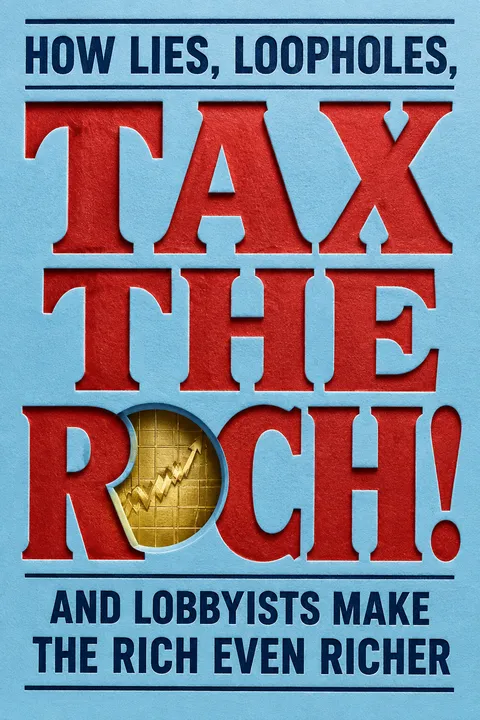


Key Takeaways
Treat the tax code as the economy's blueprint, not its receipt.
Rules shape rewards. The authors argue that taxes do more than collect money for public services. They influence who receives the gains of economic activity, which behaviors get rewarded, and which costs are shared. They call this the political economy: the way political decisions shape the economy people actually experience, from wages to public investment.
A moment of clarity. Morris Pearl recalls watching protesters in Athens from a bank conference room while working at BlackRock. The contrast prompted him to question whom his financial work served, and he eventually left to campaign for tax reform. The book's central claim follows: if human decisions built an unequal economic system, public decisions can redesign it.
What's compelling is the shift from treating the economy as weather to treating it as an engineered system. That makes distribution a legitimate subject of design, not an afterthought. The machine analogy also gives readers a useful question: which rule produces this outcome, and who can change it? Still, taxes are only part of the machinery. Labor law, competition policy, public education, and bargaining power also affect who benefits, so tax reform is central to the book's case, not a complete account of economic structure.
Judge tax fairness by what an extra dollar can actually do.
Dollars have unequal weight. Marginal utility of money means that each additional dollar generally matters less to someone who already has abundant resources. A student with $100 may use another $100 for food or books. A millionaire who finds a forgotten $100 bill may barely notice. The authors use this principle to defend higher tax rates on income that wealthy people can spare without changing their lives.
Same rate, different sacrifice. At a hypothetical 5% flat tax, a person earning $20,000 owes $1,000, potentially money needed for rent or heat. A person earning $20 million owes $1 million, but retains $19 million. The authors define their target group as people with income of at least $1 million or assets of at least $5 million, while stressing that wealth exists on a spectrum.
The diminishing value of money is a powerful ethical and economic lens: equal percentages do not necessarily mean equal burdens. It helps explain why progressive taxation can be defended as proportional sacrifice, not punishment. The difficult question is where each higher bracket should begin. The book's million-dollar threshold is a strategic definition for its campaign, not a universal boundary between rich and not rich. Housing costs, family needs, and wealth tied up in illiquid assets can make individual cases differ.
Stop taxing wages more heavily than fortunes generated by ownership.
Labor and capital differ. Ordinary income comes mainly from work, while capital gains are profits from selling assets such as stocks held for more than a year. In the book's 2020 tax example, a working couple earning $100,000 owed about $8,629 in federal income tax. A couple living on $100,000 of long-term investment gains owed none, because the gains fell within the zero-rate threshold described in the example. At $400,000, the investors' federal income tax was about $44,280, compared with roughly $82,095 for the workers, before payroll taxes.
Ownership compounds advantage. The authors argue that wealthy households receive much of their income from investments, while most workers rely on wages. They propose bringing capital-gains rates closer to ordinary-income rates, especially for high earners.
The comparison exposes a distinction often blurred in political talk: a dollar's tax treatment depends not only on its amount but on its source. That is a defensible fairness concern when investment gains accrue mainly to people who already own substantial assets. The counterargument is that taxing investment returns can affect saving, risk-taking, and the timing of sales. Those effects depend on the rate and policy design. The book makes a strong case against automatic preference, though the best rate requires more than a fairness argument alone.
Tax fund managers' labor as labor, even when Wall Street calls it carried interest.
A fee dressed as a gain. Carried interest is a share of a private investment fund's profits paid to its managers. Under the arrangement called two and twenty, managers commonly receive a fee equal to 2% of assets and 20% of profits above a specified threshold. The asset fee is generally taxed as ordinary income, but the profit share can qualify for the lower capital-gains rate.
The disputed classification. The managers invest clients' money and provide expertise, but the authors argue that the profit share is compensation for work, not a return on the managers' own capital. They describe a small group of fund managers receiving substantial tax savings, even though investors already receive capital-gains treatment on their returns.
This example is really about how legal categories distribute advantage. Calling a payment a partnership return rather than compensation can change its tax rate without changing the work that produced it. The authors' analogy to a salesperson's commission makes the distinction intuitive. A fair analysis should also recognize that investment management can involve skill, risk to reputation, and uncertain compensation. Those features may justify performance incentives, but they do not by themselves explain why the payment should receive a different tax classification.
Close inheritance loopholes before wealth becomes a family dynasty.
The basis reset. When an asset is inherited, the stepped-up basis resets its tax basis to its value at the previous owner's death. If stock bought for $10 million is worth $100 million at inheritance, the accumulated $90 million gain may escape capital-gains tax. The authors say this rule, combined with estate-planning tools, can preserve fortunes across generations.
More than one escape route. A grantor-retained annuity trust, or GRAT, can transfer investment growth to heirs under specific arrangements. A 1031 like-kind exchange lets property investors defer capital-gains taxes by reinvesting sale proceeds in qualifying property. The book reports that 35% to 45% of American wealth is inherited. It argues that estate taxes and rules for inherited assets matter because wealth can carry political and economic power forward through families.
The chapter's strongest point is cumulative: separate provisions can combine into a durable advantage, even when each has a technical rationale. Intergenerational transfers also raise a question distinct from taxing someone's annual earnings: how much inherited head start is compatible with equal opportunity? The answer is a value judgment, but implementation matters. Asset values can be hard to establish, and family businesses or illiquid holdings may need special handling. Such practical problems argue for careful rules, not necessarily for letting large gains disappear untaxed.
Audit corporate tax outcomes, not just the headline statutory rate.
The posted rate misleads. The book describes companies shifting profits across borders through intellectual-property royalties, claiming deductions for executive stock options, and taking deductions earlier through accelerated depreciation. These strategies can lower taxable profit or delay tax payments without matching where a company's customers and operations are located. The 2017 Tax Cuts and Jobs Act reduced the federal corporate rate from 35% to 21%, while leaving many of these mechanisms in place.
A revealing first year. Citing 2018 data, the authors report that 91 of 379 profitable Fortune 500 companies paid no federal income tax. Their point is not that every zero-tax year proves wrongdoing. It is that a statutory rate tells little about actual contributions when deductions, accounting rules, and international arrangements determine the final bill.
The distinction between a rate on paper and the amount actually paid is essential for public debate. It shifts attention from slogans about competitiveness to the rules that determine taxable profit. The book's examples also show why complexity matters: the same technical expertise that helps firms plan investments can make public oversight difficult. Corporate tax design must still account for international competition and the risk that mobile profits move across borders. Transparency and enforcement are therefore as important as choosing a headline rate.
Measure job creation by customers and workers, not investor slogans.
Demand sustains employment. The authors challenge claims that investors or wealthy owners automatically create jobs. Buying existing shares usually transfers ownership between investors rather than giving new money directly to the company. Businesses do organize production and take risks, but employment depends on customers continuing to buy what the business sells.
When ownership destroys jobs. The book describes Toys "R" Us before and after its 2005 private-equity takeover. It reports that the retailer employed about 97,000 people at its peak before the deal, while investors later closed stores, loaded the company with debt, and the chain entered bankruptcy in 2017. The authors also cite a study of 92 profitable companies that paid low tax rates from 2008 to 2015: their employment fell by an average of 1%, while private-sector employment overall increased by 6%.
The demand-side framing corrects a common confusion between owning a company and creating the conditions for its jobs to exist. It also makes workers and customers visible in a story often told only through investors and executives. But the distinction should not be pushed too far: entrepreneurs and investors can help build productive capacity, introduce new products, and bring capital together. The better lesson is that ownership alone does not prove public benefit. Job claims need evidence about net employment, wages, and what happened to workers after restructuring.
Replace private generosity with public rules for public-scale problems.
Charity cannot set the whole budget. The authors compare $269 billion in charitable giving reported for 2017 with a federal budget of roughly $4 trillion. Even large donations cannot reliably fund every shared need, such as infrastructure or public health, and donors choose which causes receive attention. The book also notes that private foundations generally must distribute 5% of assets each year, while donor-advised funds have no required payout schedule.
Public financing, public choice. Taxation directs resources through institutions accountable, at least in principle, to voters. The authors do not dismiss individual generosity; they argue that it cannot substitute for dependable, large-scale public provision. They also distinguish federal finances from a household or state budget, arguing that federal spending is not mechanically limited to tax receipts in the same way.
The contrast between giving and taxation is about governance as much as money. Philanthropy can support experimentation and respond quickly, while public budgets can pool resources and make services available beyond a donor's chosen priorities. Neither channel guarantees wise choices: public systems can be inefficient, and charitable projects can be innovative. The book's case is strongest when it argues for democratic accountability and scale, not when it treats private giving as inherently shallow. Federal fiscal flexibility also does not erase real limits on labor, materials, or inflation.
Fund tax enforcement enough to scrutinize the richest returns.
Rules need a referee. The book calls the difference between taxes legally owed and taxes actually paid the tax gap. It reports that the IRS's enforcement budget fell by nearly 25% after 2011, and cites estimates that about $400 billion a year went unpaid during 2011 to 2013. The authors say the top 10% of income earners accounted for 61% of that gap.
Capacity changes priorities. Millionaire audit rates reportedly dropped from 12% in 2011 to 3% in 2019. The authors argue that complex returns require trained staff, while understaffing makes simpler cases easier to pursue than wealthy taxpayers' layered finances. They urge Congress to restore enforcement capacity, presenting it as a way to collect taxes already owed rather than simply impose new ones.
Enforcement is a test of whether a legal system's rules apply in practice. When complicated returns are less likely to be reviewed, those able to buy specialized advice gain an advantage unavailable to ordinary wage earners. Funding enforcement can also strengthen voluntary compliance by making the rules credible. Yet audit numbers alone do not establish that every disputed filing is fraudulent. A capable agency needs expertise, fair procedures, and protections against arbitrary scrutiny, alongside enough resources to examine high-value and complex cases.
Use federal capacity to prevent local recessions from becoming austerity spirals.
States face tighter constraints. When a crisis reduces income and sales-tax receipts, state and local governments may have to cut services or raise taxes just as residents need support. The authors argue that the federal government can borrow and spend more flexibly, helping maintain services until local revenues recover. During the pandemic, they point to calls for states to manage their own budget shortfalls and to New York's cuts to hospital Medicaid payments rather than higher taxes on billionaires.
Shared shocks need coordination. A disease outbreak or recession crosses state borders, while each state has limited tools to respond. The book therefore calls for federal support for schools, health services, and other local functions during national emergencies, rather than forcing states to absorb the shock alone.
This is a federalism argument as much as a tax argument: responsibilities and fiscal tools should sit at the level capable of addressing the problem. Federal transfers can prevent local cuts from deepening a downturn and preserve services with benefits beyond one state's borders. The claim that federal spending is not constrained like household spending needs careful interpretation. Governments still face real resource limits, and the ability to issue currency does not make every spending choice costless. The strongest case is for targeted stabilization, not an unlimited public purse.
Turn broad tax support into pressure on the lawmakers who write the code.
Popularity is not power. The authors cite polling in which 59% of registered voters supported a 70% top income-tax rate, including 45% of Republicans. They also describe research finding that policy preferences of affluent people and organized interests aligned more often with enacted laws than majority opinion did. Campaign fundraising helps explain the imbalance: lawmakers spend time with donors who can finance elections, while ordinary constituents have less access.
Make support consequential. The book identifies the president and four congressional leaders who control key tax decisions, then recommends sustained constituent pressure and replacing officials who refuse reform. Its practical advice is to ask candidates directly whether they support higher taxes on the rich, and judge their actions and political spending alongside their public statements.
The gap between public opinion and enacted policy illustrates why agreement alone rarely changes institutions. Organized interests have continuity, access, and concentrated stakes; voters have numbers but often less coordination. The authors' emphasis on elections translates abstract tax approval into a political lever. Still, a single issue test can oversimplify candidates and governing coalitions. Tax policy includes tradeoffs over revenue, incentives, and administration. Public pressure is likeliest to matter when it demands specific, measurable commitments rather than a general promise to be fair.
Analysis
The book's central achievement is to make tax policy legible as a system of distribution and power, rather than a technical argument about rates. Its insider authorship gives the critique unusual force: a former Wall Street executive describes mechanisms from which he personally benefited, while the organizing narrative connects rules to political access. The examples of investment income, inherited assets, and corporate tax planning show how individually small provisions can compound into durable advantages.
Its strongest reasoning is institutional. Tax rules do not merely express a society's values; they help allocate bargaining power and resources, which in turn shape whose preferences are heard. The book also usefully separates statutory rates from actual tax payments and charity from public provision. Those distinctions make familiar claims testable instead of rhetorical.
The case is advocacy, not a neutral survey of every tax-policy debate. Some examples are chosen to expose unfairness, while relatively less space is devoted to administrative complexity, international mobility, investment responses, or the difficulty of valuing private wealth annually. These are real design problems, not automatic reasons to reject reform. Likewise, the claim that customer demand creates jobs corrects investor-centered storytelling, but understates how financing, entrepreneurship, and innovation can expand demand and productive capacity.
The most useful reading is therefore neither uncritical agreement nor dismissal. Treat the book's concrete mechanisms as a map of where policy choices create advantages, then assess proposed remedies by their distributional effects, enforceability, and economic costs. Its durable insight is that a tax code is not a passive mirror of the economy. It is one of the rules through which the economy is made, and its outcomes remain open to democratic contestation.
Glossary
Political economy
Politics shaping economic outcomesThe book uses political economy to describe the close relationship between political decisions and economic results. Laws, tax rules, labor protections, and public spending influence how goods, services, income, and opportunity are produced and distributed. The term challenges the idea that the economy operates independently of human choices or government policy.
Marginal utility of money
Value of the next dollarMarginal utility of money is the additional benefit a person receives from one more dollar. The book argues that this benefit generally declines as a person's resources grow: an extra $100 may cover essentials for someone with little money but make almost no practical difference to a millionaire. The concept supports progressive tax rates based on ability to pay.
Carried interest
Fund manager's profit shareCarried interest is a share of investment profits paid to managers of private-equity and similar funds. The book describes a common arrangement in which managers receive a percentage of fund profits and may have that share taxed as long-term capital gains, even though it compensates them for managing other people's money. Critics argue it should be taxed as ordinary income.
Stepped-up basis
Reset asset value at inheritanceStepped-up basis is a rule that generally sets an inherited asset's tax basis to its market value when the previous owner dies. If the asset appreciated during that owner's lifetime, the gain accrued before inheritance may never face capital-gains tax. The book argues this can combine with estate-planning strategies to preserve and transfer large fortunes.
Grantor-retained annuity trust (GRAT)
Trust transferring investment growthA grantor-retained annuity trust is an estate-planning arrangement in which a person places assets in a trust for a set period and receives scheduled payments from it. Any value remaining at the end may pass to a designated beneficiary under rules that can reduce gift or estate taxes. The book emphasizes its use by wealthy families to transfer asset growth.
1031 like-kind exchange
Defers tax on property gainsA 1031 like-kind exchange allows qualifying property owners to defer capital-gains taxes when they sell an investment property and reinvest the proceeds in qualifying replacement property. The tax is postponed rather than necessarily eliminated at the time of exchange. The book explains that repeated exchanges, combined with stepped-up basis at inheritance, can allow gains to escape taxation.
Pass-through deduction
Deduction for pass-through incomeThe pass-through deduction, established in the 2017 tax law discussed in the book, permits eligible owners of certain businesses to deduct a portion of pass-through income from taxable income. Pass-through entities include partnerships, S corporations, limited-liability companies, and sole proprietorships. The authors argue that wealthy individuals can use the provision even when their income does not come from a conventional small business.
Opportunity Zones
Tax-favored investment areasOpportunity Zones are designated areas where investors can receive tax benefits for placing capital in qualifying investments. The book describes benefits including deferring tax on some earlier gains and avoiding tax on certain new investment gains after a long holding period. It argues that some designated areas and projects were already attractive or affluent, limiting the intended benefit to poorer communities.
Mark-to-market taxation
Tax annual asset-value gainsMark-to-market taxation assesses certain assets at their market value each year and taxes the increase in value, rather than waiting until an owner sells them. The book proposes this approach for wealthy investors to reduce the benefits of deferring taxes on unrealized gains. Such a system requires rules for valuation, losses, and assets that are difficult to sell or price.
Tax gap
Taxes owed but unpaidThe tax gap is the difference between the taxes legally owed and the taxes actually paid on time. It can include underreported income, underpayment, and nonfiling. The book links the gap to limited IRS enforcement resources and argues that complex, high-income returns require specialized auditors to ensure that tax obligations are enforced fairly.
Download PDF
Download EPUB
.epub digital book format is ideal for reading ebooks on phones, tablets, and e-readers.








