

Key Takeaways
Make distant suffering readable through human lives, not spectacle.
Stories make connection. In the famine camps near Sudan and Ethiopia, reporter Jacqui Banaszynski heard people singing at night amid hunger and death. It took days and several interpreters to learn that elders were telling stories to children, carrying culture and history into a place where almost everything familiar had been left behind. The discovery shifted the famine from shocking images to a human community preserving its life together.
Feeling needs reporting. Narrative can draw readers into hard subjects, including institutional neglect or poverty, but emotional scenes must rest on verified facts and social context. Without those foundations, vivid writing becomes a seductive performance rather than a way to understand what happened.
The famine-camp story shows why narrative can make suffering apprehensible without reducing people to symbols of suffering. The singing reveals agency and continuity, not merely victimhood. That distinction matters in journalism, where images of crisis can provoke attention while flattening the people they depict. The form carries a risk, too: a compelling individual scene can stand in for a whole population more easily than it can explain one. Context and corroboration keep empathy from becoming a substitute for knowledge.
Find the idea that makes one life illuminate a public problem.
A story needs a point. David Halberstam heard about a Chinese soccer player who missed the decisive penalty kick in the 1999 Women’s World Cup final. Rather than retell the American victory, he wondered what the loss meant for the young player returning to a country invested in its rising global stature. Her private experience could open a window onto national expectations and the meaning of failure.
The idea guides the reporting. Halberstam’s books began with similarly clear questions: how a celebrated group of policymakers could lead the country into disaster, or how one firehouse could represent the human cost of September 11. A strong conception explains why this particular story matters beyond its events. Reporting supplies the evidence; the idea gives the evidence direction.
The move from public event to overlooked participant is a powerful form of reframing. It asks readers to reconsider what counts as the story, not just what happened. A person can make an abstraction emotionally legible, but the larger claim still needs independent evidence. One athlete cannot establish how an entire country responds to defeat. The strongest narrative uses the individual as an entry point, then tests what that life reveals against institutions, history, and other perspectives.
Follow unfolding action, because interviews alone rarely produce narrative.
Look for movement. A narrative needs action that develops over time, access to the people involved, and a meaningful question. Lane DeGregory followed a transgender woman for ten months, but the most revealing material gathered around one visit to a driver’s license office, where the subject’s new identity had to meet other people’s reactions. Months of observation helped her recognize the scene that could carry the story.
Go where life happens. Katherine Boo found a story about abuse in group homes after missing a bus, accepting a ride, and entering a home with the driver. The lesson is practical: spend time in places and routines that expose real interactions. If events have already happened, seek witnesses, records, photographs, and present-day consequences rather than pretending a phone interview is the same as being there.
The contrast between ten months of reporting and a two-hour scene illustrates that fieldwork is not a hunt for more material at any cost. It is a search for the moment that makes the underlying tension visible. This resembles ethnographic observation, where ordinary routines often reveal tacit rules better than formal explanations. Yet the scene that feels most dramatic may not be representative. Reporters need both immersion and enough distance to ask whether a vivid encounter is typical, exceptional, or simply convenient.
Stay long enough for sources to stop performing their public selves.
Trust takes time. Isabel Wilkerson describes interviews as relationships that move from guarded introductions toward comfort, disclosure, and sometimes a final candid moment. The process might take minutes or months. Instead of treating an interview as a contest for a quote, she recommends guided conversation, close attention, and patience. People may need several attempts to explain an experience, and the first answer is often the most rehearsed.
Listening carries responsibility. A journalist has more power than an ordinary source, especially when writing about someone with little public standing. Explain the project clearly, avoid leading questions, and take the subject’s perspective seriously without surrendering editorial judgment. The aim is not to make a source trust the journalist blindly. It is to understand the person accurately enough to portray a world the reader cannot see firsthand.
The emphasis on relationship improves reporting because people often disclose meaning through narrative, hesitation, and ordinary behavior, not polished answers. It also complicates the familiar ideal of detached observation: attention itself creates a relationship, and extended access can make a reporter feel like a friend. That closeness is useful but not proof of truth. A source has interests and a partial memory, while a journalist has a story to shape. Trust should deepen inquiry, not replace verification.
Build scenes from evidence, never from what would make them prettier.
Specificity must be earned. A scene relies on action, setting, sensory detail, dialogue, and emotion, but each element needs a factual basis. To reconstruct a historical meeting, Adam Hochschild combined minutes, biographies, newspapers, physical visits, and descriptions of similar workplaces. The surviving record was spare, so he made the limits of his knowledge part of the reporting rather than filling gaps with invented certainty.
Check every line. Ask how each detail is known. For scenes recalled by participants, ask precise questions about what they saw and heard, then seek corroboration where possible. Documents can uncover details that interviews miss: Louise Kiernan found a suicide note in an autopsy file, while public records and letters helped her establish events surrounding a fatal accident. Vividness is a craft choice; truth is a reporting obligation.
Scene reconstruction is where literary craft and evidentiary discipline meet most visibly. A reader may experience a reconstructed moment as immediate, even when the writer was absent, so clarity about sources is not bureaucratic housekeeping. It is part of the work’s credibility. The method also has limits: several memories can corroborate a broad sequence while still sharing the same mistaken assumption. Strong reporting distinguishes direct observation, recollection, documentation, and inference instead of blending them into one seamless but misleading certainty.
Arrange true events to reveal change, not merely chronological order.
Story is selected sequence. Jon Franklin distinguishes the full stream of events from a story, which selects and arranges events to make change legible. The central character encounters a complication, struggles, and reaches a resolution or insight. In a story about a person with terminal cancer, the diagnosis may not be the real turning point. The deeper movement could be a shift from fear toward a way of facing what cannot be changed.
Know the destination. Writers can begin near a decisive moment, move backward for context, and alternate scene with summary, provided readers can follow the sequence. Tom French calls the unanswered question that pulls a story forward its engine. A strong ending resolves that question and makes the central point resonate. If the lived events have no meaningful change or resolution, forcing them into a dramatic arc can distort them.
Structure does more than improve pace. It teaches readers which events matter and how to interpret their relationship. That power resembles causal reasoning: placing one moment before another can suggest that the first produced the second, even when the evidence does not support that conclusion. The book’s focus on complication and insight is a useful test for narrative potential, not a command to manufacture transformation. Some lives remain unresolved, and an honest account may need to end with uncertainty rather than a tidy payoff.
Pair vivid particulars with a larger argument, then let readers connect them.
Move between scales. Roy Peter Clark’s ladder of abstraction describes the range from concrete particulars to broad ideas. A story becomes weak when it stays in the vague middle, full of institutional language but short on people or meaning. A specific act, such as a child giving away a warm coat, can embody compassion more effectively than a label explaining that the child is compassionate.
Join story and idea. Nicholas Lemann argues that narrative and analysis need to advance together. A character’s experience can make a policy question visible, while research explains why that experience is part of a wider pattern. Numbers, history, and expert explanations belong where they clarify the human story, not as a competing lecture. The detail grounds the argument; the argument helps readers see why that detail matters.
This movement between the particular and the general gives narrative nonfiction its explanatory force. It resembles case-based reasoning: a concrete instance helps readers grasp a system, while broader evidence checks whether the instance has been overinterpreted. The balance is delicate. A striking detail can imply a social pattern without proving one, and a thesis can overwhelm the person meant to illustrate it. The writer’s task is to make the connection persuasive while showing enough context for readers to judge its scope.
Revise until every scene serves the story’s destination.
Drafts are discovery. Tracy Kidder describes turning extensive notes into rough, often unwieldy drafts, then rewriting repeatedly to find the book’s shape. Drafting can expose what the reporting failed to answer, sending the writer back into the field with sharper questions. Editing is therefore not just polishing sentences. It is a way to discover the subject and decide what belongs.
Cut toward focus. Sonia Nazario gathered 110 notebooks while reporting Enrique’s journey, then transcribed and organized them before shaping a much shorter narrative. She removed repeated incidents, moved some background into sidebars, and retained details that helped carry the central story. Such cutting can feel painful because it discards real work. But readers need the selected evidence, not the reporter’s entire archive. Each scene, fact, and digression should earn its place by advancing character, context, or meaning.
Revision is a method of thought, not a cosmetic stage after the real work. It lets the writer compare the story imagined at the outset with what the reporting actually supports. The discipline of cutting also exposes a professional hazard: material that took weeks to gather can feel more valuable simply because it was difficult to obtain. Editorial distance helps counter that sunk-cost bias. Still, compression must not erase inconvenient evidence or complexity merely to make the narrative cleaner.
Treat subjects’ trust as a duty, not a reporting convenience.
Empathy has boundaries. Immersion reporters enter private lives, where observation can bring a duty to decide when to help, withdraw, or protect someone’s identity. Sonia Nazario set a rule for her reporting on migrant children: intervene when a child faced imminent danger. She assisted one abandoned boy in contacting relatives, but did not help her main subject with a hardship that did not meet that threshold. The choice preserved the reporting relationship, but it also carried real moral weight.
Do not deceive readers. Roy Peter Clark’s basic standard is to avoid adding invented material or misleading the audience. Changing names, withholding identifying details, or using undercover methods requires careful justification and transparency. A true account may omit material for privacy or safety, but the writer should ask whether readers would feel misled if they knew what was left out. Accuracy and humane treatment are linked, not competing goals.
The book refuses the comforting fiction that reporters can enter vulnerable lives without changing them. Presence can alter behavior; publication can expose people to consequences long after the reporter leaves. Clear boundaries, informed consent, and protective choices reduce some harms, but no checklist can settle every case. The key ethical distinction is between preserving a subject’s dignity and preserving a convenient version of events. A journalist’s compassion must include readers, who deserve to know when protection has shaped the account.
Choose the form that fits what you can responsibly know.
Narrative has many shapes. A profile can follow a whole life or focus tightly on why someone is in the news. A personal essay must turn its narrator into a specific character, not assume that the word “I” explains everything. Travel writing can make a journey through place also a journey in understanding. Historical narrative must use archives and physical settings while resisting the temptation to project present-day assumptions onto the past.
Match method to material. Investigative narratives combine scene and character with records, data, and scrutiny of people accused of wrongdoing. Radio can give community members tools to tell their own stories. These forms share a commitment to truthful, engaging accounts, but they do not use identical methods. The right stance depends on access, evidence, audience, and the consequences of telling the story in a particular way.
The anthology’s range makes clear that narrative is a family of practices, not a single recipe. First person can clarify a reporter’s limits, but it can also make the writer’s experience crowd out the subject. Historical reconstruction can restore overlooked lives, but it requires restraint where evidence ends. Choosing a form is therefore an epistemic decision as much as a stylistic one: it signals what kind of knowledge the work claims to offer and how readers should assess that claim.
Practice narrative at paragraph scale, and make room for ambitious reporting.
Start with manageable work. Narrative does not require a book-length assignment. A single scene or brief character sketch can bring a routine news report to life. Lane DeGregory found story ideas by talking with strangers, noticing overlooked work, and pursuing assignments colleagues dismissed. These habits turn curiosity into a daily reporting practice rather than a rare, high-budget project.
Build conditions for depth. Longer stories need time, editorial support, organized reporting, and often collaboration with photographers or other writers. Freelancers must pitch ideas to specific publications, show evidence of reporting, and persist through rejection. Newsrooms can encourage the craft through narrative teams, story sabbaticals, early editor involvement, and rigorous fact-checking. The structure matters because strong storytelling takes labor that individual enthusiasm cannot always supply.
The practical vision here is deliberately broader than the celebrated long-form feature. Small narrative moments can change how a newsroom sees its ordinary beat, while dedicated teams can protect reporting time and spread craft across a staff. Yet institutional support should not become a prestige enclave that reserves narrative for a few favored writers. The more durable model combines specialist mentorship with opportunities for many reporters to try, receive criticism, and improve on real assignments.
Analysis
Telling True Stories is an anthology rather than a single-author manual, and its strength comes from the friction among experienced practitioners. Some prize immersion and extended access; others warn that a few hours can be enough. Some favor recorders, others distrust their effect on attention and conversation. These disagreements are not flaws to smooth away. They show that technique is conditional: the method must suit the subject, the evidence, the assignment, and the writer’s own limitations.
The book’s deepest claim is that narrative is a mode of explanation. A sequence of people acting under pressure can make institutions and abstract forces intelligible in a way that a list of findings often cannot. But narrative also concentrates persuasive power. Selection, pacing, point of view, and endings guide the reader’s judgment, sometimes before the argument is stated. That means the craft’s ethical demands are not an appendix to its literary ambitions. They are part of how it works.
A useful critical distinction is between emotional truth and evidentiary truth. A scene may feel true because it is coherent, vivid, and psychologically recognizable. Those qualities do not establish that the words were spoken or the moment occurred as presented. The contributors repeatedly insist on documentation, corroboration, and humility because literary fluency can disguise gaps in knowledge. The more seamless the reconstruction, the more important it is to know where each detail came from.
The anthology also offers a model of professional education: learn by observing skilled work, report beyond the obvious, draft before certainty, seek strong editors, and revise until the material has a shape. Its optimism about narrative journalism is persuasive, but its economic realities are sobering. Deep reporting consumes time, and publications often reward speed. The practical challenge is not simply to write beautifully. It is to build habits and newsroom conditions that make patient, accurate storytelling possible without mistaking every life for a tidy plot.
Review Summary
Telling True Stories is highly praised by readers as an invaluable resource for nonfiction writers, particularly journalists. Reviewers appreciate the diverse perspectives from experienced writers, practical advice on crafting compelling narratives, and insights into the ethics of storytelling. Many find it inspiring and comparable to attending writing workshops. While some note its focus on journalism may not apply to all nonfiction genres, most agree it offers valuable lessons for any writer seeking to improve their craft. The book is frequently recommended and reread by aspiring and established writers alike.
People Also Read




Glossary
Narrative nonfiction
Fact told through storyNonfiction that uses storytelling methods such as scenes, characters, dialogue, sequence, and voice while remaining accountable to factual evidence. It can appear in journalism, history, memoir, radio, documentary, and books. Its literary techniques do not permit invented events or quotations; reporting and verification remain central.
Felt-life-level access
Intimate understanding through reportingA reporter’s informal, accumulated understanding of a subject after spending time in that person’s world. It includes impressions of character, contradiction, habit, and atmosphere that a scheduled interview may not reveal. The term names a depth of familiarity needed to portray people as more than their official roles or prepared statements.
Accelerated intimacy
Trust built through conversationIsabel Wilkerson’s term for developing meaningful candor with a source within the limits of reporting. The process moves from introduction and guardedness toward connection, disclosure, and renewed openness. It depends on attentive listening and a comfortable interaction, not aggressive questioning, and does not remove the journalist’s responsibility to verify what is shared.
Ladder of abstraction
Move between detail and meaningA model of language that ranges from concrete particulars at the bottom to broad concepts at the top. Narrative writers use specific actions and objects to embody larger ideas, then provide enough interpretation for readers to understand their significance. Writing that stays in the vague middle can feel abstract without becoming meaningful.
Idea plot
Argument developing alongside eventsNicholas Lemann’s term for the ordered progression of a work’s analysis or argument, moving alongside the narrative plot. Scenes show what people do; the idea plot develops what those events reveal about a policy, institution, or social question. The two strands should meet at moments where decisions or experiences make the broader argument visible.
Point of insight
Turn toward understandingA moment when a character, the reader, or both recognize the deeper nature of the story’s central problem and what response it requires. It helps move a narrative from complication toward resolution. It need not be a dramatic revelation, but it should clarify what has changed or become newly understandable.
Narrative distance
How close the narration standsThe narrator’s position relative to the action and a character’s experience. A writer can observe from a wider distance, move close to a character’s immediate perceptions, or describe an event from an internal viewpoint. Changing distance, like moving from a wide shot to a close-up, shapes what readers notice and feel.
Participant observation
Learn by joining daily lifeA reporting and research practice in which the observer spends time within a group’s routines while remaining attentive to the role of outsider. Sharing activities and settings can reveal practices that interviews alone miss. The reporter must still distinguish participation from belonging and explain how their presence may affect what happens.
Methods blocks
Brief account of reporting methodsA note accompanying a story or series that explains how the reporting was conducted and where information came from. It can identify the use of interviews, documents, observations, and reconstructed scenes. Methods blocks help readers assess the account’s basis without interrupting the narrative with extensive sourcing detail.
In media res
Begin in the middle of actionA narrative technique that opens at a consequential moment rather than at the beginning of the event’s chronology. The writer can then move backward to supply necessary context. The opening creates immediate tension, but the sequence must remain clear and must not mislead readers about when events occurred.
FAQ
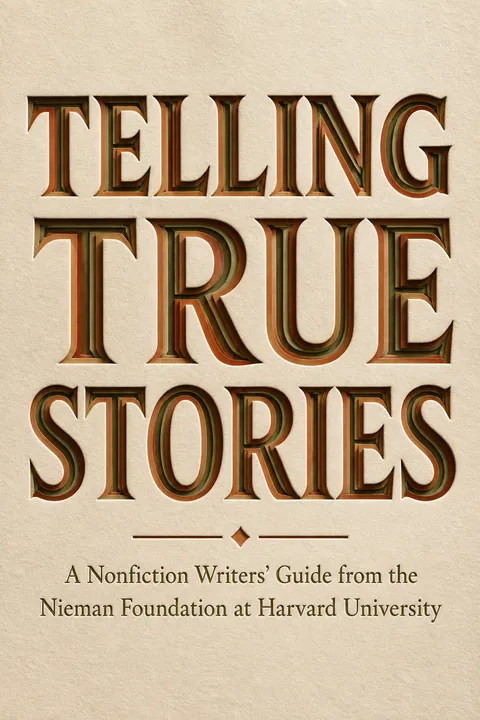
What's Telling True Stories about?
- Nonfiction Writing Guide: Telling True Stories is a comprehensive guide for nonfiction writers, focusing on narrative journalism and storytelling.
- Expert Contributions: It features insights from fifty-one respected writers and journalists, offering practical tips for crafting compelling narratives.
- Diverse Topics: The book covers various aspects of narrative writing, including finding topics, conducting interviews, and understanding subgenres like profiles and personal essays.
Why should I read Telling True Stories?
- Enhance Writing Skills: The book provides valuable insights and practical advice to improve narrative writing skills, making journalism more engaging.
- Learn from Experts: It compiles wisdom from renowned journalists and authors, offering lessons from their experiences.
- Comprehensive Resource: It serves as a go-to reference for anyone interested in narrative nonfiction, covering everything from topic selection to ethical reporting.
What are the key takeaways of Telling True Stories?
- Storytelling Importance: Storytelling is essential in journalism for engaging readers and conveying complex ideas.
- Character and Emotion: Developing strong characters and evoking emotion are crucial for compelling narratives.
- Ethical Considerations: The book emphasizes the ethical responsibilities of writers, highlighting accuracy and respect for subjects.
What specific methods or advice does Telling True Stories offer?
- Finding Good Topics: Lane DeGregory suggests immersing oneself in subjects' lives to identify engaging stories.
- Interview Techniques: Isabel Wilkerson emphasizes building trust with subjects to elicit meaningful responses.
- Scene Construction: Jon Franklin advises focusing on scene-by-scene construction to enhance reader engagement.
How does Telling True Stories address the ethics of narrative journalism?
- Ethical Code Discussion: The book includes essays proposing an ethical code for narrative journalists, emphasizing honesty and respect.
- Protecting Subjects: Contributors discuss the need to protect subjects' privacy and dignity, especially with sensitive topics.
- Fact vs. Fiction: It stresses distinguishing between fact and fiction, encouraging transparency about sources and accuracy.
What techniques does Telling True Stories suggest for character development?
- Understanding Characters: Jon Franklin emphasizes understanding a character's inner world and motivations for depth.
- Using Dialogue: Kelley Benham advocates incorporating dialogue to bring characters to life and enhance authenticity.
- Emotional Connection: Writers are encouraged to explore characters' emotional experiences for deeper reader connection.
How can I improve my narrative writing skills using Telling True Stories?
- Practice Reporting: Katherine Boo suggests immersing oneself in unfamiliar environments to enhance storytelling.
- Revise and Edit: The anthology emphasizes revising drafts and refining work for quality narratives.
- Seek Feedback: Sharing work with others for constructive criticism fosters growth and development in writing.
What are some common pitfalls in narrative journalism discussed in Telling True Stories?
- Overly Simplistic Characters: Tomas Alex Tizon warns against creating one-dimensional characters, advocating for complexity.
- Neglecting the Theme: Writers are cautioned against losing sight of the central theme while focusing on details.
- Inaccurate Quotes: Debra Dickerson highlights the importance of accuracy in quotes to maintain credibility.
How does Telling True Stories suggest structuring a narrative?
- Three-Act Structure: Nora Ephron discusses using a three-act structure for effective narrative organization.
- Strong Beginnings and Endings: Emphasizes crafting compelling openings and satisfying conclusions for reader engagement.
- Scene-by-Scene Construction: Jon Franklin advocates presenting narratives in scenes for enhanced immersion.
What role does research play in Telling True Stories?
- Foundation for Narratives: Thorough research is essential for compelling narratives, enriching stories with diverse sources.
- Contextual Understanding: Research provides context, allowing readers to grasp broader story implications.
- Fact-Checking: Emphasizes accuracy in reporting, with contributors discussing the importance of verifying information.
What are the best quotes from Telling True Stories and what do they mean?
- "Stories are for joining the past to the future.": Tim O’Brien highlights storytelling's timeless nature, connecting generations.
- "Writing well is difficult, even excruciating.": Mark Kramer and Wendy Call emphasize the challenges and dedication required in writing.
- "The line between fact and fiction.": Roy Peter Clark reminds writers of the ethical considerations in narrative journalism.
How can I apply the lessons from Telling True Stories to my writing?
- Practice Immersion Reporting: Engage deeply with subjects and environments for authentic narratives.
- Focus on Emotional Truth: Convey emotional realities to connect with readers on a personal level.
- Collaborate with Editors: Work with editors to refine narratives and ensure they resonate with readers.
Download PDF
Download EPUB
.epub digital book format is ideal for reading ebooks on phones, tablets, and e-readers.








