

Key Takeaways
Treat the next decade as a deadline for repair, not a date to start
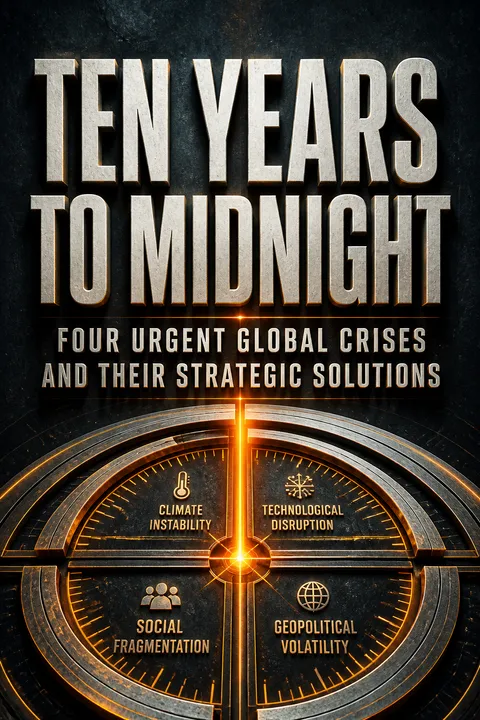
A warning with a clock. Published in 2020, the book argues that many global problems could become far harder to reverse by around 2030. The authors’ shorthand, ADAPT, gathers five pressures: widening economic gaps, technological disruption, demographic change, political polarization, and declining trust in institutions. Conversations with people in sixteen countries suggested that these worries were shared, even when their local forms differed. The book links them to four crises: prosperity, technology, institutional legitimacy, and leadership.
Interlocking problems compound. Each crisis worsens the others. When people see no path to a better life, they lose faith in institutions and become more vulnerable to divisive politics. Technology can widen inequality, while distrust and polarization make collective action harder. The deadline is not merely a call to begin discussing solutions. The authors argue that substantial progress must happen within the decade.
The book’s strongest move is to treat these crises as a coupled system rather than a queue of unrelated policy problems. That changes the practical question from “Which issue matters most?” to “Which intervention can improve several conditions at once?” The deadline creates useful urgency, but it should be read as a strategic warning, not a precise forecast: the timing and severity of tipping points vary, and the evidence does not establish one synchronized global countdown. Urgency is most useful when it sharpens priorities without turning uncertainty into false certainty.
Stop using GDP and shareholder returns as the whole definition of success
The old scorecard delivered gains. After World War II, many governments and businesses organized around globalization, market growth, and technological efficiency. GDP became a central measure for countries, while shareholder value became a central measure for companies. The model helped connect economies and lift billions from poverty, but it also treated average growth as evidence that most people were thriving.
The hidden costs accumulated. The 2008 financial crash made those costs harder to ignore: stagnant wages, insecure work, declining communities, and gains concentrated among owners and already prosperous regions. The book argues that economic growth and social progress can separate. A country can post stronger GDP while many residents see little improvement in housing, education, security, or prospects. Businesses can raise returns while leaving workers and communities exposed to the consequences of their decisions.
Metrics do not simply describe an economy; they influence which outcomes leaders notice and reward. If a scorecard records output but not who benefits, rising totals can disguise losses that later appear as distrust or political backlash. The book’s argument is not that GDP or shareholder returns are useless, but that each answers a narrower question than leaders often ask of it. A more complete assessment needs several measures, including distribution, job quality, and local well-being. The hard part is choosing indicators that are meaningful without creating a new, equally reductive scoreboard.
Track prosperity by generation, not by national averages
Three groups feel the squeeze. The book describes young adults priced out of housing and burdened by education costs; retirees with inadequate savings or pensions; and the “encumbered middle,” whose mortgages, children’s expenses, and aging parents compete for limited income. These pressures vary by country, but they are not confined to poorer regions. In the United States, the book cites a 2019 survey in which 55 percent of people aged fifty-five to sixty-five had saved less than $10,000 for retirement.
The groups affect one another. In Hamilton, Ontario, technology investment helped renew the city while its top earners pulled further ahead: between 1982 and 2013, the top 1 percent nearly doubled their pay, while inflation-adjusted earnings for the bottom 90 percent rose just 2 percent. When one group cannot afford to spend, save, or support relatives, the strain spreads to families, public services, and local economies.
This life-stage lens improves on the idea of a single, representative middle class. It shows how insecurity can arise at different points in life, and how the costs are passed between generations rather than contained within one household. It also helps explain why an apparently successful city may still have a prosperity problem. Yet the categories are broad: a young renter, a new homeowner, and a low-income retiree face different policy needs. The framework works best as a prompt to inspect who is exposed, not as a substitute for more detailed local evidence.
Make technology answerable to human goals before scaling it
Convenience carries a bill. Digital platforms bring information and services within reach, but their business models can concentrate wealth, data, and influence. Automation threatens some jobs, while social media can reward divisive material, spread falsehoods, and pull attention away from face-to-face life. The book also connects technology to climate harm through the energy systems, transport, manufacturing, and agriculture on which modern life depends. Artificial intelligence adds a further challenge: its decisions can be difficult to inspect, and systems may produce outcomes their designers did not intend.
Build safeguards into use. The authors call for broad digital education, protection against misuse of personal data, a stronger role for civil society, accountable and inspectable AI, and healthier personal habits around devices. Their idea of “tech-savvy humanists” joins technical competence with an understanding of people and social systems. Neither technological optimism nor blanket rejection is enough.
The key distinction is between innovation as a technical achievement and innovation as a social choice. A product can work exactly as designed and still distribute risk unfairly, weaken privacy, or distort public debate. That suggests human impact should be assessed at the level of incentives and deployment, not just code. The book is persuasive in asking companies and governments to accept responsibility for foreseeable harms. Its proposals, however, depend on regulators and civic groups having enough expertise and access to challenge powerful firms. Accountability needs institutional capacity, not only better intentions.
Make institutions stable enough to trust and agile enough to matter
Stability can become inertia. Institutions earn trust by being dependable, but the same routines can leave them unable to respond to fast changes. Jin Naibing, a vice mayor in Kunshan, China, saw that the city’s manufacturing success might not last as automation advanced. She worked to improve education, housing, healthcare, and cultural life for residents, including migrant workers, and sought a university that could help the city adapt. Her example shows an institution serving more than its immediate output: it can help a community learn and prepare.
Change needs a safe structure. The book’s other examples include Pearson’s refocus on trusted journalism and education, and Butler University’s creation of a separate channel to test new educational programs more quickly. The broader lesson is to preserve an institution’s core purpose while changing how it delivers that purpose. Institutions that move too slowly risk irrelevance; those that change without safeguards can lose the reliability people depend on.
This is a useful institutional design problem, not a simple demand to “modernize.” Reliability is a public good, especially in education, law, healthcare, and news. The challenge is to make experimentation possible without making basic standards arbitrary. Separate pilot programs, as at Butler, can create room to test ideas while protecting established functions. But such structures can also become peripheral projects with little influence unless leaders define how successful experiments enter the main institution. Adaptation requires both permission to try and a route for learning to alter ordinary practice.
Build economic renewal around local assets, then connect outward
Start where people live. “Local First” is the book’s approach to building self-sustaining local economies that respond to a place’s needs, history, and strengths. It does not reject international trade; it argues that global growth alone cannot repair communities left behind by it. The Tatev Revival in Armenia offers an example. Restoring a medieval monastery and building the Wings of Tatev tramway helped make a remote region accessible. The project supported education and cultural activity, while tourism helped local cafes, guesthouses, and other small businesses emerge.
One project can seed a system. The tramway shortened a difficult trip of about an hour to twelve minutes, but its significance went beyond transport. It became a centerpiece around which investment, jobs, and renewed local identity could gather. The authors emphasize that such work takes time, needs investors who demonstrate commitment to the community, and must build on local knowledge rather than impose a generic development template.
Local development makes economic policy tangible: residents can see whether new jobs, services, and institutions actually improve daily life. The centerpiece-project idea is especially powerful because it gives scattered efforts a shared focus. But localism should not be confused with self-sufficiency. Small economies need capital, infrastructure, and access to wider markets, and local priorities may exclude people with less influence. The strongest version of Local First therefore combines local decision-making with outside resources and transparent measures of who benefits. Community identity can anchor renewal, but it must remain open to newcomers and internal disagreement.
Make inclusion a strategy, not a side benefit
Measure who gains. The book calls for “interdependent, inclusive success ”: assessing nations and companies by social goods and quality of life as well as economic output. Singapore under Lee Kuan Yew illustrates how a country can attract international firms while investing in local infrastructure, education, and employment. The book reports that unemployment fell from about 15 percent in 1960 to 2 percent, while per capita GDP rose nearly sixtyfold.
Share the burdens of downturns. Dofasco Steel offers a company-level example. During the Great Depression, management reduced working hours across the workforce instead of laying off hundreds of employees, cut senior compensation, and used savings to support workers’ families. The company also introduced profit sharing and employee suggestions. The point is not that all firms can copy these measures exactly. It is that treating workers and communities as part of the enterprise can build capability and commitment, rather than treating them as costs outside the shareholder story.
Inclusion here is not presented as charity added after growth. It is part of how growth is organized and how an organization earns durable support. That perspective aligns social legitimacy with practical capacity: skilled workers, functioning communities, and trust help institutions and firms operate. Still, the examples come from particular political and historical settings. A policy that worked in Singapore or a family-led steel company does not automatically transfer elsewhere. The useful question is not whether to replicate the story, but which arrangements let workers and residents share both the upside and the risks.
Use massive, fast campaigns to turn shared threats into shared work
Scale must meet urgency. The book identifies automation-related job loss and climate change as problems too large for slow, isolated responses. It estimates that if 10 percent of global jobs disappeared through automation over a decade, roughly 300 million workers would need new training and employment. It points to the Marshall Plan as a model for coordinated action: clear governance, private-sector participation, reforms by recipients, and competition for funding based on plans.
Make ambition executable. GAME, the Global Alliance for Mass Entrepreneurship, set a goal of supporting ten million entrepreneurs in India by 2030, using local businesses to create employment. Its design combines a large coordinating organization with locally adapted delivery. Climate action also needs this combination. The book draws on Project Drawdown’s proposals, which include renewable energy, reduced food waste, plant-rich diets, and education. Shared threats can create shared purpose, but only if targets are matched by resources, accountability, and practical plans.
The chapter’s “massive, fast” idea is a call to pair ambition with operating discipline. Grand targets can coordinate attention and investment, but a number alone is not a delivery system. The Marshall Plan comparison usefully highlights governance and local implementation, while GAME shows how a central alliance can support many small enterprises rather than replace them. The tension is scale versus fit: standardization makes programs easier to coordinate, but communities need different forms of support. Effective campaigns need common goals, adaptable methods, and a way to learn from failures before replicating them.
Lead across contradictions rather than choosing one comfortable strength
Complex problems require paired strengths. The book’s “Six Paradoxes of Leadership” describes capabilities that must work together: technical knowledge with care for people; political skill with integrity; local commitment with global awareness; decisive action with humility; respect for an institution’s purpose with willingness to innovate; and long-term strategy with dependable execution. Leaders in the book embody different combinations. Jim Danko, for example, pushed Butler University to experiment while inviting input and admitting uncertainty. Ravi Venkatesan designed GAME around a large ambition and detailed local execution.
Build a complementary team. No single leader is likely to excel equally at every tension. The practical task is to recognize personal strengths and blind spots, then surround them with people who can supply missing capabilities. In a polarized environment, a leader must make decisions without pretending uncertainty has vanished, and build coalitions without trading away the integrity that makes cooperation possible.
The paradoxes resist the common leadership fantasy that one heroic trait can solve a system-level problem. Humility without decision-making can stall; confidence without listening can become arrogance. Strategy without execution spends credibility, while execution without strategy can perfect the wrong system. The framework is most useful as a diagnostic for teams: which capability is overused, and which is missing from the room? It should not imply that every tension can be neatly balanced. In practice, leaders make trade-offs, and legitimacy depends partly on explaining who bears the cost.
Analysis
The book’s central contribution is a systems account of discontent. It does not treat inequality, technology, aging, polarization, and institutional distrust as separate policy portfolios. It shows how one pressure can amplify another: technology reorganizes work and wealth; uneven prosperity weakens faith in institutions; distrust fuels polarization; polarization obstructs collective responses to technology and climate. This makes the book’s prescriptions more coherent than a list of independent reforms. Local development, institutional renewal, human-centered technology, inclusive measures of success, and rapid coordination are presented as mutually reinforcing parts of a response.
Its stories are most effective when they show agency inside a larger structure. Jin Naibing connects education and civic identity to a city’s economic future. Dofasco suggests that sharing sacrifice can strengthen a workforce. GAME gives a large employment goal an organizational design and local point of contact. These examples make abstract change legible and demonstrate that neither government nor business must wait for a perfect global consensus before acting.
The book also deserves a measured reading. Its “ten years” frame is powerful as a mobilizing device, but the crises do not share one precise deadline, and some projections in the 2020 text are more scenario than settled prediction. Its evidence combines broad data, surveys, and illustrative cases, which establish the plausibility of linked pressures more strongly than they prove every causal connection. The emphasis on preserving market institutions and reforming their outcomes is a strategic choice, not a neutral conclusion; readers may reasonably ask whether particular failures can be repaired within the existing model.
The most durable lesson is therefore not a forecast of one inevitable midnight. It is a test for decision-makers: does a proposed response improve shared well-being, strengthen the institutions needed to sustain it, and work at the speed and scale the problem demands? The book is optimistic about human ingenuity, but insists that ingenuity must be organized, inclusive, and answerable to the people affected.
Glossary
ADAPT
Five linked global pressuresThe book’s framework for grouping widespread concerns: asymmetry in wealth and opportunity, disruption from technology, age and demographic change, polarization within and between societies, and declining trust in institutions. The authors use these pressures to explain four connected crises involving prosperity, technology, institutional legitimacy, and leadership.
Local First
Locally rooted economic developmentAn approach to development that builds a self-sustaining local economic ecosystem around a community’s needs, strengths, history, and culture. It can use a central project to attract investment and generate connected opportunities in education, jobs, services, and civic life. Local First favors local understanding without rejecting outside resources or wider economic connections.
interdependent, inclusive success
Success shared across stakeholdersA way to judge the success of a country or company by more than GDP or shareholder returns. It includes quality of life, social goods, inclusion, and the distribution of gains and burdens among residents, employees, customers, and communities. The concept treats economic and social progress as connected goals.
massive, fast challenges
Urgent problems needing large actionThe book’s term for problems whose scale and urgency exceed the pace of ordinary institutional decision-making. Examples include climate change and automation-related job loss. Responding requires large-scale cooperation across governments, businesses, and civil society, paired with clear governance, sufficient resources, and practical local implementation.
tech-savvy humanists
Technologists attentive to peoplePeople who understand both how technology works and how people, communities, and institutions are affected by it. The term describes a needed blend of technical capability and insight into human needs, values, and social systems. The book argues that this combination helps technology solve problems without casually producing new harms.
Six Paradoxes of Leadership
Six paired leadership capabilitiesA framework describing tensions leaders must hold together rather than resolve by choosing one side. The pairings combine technical skill with human concern, political ability with integrity, local commitment with global awareness, humility with decisive action, respect for tradition with innovation, and strategic vision with execution. Leaders can draw on complementary colleagues when they are less strong on one side.
encumbered middle
Midcareer adults carrying many costsThe book’s term for people who may appear economically secure but face heavy concurrent obligations. They may be paying a mortgage, supporting children, helping aging parents, and trying to save for retirement, while also facing the risk that technology or economic disruption could threaten their jobs. Their financial pressure can be less visible than that of young adults or retirees.
Download PDF
Download EPUB
.epub digital book format is ideal for reading ebooks on phones, tablets, and e-readers.








