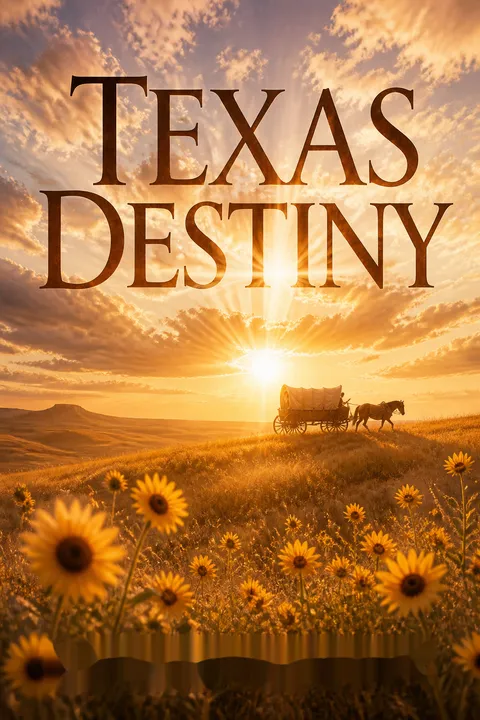


Plot Summary
The Wrong Leigh
In 1876, Amelia Carson leaves war-ravaged Georgia to marry Dallas Leigh, a Texas rancher she knows only through letters. At Fort Worth’s crowded station, she waits for the man she imagined would come eagerly to meet her. Instead, Houston Leigh appears: Dallas’s scarred, one-eyed brother, sent because Dallas broke his leg trying to tame a mustang.
Houston explains that the ranch lies weeks away and that he will escort her there by wagon. Amelia is startled by his disfigurement and disappointed that her fiancé is absent, but she accepts the journey. Houston, who wanted no part of the assignment, sees how little she has brought and realizes Dallas has failed to prepare her for the isolated life ahead.
The first meeting makes appearance and expectation collide in practical ways. Amelia’s imagined husband has been assembled from letters, while Houston arrives as a stranger carrying the physical evidence of a war neither has escaped. Her willingness to go with him is not simple romantic optimism: she has lost her family and home, and Dallas’s proposal offers a route toward safety and belonging. Houston sees the risk in her unpreparedness before he admits that her presence might change him.
A Wardrobe for West
After securing the last hotel room, Houston gives Amelia space to rest, then apologizes for his rough welcome with breakfast. The next morning, he takes her to a dressmaker and insists Dallas will pay for five outfits, despite Amelia’s reluctance to accept more than she owns. Houston chooses a plain green dress, then packs the new clothes with the wagon’s provisions.
Outside, Amelia discovers that Dallas changed the ranch brand from a D to joined initials when she accepted his proposal. The mark makes her feel that her future husband has already welcomed her into his plans. She and Houston leave Fort Worth with her carpetbag, his supplies, and the ugly bird-trimmed hat Dallas sent so he could recognize her.
The new clothes and joined brand make marriage tangible before Amelia meets Dallas. To her, the brand is evidence of partnership; to Houston, buying the clothes is an unasked-for act of care he can disguise as his brother’s instruction. Their different readings establish the central emotional imbalance: Amelia trusts the future she chose, while Houston already responds to her as someone he wants to protect.
The Hat at the Creek
As the wagon travels west, Houston keeps his face turned away and conversation sparse. At a stream, he warns Amelia that a raccoon once stole his hat, giving her a plausible way to discard the bird-covered one Dallas sent. She recognizes the kindness behind the story, leaves the hat by the water, and accepts a plain hat Houston bought for his younger brother, Austin.
That evening, Amelia learns that Houston and Dallas were only twelve and fourteen when their father took them to war. Houston refuses to discuss it further, but he does answer her questions about Dallas, even joining her in a game of checkers. Later, he takes her to a rise and shows her how empty the land is, warning her that the ranch will be lonely.
The hat is a small test of whether affection must be expressed as obedience to a gift. Houston helps Amelia preserve Dallas’s feelings while letting her reject something impractical, a compromise that quietly builds trust. The overlook exposes a deeper difference: Houston sees absence and isolation, while Amelia sees room to begin again. Their shared game briefly gives Houston a form of companionship he can accept without naming it.
The Shadow’s Betrayal
Houston’s awkward attention to Amelia grows more intimate than he intends. He watches her shadow in the tent while she washes and undresses, then recoils the next morning when she offers him her mother’s large mirror for shaving.
Amelia tries to understand his shame by covering one eye and moving around camp as he does, but her attempt only makes him angry. Later, she catches him playing checkers against his horse and draws him into a real game. Their ease ends when she notices that the lantern makes her tent transparent to someone outside.
Houston admits through his silence that he has been watching. Amelia forces him to wash inside her tent while she waits outside, making him experience the exposure he caused. His apology cannot restore her trust at once.
The breach is not softened by Houston’s attraction or his self-loathing. Amelia’s anger insists that compassion does not erase consent, and her improvised punishment forces him to feel the imbalance he created. His discomfort with mirrors and attention points to a wound deeper than vanity, though he cannot explain it yet. Their connection advances only when he accepts that wanting closeness does not give him the right to take it.
Venom and Vigil
The next morning, Amelia tries to understand Houston’s one-sided sight by covering an eye. Later, a snake bites her calf beside a stream. Houston cuts the wound and repeatedly draws out the venom, then carries her back to camp and stays beside her through fever, vomiting, chills, and delirium.
He tells her she will survive, although he fears the venom may kill her. While she recovers, he reads aloud one of Dallas’s letters, which describes the ranch as a place where a wife and sons could share his ambitions.
Amelia asks Houston about the family he lost after the war. He tells her that he and Dallas returned to find their mother dead and young Austin alone. Houston’s care keeps Amelia alive, and the ordeal makes their tenderness harder to deny.
The crisis turns Houston’s guardedness into action: he cannot offer polished comfort, but he remains, treats the wound, and keeps speaking when Amelia is frightened. Dallas’s letter is both reassurance and reminder of the promise she made. Houston’s account of the family’s losses also reveals why silence has become his preferred protection. Amelia’s survival deepens their intimacy, but it does not dissolve the ethical boundary between her and her fiancé.
A Storm Opens Georgia
After Amelia regains her strength, Houston stops at the home of John and Beth Denton, neighbors who welcome the travelers with supper, baths, and a real bed. Beth explains how isolated ranch families rely on one another, and Amelia learns that Houston has rarely shared domestic comfort with anyone.
The next stretch of the journey brings a violent lightning storm. Houston puts Amelia beneath the wagon’s tarpaulin for safety, but the darkness traps her in memories of Georgia.
As a child, she was hidden inside her dead father’s coffin while armed men attacked the plantation. When she emerged, her mother was traumatized and her sisters were dead. Houston holds Amelia through the storm as she recounts the violence and explains why she left Georgia to seek new memories.
The storm joins two kinds of danger: the immediate threat of lightning and the remembered terror of being hidden among the dead. Amelia’s history explains why enclosure and darkness can undo her composure, while Houston’s steady presence gives her a witness who does not demand that she minimize what happened. The Dentons’ hospitality briefly offers a model of communal life, sharpening the contrast with the isolation awaiting her at Dallas’s ranch.
The River’s First Kiss
The storm swells a river that Houston decides to cross before more time is lost. He first carries Amelia across on Sorrel, then returns for the wagon and team. A floating log slams into the wagon, the mules panic, and Houston is dragged under while trying to free them. Amelia jumps into the current; Houston surfaces, reaches her, and hauls her to shore.
Shivering together, they kiss with a tenderness neither can explain away. Houston immediately calls it the result of fear and physical need, not love, and Amelia is hurt by the dismissal. That night, he holds her beside the fire to keep her warm and reminds himself that Dallas has a claim on her. The wagon and most of their belongings are lost to the flood.
The river makes Houston’s conflict bodily: he risks himself to save the wagon, then Amelia risks herself to save him. Their kiss grows from genuine fear and mutual dependence, but Houston recasts it as mere appetite to avoid responsibility for what he feels. The lost wagon strips away their possessions and practical security, leaving the two travelers more exposed to each other and to the uncertain road ahead.
The Wild Herd’s Invitation
Amelia and Houston salvage her mother’s mirror and the green dress, but Dallas’s letters and most of her belongings are gone. Houston gives Amelia his own hat and leads her onward with the few animals and supplies they have left.
A stampede sweeps through their camp, forcing them into a tree; afterward, Amelia cannot forget the silver-maned palomino stallion leading the herd. Houston admits that wild horses are becoming scarce and that he hopes to breed them.
Although he insists they must reach Dallas, Amelia argues that this herd may be his chance to build the life he wants. Houston eventually agrees to pursue it. He leaves her with Sorrel and a makeshift enclosure while he works to earn the horses’ trust, turning a disastrous delay into the beginning of his own ambition.
Amelia’s encouragement marks a shift from being the person Houston must deliver to someone who recognizes his desire and asks him to honor it. The stampede gives the mustangs a concrete, living presence before Houston chooses to pursue them. In the aftermath of the flood, his lost supplies seem to make dreams less practical; Amelia instead treats the horses as a future worth risking time for.
Valiant’s First Ride
For several days, Houston and Amelia approach the mustangs until the animals stop fleeing. He studies the herd, then drives them toward the canyon enclosure while Amelia closes the gate behind them. Houston selects eight horses, including the palomino mare he will name Valiant for Amelia.
Their days among the herd bring a closeness that neither discusses openly; at night, they share stories and sleep wrapped in the same blankets. At a spring, Amelia teases Houston into splashing with her, and his laughter surprises them both.
When the journey resumes, Houston signals Dallas’s ranch with smoke. Amelia tells him she loves him, but he refuses to claim her and insists Dallas will make a good husband. The riders appear, and Houston watches Dallas lead Amelia away.
The capture is a practical achievement and an emotional turning point: Houston can approach wildness patiently without breaking its spirit, a method that mirrors what Amelia offers him. Naming the mare Valiant gives her a place in his private dream, while Houston’s first genuine laughter shows how much companionship has returned to him. Yet he still treats love as something he must surrender for Amelia’s sake.
The Castle at Last
Dallas Leigh arrives with his ranch hands, limping but unmistakably the confident man Amelia pictured in her letters. His younger brother Austin charms her at once. Dallas is grateful she has arrived, but angry that Houston is more than three weeks late and has lost the wagon.
He learns that the circuit preacher has left, so Amelia’s wedding must wait. At the enormous adobe ranch house, Dallas explains his plans to build an empire and gives Amelia a pocket watch she bought for him, though floodwater has stopped it.
Amelia meets the cook and sees the rooms she is expected to make into a home. Dallas shows her the boundaries of his land and assures her that she is as he imagined. His ambition is real, but the woman beside him is already carrying a different journey in her heart.
Dallas’s arrival confirms that the man in the letters exists, but his grand house and carefully ordered plans do not automatically create intimacy. Amelia receives security and respect, yet she has already built a private history with Houston. The damaged watch becomes a precise emblem of their situation: her gift survives, but its original function has been lost, and marriage cannot be made to run on obligation alone.
Brothers Under One Roof
While Dallas is away, Austin takes Amelia to watch the sunrise and then to Houston’s cabin. She sees the mustangs and learns that Houston is deaf on his left side, which explains some of the moments when he seemed to ignore her.
Back at the ranch, Dallas takes Amelia to a cattle roundup; later, her repeated references to Houston make him ride out and confront his brother. Dallas accuses Houston of taking liberties with his future wife, and Houston punches him rather than let him blame Amelia.
Amelia tends Dallas’s bruised face, asks him to stop lying, and receives his promise. Austin’s violin playing then moves Dallas, who recognizes the boy’s gift and comforts him over his fear of disappointing Houston. The household begins to change, but the brothers still struggle to speak plainly to each other.
The visit to Houston’s cabin makes Amelia’s attachment visible, while Dallas’s accusation exposes how easily men interpret a woman’s agency as a contest over possession. Houston’s violence is a poor substitute for explanation, but he directs his anger at his brother rather than letting Amelia bear the blame. Austin’s music gives Dallas a rare chance to respond as a brother rather than a commander.
Black Thunder Taken
Austin rides Houston’s black stallion, Black Thunder, to a bluff, where horse thieves surprise him and steal the animal. He escapes their gunfire by clinging to the cliffside, then returns claiming the horse broke its leg and had to be shot.
Houston and Amelia find him, accept the story, and bring him home without accusation. Dallas later orders a preacher fetched and prepares for the wedding. Amelia asks Dallas to invite Houston to a celebration; Houston attends, though he keeps his distance while she dances with the ranch hands.
He later takes Austin to Dusty Flats, hoping to introduce him to a sporting woman. Austin chooses not to go with her and instead questions Houston about love and sacrifice. Their conversation forces Houston to face how often he has confused fear with doing what is best for Amelia.
Austin’s lie grows from shame, not malice: he fears being judged as a boy, so he hides the fact that armed men overwhelmed him. Houston and Dallas’s attempts to protect him risk reinforcing that fear, though Dallas begins to see Austin’s emotional gifts. The trip to Dusty Flats exposes Houston’s own self-deception. A paid encounter cannot substitute for the love he has relinquished, and Austin’s questions make that evasion harder to sustain.
Vows and Old Wounds
Dallas marries Amelia once the circuit preacher returns. After the ceremony, she asks Houston for help facing her wedding night, and he finally tells her the story he has hidden for thirteen years. During a battle, fifteen-year-old Houston ran when their father ordered him forward.
Their father chased him, and an explosion killed him while Houston was badly wounded. Houston has believed ever since that his fear made him responsible. Amelia insists the frightened boy was not the coward he condemns, but Houston cannot accept her judgment.
He then leaves with Austin for Dusty Flats. Austin’s refusal to use the sporting woman, and his questions about whether Houston truly knew what Amelia wanted, make Houston turn back toward the ranch. Before he arrives, horse thieves burn the barn and abduct Amelia.
Houston’s confession reveals that his isolation is organized around a child’s guilt, not simply the visible scars of battle. He equates one act of fear with his entire identity and refuses to let Amelia’s evidence of his courage revise that verdict. Austin’s challenge matters because it makes Houston consider that self-sacrifice can be another form of control when he decides what Amelia should want without asking her.
Fire and Horse Thieves
Houston and Austin return to find the ranch barn burning, the corral wrecked, and Amelia missing. Dallas, wounded but determined, rides with Houston to track the thieves. They locate the gang in a canyon, where the leader, Colson, has tied Amelia and intends to claim her.
Dallas takes a position above the camp while Houston enters alone, pretending to be an outlaw. He lures Amelia from a narrow crack in the rock by making her believe it holds snakes and scorpions. When the thieves turn toward the distraction, Houston lifts her onto Sorrel and escapes under Dallas’s cover fire.
Three riders pursue them. Houston gives Amelia the reins, jumps from the moving horse, and shoots two pursuers; the third shoots Houston. Dallas kills the last attacker. Amelia finds Houston bleeding and begs him not to die, while he insists he did not run.
The rescue gathers the story’s earlier dangers into one concrete crisis: the horse, the canyon, Houston’s impaired sight, and Amelia’s terror all matter to the escape. Houston’s choice to leap from the horse is both courageous and self-punishing; he protects Amelia but still frames his worth through a test of whether he can stand and fight. His final insistence that he did not run answers the childhood shame he has carried, even as it leaves Amelia fearing she may lose him.
The Mirror Turned
Dallas and Amelia carry Houston to his cabin, where she tends him through fever while Dallas organizes the search for a doctor. Austin admits that thieves took Black Thunder; Dallas recovered the horse, and Houston gives him the stallion rather than let guilt keep the brothers apart.
When Houston wakes, he and Dallas discover the truth behind their distance: Houston believed Dallas blamed him for their father’s death, while Dallas had saved him from the field hospital because he had promised not to let him die. Dallas offers Amelia an annulment and leaves the choice to her.
Houston finally looks into Amelia’s mirror and sees the man she loves, then asks her to marry him. She accepts. The following spring, they wed at the waterfall, where Houston makes his own vows and dances with Amelia to Austin’s violin. Their marriage begins with shared dreams, not a contract.
The mirror works because Houston’s problem is not that he cannot see his scars, but that he has mistaken them for proof of a fixed moral identity. Dallas’s revelation releases both brothers from a story of accusation neither had actually told the other. Amelia’s choice matters more than either man’s plan: she can accept the security Dallas offered and still choose the love she has earned with Houston. Austin’s restored horse and music make the reconciliation communal, not merely romantic.
Analysis
Texas Destiny makes the road to marriage a test of what a promise can and cannot guarantee. Amelia’s contract with Dallas offers material safety and a future after the destruction of her family, but the journey teaches her that security alone cannot create intimacy. Houston’s resistance is equally specific: he does not merely feel unattractive. He has built an identity around a childhood moment when fear, an explosion, and his father’s death fused into a private verdict of cowardice. The novel’s repeated physical tests, the snakebite, storm, river, stampede, and gunfire, expose how often his actions contradict that verdict.
The brothers’ conflict grows from silence rather than simple rivalry. Dallas believes his promise saved Houston’s life; Houston believes Dallas sees him as the cause of their father’s death. Each has acted from loyalty, yet their unspoken assumptions turn loyalty into distance. Amelia changes the family not by curing anyone, but by asking questions, naming what she sees, and refusing to accept another person’s account of her wishes. Her agency remains essential even when the men frame her as a bride to be delivered or a wife to be claimed.
The mustangs offer a counterimage to the ranch’s systems of ownership and ambition. Houston’s skill depends on patience and trust, not breaking a horse’s spirit. His relationship with Amelia becomes possible when he applies that same respect to a person and allows her to choose her life. The final movement therefore resolves more than a romance: it replaces inherited shame and unexamined duty with explicit truth, chosen commitment, and a dream shared without erasing either person’s independence.
Review Summary
Texas Destiny receives mixed reviews averaging 3.99/5 stars. Readers praise Lorraine Heath's beautiful writing and the slow-burn romance between scarred Civil War veteran Houston and mail-order bride Amelia, who falls for him instead of his brother Dallas. Many love the emotional depth and tortured hero trope. However, critics find the pacing tedious, characters frustratingly passive, and some prose overwrought. Several reviewers struggle with the Confederate setting and plantation references. The second half divides readers—some appreciate the moral complexity, others find it melodramatic. Most agree it's an old-school romance requiring patience.
People Also Read
Characters
Amelia Carson
The determined mail brideAmelia travels from Georgia to Texas to marry Dallas Leigh, hoping to escape the losses and memories left by the war. She is practical, observant, and resilient, though she can mistake a promise of safety for a promise of love. Her habit of asking questions draws guarded people into conversation, while her small acts of gratitude help her endure discomfort without denying its cost. Amelia is not merely a passenger on the journey: she challenges Houston to pursue his own ambitions and expects honesty from the people she trusts. Her tenderness is grounded in self-respect, and her courage comes from having survived what she would rather not remember.
Houston Leigh
The scarred horsemanHouston is Dallas’s younger brother, a mustanger whose face, hearing, and sight were damaged during the Civil War. He keeps to his small cabin and trusts horses more easily than people. His reserve protects him from pity, but it also hides a deep conviction that he is unworthy of love and happiness. Skilled at reading animals and patient with their fear, he rarely offers himself the same understanding. Amelia’s questions and companionship expose the contrast between the man he has become and the frightened boy he still believes himself to be. His central struggle is not simply accepting his appearance, but learning to judge himself by his choices rather than his worst memory.
Dallas Leigh
The empire-building brotherDallas is Houston’s older brother, a successful rancher who wants to build a lasting cattle empire and raise a son to inherit it. Handsome, confident, and accustomed to taking charge, he trusts planning, contracts, and hard work more than emotional uncertainty. His authority comes partly from the responsibility he assumed for his brothers during the war, but that responsibility can make him sound more like a father than a sibling. Dallas values loyalty and keeps his word, yet he does not always recognize what his silence communicates to Houston. Amelia’s arrival challenges him to make room for needs and ambitions beyond his own carefully drawn plans.
Austin Leigh
The restless youngest brotherAustin is the sixteen-year-old youngest Leigh brother, raised among men and eager to be treated as one of them. His humor and easy friendliness contrast with Houston’s reserve and Dallas’s command. He is curious about women and adulthood, but his sensitivity shows in his music and in his desire for a family presence he barely remembers. Austin wants his brothers’ respect and can hide mistakes when he fears he has failed them. Amelia gives him the patient attention he lacks, while his questions sometimes reveal truths that Houston and Dallas avoid. His violin and his affection for horses offer him ways to express himself beyond the masculine rules of the ranch.
Beth Denton
The welcoming ranch wifeBeth lives with her husband, John, and daughter, Sarah, on an isolated Texas homestead. She welcomes Amelia and Houston with food, baths, and beds, offering the kind of domestic kindness that frontier travelers seldom find. Beth is lively and direct, and she understands the loneliness of women living far from other families. Her hospitality shows Amelia a possible model for building community in a place where neighbors may be a day’s ride away.
John Denton
The hospitable neighborJohn is Beth’s husband, a rancher who makes furniture for their home and offers practical help to his neighbors. He is quieter than Beth and uses dry humor to participate in conversation. His home provides Amelia and Houston a brief refuge from the road, demonstrating the mutual aid that makes isolated ranch life survivable.
Sarah Denton
The observant little girlSarah is John and Beth’s young daughter. Shy around strangers, she studies Houston’s scarred face and responds with the straightforward kindness of a child. Her willingness to offer comfort without treating him as frightening gives Houston a rare moment of uncomplicated acceptance.
Mimi St. Claire
The Fort Worth dressmakerMimi owns the Fort Worth dress shop where Houston outfits Amelia for the journey. Sociable and perceptive, she treats the awkward cowboy’s clothing requests as a puzzle and recognizes that his concern for Amelia runs deeper than he admits.
Cookie
The ranch’s musical cookCookie cooks for Dallas’s ranch hands and plays the fiddle at gatherings. He keeps memories of his late wife through her clothes and shares music with Austin, helping the boy develop a talent that the ranch’s hard routines might otherwise suppress.
Reverend Preston Tucker
The armed circuit preacherReverend Tucker travels the frontier performing marriages and ministering where settled churches are scarce. He carries a gun because he understands how dangerous the territory can be. His practical manner suits a world where faith and self-protection must travel together.
Colson
The horse-thief leaderColson leads the gang that steals horses and abducts Amelia. He treats people and animals alike as things to be claimed or sold, making him a direct threat to the care and consent that define the Leigh brothers’ better choices.
Maria
The Dusty Flats workerMaria is a sporting woman in Dusty Flats who knows Houston from earlier visits. Her weary familiarity with the town’s trade helps reveal how emotionally distant his former encounters have been.
Sorrel
Houston’s steady mareSorrel is Houston’s dependable mare, valued for her speed, endurance, and calm temperament. She carries Amelia on the journey and is trusted in dangerous terrain, including the river crossing and the flight from the horse thieves.
Black Thunder
Austin’s spirited stallionBlack Thunder is Houston’s powerful black stallion, admired for his speed and strength. Austin is particularly attached to him and gives him his name. The horse represents both Houston’s ambitions as a breeder and Austin’s wish to prove himself capable.
Plot Devices
The marriage contract
A promise under pressureDallas and Amelia agree in writing that she will travel to Texas and become his wife. The contract gives Amelia a route out of her ruined life and gives Dallas confidence that his bride will arrive. It also makes Houston’s growing love difficult to act upon: Amelia has promised herself to his brother before she knows either man in person. The document frames the romantic conflict as more than a choice between two brothers. It asks whether a promise made for security can remain binding when lived experience reveals a different truth.
The joined ranch brand
A mark of intended unionDallas changes the ranch brand to join the initials associated with himself and Amelia after she accepts his offer. Amelia reads the mark as evidence that he has already made room for her in his plans. Houston uses it differently, tracing the joined letters in the dirt to remind himself that Amelia is pledged to Dallas. The same symbol therefore carries both hope and restraint, reflecting how the brothers understand marriage through their separate habits: Dallas plans for it, while Houston treats it as a boundary he must not cross.
The hand mirror
A test of self-recognitionAmelia brings a mirror that belonged to her mother and offers it to Houston for shaving. He refuses it, and she gradually understands that his aversion is connected not only to his facial wounds but to the self he sees in the reflection. After the crisis at the ranch, Houston takes up the mirror she leaves behind and finally confronts his own image. It gives physical form to his internal conflict: he has mistaken the frightened boy he remembers for the whole man he has become.
The wild mustangs
A future worth pursuingHouston’s knowledge of mustang behavior and his desire to breed the increasingly scarce horses establish an ambition separate from Dallas’s cattle empire. The palomino herd appears after the flood and stampede, giving Amelia a chance to recognize Houston’s dream and urge him to act on it. His patient method depends on earning the animals’ trust rather than simply forcing them into submission. The horses provide a practical livelihood, but they also measure Houston’s ability to imagine a future that belongs to him.
The war’s buried guilt
A memory mistaken for identityHouston and Amelia carry different kinds of trauma from the Civil War: he survived a battlefield wound and believes his fear caused his father’s death, while she witnessed the destruction of her family and was hidden in her father’s coffin. Their memories surface during the journey, first through Houston’s nightmares and then through Amelia’s response to the storm. The past explains their behavior without excusing every choice. Its eventual reinterpretation allows Houston to separate the frightened boy he was from the man who has repeatedly shown courage.
Texas Trilogy Series

Download PDF
Download EPUB
.epub digital book format is ideal for reading ebooks on phones, tablets, and e-readers.








