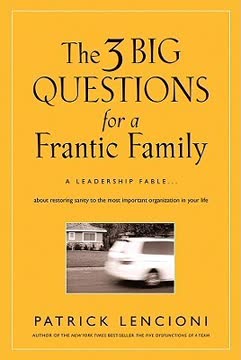
Key Takeaways
1. Families are Organizations: Embrace Intentional Leadership
Why would intelligent, family-oriented people overinvest in their work and fail to manage the most important organizations in their lives?
Unmanaged chaos. Many intelligent, family-oriented individuals meticulously plan their careers, finances, and health, yet neglect to apply similar strategic thinking to their families. This oversight leads to reactive, frantic, and unfocused home lives, accepted as an inevitable part of modern parenting. The book's protagonist, Theresa Cousins, a full-time stay-at-home mom, felt this acutely when her husband, Jude, remarked, "If my clients ran their companies the way we run this family, they’d be out of business."
The hidden cost. This lack of intentional management isn't harmless; it contributes to increased stress, exhaustion, and a pervasive sense of not enjoying the very things parents always wanted to do. Families often don't realize the true cost of their chaos until facing severe issues like divorce or substance abuse, highlighting the importance of proactive planning. Just as a business needs a plan to thrive, a family, as the most important organization in one's life, requires deliberate leadership to foster peace and purpose.
Proactive vs. reactive. The core problem is taking family life for granted, assuming it will simply "work itself out." This leads to accepting levels of confusion and disorganization at home that would be intolerable in a professional setting. By recognizing the family as an organization, parents can shift from a reactive, survival mode to a proactive, intentional approach, transforming daily stress into purposeful progress and reclaiming joy in their shared adventure.
2. The Power of Context: Guiding Every Family Decision
Context is the information and framework we need to make a decision in the most informed, intentional manner possible.
Decision paralysis. Without a clear context, every decision, from signing up for extracurriculars to planning vacations, becomes an isolated, anxiety-inducing event. Theresa experienced this "flailing" feeling, where each choice felt like reinventing the wheel, leading to overwhelming stress and a sense of being victimized by life's demands. This lack of a guiding framework makes it difficult to prioritize and often results in families chasing every new idea without understanding why.
A guiding framework. Context provides the essential backdrop for all family choices, allowing parents to evaluate opportunities and challenges against a consistent set of principles. It helps answer questions like:
- Should we go on vacation with the Harrisons?
- Should we move into a bigger house?
- Should we let Sophia watch SpongeBob?
- Should I accept this overseas client trip?
Simplicity over complexity. The beauty of context is its simplicity. It's not about elaborate systems or complex psychological theories, but about mastering a few fundamental concepts that require persistence more than intelligence. By establishing this clear framework, families can make purposeful decisions, reduce unnecessary anxiety, and avoid unproductive conflicts, leading to a more peaceful and intentional home environment.
3. Define Your Family's Uniqueness: Values and Strategy
If you don’t know what differentiates your family from others, you won’t have a basis for making decisions, and you’ll try to be all things to all people.
Who are we? The first big question for a frantic family is: What makes your family unique? This involves identifying core values and a clear strategy. Theresa and Jude, after much discussion, realized their family's uniqueness wasn't about being perfect, but about embracing their authentic selves. This clarity prevents families from trying to conform to external pressures or the perceived "perfect" lives of others.
Core values. These are the 2-3 fundamental, undeniable positive qualities that define your family, almost impossible to suppress. They are not aspirational (what you wish you were), permission-to-play (minimum standards like honesty), or accidental (temporary traits). For Theresa and Jude, their core values were passion, humility, and compassion. A good test for a core value is if you occasionally take it "to an extreme that's not always helpful, but that's what makes it core."
Family strategy. This involves 2-3 purposeful decisions that drive how your family lives, week by week, year by year. It's a "messy, inexact science" without right or wrong answers, but it provides direction. Theresa and Jude identified their strategic anchors as:
- Maximize time with children (Mom stays home, Dad limits travel, outsourcing chores).
- Centered around faith and church (volunteering, Catholic school, home prayer).
- Nurture family-like relationships with friends (due to lack of nearby extended family).
This combined understanding forms a unique paragraph describing the family's identity, guiding future decisions.
4. Establish a Rallying Cry: One Top Priority at a Time
If everything’s important, nothing is.
Focused effort. The second big question is: What is your family’s top priority—rallying cry—right now? This single, agreed-upon objective provides unity and maximum impact, preventing the family from being pulled in countless directions. Theresa and Jude realized their initial "family clarity" goal was too broad; a true rallying cry should be achievable within two to six months.
The right question. To identify this priority, ask questions like:
- "If we accomplish just one thing as a family before the Fourth of July, what would that be?"
- "What is it that we’d have to accomplish by the time that the school year starts in order for us to say that it was a successful summer?"
The key is to limit it to one primary answer and ensure the timeframe is realistic (2-6 months). Too short, and there's not enough progress; too long, and procrastination sets in.
Impactful change. For the Cousins, their rallying cry became "spend more 'quantity time' together as a family." This wasn't about adding more activities, but about being together at home, playing games, watching movies, and simply being. This focus allowed them to make difficult decisions, like Theresa stepping down from the school board or Jude limiting travel, because they now had a clear, overarching purpose.
5. Break Down Goals: Defining and Standard Objectives
Defining objectives are just the basic categories of things you’ll have to do to achieve your rallying cry.
Actionable steps. Once a rallying cry is established, it needs to be supported by "defining objectives"—the specific, trackable activities required to achieve the main goal. For the Cousins' rallying cry of "more quantity time," their defining objectives included:
- Cut back on extracurricular activities.
- Do a little less socializing with other families.
- Watch less television (for both kids and parents).
- Make family vacations a priority.
- Reduce Jude's travel.
These concrete steps transform a broad goal into a manageable plan, providing context for daily choices.
Ongoing responsibilities. Alongside defining objectives, families need "standard objectives"—the regular, ongoing responsibilities essential for the family's well-being, regardless of the current rallying cry. These are the perennial duties that keep the family afloat and prevent surprises. Common standard objectives include:
- Financial health
- Physical health
- Spiritual health
- Marriage
- Education
- Social life and fun
- Relationships with extended family
- Home maintenance
These ensure that while focusing on a top priority, fundamental aspects of family life are not neglected.
Contextual clarity. The combination of a rallying cry, defining objectives, and standard objectives creates a comprehensive, yet simple, framework. It allows families to understand not only what they are working towards (rallying cry) and how they will get there (defining objectives), but also what else must be maintained (standard objectives). This layered clarity empowers families to make informed decisions and avoid the "flailing" feeling of disconnected actions.
6. Keep it Simple: The 80/20 Rule and "Good Enough"
If something’s worth doing, it’s worth doing half-assed.
Efficiency over perfection. The book emphasizes two aphorisms for quick and effective change: the 80/20 Rule (Pareto Principle) and "Don't make the perfect the enemy of the good." This means that 80% of the value comes from the first 20% of the effort, and a good, simple plan implemented quickly is far superior to a perfect one that never gets off the ground. Theresa initially struggled with the complexity of business models, but realized families need a simpler, more intuitive approach.
Liberating simplicity. The goal is not to create an exhaustive, academically perfect plan, but to achieve "messy clarity." This means parents don't need to spend hours debating the nuances between a "value" and a "strategic anchor." What matters is that the answers are honest, true, and provide a clear sense of direction. This approach makes the process liberating and even fun, rather than an overwhelming chore.
Practical application. For families, this translates to focusing on the essence of the three big questions without getting bogged down in corporate jargon or excessive detail. Theresa's simplified model, boiling down complex business concepts into two core questions and a method for using them, proved effective for her and her friends. It acknowledges that families operate differently from businesses and require a more agile, less rigid framework.
7. Regular Meetings: The Engine of Family Clarity
The most important thing a family has to do to keep its context alive is discuss it in regular meetings.
Consistent engagement. Answering the three big questions is only the first step; the real work lies in consistently discussing and using those answers. Regular, short family meetings are crucial for keeping the family's context alive and ensuring progress. Theresa and Jude committed to weekly check-ins, realizing that without them, their plan would simply collect dust.
Efficient check-ins. These meetings should be brief, ideally 10-20 minutes, to maintain engagement and prevent them from becoming a dreaded chore. The structure is simple:
- Review the rallying cry.
- Assess progress on defining objectives.
- Assess progress on standard objectives.
- Use a simple color system: Green (on track/ahead), Yellow (some concern), Red (behind/needs immediate attention).
- Discuss red/yellow areas and agree on actions for the week.
- End the meeting promptly.
This focused approach ensures accountability without consuming excessive time or energy.
Parental leadership. While children don't need to be involved in the initial planning or every sensitive discussion, parents should lead these meetings. Afterward, parents can share relevant updates with the children, fostering a sense of shared purpose and understanding. The key is to use judgment, knowing when to involve kids for perspective and confidence, and when to keep discussions adult-focused.
8. Visibility is Key: Display Your Family's Plan
It would be better to have your three-year-old write it in crayon on the kitchen wall, because at least then you would have to look at it from time to time.
Constant reminder. To prevent the family plan from becoming a forgotten document, it must be visible. Theresa realized the power of a physical display, opting for an oversized whiteboard in her kitchen. This serves as a constant, tangible reminder of the family's unique identity, top priorities, and ongoing responsibilities.
Strategic placement. The ideal location for this visual aid is near the family calendar. This proximity provides a holistic context for daily scheduling and activity decisions, which are often the source of family franticness. When faced with a new commitment, parents can glance at the board and immediately assess if it aligns with their established values, strategy, and current rallying cry.
Beyond the document. The visual display transforms the abstract "plan" into a living, breathing guide. It becomes an inevitable topic of conversation for visitors and a daily touchstone for family members. This constant exposure reinforces the family's context, making intentional decision-making a natural part of daily life, rather than an occasional, forced exercise.
9. Overcoming Resistance: The Journey to Sanity
I’m here to say that it is not supposed to be this way, and it is certainly not inevitable.
Initial skepticism. Theresa's journey wasn't without setbacks. Her friends initially found the concepts too complex or felt too overwhelmed to implement them. Even Theresa herself admitted, "It's too much." This resistance is common because applying business principles to family life can feel awkward or overly structured, and the immediate benefits aren't always obvious.
The "aha!" moment. The turning point for Theresa came when she simplified the model to just three core questions and experienced its power firsthand. When she instinctively used her family's rallying cry to decline a demanding school auction chairmanship, she realized the system's practical, liberating potential. This "moment of truth" transformed her from a frustrated planner into a confident advocate.
Ripple effect. As Theresa continued to teach and refine her approach, she saw its transformative power in diverse families—from those with young children to empty nesters seeking new purpose. The system provided clarity, reduced stress, and enabled families to make purposeful decisions, proving that chaos is not inevitable. The ultimate validation came when a young dad, echoing Jude's initial remark, declared, "If the executives at work ran our company the way you do your family, we wouldn’t be on the verge of going out of business."
Last updated:
Review Summary
The 3 Big Questions for a Frantic Family receives generally positive reviews (4.03/5) for its practical approach to family management. Readers appreciate Lencioni's framework of three core questions: what makes your family unique, what's your top priority for the next 2-6 months, and how will you track progress. Most praise the simplicity and actionable nature of the model, though many criticize the "fable" format as unnecessarily long, suggesting readers could skip to the final chapters. Several reviewers successfully implemented the system, reporting increased clarity and reduced stress. Common criticisms include the drawn-out storytelling and one reviewer's concern about gender dynamics in the narrative.
Similar Books