

Key Takeaways
Launch in seven days to replace speculation with evidence from buyers.
Planning left him guessing. At university, Norris spent six months researching an online library of human-resources documents, earned an A for the business plan, and never opened the business. Years later, his analytics startup Informly had press coverage and enthusiastic signups, but after 11 months it brought in just $476 in monthly recurring revenue while costing more than $2,000 a month.
A week changed the evidence. With little time left, he launched WP Curve, a WordPress support service, and won his first paying customer that week. Ten customers brought in $476 in monthly recurring revenue, matching Informly’s total after nearly a year. WP Curve covered costs within 23 days. The speed did not guarantee success; it got real customer behavior into the decision-making process sooner.
What's striking is the shift from prediction to feedback. A plan can organize what a founder already believes, while a purchase reveals whether a particular offer, price, and audience meet in the real world. That makes a fast launch a form of low-cost learning, not a shortcut to certainty. The comparison between Informly and WP Curve is persuasive but not a controlled experiment: the ideas and markets differed, so speed alone cannot explain the contrast. Its durable lesson is narrower and stronger: do not let polished forecasts substitute for evidence.
Pair a promising idea with execution and relentless customer-finding.
Three capabilities must meet. Norris argues that a startup needs an idea with potential, the ability to deliver it well, and the hustle to find customers. Hustle here means persistently doing the work most likely to bring in buyers, not simply staying busy. A founder who loves discussing a concept but avoids selling, or keeps adding software features instead of speaking to customers, is missing a crucial part of the job.
Strengths need not be equal. Norris built an audience through extensive content creation, including 250 posts in one year. Another founder might be better at direct sales, networking, or public speaking. Because one person may not excel at all three capabilities, the book recommends finding a co-founder whose strengths complement the gaps rather than pretending every task is a personal strength.
The framework helps diagnose why an appealing idea can stall: invention, delivery, and distribution are different kinds of work. This resembles the idea of complementary assets in strategy, where a product's value depends partly on capabilities that get it to customers. It also gives co-founder selection a practical test: identify the missing function, then seek someone who can perform it. The caution is that hustle can become a flattering name for overwork. The useful standard is not hours spent, but whether the work addresses the startup's current constraint.
Choose a business that fits its founder and can grow beyond one person's labor.
Screen the business, not just the idea. Norris's checklist for a bootstrapped startup asks whether its daily work suits the founder, its skills fit the product, and its market and business model can support growth. It also asks whether the business can make a profit without the founder, create assets that could be sold, solve a problem customers care about, attract customers through an advantage, and launch quickly. These are tests of fit and feasibility, not a formula that guarantees success.
Start with an existing pain. WordPress users already paid agencies or freelancers to repair their sites. WP Curve offered ongoing help with more predictable cost and availability. By contrast, Informly asked many users to pay for analytics they had previously obtained free or did not know they needed. The first idea asked customers to adopt less new behavior.
This checklist joins personal sustainability to business economics. Founder fit matters because the recurring tasks of a company shape whether its operator can persist, while founder-independent profit tests whether that persistence can become an organization rather than a self-employed job. The emphasis on existing spending is especially useful: customers already paying to address a pain offer clearer evidence than people who merely endorse a novel concept. Still, established markets are not automatically easy markets. Competition, access to buyers, and delivery costs can defeat an otherwise sensible idea.
Make the first version deliver value, even if humans do the automation.
Viable matters as much as minimal. A minimum viable product, or MVP, is the smallest version that lets a founder test the offer while still giving customers a credible experience of its value. Norris warns that a stripped-down product may be too weak to test the real idea. His analytics product had fewer features than existing alternatives, so customer indifference could not distinguish a bad market from an inadequate product.
Manual work can test the promise. Instead of building analytics software, he could have sold access to a report, collected each buyer's preferred data sources, and prepared the report by hand. WP Curve used live chat and email, with Norris personally covering overnight hours, to provide the advertised support before it had a mature support system. The customer received the service; the founders handled the rough mechanics behind it.
This is a useful distinction between a prototype that demonstrates functionality and a test that delivers the customer outcome. In service design, the visible experience can be separated from the backstage process; a human can temporarily perform tasks that software may automate later. That lowers the cost of testing a promise. The limit is operational strain: manual delivery can conceal labor costs, inconsistent quality, or safety requirements that automation would not solve. A responsible MVP should be honest about what is being offered and should measure whether the delivery can become economically repeatable.
Count purchases, not compliments, signups, surveys, or headlines.
Interest is not commitment. Before Informly launched, Norris gathered 1,000 beta signups and 1,200 email addresses from people who wanted to hear about the product. Press coverage followed, but the cited publications sent no paying customers. In a later survey about a revised analytics product, 60 percent said they might pay and 20 percent said they definitely would. After launch, three people signed up, one cancelled quickly, and the others did not use it.
Money is stronger evidence, not perfect proof. Free signups and praise may help identify people to contact, but they do not establish willingness to pay or continued use. Discounted pre-sales can also mislead if buyers respond to the deal rather than the intended price or product. The relevant test is whether people choose the actual offer, use it, and keep paying.
The argument aligns with revealed preference: choices made at a cost generally provide stronger evidence of demand than stated intentions. Yet a purchase is not a verdict on the idea in isolation. Price, trust, timing, product quality, and the buyer's ability to understand the offer all shape conversion. A failed launch can therefore identify a problem without pinpointing its cause. The best use of payment data is diagnostic: pair it with conversations and usage patterns, then change one important assumption at a time rather than declaring an entire market good or bad.
Give prelaunch work one week, then put a payment button in public.
A deadline exposes distractions. Norris's seven-day schedule forces decisions that founders often stretch across months: choose an idea, define the offer, pick a workable name, build a simple website, prepare marketing, set a target, and launch. The aim is not to finish a grand vision in a week. It is to make the smallest credible offer available to buyers and learn from their response.
The constraint changes priorities. Norris says Informly's payment setup took six months, while a basic PayPal button could be configured in about half an hour. That contrast captures the book's argument: elaborate infrastructure can feel like progress while postponing the uncomfortable test of asking for money. The timetable is a forcing device. If an idea cannot be tested for months, the book suggests simplifying the offer or choosing a more testable idea.
A short deadline works as a design constraint: it makes hidden assumptions visible by forcing the founder to decide what can be removed, done manually, or postponed. That is useful when uncertainty is high and reversibility is high. It is not a universal speed mandate. Products involving health, finance, physical safety, complex manufacturing, or legal obligations may require checks that should not be rushed. The valuable principle is to compress avoidable delay, not necessary diligence. A one-week launch can be a disciplined experiment only when its scope matches the risk.
Market through the channel that matches your strengths and your buyers.
Reach the right people first. Norris's marketing examples range from publishing useful content and building an email list to podcast interviews, online groups, guest articles, directories, webinars, live events, free sample work, and media outreach. The channel matters less than whether qualified buyers see a relevant offer. Terry Lin, for example, wrote for a niche blog read by people in the finance industry. The article brought his accessories business $700 in sales that day.
Use an existing advantage. Liam at Trak.io published practical articles on a rising topic and collected about 2,500 free signups; the book reports 217 paid customers in the first few months. A trusted member of an entrepreneur forum found his first four customers there, generating $3,000 in monthly recurring revenue. These cases show why a launch plan should test several plausible channels, then invest more effort where buyers respond.
Distribution is not an afterthought to product design. A founder's credibility, network, writing ability, or access to a specific community can make one channel unusually efficient. The examples also show why audience size alone is a poor proxy for value: a small, relevant readership can outperform broad press exposure. Content and relationships may build trust over time, while direct outreach can produce faster feedback. The strategic challenge is attribution. Founders should record which efforts produce qualified conversations and paying customers, not confuse visibility with a working acquisition path.
Build margins and recurring value before adding complexity.
Revenue can disguise a weak model. Norris's web agency reached about $180,000 in annual revenue but left him earning around $40,000. Each attempt to grow added sales, staffing, management, or delivery costs, so higher revenue did not create dependable profit. He contrasts that with WP Curve's simpler offer and a target margin of roughly 50 percent after accounting for the cost of serving customers.
Design for repeatability. The book favors a large enough market, healthy margins, assets such as recurring customers or original intellectual property, a simple offer, and predictable revenue. Monthly subscriptions can make growth easier to track, but only if customers continue to see value. Not every service belongs on a subscription. A founder should test the model with buyers, and estimate whether a team or system could deliver the service profitably without the founder doing every task.
The agency story illustrates why growth in sales is not the same as operating leverage. A business scales when additional revenue does not require an equal or greater increase in labor, complexity, or founder attention. Recurring revenue can improve planning, but it does not create scale by itself; churn and support costs can erase its advantages. The founder-independent test is especially clarifying because it prices work that founders often treat as free. Its usefulness depends on realistic estimates, not optimistic assumptions about future automation or cheap staffing.
Track the financial behavior that matters at this stage.
Choose one useful measure. Norris calls the stage-specific priority the One Metric That Matters, or OMTM. At launch, a useful measure might be the number of genuine paying customers; in a recurring business, it might be monthly recurring revenue and whether new customers outnumber cancellations. Website visits and social-media likes can indicate attention, but they do not show whether the offer supports the business.
Make targets realistic and revisitable. For WP Curve, Norris initially aimed for ten customers in the first month and 10 percent monthly growth. The business reached ten customers in its first week, covered costs within 23 days, and later grew faster than the target. He also used $40,000 a year in founder pay as a personal sustainability threshold. The point is not to copy those figures, but to choose a measurable goal suited to the business and review it as evidence changes.
A stage-specific metric limits distraction by linking attention to the question the company currently needs to answer. This resembles feedback control: measure an outcome, compare it with a target, and adjust the system. But metrics can distort behavior when treated as the goal rather than evidence. A team could increase signups while attracting poor-fit customers, or protect revenue while ignoring cancellations. Pairing a financial measure with customer quality and retention gives a more faithful picture. Targets should guide judgment, not replace it.
Protect customer momentum by fixing bottlenecks and abandoning rejected work.
Solve problems you actually have. WP Curve served 200 recurring customers using shared email, Trello, and documents before adopting a dedicated help desk. The team upgraded its website only after traffic reached about 20,000 visits a month. Norris uses these examples to argue against polishing systems before demand makes them necessary. Early on, the urgent problem is often finding and keeping customers, not perfecting internal tools.
Follow evidence, not attachment. The company tried selling to agencies for four months and won only one $49 job, then stopped pursuing that customer segment. It also abandoned services that failed to gain traction. In one difficult month, a failed product caused 22 customers to leave and growth began at negative 6 percent; the company finished the month up 15 percent. Norris attributes resilience partly to existing customer momentum, while still emphasizing product quality, retention, and founder motivation.
The examples distinguish infrastructure readiness from actual capacity constraints. Delaying a tool can preserve cash and attention, while dropping an offer that buyers reject prevents sunk costs from dictating strategy. Momentum, however, deserves careful interpretation. Existing demand can cushion mistakes, but it can also make a company slow to notice declining quality or changing customer needs. Retention, referrals, and repeated use help test whether momentum reflects durable value rather than temporary attention. The practical discipline is to protect what customers consistently reward and investigate what they repeatedly refuse.
Analysis
The book's central move is to replace the imagined business with an offer customers can actually accept or reject. Its seven-day launch is less a calendar prescription than an argument about the cost of delayed evidence. Norris's own contrast is vivid: years spent building a low-margin agency and nearly a year on Informly produced less useful learning than a week of selling a simpler service. The story gives the framework emotional credibility because the recommendation emerges from expensive failure, not from abstract enthusiasm for speed.
The strongest practical contribution is the insistence that the first version should preserve the customer's promised value even when the internal operation is manual. This avoids two common traps: building a feature-poor product that tests the wrong thing, and mistaking interest in a landing page for demand. The book also connects launch tactics to business durability. A paying customer is not enough if delivery costs consume the revenue, the founder cannot be replaced, or the market is too small to support growth.
The argument is most persuasive for bootstrapped, low-risk offers that can be delivered in a narrow form, especially services and lightweight software. It is less transferable to products whose safety, reliability, regulation, or manufacturing requirements make speed costly. A one-week deadline can surface unnecessary work, but it cannot make a complex task simple by declaration. Likewise, payments are stronger evidence than compliments, yet they do not isolate whether a weak result comes from the idea, price, product, or channel.
That leaves a productive tension: move quickly, but interpret results carefully. The book's best advice is not to worship speed or recurring revenue. It is to make consequential decisions from observed customer behavior, design for sustainable delivery, and change course when evidence contradicts the founder's preferred story. Launching begins the learning process; it does not finish the analysis.
Review Summary
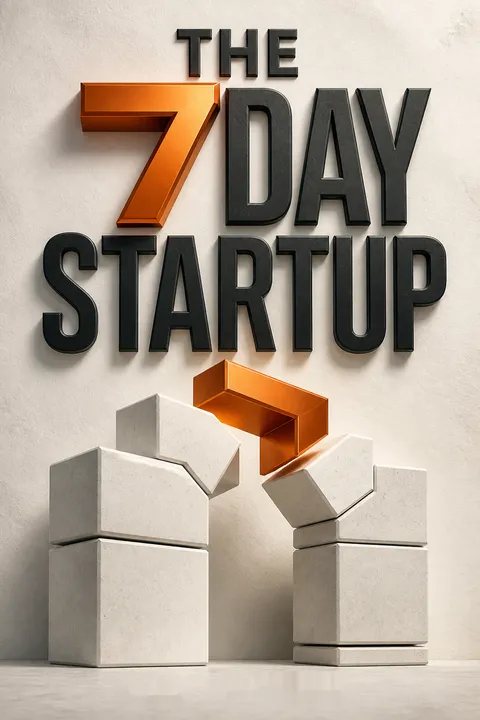
The 7 Day Startup receives mostly positive reviews, with readers praising its practical advice for quickly launching a business. Many appreciate the author's focus on taking action rather than overthinking. The book offers a day-by-day guide, emphasizing the importance of validating ideas through real customer payments. Some readers found the content simplistic or contradictory, but overall, it's considered a valuable resource for entrepreneurs looking to start a business efficiently. The book's concise nature and actionable tips are frequently highlighted as strengths.
People Also Read









Glossary
Minimum Viable Product (MVP)
Smallest credible customer offerThe smallest version of a product or service that lets a founder test an important business assumption while still delivering a credible version of the promised customer value. The book emphasizes that minimal features are not enough: if the offer is too weak to be useful, customer rejection does not reliably test the underlying idea.
One Metric That Matters (OMTM)
Stage-specific priority metricA single key measure chosen to answer the business's most important current question. At launch, that may be the number of paying customers; in a subscription business, it may be recurring revenue or the balance between signups and cancellations. The measure should change as the company's needs change, and should reflect financial or customer behavior rather than vanity.
Product/founder fit
Match between founder and productThe degree to which a business's work, demands, and required skills align with a founder's abilities, reputation, and interests. The concept asks founders to consider not only whether customers might want a product, but whether they are well suited to build and operate the business. Poor fit can turn an otherwise plausible idea into a persistently difficult venture.
wantrepreneur
Aspiring founder who never launchesA person who wants to become an entrepreneur but stays occupied with discussing ideas, consuming startup advice, planning, or polishing instead of offering something to customers. In the book, the dividing line is action: an entrepreneur puts an offer into the world and learns from what happens, rather than repeatedly revisiting the same untested idea.
hustle
Focused customer-getting workPersistent effort directed toward the task most likely to move the business forward at its current stage. For an early startup, this often means finding and serving customers rather than adding features, redesigning a website, or attending events without a clear purpose. The term describes prioritization and follow-through, not simply long hours or indiscriminate activity.
MRR
Monthly recurring revenueThe monthly revenue a business expects from customers paying on a recurring basis, such as through subscriptions. The book uses MRR to track growth, estimate the founders' potential wages, and judge whether a subscription business is gaining or losing ground. MRR is useful for forecasting, but it does not by itself reveal profit, customer satisfaction, or the cost of retaining subscribers.
Build, Measure, Learn
Product feedback cycleA startup learning cycle in which a team builds a version of an offer, measures how customers respond, and uses those observations to decide what to change. Norris draws on the concept to support launching early and testing assumptions with real behavior. The cycle is valuable when measurement reflects meaningful customer outcomes, not merely activity such as page views or email signups.
Startup
Uncertain, innovative growth ventureIn the book's usage, a startup is more than a business that provides its founder with a wage. It is a venture pursuing innovation and significant impact under uncertainty, with the potential to serve a larger market. A local business can qualify if it has ambitions and a model capable of broader growth; a self-employment arrangement alone does not meet this definition.
FAQ
What's "The 7 Day Startup" about?
- Author's Experience: "The 7 Day Startup" by Dan Norris is based on his personal journey of launching a successful business in just seven days after multiple failed attempts.
- Core Concept: The book emphasizes the importance of launching quickly to learn from real customer feedback rather than spending excessive time on planning and assumptions.
- Practical Guide: It provides a step-by-step guide to launching a startup in seven days, covering everything from idea generation to marketing strategies.
- Target Audience: The book is aimed at aspiring entrepreneurs who want to transition from having an idea to running a startup.
Why should I read "The 7 Day Startup"?
- Action-Oriented Approach: The book offers a practical, no-nonsense approach to launching a business quickly, which is ideal for those who want to avoid analysis paralysis.
- Real-Life Examples: Dan Norris shares his own experiences and failures, providing relatable and actionable insights for readers.
- Community Support: The book encourages joining a community of like-minded entrepreneurs for support and idea exchange.
- Focus on Execution: It stresses the importance of execution and hustle over merely having a great idea.
What are the key takeaways of "The 7 Day Startup"?
- Launch Quickly: The book emphasizes that you don't learn until you launch, encouraging entrepreneurs to get their product to market as soon as possible.
- Avoid Assumptions: It advises against making decisions based on assumptions and instead focuses on real customer feedback.
- MVP Importance: Understanding and creating a Minimum Viable Product (MVP) is crucial for testing your business idea effectively.
- Growth Mindset: The book highlights the importance of building a business with growth potential and scalability in mind.
What is the 7-day method proposed by Dan Norris?
- Day 1 - Idea Generation: Focus on finding a business idea that meets specific criteria for success.
- Day 2 - MVP Development: Create a Minimum Viable Product that can be launched quickly to test the market.
- Day 3 - Naming the Business: Choose a simple and memorable business name without overthinking it.
- Day 4 - Website Creation: Build a basic website in one day to establish an online presence.
What is a Minimum Viable Product (MVP) according to "The 7 Day Startup"?
- Definition: An MVP is the simplest version of your product that allows you to test your business idea with real customers.
- Focus on Viability: It should be viable enough to attract paying customers, not just a bare-bones version.
- Manual Processes: Initially, many processes can be done manually to simulate the final product experience.
- Customer Feedback: The MVP is a tool to gather customer feedback and iterate on the product quickly.
How does Dan Norris define a startup in "The 7 Day Startup"?
- High Impact Potential: A startup should aim to have a significant impact in its industry.
- Innovation and Uncertainty: It involves delivering a new product or service under conditions of extreme uncertainty.
- Scalability: The business model should have growth potential and not be limited by small market size.
- Focus on Execution: Execution and hustle are as important as the idea itself in a startup.
What are the 9 elements of a great bootstrapped business idea in "The 7 Day Startup"?
- Enjoyable Daily Tasks: Ensure the business involves tasks you enjoy doing daily.
- Product/Founder Fit: The business should align with your skills and interests.
- Scalable Business Model: The model should allow for growth and not be limited by the founder's involvement.
- Large Market Potential: The business should have the potential to serve a large market.
What are some marketing strategies suggested in "The 7 Day Startup"?
- Content Marketing: Create valuable content that addresses customer problems to attract and engage your audience.
- Email Marketing: Build and nurture an email list to maintain communication with potential customers.
- Guest Blogging: Write guest posts on relevant sites to reach new audiences and drive traffic to your site.
- Webinars and Presentations: Use webinars and live events to educate and convert potential customers.
What are the best quotes from "The 7 Day Startup" and what do they mean?
- "You don’t learn until you launch." This quote emphasizes the importance of launching quickly to gain real-world insights and feedback.
- "Move fast and break things." It encourages entrepreneurs to take action and not be afraid of making mistakes along the way.
- "If you are not embarrassed by the first version of your product, you’ve launched too late." This highlights the importance of launching an MVP and iterating based on customer feedback.
- "The only way to win is to learn faster than anyone else." It underscores the value of continuous learning and adaptation in business.
How does "The 7 Day Startup" address the concept of validation?
- Avoid Over-Validation: The book warns against relying too heavily on pre-launch validation techniques that may not accurately predict success.
- Real Customer Feedback: It stresses the importance of launching to gather real customer feedback rather than relying on assumptions.
- Pre-Selling Limitations: Pre-selling is seen as a flawed validation method because it doesn't test the actual product offering.
- Focus on Launch: The book advocates for launching quickly to test the market and make informed decisions.
What are the 14 business rules to live by in "The 7 Day Startup"?
- Test Assumptions: Always validate your assumptions with real data.
- Solve Real Problems: Focus on solving problems as they arise rather than preemptively.
- Deliver on Promises: Ensure you do what you say you will do to build trust.
- Focus on Retention: Retaining customers is crucial for long-term success.
What is the significance of community in "The 7 Day Startup"?
- Support System: Being part of a community provides support and motivation from like-minded entrepreneurs.
- Idea Exchange: It offers a platform for exchanging ideas and learning from others' experiences.
- Accountability: A community can help hold you accountable to your goals and timelines.
- Networking Opportunities: It provides opportunities to network and collaborate with other entrepreneurs.
Download PDF
Download EPUB
.epub digital book format is ideal for reading ebooks on phones, tablets, and e-readers.








