

Key Takeaways
Treat conversation as a learnable craft, not a talent show
Not a personality test. Blyth opens with her own freeze-up while trying to interview actor Jeremy Irons. She had prepared questions, but nerves erased them. The episode makes the book’s central point: conversation is not a rare gift reserved for dazzling talkers. It is a practical art that can be learned through attention, practice, and responsiveness. Its purpose is not to perform, compete, or recite a script, but to create a shared exchange.
Start with generosity. Blyth’s compact principles are openness, clarity, and generosity. Think before speaking, listen more than you speak, look for what gives others a reason to talk, avoid assuming that either person has understood, and take turns. There is no single correct conversational style. The goal is to draw out a companion and make the encounter worthwhile for both.
The useful distinction is between fluency and reciprocity. A polished speaker can dominate a room while leaving everyone else with less to say; a quieter person can create a memorable exchange by making space and responding thoughtfully. That makes conversation less like public speaking and more like collaborative work, where each contribution changes what can happen next. The advice also lowers the stakes: awkwardness is not proof of a defective personality. Still, practice cannot guarantee chemistry. It can improve the conditions for connection, not command another person to feel it.
Make your opening greeting a small act of recognition
The first signal matters. A greeting is not empty ceremony. It tells another person that their presence has registered and helps establish the relationship’s tone. Blyth recounts traveler Rory Stewart learning elaborate Afghan greetings while crossing communities recently damaged by war. The local forms could appear excessive to an outsider, yet observing them helped him show respect and establish trust. The same principle applies in less dangerous settings: meet the other person’s level of formality rather than presuming instant intimacy.
Keep it attentive. A standard greeting, a smile, eye contact, and a correctly remembered name are simple ways to make someone feel seen. Blyth recalls Ronald Reagan introducing himself to his own son as if they had never met, an amiable mistake that nevertheless suggested he was elsewhere. Customs differ across cultures, so observation matters more than imposing one universal rule.
An opening is a coordination signal: both people learn how formal, warm, or familiar the encounter might be. Treating the greeting as recognition rather than a clever entrance shifts attention away from self-display and toward the other person. The cross-cultural examples also caution against reading a gesture through only one local code. A handshake, gaze, or silence can carry different meanings in different settings. The practical rule is not to memorize every custom, but to notice cues, begin conservatively, and let the other person help set the register.
Use small talk to discover common ground, not display polish
A warm-up with a purpose. Blyth uses the term phatic speech for remarks whose main value lies not in their information, but in the friendly relationship they signal. A comment about the weather may add little meteorologically, yet it offers a low-risk way to establish that conversation is welcome. Small talk also tests which subjects interest both people, setting the pace and mood for deeper discussion. That is why financial directors in one example named casual client conversation as a difficult part of their work.
Look for a thread. Begin with neutral ground: the place, event, or shared situation. Add an open question that invites more than a yes or no, then follow the other person’s response. The aim is not to sparkle on command. It is to find a mutual reason to continue, while allowing the subject to shift naturally as new interests appear.
The distinction between informational content and relational function explains why apparently trivial exchanges can matter. Small talk gives strangers a reversible first move: either person can continue, redirect, or leave without having exposed much. That makes it a useful social interface, especially where trust has not yet formed. Its weakness is that formulaic friendliness can feel like an obligation or a sales tactic. Curiosity is more convincing when the question genuinely follows from what the other person has said, rather than from a memorized list of safe topics.
Listen for the feeling beneath the words
Listening takes work. Blyth treats listening as both displaying attention and interpreting what someone means. It includes words, tone, expression, timing, and the context of the exchange. In early parent and infant interactions, vocal play teaches timing and turn-taking through what researchers call musical companionship, the back-and-forth of sounds and responses that helps build social coordination. Listening remains creative in adulthood: people select some signals, infer others, and can easily mistake an inference for certainty.
Respond with imagination. Blyth describes a computer program designed to echo users’ statements with questions. A secretary began confiding in it, suggesting that the appearance of attention can feel powerful. But an echo is not the same as understanding. Strong listeners face the speaker, signal interest, and ask questions that clarify motive or emotion before offering advice. The task is not merely to wait for a turn to speak.
This account makes listening a form of active interpretation rather than passive reception. The distinction matters because people often respond to their own quick explanation of a speaker’s motive, not to the speaker’s meaning. A clarifying question can interrupt that cycle and give the other person a chance to correct the listener’s guess. Visible attention helps, but it is not proof of understanding, just as quietness is not proof of indifference. Good listening combines outward signals with intellectual humility about what those signals mean.
Let silence create thought instead of rushing to fill it
A pause can communicate. Silence may signal hesitation, respect, discomfort, power, or simply a moment to think. Blyth notes that pauses form a substantial part of ordinary speech, and many are not just breaths. Hesitation can mark a speaker planning what to say, rather than lacking confidence. In classroom research she cites, teachers who allowed students a few extra seconds to answer saw fuller participation and improved end-of-year results.
Use it with care. A pause can give an idea room to land, invite someone else to speak, or prevent a hasty reply. It can also pressure or confuse someone, because silence has no fixed meaning. Blyth recalls a friend announcing a pregnancy and then calling attention to the silence that followed. The lesson is not to stay quiet by rule, but to notice when a pause is useful and when the other person needs reassurance.
Silence is a conversational resource precisely because it is ambiguous. A pause may create room for thought, but the listener may interpret it as judgment or rejection. The pregnancy anecdote captures that gap between what a silence contains for the speaker and what it appears to mean to someone else. In negotiation or conflict, deliberate quiet can also become a pressure tactic. The ethical difference lies partly in whether the pause supports reflection or exploits another person’s discomfort. When meaning matters, a few words can keep silence from becoming a false message.
Steer topics by responding to what genuinely catches attention
Every reply redirects. Blyth calls an offer to start, extend, or change a subject a topic bid. Bids can be direct, such as asking about a subject, or indirect, such as making an observation that invites a response. Replies also steer: adding a detail encourages the topic, a brief acknowledgment leaves it where it is, and a flat response can signal that it is time to move on. These small choices give conversation its direction without requiring anyone to seize control.
Build a gradual bridge. Blyth suggests moving from courtesies to exchanged facts, then opinions, and only then more personal feelings, adjusting to the other person’s comfort. A new topic works best when connected to something already said or something both people can see. This keeps the exchange flexible without making it feel like an interrogation or a series of disconnected questions.
The idea that each response selects what deserves attention makes conversational steering visible and more accountable. A listener can help a promising subject grow, or gently signal that it has run its course. This is a form of influence, but it need not be manipulation: the other person’s interests remain part of the decision. The gradual movement from public facts toward personal feeling is also a useful model of consent in ordinary talk. It allows intimacy to develop by invitation rather than by assuming that access is owed.
Notice when attention fades, then give the floor back
Boredom is a mismatch. Blyth describes it as the gap between the attention a speaker demands and the interest the listener feels. Her playful Tedium Index divides the time taken by a speaker by the listener’s interest, rated from 1 to 10. It is a prompt for self-awareness, not a scientific diagnosis. Repeated stories, monosyllabic replies, wandering attention, or finding oneself repeating the same point can all suggest that the exchange has stalled. Body language alone is unreliable, so no single cue proves boredom.
Make room for return. Blyth advises speakers to keep a point concise and leave space for questions or a change of subject. When someone else is quiet, ask a question broad enough to let them contribute, then offer an answer with something to follow up on. Boredom is not a permanent trait in either person. A different question, topic, or balance of airtime may revive the conversation.
The Tedium Index turns a vague social discomfort into a useful reminder to check the balance of an exchange. Its value is diagnostic, not numerical: interest cannot be measured accurately by dividing minutes by a rating. A quiet listener may be tired, distracted, or simply reflective, and a lively nod may be politeness rather than enthusiasm. The stronger practical signal is whether the other person has room to add something. Asking and then genuinely waiting is more informative than trying to decode every gesture.
Tell difficult truths with tact, and keep the exchange open
Accuracy is not the only virtue. Blyth argues that ordinary social life depends on selective truth: people soften or omit details to avoid needless embarrassment, not necessarily to deceive maliciously. That does not make every blunt statement virtuous. Directness is more easily received in an established relationship, where care and context are understood. At the same time, tact should not become an excuse to hide a serious problem or silence someone who needs an answer.
Make complaint discussable. The book presents a three-part complaint formula: name the behavior, explain how it affects you, and say why. In difficult conversations, slow down, acknowledge the other person’s feelings, ask questions, and summarize before advising. Face-to-face conversation lets each person adjust to the other’s reaction. Research on couples cited by Blyth also distinguishes ordinary disagreement from destructive patterns such as contempt or withdrawing into silence.
The useful ethical test is whether editing a truth protects the relationship’s ability to respond, or merely protects the speaker from discomfort. Tact can make a difficult fact hearable; evasion can leave the other person unable to make an informed choice. The complaint formula helps separate observable behavior from sweeping judgments about character, which lowers the chance that a disagreement becomes a trial of identity. Yet in situations involving safety, consent, or material consequences, clarity must take priority over preserving a pleasant atmosphere.
Make workplace conversation translate expertise into shared action
Information needs a bridge. At work, people often assume others know what they know, or cannot safely question someone with more authority. Blyth describes how Xerox engineers and scientists stopped communicating across professional groups. Their ideas failed to reach the people able to develop them, while Steve Jobs recognized their potential and licensed the innovations for Apple. The story shows how a company can lose valuable knowledge when expertise stays trapped in separate circles.
Make expectations explicit. Useful work conversations clarify the purpose, surface assumptions, and end with a shared understanding of decisions and next steps. Managers should make room for disagreement, while employees should check what is expected instead of guessing. Informal talk matters too: stories and questions can reveal practical knowledge that formal reports miss. The goal is not more meetings, but clearer communication that lets people coordinate without mistaking hierarchy or jargon for understanding.
The Xerox example frames conversation as infrastructure for organizational learning, not merely a perk or a sign of friendliness. Knowledge can exist inside a team without becoming available to the organization; talk helps move it across boundaries and exposes misunderstandings early. But openness alone does not neutralize hierarchy. A junior employee may technically be invited to speak while still bearing the risk of contradicting a senior colleague. Good workplace conversation therefore requires both clear language and conditions in which dissent can be expressed without penalty.
Protect face-to-face time from false efficiency
More contact is not always more connection. Blyth argues that phones and online messages expand access while often removing tone, expression, and the chance to adjust in real time. A 2008 survey she cites found that seven in ten Britons texted or emailed when face-to-face conversation was possible. She also reports that employees spent roughly one and a half to two hours a day handling email. The book’s warning is not that technology is useless, but that messages can create a feeling of progress while consuming attention.
Create room for talk. Say hello to people encountered in daily routines, make plans instead of relying on vague intentions, and put devices aside when meeting. Shared meals, tea, walks, and ordinary chores can provide openings for conversation without requiring a special occasion. Blyth’s central practical challenge is to protect stretches of undivided attention, so everyday relationships are not reduced to a stream of notifications and abbreviated replies.
The argument is strongest when read as a case for matching the channel to the task, rather than as nostalgia for a pre-digital world. A quick message can coordinate a meeting or keep distant friends in touch; a sensitive disagreement often needs the richer feedback of a live exchange. The reported figures come from the book’s 2008 setting, so they should not be treated as a current measure of digital behavior. The lasting question is more basic: does a tool help people attend to one another, or repeatedly pull attention elsewhere?
Analysis
Blyth’s central claim is that conversation is not ornamental social polish. It is a working system for building shared attention, testing interpretations, negotiating closeness, and moving knowledge between people. That argument explains the book’s unusual range: greetings, jokes, silence, gossip, romance, meetings, and complaints are all treated as variations on one problem, how separate minds coordinate without becoming identical.
The strongest practical insight is that conversation is made of small choices rather than spectacular performances. A greeting grants recognition. A follow-up question shows where attention has landed. A pause can give another person room, while a summary checks whether both parties mean the same thing. These actions make the exchange both expressive and corrective. Conversation does not merely transmit thoughts that are already complete; it helps people discover what they think by hearing how another person responds.
The book also resists a simplistic opposition between sincerity and tact. Social life requires discretion, but bluntness can disguise self-interest as honesty. The relevant question is not simply whether a statement is accurate, but what it enables or damages in the relationship. That standard needs limits: tact cannot justify concealing facts that affect another person’s safety or choices. Similarly, conversational skill can be used to connect, but also to flatter, persuade, or control. Reciprocity and respect for another person’s agency distinguish social intelligence from social engineering.
A further qualification concerns the book’s defense of face-to-face talk. Live conversation offers rich cues, yet it is not automatically fair or welcoming. Status, disability, language, temperament, and cultural difference can shape who gets heard and whose style is judged competent. Nor are historical salons and court circles uncomplicated models of community. Their value lies less in idealized civility than in the idea that people’s judgments improve when they can question and respond to one another.
The book’s enduring message is therefore not to talk constantly, but to protect conditions in which attention can become mutual. Conversation is a skill, a pleasure, and a form of shared thinking. Its quality depends less on verbal brilliance than on whether each person can affect what happens next.
Review Summary
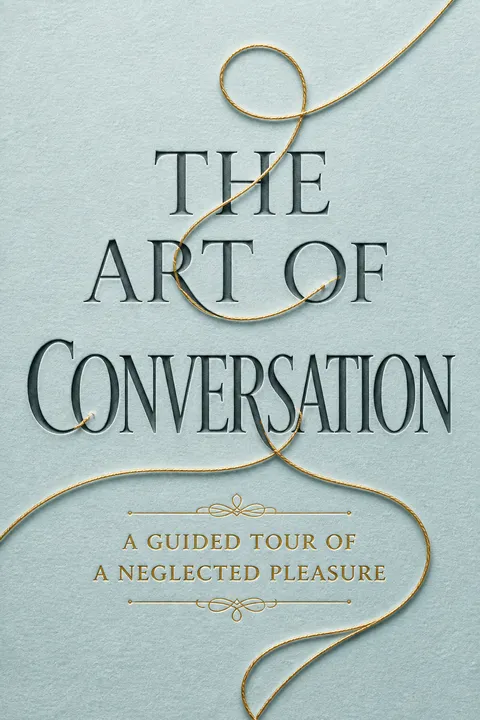
The Art of Conversation receives mixed reviews, with an overall rating of 2.80 out of 5. Some readers appreciate the book's content, historical anecdotes, and insights on improving conversational skills. However, many criticize the author's writing style as disorganized, overly clever, and difficult to follow. Critics also note the book's excessive use of quotes and examples, lack of practical advice, and occasional contradictions. While some find value in the exploration of conversation as an art form, others feel the book fails to deliver on its promise of improving communication skills.
People Also Read



Glossary
phatic speech
Relationship-signaling languageSpeech whose main purpose is to establish or maintain social connection rather than convey new information. A remark about pleasant weather, for instance, may matter less for its factual content than for signaling friendliness and willingness to interact. Blyth presents this as one function of small talk, while emphasizing that small talk can also discover topics and guide a conversation.
musical companionship
Early conversational coordinationThe back-and-forth vocal interaction between infants and caregivers, including changes in pitch, timing, facial expression, and turn-taking. In the book, this early exchange is described as a foundation for learning the rhythms of communication and emotional connection. The term emphasizes that conversational abilities develop through responsive interaction, not simply exposure to words.
topic bid
Offer to shape a topicA conversational move that proposes, continues, or redirects a subject. A bid can be direct, such as asking a question, or indirect, such as making an observation that invites a response. How another person reacts helps determine whether the subject expands, stays in place, or gives way to something new.
Tedium Index
Prompt for checking conversational balanceBlyth’s playful measure of conversational boredom: divide the time a speaker takes by the listener’s interest, rated from 1 to 10. A higher result suggests a greater mismatch between the speaker’s demands on attention and the listener’s engagement. It is a practical reminder to check the balance of a conversation, not a validated psychological test.
three-part complaint formula
Describe behavior and impactA method for raising a complaint by identifying the other person’s behavior, explaining its effect, and giving the reason it matters. Blyth presents the structure as a way to make a concern specific without immediately assigning malicious intent. It can keep a conversation focused on what happened and what should change, rather than on broad attacks against character.
FAQ
What's The Art of Conversation about?
- Exploration of Conversation: The Art of Conversation by Catherine Blyth explores the nuances and significance of conversation in human interaction, portraying it as an art form that enriches lives and fosters connections.
- Modern Challenges: The book examines how modern technology and social changes have impacted our ability to engage in meaningful conversations, often resulting in superficial interactions.
- Practical Guidance: Blyth offers practical advice and techniques to improve conversational skills, making it accessible for readers seeking to enhance their social interactions.
Why should I read The Art of Conversation?
- Enhance Social Skills: The book provides insights that can transform awkward silences into engaging dialogues, essential for personal and professional relationships.
- Understand Human Connection: It highlights the importance of conversation as a means of connection, helping readers appreciate the depth and joy of meaningful exchanges.
- Cultural Commentary: Blyth critiques contemporary communication, making it relevant for those interested in understanding modern social dynamics.
What are the key takeaways of The Art of Conversation?
- Importance of Listening: Great conversationalists listen more than they talk, fostering deeper connections and understanding between individuals.
- Navigating Topics: Choosing appropriate topics is crucial, as good topics create talk and should be relevant and accessible to all parties involved.
- Silence as a Tool: Silence can be meaningful, allowing for reflection or prompting others to speak, enhancing the quality of interaction.
What are the best quotes from The Art of Conversation and what do they mean?
- “True ease in talking comes from art, not chance.”: Effective conversation is a skill developed through practice and understanding, not spontaneity.
- “If people only spoke when they had something to say, the human race would soon lose the power of speech.”: Highlights the necessity of small talk and casual conversation for maintaining social bonds.
- “Conversation is second only to sex, a lot less hassle, and it really matters.”: Emphasizes the fundamental role of conversation in human connection.
What specific methods or advice does Blyth offer in The Art of Conversation?
- Starting Conversations: Simple greetings can spark connections and set the tone for further dialogue, making the takeoff phase critical.
- Navigating Difficult Topics: Approach sensitive subjects with tact and empathy to avoid discomfort and maintain a positive interaction.
- Using Silence Effectively: Silence can create space for thought and reflection, enhancing the overall quality of the interaction.
How does The Art of Conversation address modern communication challenges?
- Impact of Technology: Technology has led to less meaningful face-to-face interactions, with digital connections often lacking the richness of personal conversation.
- Cultural Shifts: Societal changes have affected conversational skills, with many feeling intimidated or unsure about engaging in dialogue.
- Encouragement to Engage: Blyth encourages reclaiming the art of conversation by consciously engaging with others to foster deeper connections.
What are some common conversational pitfalls discussed in The Art of Conversation?
- Talking Too Much: Dominating conversations can alienate listeners and stifle meaningful exchanges, emphasizing the need for balance.
- Avoiding Silence: Many fear silence and fill it with chatter, leading to superficial conversations rather than deeper connections.
- Inappropriate Topics: Choosing unsuitable topics can lead to discomfort or conflict, highlighting the importance of relevance and sensitivity.
How can I improve my conversational skills based on Blyth's advice in The Art of Conversation?
- Practice Active Listening: Focus on truly hearing others, interpreting their emotions and intentions, not just their words.
- Engage with Curiosity: Approach conversations with genuine interest, asking open-ended questions to encourage sharing.
- Be Mindful of Body Language: Non-verbal cues significantly impact the flow and tone of conversation, so pay attention to them.
What role does humor play in The Art of Conversation?
- Social Bonding: Humor creates connections and eases tension, making interactions more enjoyable and engaging.
- Navigating Awkwardness: It can diffuse uncomfortable situations, allowing smoother transitions in stalled conversations.
- Enhancing Engagement: Light-heartedness keeps conversations lively, encouraging participants to open up and share more.
How does Blyth suggest handling difficult conversations in The Art of Conversation?
- Preparation and Empathy: Consider the other person's perspective and feelings to approach topics with sensitivity.
- Using Clear Communication: Be clear and direct while being tactful to convey messages without causing unnecessary hurt.
- Allowing for Silence: Pauses give both parties time to process thoughts and emotions, leading to more constructive dialogue.
What techniques does Blyth suggest for dealing with difficult conversationalists?
- Diverting Attention: Redirect focus with fresh ideas to keep discussions engaging and avoid monotony.
- Teasing as a Strategy: Light teasing can disarm self-important individuals, using humor to challenge authority without confrontation.
- Listening and Engaging: Even with difficult conversationalists, listen carefully to find valuable insights within their words.
How can I apply the concepts from The Art of Conversation in my daily life?
- Practice Active Listening: Truly hear what others say to respond thoughtfully and keep conversations engaging.
- Engage with Curiosity: Ask open-ended questions to draw out more from your conversational partner.
- Be Observant: Use surroundings as conversation starters to find relatable topics that spark interest and connection.
Download PDF
Download EPUB
.epub digital book format is ideal for reading ebooks on phones, tablets, and e-readers.








