

Key Takeaways
Turn any journey into pilgrimage by giving it a question that matters.
A journey needs purpose. Cousineau’s central claim is that pilgrimage is not limited to religious travel or famous shrines. It is any journey made with serious intent, close attention, and a hope of being changed. The destination matters, but the way the traveler sees matters more. A crowded monument can leave someone unmoved, while an ordinary encounter can feel sacred.
A vow gives the road weight. Cousineau’s childhood fascination with Angkor Wat began with a book from his father. After his father died, he promised himself he would visit the temples for both of them. Years later, standing among the ruins with his brother, he found wonder, grief, and the shadow of Cambodia’s recent violence together. The journey became more than sightseeing: it gave his private longing a place in the world.
The book’s strongest move is to relocate the sacred from the site alone to the relationship between place, attention, and purpose. That makes the idea available to people who do not share a faith or have the means to travel far. It also guards against treating famous places as automatic sources of insight. Still, reverence can become a tourist’s projection if it ignores local history and living communities. Cousineau’s Angkor story resists that danger by keeping the temples’ beauty alongside the evidence of war and suffering.
Treat longing as a compass, not a demand for instant escape.
Notice what aches. Cousineau presents longing as a signal that something important feels absent: creativity, faith, family connection, beauty, or a sense of direction. It can point toward a distant place, but the place is not a guaranteed cure. The value lies in identifying what the desire is asking for. A trip to a writer’s home, a family’s ancestral region, or a quiet natural setting can give that question a shape.
Make the desire specific. Cousineau traces his own attraction to Angkor to a book his father gave him as a boy. That early image kept the place alive in his imagination and eventually became a promise he could fulfill. He also describes travelers drawn by poetry, family history, and sacred art. Naming the source of the pull turns vague restlessness into an intention that can guide preparation and choices on the road.
Longing can be useful because it organizes attention: once a person names what matters, details that once seemed incidental become relevant. This resembles narrative identity, the way people make sense of their lives by linking memories and future aims into a story. But desire is not always a reliable instruction. It may reflect idealized images, commercial marketing, or a wish to avoid a difficult situation at home. The book’s more grounded advice is to ask what the destination represents, then remain open to an answer that differs from the fantasy.
Travel far enough to hear what your own home could not tell you.
Distance can reveal the nearby. A Hasidic tale tells of Rabbi Eisik, who repeatedly dreams of treasure beneath a bridge in Prague. When he arrives, a guard laughs at the dream and says he himself dreamed of treasure hidden behind a stove in the home of a rabbi named Eisik. The rabbi returns to Cracow, searches behind his stove, and finds the gold. His journey does not locate treasure abroad. It makes him understand where to look at home.
The stranger helps interpret. Cousineau uses this story to describe pilgrimage’s paradox: insight may be close, yet travel loosens familiar habits enough to make it visible. A new landscape, conversation, or difficulty can interrupt the assumptions that keep a person from seeing what is already present. The journey is not an escape from home so much as a changed route back to it.
The tale offers a useful model of perspective change. Novel settings disrupt automatic attention, while encounters with unfamiliar people expose the limits of one’s usual explanations. In that sense, travel resembles a thought experiment conducted in real life. The caveat is that novelty alone does not create insight; constant motion can distract as readily as it can clarify. The rabbi’s return is essential to the story. Without reflection, the traveler may collect impressions without discovering what they mean for ordinary life.
Prepare carefully, then leave a gap where surprise can enter.
Give the journey a frame. Cousineau recommends clarifying why the trip matters, learning something about the place, and preparing practical and personal rituals. Travelers in his examples read local poetry, study maps, keep journals, seek an elder’s blessing, or carry a small object tied to someone they love. Preparation helps a person notice more, rather than merely arrive with a camera and a checklist.
Do not script every moment. Joseph Campbell once met a woman who had planned her Greek pilgrimage so precisely that she seemed to leave no room for discovery. He teased that the divine could hardly find her if she controlled every step. Cousineau’s point is not to reject planning, but to keep it from becoming a wall against unplanned encounters. A Polynesian navigator’s training offers the other side: before departure, he learned the route and its changing conditions so thoroughly that he could hold the destination in mind while responding to the sea.
This balance resembles the distinction between a plan and a procedure. A plan gives direction; a procedure lets someone adapt when conditions change. Preparation can also lower cognitive load, leaving more attention for people and places instead of logistics. Yet openness should not be confused with carelessness, especially in unfamiliar or risky settings. The most compelling version of the advice is disciplined receptivity: know enough to act responsibly, but do not mistake a full itinerary for control over experience.
Train attention until a place becomes more than a backdrop.
Practice seeing in detail. Cousineau argues that meaningful travel depends on learning to notice, not simply on covering ground. He draws on the poet Rilke, who was struggling to write until the sculptor Rodin urged him to study one animal closely. Rilke returned to the Paris zoo and observed a panther until sustained attention began to renew his perception. On the road, a traveler can do something similar by following a theme, such as doorways, local markets, or the changing light.
Make memory deliberate. Cousineau recommends walking, listening, reading, sketching, and writing down sensory impressions. His five recurring practices include attention, daily renewal, wandering toward the center of a place, reading meaningful texts, and expressing gratitude. These habits slow the rush from attraction to attraction. A journal or sketch is not just a record; making it asks the traveler to look again.
Attention is not passive reception. It is selective work, and the chosen focus changes what becomes perceptible. Writing or drawing can deepen that work because each requires a person to organize impressions rather than merely accumulate them. This helps explain why a single carefully observed scene may outlast a packed itinerary in memory. Still, attention should not become another performance metric. The goal is not to produce an impressive travel journal, but to make contact with what is actually there, including what resists the traveler’s preferred story.
Use setbacks as a thread through the labyrinth, not proof you failed.
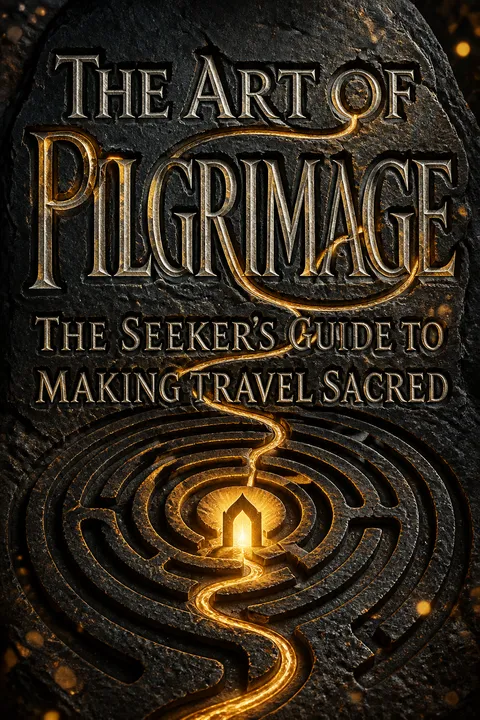
Expect the route to twist. Cousineau uses the labyrinth as an image for the confusion, delay, grief, and disappointment that can overtake a purposeful journey. In the Greek myth, Ariadne gives Theseus a thread to help him find his way through the maze and back out. Cousineau calls this guiding thread a clew: a clue, intuition, or remembered purpose that helps the traveler keep moving when the route becomes difficult.
Difficulty can clarify, but it is not automatically good. On a pilgrimage to the Holocaust memorial at Yad Vashem, filmmaker Gary Rhine felt despair about humanity’s capacity for cruelty. During the flight home, he concluded that the appropriate response was to work harder against cruelty, not give up. The experience redirected his life’s work. The book does not make every hardship a lesson; it asks travelers to respond thoughtfully rather than assume a setback has erased the journey’s value.
The labyrinth image is powerful because it distinguishes disorientation from failure. A person can lose the easy route while remaining oriented toward a meaningful purpose. That is useful in travel, grief, and other forms of change. The account of Yad Vashem also shows why hardship should not be romanticized: some experiences are devastating, and any meaning drawn from them belongs to the person who endured them. The ethical task is to honor the reality of harm while asking what response, if any, the experience makes possible.
Arrive with a question, and let the destination answer obliquely.
The site is not a vending machine. Ancient pilgrims went to Delphi to consult an oracle, but its answers were famously ambiguous. Croesus, king of Lydia, asked whether he should attack Persia and heard that crossing the river would bring down a mighty empire. He attacked and lost his own. He had assumed the prophecy referred to Persia. Cousineau sees the episode as a warning: a sacred place may provoke reflection, but it does not provide a simple guarantee or decision.
Let arrival be an encounter. Before visiting a place that matters, Cousineau suggests waking early, reading, praying or sitting quietly, and carrying one question through the day. The goal is not to force a revelation. The poet Basho found meaning by noticing a familiar stone and its connection to writers who had visited centuries before. What matters is the traveler’s readiness to meet the place, not the site’s fame or the number of sights collected.
Questions can make an experience more generative because they direct attention without dictating the answer. This is close to the logic of good inquiry: a strong question opens possibilities and tests assumptions rather than seeking confirmation. The Delphic story adds an important caution about interpretation. People can bend ambiguous signs toward what they already want to believe. A useful practice is to distinguish the event itself from the meaning assigned to it, then ask whether that meaning remains persuasive after returning to ordinary circumstances.
Bring home a practice, not merely souvenirs from the road.
The journey is incomplete without return. Cousineau describes pilgrimage as a cycle: departure, arrival, and return. The final task is to carry some part of the experience into daily life, through a changed habit, a story, a creative work, or a renewed commitment to others. A traveler can finish a journal, make a memory box, share a meal, or place a small object on a home altar as a way to remember what the trip clarified.
Angkor closes the circle. At the end of his long-awaited visit, Cousineau lit a candle for his father in the temple and thought about the father whose book had first stirred his interest in the place. The visit brought a sense of completion, but not an end to travel or grief. Its gift was renewed connection to his father’s love and to the story that had carried him there. The point is to bring the insight back into life, not to display the miles traveled.
Return is the test of whether an experience has become part of a life rather than a vivid exception to it. Memory practices help preserve details, while storytelling lets others participate in what the traveler learned. The idea of a gift also shifts the emphasis away from personal transformation as a private trophy and toward what can be shared. Yet not every journey needs to produce a public lesson or a grand service project. Sometimes the durable boon is modest: attention restored, grief acknowledged, or a relationship seen differently.
Analysis
The book is part travel memoir, part spiritual guide, and part anthology of other people’s journeys. Its seven-stage arc follows longing, calling, departure, travel, ordeal, arrival, and return. That sequence gives shape to an expansive collection of histories, poems, religious practices, and personal stories. The organizing idea is not that travel automatically makes people wiser. It is that intention changes what a traveler notices, and attention can make a journey meaningful even when the destination is ordinary or the experience disappointing.
Cousineau’s own trip to Angkor supplies the emotional backbone. A childhood book from his father becomes a vow after his father dies, and the eventual visit brings together beauty, family memory, historical violence, and grief. The story demonstrates the book’s central method: let a concrete place give form to an inward question, then return with a changed understanding. Other examples broaden the method beyond conventional religion, from literary shrines and family-history trips to peace activism and visits to sites of trauma.
The book’s strength is its unusually rich account of attention as a practice. Reading before departure, walking slowly, asking questions, keeping a journal, and leaving offerings all make travel participatory rather than consumptive. Its recurring labyrinth image also allows for uncertainty without treating every obstacle as defeat. The return journey matters because an insight that never enters daily life remains only a travel memory.
The approach has limits. Sacred language can impose a traveler’s interpretation on places whose meanings belong to local communities, and the book’s emphasis on individual revelation can understate the economic and political conditions that shape access to travel. It also risks making hardship seem inherently redemptive. The most careful reading preserves its invitation to attention while refusing those shortcuts. A journey becomes worthwhile not because it guarantees revelation, but because it can train a person to look, listen, and respond more fully, at home as well as away.
Review Summary
Glossary
pilgrimage
purposeful, transformative journeyCousineau uses pilgrimage for both traditional religious travel and any journey undertaken to pursue something deeply important. It combines a meaningful intention with attention to the route, encounters, and destination. A pilgrimage may be to a sacred shrine, an ancestral home, a site of historical memory, or a place that represents a personal commitment.
Kairos
the charged momentKairos is the Greek figure and idea associated in the book with the ripe, passing moment of opportunity. It represents a chance or encounter that calls for attention and response. The concept cautions that an opening may be brief, so travelers should remain alert rather than assume that meaningful possibilities arrive on schedule.
clew
a guiding threadA clew is the thread Ariadne gives Theseus in the Greek labyrinth myth so he can find his way back from its center. Cousineau connects the word to a clue or guiding sign. In a difficult journey, a clew can be intuition, patience, a remembered purpose, or another source of orientation when the traveler feels lost.
touchstone
a test of authenticityA touchstone was a dark stone used to test the purity of gold by the mark left when gold was rubbed against it. Cousineau extends the image to a person, practice, or question that helps travelers judge whether a place or experience feels genuinely meaningful. It provides a point of discernment rather than a guarantee.
pilgrim mood
attentive inward readinessThe pilgrim mood is a state of reflective attention in which a traveler becomes receptive to memory, emotion, and the significance of ordinary encounters. Cousineau describes it as something that can arise during quiet moments on the road, prompting a person to write, sketch, read, or sit with an experience instead of brushing it aside.
turas
a sacred circuitTuras is an Irish term used in the book for a ritual journey or circuit, often to holy wells, saints’ graves, chapels, or ancient sites. Travelers traditionally walked these routes while praying or singing, sometimes leaving small offerings. The practice links movement through a landscape with devotion, remembrance, and renewal.
boon
wisdom brought backThe boon is the insight, knowledge, or renewed capacity a traveler carries home from a meaningful journey. In the book, it is not a trophy or a tale told to impress others. It becomes valuable when remembered, shared, or put into practice in ordinary life, completing the journey’s movement from departure through return.
Download PDF
Download EPUB
.epub digital book format is ideal for reading ebooks on phones, tablets, and e-readers.








