

Key Takeaways
Treat the garden as a story that teaches beyond the flower.
A living parable. A parable is a story whose everyday events point toward a larger meaning. Roach uses gardening this way: sowing, waiting, losing plants, and starting again become lessons about attention, grief, and limits. Her first garden was a cramped, badly planned patch planted while someone she loved was seriously ill. The plants did not solve the illness, but tending them gave her work, possibility, and a way to keep going. Over decades, the garden became a spiritual practice, not simply an outdoor decoration.
The book follows one difficult garden year through Water, Earth, Fire, and Wind, while practical guidance on seeds, pruning, birds, and soil grounds its reflections. The horticultural details are not a detour from the meaning. They are where the meaning takes root.
What's striking is how the book makes reflection physical. Digging, noticing, and tending give abstract questions a scale the body can work with. This resembles the role of ritual in many traditions: repeated ordinary actions create a setting for attention without requiring a sudden revelation. The garden is not presented as a universal cure, and that distinction matters. Grief and illness remain real; the practice offers companionship and structure, not control over outcomes. The book's strongest claim is therefore modest and durable: close attention can make a difficult life more inhabitable.
Plan for recurring cycles, not a permanently finished garden.
Six human seasons. Roach divides the garden year into Conception, Birth, Youth, Adulthood, Senescence, and Death and Afterlife. Seed planning belongs to conception; the first shoots signal birth; summer growth brings youth and adulthood; autumn makes decline visible; winter returns plant matter to the cycle through compost. This calendar links garden tasks to human stages without pretending the resemblance is exact.
The book's four main sections use the elements instead: winter is Water, spring is Earth, summer is Fire, and autumn is Wind. The gardener's own schedule is never fully in charge. Growth, dormancy, weather, and decay keep recurring, while the work changes with them. A garden is not a project that reaches a final, maintenance-free state. It is a relationship with a moving calendar.
The seasonal model offers a useful alternative to treating every pause as lost productivity. In ecological systems, dormancy is not the opposite of life; it is one of life's operating modes. That perspective can also soften human impatience with periods that feel unproductive. Still, the metaphor should remain a guide, not a rigid map. Roach gardens in a particular northern climate, and the dates and plant behavior she describes cannot simply be transferred elsewhere. The transferable insight is to read local conditions and repeated patterns rather than demand that nature obey a universal timetable.
Design for the view you actually live with.
Start indoors. Roach's practical design rule begins at the window, because much of her garden viewing happens from inside the house, especially in winter. She identifies the seats and windows she uses most, then places plants along those sightlines. Foliage, bark, berries, and evergreen structure keep a view interesting beyond a brief flowering period. A group of winterberry hollies, for example, offers red fruit across the colder months.
Her first aim was to attract birds. Choosing viburnums for their fruit also brought spring flowers and, in some cases, autumn color. Water helps sustain birds year-round, including a heated opening in a pond during freezing weather. These choices turn the garden into both habitat and a changing picture, with something to notice from the house in every season.
This approach joins landscape design to the ordinary architecture of attention. A garden is experienced from particular chairs, doorways, and daily routines, not from an imaginary viewpoint in a design book. The principle applies beyond gardens: arrange a space around the moments when people actually use and see it. Habitat value adds another layer, since birds need more than a picturesque feeder. There is a practical tension, though: a highly composed view can privilege human pleasure. Roach's emphasis on water, fruit, cover, and insects helps keep the living community in the frame.
Give woody plants room, then edit without sentimentality.
Think past the sapling. Small nursery plants invite overplanting, but shrubs and trees keep expanding long after the garden seems full. Roach learned this through crowded beds, plants planted too close, and mature specimens that later needed removal. Her advice is to check a woody plant's expected mature width and allow extra space, since published estimates may understate what a plant does in a particular garden.
When old plants become crowded, damaged, or unsuitable, editing is part of care, not proof of failure. Roach moves toward more shrubs and dependable groundcovers, with fewer demanding perennial beds. Beneath trees, an underplanting mosaic combines repeated drifts of foliage plants with smaller seasonal accents. It takes patience and upkeep, so she recommends using it where the detail will be seen and keeping simpler groundcover for less prominent areas.
The garden's long time horizon creates a familiar planning problem: today's inexpensive choice can become tomorrow's maintenance burden. Designing for mature scale is a form of lifecycle thinking, similar to building infrastructure that can be maintained rather than merely launched. The advice also recognizes that a garden is not static property; it is a changing arrangement that needs periodic revision. The caution is that restraint can become its own aesthetic dogma. Roach's preference for simpler plantings fits her age, workload, and site, but another gardener may reasonably choose greater complexity and accept the labor.
Observe before intervening; identify the creature before declaring war.
Diagnose the damage. Holes, tunnels, and eaten plants are evidence, but not a diagnosis. Roach learns to distinguish the traces left by voles, chipmunks, moles, and woodchucks before deciding what to do. That attention matters because the appropriate response depends on the animal. She tolerates many insects, recognizing that they feed other creatures, while using barriers or hand removal for particular threats. For deer, years of sprays and improvised protections fail to protect the garden's woody backbone, so she researches local conditions and installs fencing.
The same patient observation changes her response to caterpillars. Rather than automatically crushing an unfamiliar one, she watches, identifies it, and considers its role in the wider food web. The lesson is not to leave every problem untouched. It is to replace reflexive extermination with informed, proportionate action.
This is a practical form of systems thinking: an organism's effect on one plant does not reveal its full ecological role. Careful identification can prevent needless harm and make interventions more effective. The approach also distinguishes tolerance from passivity. Roach accepts some damage but fences deer when the accumulated losses become untenable. That balance is more persuasive than a simple command to coexist with everything. The hard question is how to set the threshold for intervention. The book offers experience and observation rather than a universal formula, leaving each gardener responsible for weighing damage against ecological costs.
Choose materials and methods that feed the garden's living community.
Steward the whole system. Roach's environmental commitments reach beyond avoiding chemical sprays. She favors organic seed when available, buys edible seed from companies that take the Safe Seed Pledge, and rejects treated seed. She explains that seed crops can require more water and chemical inputs than crops harvested young, and that seed raised under intensive conditions may be less suited to an organic home garden.
She also chooses local, composted mulch that can break down into soil, rather than dyed or synthetic materials that do not return to it. In the garden, she relies on compost, barriers, hand removal, and habitat that supplies birds with food and cover. These choices do not eliminate labor or loss. They express a preference for supporting the soil and food web instead of treating every difficulty as a reason to reach for a packaged remedy.
The book makes environmental ethics concrete by connecting purchasing decisions to cultivation practices. A seed packet, mulch delivery, or pest-control choice participates in a larger system of production and waste. This is a useful corrective to the idea that ecological gardening is simply conventional gardening without one class of products. It asks what a method supports over time. The trade-off is real: certified options may be unavailable or costly, and local conditions shape what works. Roach acknowledges that responsibility does not require perfect purity; it requires informed choices and a willingness to keep evaluating them.
Let losses change the plan instead of defining the season.
Begin again after damage. Roach's garden year is battered by excessive rain, pests, equipment failures, injury, and a freak October snowstorm that breaks mature trees and shrubs. She cannot restore the old scene by force. After the storm, her mentor's practical counsel is to remove the wreckage promptly and start imagining what might occupy the gaps. The work is both literal cleanup and a way to stop treating absence as the garden's only future.
This response does not make the losses pleasant. Roach grieves particular plants, including a long-loved tree, while accepting that some will not return. Gardening teaches her that survival is uneven: some things die, others persist, and the next season arrives without asking whether she feels ready. Recovery means acknowledging damage, doing what can be done, and making a new plan within the limits of the site and body.
The passage offers a grounded model of recovery: first recognize the loss, then clear what obstructs further action, then imagine replacement without pretending the original did not matter. That sequence has relevance to many forms of disruption because it combines mourning with agency. The metaphor should not be used to rush grief or imply that every loss needs to be redeemed by growth. In Roach's account, the garden's renewal is possible partly because she has a physical place and practical help. Her story honors both resilience and dependence on other people.
Keep curiosity alive, but prune obligations as the garden grows.
Make room to notice. Early in her gardening life, Roach wanted every plant and pursued each new discovery as a lesson in botany. Years of tending an overgrown garden change that appetite. She and a friend recognize that their elaborate gardens have become burdens, and consider simplifying them to trees, shrubs, and reliable groundcovers. The garden's size becomes a warning about trying to be everywhere and do everything.
Yet simplification need not mean closing the door on discovery. A newer gardener's enthusiasm helps Roach see familiar plants with fresh eyes, and exchanging seeds, cuttings, advice, or labor creates companionship. Her standard for a worthwhile garden is not flawless control. It is a place that keeps teaching, while remaining possible to care for. Curiosity sustains the practice; pruning commitments keeps it livable.
The tension here is not between ambition and laziness, but between exploration and capacity. A project can begin as a source of identity and quietly become a system of obligations. Simplifying preserves the underlying value by reducing the tasks that crowd out attention and pleasure. The renewed perspective offered by less experienced gardeners also suggests that expertise is healthiest when it stays porous. Familiarity can sharpen judgment, but it can also narrow perception. The book's answer is not to stop learning, but to make the practice small enough to keep seeing.
Analysis
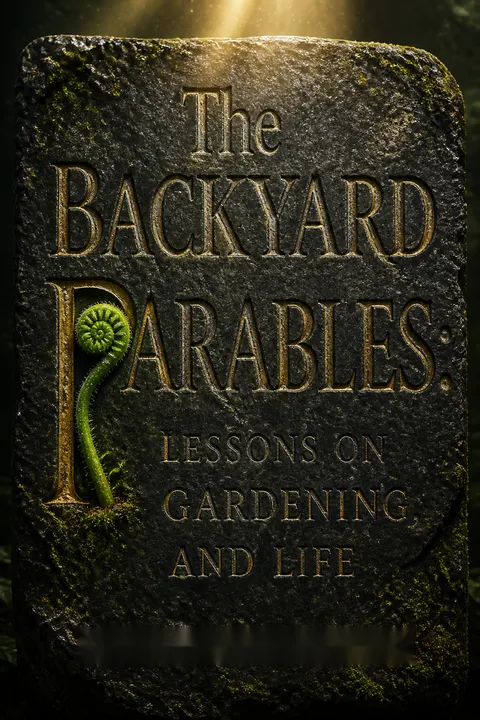
The Backyard Parables is part garden memoir, part practical manual, and part meditation on mortality. Its structure follows a year shaped by four elements, but its deeper organizing pattern is the repeated collision between a gardener's wish to shape nature and nature's refusal to stay shaped. Roach begins with an imperfect first garden planted during family illness, then returns to that tension through frozen ponds, overcrowded shrubs, animal damage, heat, flood, and storm loss. The garden's practical demands make its philosophical claims credible: surrender is not an idea she adopts from a distance, but a lesson encountered while trying to protect a frog pond or deciding which old tree must come down.
The book's distinctive strength is its double register. Botanical facts and workaday advice keep the reflections accountable to real plants, while humor and self-mockery prevent the spiritual language from becoming solemn doctrine. Its ecological ethic is similarly practical rather than pure. Roach avoids many chemicals and welcomes much wildlife, yet fences deer and removes particular pests when damage becomes too great. The result is not a claim that humans can disappear from the garden, but that intervention should be selective and aware of consequences.
The perspective also has limits. The advice grows from a large rural property in a cold New York climate, with access to a house, storage spaces, tools, and occasional help. Readers in different climates, smaller homes, or less resourced circumstances cannot reproduce every technique. Nor does the garden's consoling role erase the seriousness of illness, aging, or environmental disruption. These limits strengthen the book when treated as context rather than universal prescription. Its broadest contribution is a method of attention: learn a place's rhythms, notice what your actions affect, accept that control is partial, and keep adapting without mistaking adaptation for defeat.
Review Summary
The Backyard Parables receives mixed reviews, with an average rating of 3.63 out of 5. Readers appreciate Roach's gardening wisdom, philosophical musings, and witty writing style. Many find the book enjoyable and insightful, particularly for experienced gardeners. However, some criticize the meandering narrative and frequent digressions. The book's structure, divided into seasons, explores gardening techniques, life lessons, and the author's personal experiences. While some readers found it slow-paced, others praised its depth and reflective nature.
People Also Read





Glossary
Backyard parables
Garden stories with meaningRoach's term for lessons drawn from ordinary gardening events. Planting, pruning, animal damage, seasonal change, and plant death remain literal horticultural experiences, but also illuminate questions about grief, control, patience, and human life. The garden's factual details act as the story through which a larger insight becomes visible.
Six seasons
A life-stage garden calendarRoach's expanded calendar of Conception, Birth, Youth, Adulthood, Senescence, and Death and Afterlife. It maps planning, emergence, rapid growth, maturity, decline, and dormancy onto the garden year. The framework makes recurring botanical change easier to understand as a cycle rather than a simple season of growth followed by an ending.
365-day garden
A garden with year-round interestA landscape designed to remain engaging and useful throughout the year, including winter. Roach develops this approach through plants with persistent fruit, distinctive bark, evergreen foliage, and seasonal structure, along with water and habitat for birds. It reflects both her interest in wildlife and the fact that she lives in and observes the garden year-round.
Phenology
Nature's timing calendarThe study of recurring life-cycle events in plants and animals, and how their timing relates to weather and climate. Gardeners can track events such as flowering, insect emergence, bird arrival, and frog calls, then use local patterns as seasonal cues. Unlike fixed calendar dates, phenological timing responds to conditions such as temperature, rainfall, and day length.
Underplanting mosaics
Layered plant communities below shrubsRoach's approach to planting beneath trees and shrubs with a designed mix of groundcover plants, foliage textures, seasonal bulbs, and occasional standout specimens. Rather than using a single uniform carpet, the gardener repeats drifts and combinations to create a layered effect. These plantings require more maintenance, so she recommends placing them where their detail will be noticed.
Download PDF
Download EPUB
.epub digital book format is ideal for reading ebooks on phones, tablets, and e-readers.








