

Key Takeaways
Cruyff turned inherited passing ideas into Barcelona's governing identity.
The roots run deep. Wilson traces the lineage from Scotland’s 1872 international, when Queen’s Park used passing to counter England’s more physical game, through a chain of Scottish and English coaches to Ajax. Vic Buckingham carried those ideas to Amsterdam, where Rinus Michels and Johan Cruyff added movement, pressing, and collective positioning. Cruyff’s revolution was not an invention from nowhere. It was an old tradition made more ambitious and coherent.
A legacy becomes identity. Cruyff’s Barcelona won four league titles in a row and the club’s first European Cup, but his final season ended in a bitter dismissal. The contrast is central: a manager can lose his job while his ideas outlive the results that ended it. Cruyff’s influence remained embedded in Barcelona’s sense of how the game should be played.
What's striking is how this history complicates the familiar story of the solitary genius. Cruyff’s achievement depended on ideas transmitted across generations, then recast by a singular mind. That is how durable traditions work: they preserve principles while allowing new practitioners to reinterpret them. The risk is turning inheritance into a purity test. A tradition stays alive through adaptation, not by treating every departure from its founding era as betrayal.
Use possession to control space, deny counters, and create better attacks.
The ball is a tool. Cruyff’s approach sought to win possession, keep it, and use it to make the opponent defend. His teams spread out when attacking, compressed space when defending, and maintained close passing options. Guardiola’s preferred term, juego de posición, describes players occupying and rotating through positions that give the ball carrier several useful choices. Barcelona’s goalkeeper also joined the build-up, while a high defensive line helped keep the team compact.
Possession needs purpose. Guardiola’s City averaged 66.4 per cent of the ball and 743 passes per league game in 2017-18, but the numbers alone cannot tell whether a team is dangerous. The point is to use circulation to create space, reach advanced players, and stay organized if possession is lost. Passing without that purpose can become sterile.
This model treats space as something a team actively manufactures, rather than empty ground waiting to be occupied. In cognitive terms, familiar passing angles reduce the burden of deciding under pressure: teammates know where options are likely to appear. Yet possession statistics are an imperfect proxy for control. A team can have the ball and still concede the most dangerous chances. The more revealing question is what possession makes possible, and what risks its structure leaves behind.
Give players freedom inside a structure they have rehearsed together.
Freedom needs a framework. Total Football asked players to exchange positions while preserving the team’s shape and shared understanding. Cruyff made training a constant lesson in spacing, body position, and choosing the right pass. His Barcelona side practiced for thousands of hours before the Dream Team’s patterns became instinctive. Players were expected to press together too, not merely admire the ball after losing it.
Too little discipline frays the system. Ajax’s coach Ştefan Kovács gave an exceptionally talented team more room for self-expression after Michels’s stricter reign. The team played exhilarating football, but its discipline and shared spirit weakened, and its success faded. Cruyff saw the tension clearly: a system needs individual initiative, yet initiative becomes disorder when players no longer agree on their responsibilities.
The useful comparison is not between creativity and rules, but between improvisation with shared cues and improvisation without them. Jazz musicians can depart from a melody because they know its structure and can hear one another. Football has the same coordination problem, with less time to communicate. Still, too much dependence on a coach’s corrections can make players obedient rather than resilient. The strongest structure teaches players how to solve problems, not only where to stand.
Barcelona trained both Guardiola's heirs and Mourinho's counter-vision.
A coaching network formed. When Bobby Robson arrived at Barcelona in 1996, José Mourinho came as his translator, but quickly took on scouting and tactical responsibilities. The squad included Pep Guardiola, already a student of the game. Louis van Gaal succeeded Robson and made Guardiola captain, while giving Mourinho increasing responsibility for opposition analysis and training. Other future coaches, including Ronald Koeman and Frank de Boer, also passed through the club.
Shared schooling produced different answers. Guardiola embraced positional play and proactive football. Mourinho absorbed the same attention to detail but built a more pragmatic approach, increasingly willing to surrender possession and attack space on the counter. The book presents Barcelona not just as a team, but as a remarkable coaching seminar: people learned from one another, then carried their disagreements into football’s biggest clubs.
This is a powerful example of an organization producing influence beyond its immediate results. Much knowledge in coaching is tacit: it is learned by watching training, studying decisions, and working alongside people who can explain their reasoning. But apprenticeship does not transmit a doctrine intact. Each student filters what they observe through temperament, experience, and ambition. The seminar’s significance lies as much in the divergence it generated as in any shared footballing creed.
Mourinho treated preparation, emotion, and media as parts of the match.
Preparation reached beyond tactics. At Porto, Mourinho used detailed opponent analysis, tightly organized training, and game-like exercises influenced by Vítor Frade’s periodisation. This approach treated fitness, technique, tactics, and confidence as connected, rather than training them in isolation. Players practiced situations that might arise in a match so they could recognize problems and choose responses, rather than memorizing a fixed sequence.
Belief became a competitive weapon. Mourinho also tried to build intense loyalty and a sense that his team faced outside opposition together. He could protect players publicly, confront rivals, and use press conferences to shape the atmosphere around a match. Those methods helped Porto win the Champions League in 2004. But his frequent accusations against referees and opponents also showed the danger: a team’s unity can depend on a manufactured grievance, and the public consequences may outlast the motivational benefit.
Mourinho’s method links skill acquisition to emotional commitment. Practicing realistic situations can help people recognize patterns and make better decisions under pressure, while a leader’s attention to individual personalities can strengthen trust. The boundary between building shared purpose and engineering dependence is less comfortable. A group can become cohesive because it trusts a leader, or because it has been taught to distrust everyone else. Those forms of unity may look similar during a winning run, but they are not equally durable.
Call a tactic pragmatic only when it fits the players and problem.
Pragmatism is not a formation. Mourinho’s teams could press high, keep the ball, sit deep, or counterattack, depending on the players and the match. At Inter, he used a defensive block to eliminate Barcelona’s options in the 2010 Champions League semi-final. Against Chelsea that season, his side instead attacked and controlled possession. Van Gaal also adapted: at AZ Alkmaar he used a compact 4-4-2 and quick counterattacks, and with the Netherlands in 2014 he chose a back three to protect a vulnerable defence.
Adaptation has a limit. These choices were responses to actual constraints, not proof that one style always wins. But a coach can invoke circumstance to defend almost any decision. The important test is whether a change helps the team use its strengths and address the opponent’s threats, or simply excuses a drift away from the principles that once made the team effective.
A good definition of pragmatism is means fitted to ends, not caution mistaken for intelligence. A team should not be judged by whether it has possession, but by whether its choices suit its talent and competitive situation. Still, adaptation can become a rhetorical shield: if every result is explained as the only realistic option, the underlying strategy becomes impossible to evaluate. Useful flexibility requires a stable purpose, clear trade-offs, and honest review of what the chosen approach actually achieved.
The Guardiola-Mourinho rivalry made football style a fight over legitimacy.
One match became a referendum. In 2010, Inter lost 1-0 at Barcelona but advanced to the Champions League final on aggregate, defending with ten men for much of the second leg. Mourinho celebrated openly, treating the victory as proof that Barcelona’s possession game could be stopped. The clash was about more than tactics: Barcelona cast its approach as an ideal, while Mourinho challenged the moral authority that came with that claim.
The conflict turned toxic. Mourinho’s Real Madrid later met Guardiola’s Barcelona repeatedly, including four Clásicos in 18 days in 2011. Refereeing accusations, confrontations, and theatrical protests came to dominate the story. Barcelona’s players and staff were not beyond complaint or gamesmanship, but Mourinho’s persistent public attacks helped turn tactical rivalry into a campaign over who deserved to be believed.
Sports systems acquire moral meanings because supporters identify with more than outcomes. A style can signal creativity, hierarchy, risk, or control, so tactical disagreement easily becomes a claim about character. That symbolism makes football compelling, but it can also distort judgment: attractive play is not automatically virtuous, and winning by defending is not inherently cynical. The useful distinction is between criticizing a method and declaring its practitioners illegitimate. The latter often damages trust in the institutions that make competition meaningful.
A philosophy survives through academies, succession, and institutional choices.
Identity must be taught. Cruyff changed Barcelona’s academy, La Masia, so that young players learned the same basic shape and were selected for technical ability and tactical understanding, not simply height. Guardiola’s team later showed what that pipeline could produce: in 2012, all eleven Barcelona players on the pitch against Levante had come through the club’s youth system.
Institutions can frustrate their own ideals. At Ajax, Cruyff’s 2010 campaign sought to return the club to a player-centered, youth-focused model. Frank de Boer then led Ajax to four consecutive league titles, but the people who had backed the reform disagreed over transfers, coaching, and the quality of the football. Several left. A celebrated tradition could not be preserved by slogans alone; it needed good appointments, coherent authority, and a willingness to resolve internal conflict.
The organizational lesson is that values need mechanisms. An academy can embody a playing philosophy through its coaching, recruitment, and promotion pathways; a board can either support that work or undermine it through conflicting incentives. Yet continuity is not the same as keeping former players in charge. Insider knowledge is valuable, but it can harden into nostalgia or factional loyalty. A sustainable identity needs people able to explain its principles, test them against evidence, and revise what no longer works.
No winning system stays revolutionary once opponents learn to answer it.
Success invites countermeasures. Guardiola’s Barcelona made positional play and pressing look nearly invincible, but opponents adapted, and his Bayern and Manchester City teams could be exposed when rivals broke through their press. City’s 100-point Premier League season in 2017-18 confirmed the system’s power, yet Liverpool’s rapid attacks eliminated them from the Champions League. A league campaign and a knockout tie test different things.
The legacy is influence, not permanence. Barcelona under Luis Enrique added more direct attacking through Messi, Neymar, and Suárez, and won a treble in 2015. Later versions of Barcelona and the Netherlands national team struggled to reproduce earlier success. That does not erase Cruyff’s impact. His ideas shaped the questions elite coaches had to answer, even when they chose different solutions.
This distinction between influence and dominance is essential. A successful model changes opponents’ behavior, which can reduce its own advantage; tactical innovation is partly a moving target. Moreover, league points, knockout success, and aesthetic quality measure different outcomes, so one competition rarely settles the argument. The book’s strongest implication is not that one style has finally won football, but that Cruyff’s approach permanently altered the terms of debate. Its survival depends on renewal rather than imitation.
Analysis
The book’s central subject is not simply Barcelona, Guardiola, or Mourinho. It is the afterlife of a footballing idea: whether a team can make coordinated possession, spatial intelligence, and collective pressing both beautiful and dominant. Wilson traces that idea through a historical lineage, then watches it become an institutional identity at Barcelona and Ajax. The rivalry between Guardiola and Mourinho supplies the drama because both men emerged from the same coaching environment yet came to represent opposing answers to risk, control, and what a manager owes the spectator.
The history makes a valuable distinction between principles and their implementations. Cruyff’s tradition is not one formation or a promise to pass indefinitely. It is a way of organizing space and making players responsible to one another. Van Gaal, Guardiola, Luis Enrique, and Mourinho each adapted what they inherited, with different results. This helps explain why the book resists a simple story of idealists versus pragmatists. Mourinho could attack when the situation called for it, while Van Gaal could counterattack; the genuine divide concerned how much control, risk, and aesthetic purpose each coach was willing to prioritize.
The argument is strongest when it treats football as both a technical practice and a cultural institution. La Masia, the Barcelona boardroom, and Ajax’s academy disputes show that a playing style needs structures that reproduce it. The argument is more debatable when it associates attacking football with greater virtue or suggests a clear tactical lineage can explain results. Elite teams also depend on exceptional players, resources, and timely decisions; beautiful possession cannot guarantee success, as the knockouts repeatedly demonstrate. The book’s enduring insight is therefore not that Cruyff’s football is always superior. It is that his model changed what teams consider possible, and forced even its opponents to define themselves against it.
Review Summary
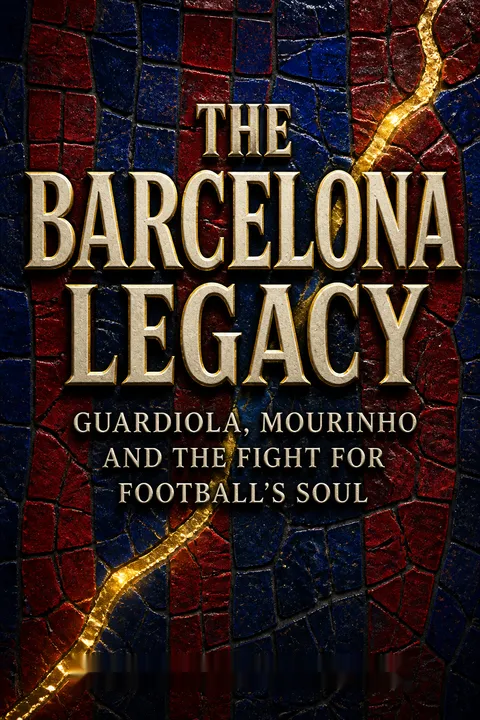
The Barcelona Legacy receives mostly positive reviews, praised for its in-depth analysis of modern football tactics and the influence of Johan Cruyff. Readers appreciate Wilson's exploration of key figures like Guardiola and Mourinho, as well as the interconnected nature of football management. Some criticize the book's bias towards Barcelona and attacking tactics. Many find it an engaging read for football enthusiasts, offering insights into the evolution of the game and the personalities that shaped it. A few reviewers note that the content doesn't fully align with the title's focus on Barcelona.
People Also Read

Glossary
Total Football
Interchangeable collective playA Dutch approach to football associated with Ajax and the Netherlands in the 1970s. Players exchange positions while maintaining the team’s collective structure, using possession, movement, pressing, and a high defensive line to control space. The book emphasizes that Cruyff inherited earlier passing traditions and helped give this approach its most influential form.
juego de posición
Position-based team playSpanish for positional play, the organizing idea associated with Guardiola’s football. Players occupy and rotate through positions that create passing options, numerical advantages, and a shape able to respond if possession is lost. The aim is not simply to keep the ball, but to use positioning to advance, control space, and prepare the team to defend.
periodisation
Game-specific training designA training approach linked in the book to Portuguese coach Vítor Frade and adopted by Mourinho. Rather than separating fitness, technique, and tactics into unrelated drills, it uses football-like situations to develop them together. Players practice recognizing and solving changing problems, with the aim of making them physically and mentally prepared for the demands of matches.
false nine
Striker dropping into midfieldAn attacking role in which the nominal centre-forward moves deeper instead of remaining between the opposing centre-backs. If defenders follow, space opens behind them; if they hold their line, the forward can receive the ball in midfield. Cruyff used the idea against Real Madrid in 1974, and Guardiola later deployed Messi in a similar role.
La Masia
Barcelona's youth academyBarcelona’s youth development system, which trains young players and supplies talent to the first team. Under Cruyff, academy teams were encouraged to learn the club’s playing system, and selection placed less emphasis on physical stature. The book presents La Masia as a means of passing a football identity from one generation to the next.
entorno
Club's surrounding pressuresA Spanish term meaning environment or surroundings, used by Cruyff to describe the political, media, and institutional pressures around Barcelona. He believed these forces could distract or undermine the football operation. The term also captures the club’s persistent entanglement of sporting decisions with internal politics, public opinion, and competing claims to represent its identity.
trivote
Three-player holding midfieldA Spanish football term for a midfield arrangement featuring three deeper or holding players. Mourinho used the shape at Real Madrid, including against Barcelona, to add defensive protection and contest central areas. It could make a team harder to play through, but critics argued that it sometimes placed players out of position and restricted the team’s attacking play.
counter-pressing
Press immediately after losing possessionA defensive response in which players try to recover the ball as soon as their team loses it, before the opponent can organize an attack. The book links this idea to modern pressing football and explains its relationship to Guardiola’s model: the team presses in a coordinated way, but can fall back into a more settled defensive shape if the ball is not recovered quickly.
FAQ
What's The Barcelona Legacy about?
- Focus on Rivalry: The book delves into the intense rivalry between Pep Guardiola and José Mourinho, two of football's most influential managers, and their contrasting philosophies.
- Historical Context: It provides a historical backdrop, tracing the evolution of football tactics from Johan Cruyff's influence at Barcelona to the present day.
- Cultural Reflections: The narrative also explores broader themes such as identity, culture, and the commercialization of football, offering a commentary on the state of the game.
Why should I read The Barcelona Legacy?
- Insightful Analysis: Jonathan Wilson offers a deep analysis of the tactical innovations and managerial philosophies of Guardiola and Mourinho.
- Engaging Storytelling: The book is written in an engaging and accessible style, making complex football concepts understandable for both casual fans and serious analysts.
- Broader Implications: It discusses how the rivalry reflects societal changes and the evolution of sports management, making it relevant for anyone interested in sports, culture, or leadership.
What are the key takeaways of The Barcelona Legacy?
- Contrasting Philosophies: Guardiola's possession-based style is contrasted with Mourinho's pragmatic approach, illustrating the ongoing debate between aesthetics and results in football.
- Impact of Cruyff: Johan Cruyff's influence is a recurring theme, as his philosophies laid the groundwork for modern football tactics.
- Psychological Aspects: The book highlights the psychological dimensions of coaching, including how pressure affects decision-making and performance.
How does The Barcelona Legacy compare Cruyff and Mourinho's philosophies?
- Total Football vs. Pragmatism: Cruyff's Total Football emphasizes fluidity and attacking play, while Mourinho focuses on defensive solidity and counter-attacking.
- Cultural Reflections: Each manager's style reflects their cultural backgrounds, with Cruyff embodying an idealistic vision and Mourinho a results-oriented mindset.
- Impact on Players: Cruyff's methods foster creativity, while Mourinho's tactics require strict adherence to roles, creating different team dynamics.
How do Guardiola and Mourinho's styles differ according to The Barcelona Legacy?
- Guardiola's Approach: Characterized by high possession, intricate passing, and a focus on attacking play, maintaining control through ball possession.
- Mourinho's Tactics: Emphasizes a pragmatic, defensive approach with counter-attacking football, focusing on exploiting opponents' weaknesses.
- Philosophical Implications: Reflects broader debates in football about aesthetics versus results, impacting team building and performance under pressure.
What tactical concepts are discussed in The Barcelona Legacy?
- Total Football: Introduced by Cruyff, involves versatile players, ball possession, and fluid movement to create scoring opportunities.
- Juego de Posición: Guardiola's adaptation, focusing on positional play with passing triangles to maintain game control.
- Counter-Pressing: Mourinho's approach includes counter-pressing, regaining possession quickly to disrupt opponents' rhythm.
What role does Johan Cruyff play in The Barcelona Legacy?
- Philosophical Foundation: Cruyff is portrayed as the architect of modern football philosophy, particularly through his time at Barcelona.
- Cultural Icon: His influence extends beyond tactics, becoming a cultural icon whose legacy is seen globally in football.
- Contrast with Modern Trends: Wilson contrasts Cruyff's ideals with current trends, critiquing commercialization and celebrity culture in football.
How does The Barcelona Legacy address the evolution of football tactics?
- Historical Development: Traces the evolution from Total Football to present, illustrating how different philosophies have emerged.
- Influence of Key Figures: Examines contributions of Cruyff, Guardiola, and Mourinho to tactical evolution, providing a framework for understanding contemporary strategies.
- Modern Adaptations: Discusses how modern coaches adapt traditional tactics, emphasizing flexibility for success in an evolving sport.
How does The Barcelona Legacy reflect on the commercialization of football?
- Impact on Identity: Discusses how commercialization affects club identities and fan relationships, questioning modern football's authenticity.
- Celebrity Culture: Critiques the rise of celebrity culture, suggesting it detracts from the sport's core values and team cohesion.
- Financial Disparities: Highlights financial disparities between clubs, suggesting a transactional approach impacting traditional values.
What psychological themes are explored in The Barcelona Legacy?
- Pressure and Performance: Examines how Guardiola and Mourinho handle pressure, with differing responses to stress and expectations.
- Team Dynamics: Explores the psychological impact of team dynamics, emphasizing trust and communication for successful teams.
- Resilience and Adaptation: Highlights the importance of psychological resilience and adaptability in high-stakes situations for success.
What are the best quotes from The Barcelona Legacy and what do they mean?
- “Football is a sport for teams that are in harmony.”: Emphasizes teamwork and collective effort, reflecting Guardiola's philosophy.
- “Winning must taste different when you win like that.”: Mourinho critiques controversial victories, highlighting integrity in success.
- “You have to believe in the philosophy that we make again a big club but it needs time.”: Van Gaal stresses patience in team rebuilding, reflecting modern football challenges.
How does The Barcelona Legacy conclude regarding the future of football?
- Enduring Influence of Cruyff: Concludes that Cruyff's legacy remains influential, shaping modern coaching philosophies.
- Evolving Tactics: Suggests that while tactics evolve, core principles of adaptability and innovation are crucial for future success.
- Cultural Reflection: Portrays football's future as reflecting societal changes, with commercialization posing challenges and opportunities.
About the Author
Other books by Jonathan Wilson
Download PDF
Download EPUB
.epub digital book format is ideal for reading ebooks on phones, tablets, and e-readers.








