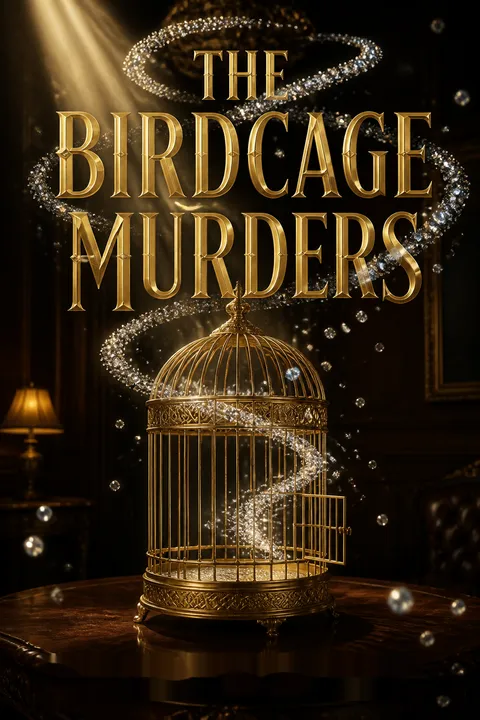


Plot Summary
Diamond Dust at Brundles
In February 1923, retired Scotland Yard detective Jonathan Swift and country-dwelling Major Heathcliff Lennox are summoned to meet Detective Chief Inspector Billings. Ezra De Ruyter, a wealthy club member, has died after coughing blood over his dinner.
A pathologist found tiny diamond fragments embedded in his stomach; they pierced an existing ulcer and caused fatal bleeding. Billings links the killing to the unsolved Birdcage Murders of 1911, when an exploding jeweled automaton killed eight people, including De Ruyter’s relatives and the young woman engaged to marry his cousin.
Police suspected Ezra arranged the blast for his inheritance, but never proved it. Billings asks Lennox, a Brundles member, and Swift to discreetly gather information from the club.
The murder’s method converts inherited wealth into a weapon that acts from within: the diamonds do not merely signify fortune, they physically tear the body that profited from the earlier explosion. Yet the police cannot treat Ezra’s presumed guilt as proof. Billings recruits Lennox and Swift because social access may uncover what formal investigation has not, while limiting their task to the new death. The case therefore begins with a tension between moral certainty and evidentiary uncertainty. Ezra’s reputation makes revenge seem understandable, but the presence of a killer who has chosen private punishment forces the investigators to ask whether justice can be inferred from a victim’s apparent guilt.
A Club Full of Grief
Lennox brings Swift, his butler Greggs, spaniel Fogg, and cat Tubbs to Brundles, where club Master Alessandro Rossetti resents the police attention but lets them stay. The staff initially keep silent, so Lennox and Swift reconstruct the dinner from the Strangers Room itself.
Steward Browne marks where Ezra and his companion Lillian Lamb sat, then identifies the other guests: Lord and Lady Clifton, the Stanfords, Dr Moore, artist Richard Phillips, actress Gloria Thornton, and Rossetti. At nine, Lady Estelle Clifton’s sleeve caught fire.
Browne says the men rushed to help while Ezra and Rossetti stayed put; he extinguished the flames. Only Phillips, Moore, and Sir Humphrey Stanford passed near the dessert trolley, giving Swift his first short list of possible suspects.
The club’s rules create a physical and social map of the mystery. Swift cannot move freely without Lennox, while staff are expected to obey Rossetti, so access itself becomes evidence and an obstacle. Browne’s diagram gives the investigators a usable sequence, but the fire complicates it: a public emergency draws attention away from the trolley and makes ordinary helpfulness difficult to distinguish from a planned diversion. The guests are united less by intimacy than by bereavement, each connected to the 1911 blast. That shared loss makes motive almost universal, weakening the usual detective’s task of separating the suspicious from the innocent.
Estelle's Candlelit Cue
Lord Arthur Clifton asks to see Lennox and Swift at his Belgrave Square home, where they learn that Estelle deliberately made the scene at dinner. She had received an ornate invitation depicting the Birdcage and Justice, with instructions to create a disturbance at nine and await the Devil’s undoing.
Estelle thought the gathering would expose proof of Ezra’s guilt, not kill him. Arthur explains that their daughter Daphne was among the 1911 victims and that he had falsely claimed illness to avoid the family dinner. He recounts how the Birdcage exploded when the young couple wound its mechanism.
Their lawyer, Wallace, adds that the suspected bomb-maker, Reynolds, died in custody after a police officer struck him, destroying the investigation’s crucial lead. Lennox and Swift refuse Wallace’s attempt to control the invitation and take it to Billings.
Estelle’s action shifts the case from a murder with coincidental witnesses to a murder staged through instructions. Her misunderstanding matters: she accepts a theatrical promise of public justice because the official process has already failed her family, but she does not understand the danger hidden in the performance. Arthur’s account exposes the personal wound beneath the Cliftons’ reserve, while Reynolds’s death explains why suspicion of Ezra never became a conviction. Wallace’s effort to manage the evidence shows how the wealthy can protect themselves through procedure as well as money. The investigators must now navigate competing forms of authority: Scotland Yard’s investigation, the Cliftons’ private inquiry, and the bereaved guests’ demand for redress.
Invitations Behind Closed Doors
Billings accepts Estelle’s invitation as a major lead, then dismisses Lennox and Swift from the official inquiry. Lord Clifton privately asks them to continue investigating for him, and Swift builds a color-coded board connecting the 1911 victims to the dinner guests.
At dinner, retired doctor Rupert Moore produces his own invitation and recalls Rossetti directing the guests to their seats. He says the room grew tense as the bereaved arrived, then describes Ezra’s collapse and Lillian’s refusal to help him.
Moore reveals that Ezra inherited Brundles’ freehold, giving him influence over the club despite his suspected crimes. Later, Lennox confronts Rossetti in the garden. Rossetti admits that the dead butler Grimes was his father and that Fannie Johnson, another victim, was Browne’s daughter, explaining their personal ties to the explosion.
The invitation is not simply a clue about who attended; it is a mechanism that turns grief into an organized gathering. Moore’s recollection makes Rossetti’s role in arranging the room newly significant, while Ezra’s ownership explains why the club tolerated a man its members despised. Rossetti and Browne are not detached servants: their family losses make the service hierarchy itself part of the crime’s emotional landscape. Lennox’s garden confrontation also tests his instinct that people are hiding something against Rossetti’s persuasive account of institutional failure. The investigation advances by uncovering relationships, but each new connection multiplies possible motives rather than narrowing them.
Phillips Takes the Chocolates
Lennox and Swift visit Phillips at his expensive flat, where reproductions of famous paintings reveal his work as a copyist rather than a celebrated portraitist. Phillips admits that Daphne Clifton once rejected him for Xavier De Ruyter, but refuses to explain much about the dinner.
He keeps his invitation and resents the police for failing to convict Ezra. After the detectives leave, Phillips eats chocolates Gloria Thornton had set aside for him. The box had arrived for Gloria, who dislikes sweets and routinely gives them away; this time the chocolates contain cyanide.
Swift hears the doctor identify the poison as Phillips dies. Police arrest Gloria, who is devastated and insists she did not poison her friend. The second murder turns the inquiry from a planned act of revenge into a threat that may still be active.
Phillips’s death breaks the apparent boundary between the old crime and the new one. The first killing can be read as a deliberate answer to an unresolved massacre; cyanide in a gift is more indiscriminate, and the intended recipient may not even be the person who dies. Gloria’s arrest demonstrates how quickly circumstantial opportunity can harden into public accusation, particularly when an actress’s practiced composure invites suspicion. Phillips himself is difficult to read: his resentment of the police, his financial bargaining, and his attachment to Daphne make him both a possible witness and a man who may conceal what he knows. The case now demands attention not only to motive but to the design of the trap.
Gloria's Glittering False Lead
Gloria tells Lennox and Swift that she attended dinner reluctantly, received no invitation, and saw nothing beyond Estelle’s fire and Ezra’s collapse. She confirms that Phillips had once been her close neighbor and that she had previously loved Ezra, but says she withdrew after the explosion and his growing fixation on inheritance.
Her mention of shimmering eye makeup sends the detectives to Gloria’s Boutique, where police suspect her branded Diamond Eyes powder contains real diamond dust. Assistant Rebecca Hastings shows them the glittering mineral: it is mica, not diamond, and the shop’s product is a false lead.
At Brundles, the gathered relatives admit they discussed the invitations but deny expecting a killing. Clifton promises to provide Wallace’s old investigation notes, giving Lennox and Swift a new way to revisit the 1911 case.
The boutique investigation shows how an image can misdirect inquiry. Glittering makeup resembles the fatal substance, but resemblance is not identity; Swift’s demand for testing checks Lennox’s imaginative leap against material evidence. Gloria’s connection to both Ezra and Phillips makes her look narratively central, yet neither old affection nor access proves guilt. Meanwhile, the bereaved guests’ admission that they discussed the invitation confirms collective foreknowledge without establishing a murder plan. Clifton’s notes promise a return to the earlier investigation, but his selective cooperation remains suspect. Across these events, the detectives learn to distinguish a clue’s dramatic appeal from its evidentiary value, a discipline Lennox finds harder than Swift.
The Tiara in the Ruins
After reading Wallace’s notes, Lennox and Swift visit Lillian Lamb’s house, where an open kitchen door and a strong perfume scent lead them upstairs. They find Lillian’s maid unconscious beside the fireplace, her head bloodied, and the bedroom ransacked.
While Swift calls for help, Lennox notices a tiara among the spilled jewelry. Its diamonds appear to match the one-carat stones once fitted to the Birdcage, and its case bears the name Bronski, a cartridge reloader. Police arrive and carry the maid to hospital.
Billings reports that the diamond dust was irregularly ground rather than taken from industrial tools, suggesting someone crushed a gemstone by hand. Lennox tells him about the tiara and its case, turning a piece of luxury jewelry into a possible link between De Ruyter’s fortune and the old explosion.
The ransacked room makes the past materially present. The tiara is not only an expensive gift but a possible container for the history that its wearer would prefer not to see. Its matching stones connect domestic display to bodies recovered from the 1911 blast; the Bronski mark adds a practical trace to an otherwise emotional chain. The injured maid also makes the violence immediate, though the investigators do not yet know whether she was targeted or interrupted an intruder. Billings’s laboratory finding sharpens the clue: the killer had access to an actual diamond and took the trouble to pulverize it. Evidence now ties ostentation, criminal memory, and method together.
The Russian in Wolf House
Wallace’s surveillance notes show that Ezra bought Lillian a house and spent time with her at the Chequers Tavern, near Bronski’s former workshop. The maker’s stamp on the tiara case points Lennox toward Russian immigrant Markov, once employed by Bronski to handle gunpowder.
Lennox and Swift find Markov at Wolf House in Queen Anne’s Gate. When Lennox accuses him of preparing the Birdcage bomb, Markov reacts with shock, then attacks Swift. Lennox punches Markov and pulls Swift out before the pair can be trapped without police authority.
Billings rebukes them, but sends officers to investigate Markov. The suspects list expands as Lady Marina Stanford asks the detectives to visit her. Their reckless lead may have uncovered the bomb-maker, but they have also alerted someone to their progress.
Lennox’s intuition produces a plausible connection, but his confrontation outruns the evidence and nearly turns investigation into private violence. Swift’s insistence on procedure is not mere pedantry here: without authority, proof, or a safe arrest plan, the detectives risk compromising both the suspect and themselves. Markov’s startled reaction intensifies suspicion without resolving it. The episode also inverts the detectives’ roles: Lennox, usually wary of the case, acts first, while Swift must be pulled away from an arrest he cannot lawfully make. Their partnership works because each restrains the other at different moments, though not always before damage is done.
Lillian's Version Fractures
Lady Marina tells Lennox and Swift that Phillips recognized Lillian’s tiara as bearing diamonds recovered from the Birdcage victims. He confronted Lillian, who said Ezra had given it to her as a Christmas present; Marina understood that the discovery helped ignite the plan at Brundles.
The detectives then question Lillian. She admits receiving an invitation and says Ezra chose the tiara case, but denies knowing the stones’ origin and becomes furious when Lennox suggests she led Ezra to his death.
Her changing account leaves the investigators unsure whether she is a bereaved witness or a participant. The encounter also establishes that she had a separate invitation, one she says she burned, and that Ezra repeatedly checked his watch during dinner because he wanted to leave.
The tiara converts suspicion into a specific emotional trigger. For the bereaved, the diamonds make Ezra’s suspected crime visible as an intimate insult: he has turned fragments associated with the dead into adornment for his lover. Marina’s disclosure also complicates her earlier silence, showing how loyalty to her sister and fear of scandal compete with the need to prevent further harm. Lillian’s anger and contradictions make her difficult to dismiss, but they do not yet prove that she arranged anything. Her insistence that Ezra wanted to leave introduces a small but useful discrepancy between the intended spectacle and his own experience of the evening.
A Spy in the Linen Cupboard
After the suspects’ meeting, Lennox and Swift organize their evidence and plan to confront the group again. Before dawn, Pinner warns them that Markov has been found tortured and dead in his garden. Billings questions the detectives, who realize someone must have learned Markov’s address from their private discussion.
Lennox spots a glass in a linen cupboard positioned to carry sound through the wall. He marks its rim with iodine; when Pinner returns, the stain appears on his ear.
Pinner admits Rossetti and Browne ordered him to listen because the club staff were frightened and Rossetti wanted to know what was happening. Billings reports that Markov was beaten with an iron bar, and Wallace is brought in for questioning. The upcoming gathering now carries the danger of a crime committed to silence the past.
The listening glass turns the club’s architecture into an instrument of surveillance. The detectives believed they were working in private, but their conversations have been absorbed by the institution sheltering them. Pinner’s confession is not driven by malice alone; he describes fear and obedience to Rossetti and Browne, exposing how authority can recruit ordinary workers into concealment. Markov’s death raises the stakes and reverses the investigators’ position: they are now vulnerable to suspicion and may have inadvertently supplied the killer with a target. The clue does not identify the attacker, but it establishes a causal path from their investigation to the violence.
Seven Invitations, Shared Guilt
At nine the next morning, Billings brings the suspects into the Strangers Room and seats them in the positions they occupied during Ezra’s dinner. Lennox accuses the group of knowing about the murder plan.
Lord Clifton admits he suspected his wife’s intentions and did not stop her; Sir Humphrey confirms that Wallace had investigated the plan for him. Estelle confesses that she and Marina designed the invitations, with Phillips finding a printer and Rossetti supplying addresses. Rossetti acknowledges agreeing to the plan because his father died in the explosion.
Estelle says the guests were summoned to expose Ezra, not necessarily to kill him. The confessions establish shared complicity, but no one identifies who actually put diamond dust into Ezra’s food, leaving Billings and Lennox to press the question.
The staged seating recreates the original dinner as an experiment in social pressure. Lennox uses the room not to prove a physical act but to make silence costly by placing each person before the others they have protected. Their admissions reveal different degrees of complicity: Estelle and Marina organized the gathering, Rossetti joined from personal grief, and the husbands chose not to intervene. Yet collective guilt obscures individual action. The distinction matters legally and morally, because a shared desire for justice does not establish who committed murder. The group’s refusal to isolate a culprit shows loyalty functioning as both compassion and obstruction.
Browne Names the Mastermind
Lennox presses the group about Phillips’s cyanide death, then reveals that Markov is dead. Rossetti initially accepts responsibility for the beating, but Browne confesses that he tortured Markov to learn the truth.
Markov had told him that Ezra paid for the bomb, while Lillian had devised the original scheme. Browne adds that he saved some diamond dust and put it into Lillian’s coffee cream. As the group argues, Gloria explains how Phillips discovered the origin of Lillian’s tiara and how Estelle’s revenge plot grew from that revelation.
Browne’s confession confirms he put the dust into Ezra’s dessert cream as well. Lillian realizes she has been poisoned. She is taken away screaming, while Billings begins arresting the people whose crimes can be proved.
The climax separates two kinds of culpability that the room has tried to merge. Lillian’s concealed authorship of the 1911 plot and later killings makes her the architect of the cycle, while Browne’s acts make him both witness and avenger. His decision to reuse the poison transforms the group’s demand for justice into another execution without trial. The correction from custard to cream matters because it exposes how confidently the investigators had mistaken an assumption for a fact. Browne supplies truth, but he does so through torture and a second poisoning, making the revelation ethically compromised even as it explains the deaths.
A Birdcage for Home
After Lillian is removed, Estelle and Marina reconcile, and Arthur Clifton agrees to help defend Browne. Moore and Gloria recognize that the bereaved were manipulated into carrying out Lillian’s design, while Swift warns that Browne may face execution for murder.
Lennox argues that the law failed to punish Ezra and now risks punishing the man who exposed him, but Swift insists that motive cannot erase Browne’s crime. The detectives give statements at Scotland Yard, then prepare to return to the Cotswolds with Greggs, Fogg, and Tubbs.
Outside Brundles, the doorman presents Lennox with a live cockerel bought for Persi and Tommy. Greggs notices that the bird travels in a cage, an ordinary household gift made newly unsettling by the case they have just survived.
The departure refuses a clean moral settlement. The innocent and guilty have been separated only imperfectly, and Browne’s truth-telling does not protect him from legal consequences. Lennox’s objection to the law’s failure is sincere, but Swift’s response preserves a boundary between understanding a motive and excusing an act. The cockerel offers a domestic counterweight to the club’s jeweled automaton: it is alive, useful, and intended to restore order among Persi’s hens. Still, the cage cannot be entirely innocent after the investigation. Lennox returns home with greater attachment to his family life, but also with a sharper awareness of what justice costs when institutions arrive too late.
Epilogue
At home, Lennox discovers that Persi has already arranged a garden fete, while Tommy proudly explains how the new cockerel, George, keeps the hens in line and how Hoppy is learning to manage on her injured leg.
Swift calls with the final account: Lillian died after confessing that she devised the 1911 bombing, recruited Reynolds and Markov, and manipulated Ezra into complicity. She had Reynolds provide the Birdcage’s mechanism plans, then used a staged bicycle mishap to let Markov plant the bomb during delivery.
Ezra paid them with diamonds stolen from the victims. Lillian later used the tiara to provoke the bereaved and had Phillips killed to confuse the inquiry. Browne remains determined to accept punishment; the Cliftons and Stanfords expect leniency, while Gloria and Moore face no charges.
The epilogue closes the factual case while refusing to restore a simple moral order. Lillian’s confession confirms that the bereaved were manipulated, but it does not erase their willingness to participate in revenge or Browne’s choice to torture and poison. The final revelation also revises the meaning of Ezra’s guilt: he was not an innocent heir falsely accused, but neither was he the mastermind the mourners imagined. At home, the cockerel and injured hen place Lennox among the ordinary demands of care, where harm is answered by feeding, shelter, and patience rather than punishment. His comic frustration with Persi’s plans signals a life he is learning to share, not merely defend.
Analysis
The novel builds its mystery around a distinction between justice as a public process and justice as a private act. Ezra’s apparent guilt makes the bereaved feel that ordinary law has abandoned them, especially after the original investigation loses its key witness through police violence. Their response is not a spontaneous outburst but a carefully staged gathering, one that turns grief into choreography. Yet the plan’s theatrical language allows each participant to believe a different version of what will happen, blurring the line between shared intention and individual responsibility.
Objects carry the story’s moral memory. The Birdcage is an heirloom transformed into a bomb; the tiara turns stolen diamonds into a display of impunity; diamond dust makes wealth literally injure the body. The matching jewels connect the dead to the living, but they do not offer self-interpreting proof. The detectives’ early assumption about the custard shows how easily a plausible story can substitute for evidence. Swift’s methodical notes and Lennox’s instinctive associations are valuable precisely because neither method is sufficient alone.
The novel also examines the class structures that control access to truth. Brundles can exclude outsiders, servants can be ordered into silence, and the wealthy can hire lawyers and private investigators. But class does not neatly determine guilt or virtue. Rossetti and Browne are servants with intimate losses; Lillian’s poverty does not make her harmless; the bereaved aristocrats are capable of both loyalty and conspiracy. The police, meanwhile, are neither omnipotent nor uniformly trustworthy, having failed to convict Ezra and helped destroy the case against him.
Lennox’s emotional movement is quieter but consequential. He begins irritated by the assignment and protective of his private life, while Swift hopes the case will restore his connection to police work. Their collaboration shows each man the limits of his preferred approach. At home, Persi’s chickens and planned fete continue without Lennox’s control, inviting him to treat domestic change not as a breach of refuge but as a shared life. The final domestic comedy does not erase the murders; it offers a contrasting model of responsibility, one based on care rather than punishment.
Review Summary
Readers praise The Birdcage Murders as an entertaining and cleverly plotted mystery. They enjoy the character development, especially Heathcliff Lennox and Swift. The book's setting in 1920s London and the private club atmosphere are highlighted. Many find the plot intriguing, with unexpected twists. Fans appreciate the humor, historical details, and the inclusion of Lennox's pets. While some note similarities to Agatha Christie's work, most consider it a worthy addition to the series, praising Menuhin's writing style and ability to create a captivating story.
People Also Read
Characters
Heathcliff Lennox
Intuitive country majorA former wartime pilot living in the Cotswolds, Lennox is observant, socially connected, and inclined to follow a hunch before he has finished weighing it. His courtesy can turn to impatience, especially when an authority figure mistakes restraint for obedience. He is newly married to Persi and still learning that home must change to belong to both of them. His ease with servants, club members, and strangers lets people speak around him, while his own discomfort with London and investigation pulls him toward the quieter life he has built. His partnership with Swift works because his intuition supplies paths the more methodical detective might miss, even as Lennox’s impulsiveness can put them both at risk.
Jonathan Swift
Methodical former detectiveA former Scotland Yard inspector, Swift has left London to live with his wife, Florence, and their young son in the Scottish Highlands. He misses the rigor and camaraderie of police work, and the chance to assist Billings awakens a professional ambition he thought he had set aside. He takes notes, constructs diagrams, and insists on distinguishing evidence from speculation. That discipline can make him brusque, particularly with Lennox, whose associative instincts frustrate him. Yet Swift is not simply a policeman stranded outside the force: his life with the Braeburn clan has given him responsibilities he values. The case tests whether he can honor both his former vocation and the family life he has chosen.
Persi Lennox
Lennox's spirited new wifePersi, whose full name is Persephone, is Lennox’s newly married wife and a forensic archaeologist with a lively curiosity about evidence and the past. While he is away, she begins reshaping their home, adds chickens, and recruits a young farmhand to help with the grounds. Lennox sometimes reads her initiative as an intrusion into the refuge he built after the war, but Persi treats the house as shared space and the surrounding community as something to join. Her knowledge of historical uses of diamond dust gives the investigation a useful lead. Her easy affection also draws out the tenderness Lennox struggles to express directly.
Greggs
Loyal, watchful butlerGreggs is Lennox’s old butler, a dignified, dutiful man whose sense of service persists even when his employer tries to make him take a holiday. He watches over the pets, manages practical details, and quietly gathers information from people who might overlook him. His interest in Miss Fairchild reveals a private life and romantic uncertainty beyond his role in Lennox’s household. His loyalty is affectionate rather than merely professional, though Lennox’s dependence on him makes the prospect of Greggs building a life of his own unexpectedly unsettling.
Billings
Pressured Yard detectiveDetective Chief Inspector Billings is a blunt, overworked investigator carrying the institutional burden of the Birdcage failure. He remembers the case from his early career and resents that suspicion of Ezra never became proof. His temper and sharp orders mask a practical sense of responsibility: he recruits Lennox and Swift when their access may help, then must manage the consequences when their work creates new risks. He values results but remains wary of outsiders, partly because any public mistake could damage his career and the force’s already bruised reputation.
Estelle Clifton
Grieving American matriarchEstelle Clifton is an American-born society woman whose buoyant charm survives beneath years of grief for her daughter Daphne. She is warm, theatrical, and difficult to intimidate, often using humor to keep others from managing her emotions for her. Her grief is not passive: she wants the truth about the explosion that took Daphne and resents the police failure that left suspicion unresolved. She loves her husband Arthur, but does not always trust him with her decisions, believing that his caution might prevent her from acting. Her social connections place her at the center of the bereaved families’ gathering.
Arthur Clifton
A father with old griefLord Arthur Clifton is a reserved, politically influential man whose grief for his only surviving child, Daphne, has settled into a controlled public manner. He once rejected the De Ruyter family’s ostentation and disliked the match between Daphne and Xavier, but his private pain is deeper than his formal bearing suggests. Arthur is accustomed to managing information through lawyers and discreet inquiry, and he sees caution as a way to protect his family. His love for Estelle is evident even when he disapproves of her choices. His relationship with Lennox is complicated by family familiarity and competing expectations about who deserves trust.
Lady Marina Stanford
Estelle's candid sisterMarina Stanford is Estelle’s sister and the mother of Nancy, another young woman lost in the Birdcage explosion. Sociable and affectionate, she is less guarded than her husband and more vulnerable to the cost of keeping a secret. Her loyalty to Estelle pulls her into difficult decisions, while her horror at the renewed deaths makes silence increasingly painful. She values friendship and decency, particularly in Gloria, whom she knows through the actress’s boutique. Her openness can create danger for those she loves, but it also gives Lennox and Swift a way into the truth.
Sir Humphrey Stanford
Marina's guarded husbandSir Humphrey Stanford is Marina’s husband and Nancy’s father, an austere intellectual whose formal manner can seem cold beside his wife’s warmth. He is protective of Marina and distrustful of the police after the failed Birdcage investigation. His instinct is to keep family matters contained, yet his loyalty to his wife is stronger than his public reserve. He belongs to the same privileged world as the Cliftons, but grief has made status feel less protective than useless.
Alessandro Rossetti
Commanding club masterRossetti is the polished, highly intelligent Master of Brundles, responsible for protecting the club’s privacy and reputation. He prefers animals to people and responds to Lennox’s dog with a tenderness that contrasts with his rigid dealings with guests and staff. Rossetti’s authority depends on command and discretion; he expects employees to follow his lead and views outside scrutiny as a threat. Beneath his composed manner lies a personal connection to the old tragedy and a longstanding resentment of the man who profited from it. His loyalty to the club and its workers shapes how he judges justice.
Calum Browne
Solemn club stewardBrowne is Brundles’ Scottish steward, a precise, reserved man trusted with the club’s service and its most delicate routines. He follows orders carefully but has a strong private sense of what is right, and he dislikes seeing the staff kept ignorant while they fear being blamed. His connection to the old tragedy gives his silence emotional weight. He and Rossetti share a long friendship, though Browne’s formal self-control can make it difficult to know what he has observed or decided. He is both an insider in the club’s operations and a grieving father.
Rupert Moore
Bereaved club doctorDr Moore is a retired physician who lives at Brundles and speaks with genial confidence, often puncturing tense moments with appetite or humor. His son Lionel died in the Birdcage explosion, leaving Moore with a fierce conviction that Ezra deserved punishment. As a doctor, he is attentive to physical details; as a grieving father, he is not neutral about how those details are used. He enjoys company and good food, but his cheerfulness does not conceal the old wound.
Lillian Lamb
Ezra's beautiful companionLillian Lamb is Ezra De Ruyter’s elegant companion, a striking woman whose polished appearance contrasts with her East End origins. She has learned to move among wealthy people without surrendering the guardedness that survival has taught her. Others read her beauty as a kind of power, but her position depends on relationships shaped by money and unequal access. Her past with Ezra and her connection to artist Richard Phillips place her near the center of the mystery, though she offers little freely. Lennox is particularly vulnerable to her charm, making his judgment of her an important test of his confidence.
Ezra De Ruyter
Wealthy, suspect heirEzra is the fourth Lord De Ruyter, a wealthy man whose inheritance followed the deaths of his uncle and cousin in the Birdcage explosion. He is remembered as corpulent, self-indulgent, and careless of other people’s feelings, and the police once considered him the likely architect of the tragedy. His money allows him to retain influence at Brundles despite the club’s distaste for him. His relationship with Lillian and his history with the De Ruyter family make him central to the mystery, but his guilt remains a question to be established rather than assumed.
Gloria Thornton
Actress with a beauty businessGloria Thornton is a seasoned actress and businesswoman who sells cosmetics to wealthy clients. She carries herself with theatrical confidence, enjoys flirtation, and is proud of her craft even as roles for mature women become harder to find. She was once Ezra’s lover and is a longtime friend and neighbor of Phillips, connections that make others quick to suspect her. Gloria’s loyalty to Phillips and her friendships with Estelle and Marina complicate her public image. Her sharp humor is a defense against being reduced to either her appearance or her romantic history.
Richard Phillips
Bitter society artistPhillips is an artist who makes copies of famous paintings and once painted portraits for wealthy patrons. His broken engagement to Daphne Clifton left him resentful of the class barriers that separated him from her family. He drinks heavily, dislikes the police, and has little patience for people who expect him to perform gratitude. His friendship with Gloria is genuine, though his guarded manner makes it hard for Lennox and Swift to know what he has noticed. His work links several characters who might otherwise remain separate.
Wallace
Clifton family lawyerWallace is a polished lawyer who represents the Cliftons and has overseen private investigations into the Birdcage case. He thinks in terms of exposure, admissible evidence, and the legal risks facing his clients. His instinct to control information clashes with Lennox and Swift’s need to investigate openly. Though his manner is self-assured and sometimes evasive, he is not merely an obstacle: the legal consequences of the case make his expertise important to everyone involved.
Markov
Russian powder specialistMarkov is a Russian immigrant and former employee of the cartridge reloader Bronski, where he handled gunpowder and ammunition. He later becomes wealthy enough to live in an imposing London home, a change that draws Lennox’s suspicion. He is forceful, proud, and unwilling to speak with police, especially when challenged in his own house. His skill with explosives makes him an important figure in the older mystery, while his guarded history leaves the detectives with more questions than answers.
Reynolds
Brilliant, isolated mechanicReynolds was a technically gifted watch-mender who had served in the army and worked on the Birdcage’s mechanism. He struggled to cooperate with others and could become absorbed in intricate mechanical tasks. His specialized knowledge made him a focus of the original investigation, while his difficulty communicating left others to interpret his silences.
Daphne Clifton
Clifton family daughterDaphne was the only surviving child of Arthur and Estelle Clifton and was engaged to Xavier De Ruyter. Those who remember her describe a lively young woman whose affection for Xavier persisted despite her family’s disapproval. Her portrait, painted by Phillips, remains a vivid presence in her parents’ home and in the grief that shapes the investigation.
Fannie Johnson
De Ruyter household maidFannie Johnson worked as a maid for the De Ruyter family and was connected to Browne. Her place in the household gives the old tragedy a human dimension beyond the aristocratic families, and her story binds the club’s steward to the victims.
Pinner
Chatty club attendantPinner is a friendly, awkward Brundles attendant with a pronounced stoop and a quick willingness to help Lennox and Swift. His knowledge of the staff’s habits makes him a useful guide, but his position beneath Rossetti leaves him vulnerable to orders from above. He wants the club’s workers to feel safe, even when the methods chosen to protect them cross a line.
Tommy Jenkins
Lennox household bootboyTommy is the talkative young bootboy at the Lennox home, eager to care for animals and to be trusted with real work. He bonds with Persi over the chickens and with Brendan over their care. His chatter supplies comic domestic contrast to Lennox’s London investigations.
Plot Devices
Diamond dust
Wealth turned into a weaponThe powder is made by crushing a real diamond into fragments small enough to mix with food. In Ezra’s case, the particles pierce an existing stomach ulcer and cause fatal bleeding; the investigators initially assume they were placed in his custard, but later learn they were carried in cream. The substance links the new killing to the diamonds recovered from the Birdcage victims and becomes a test of careful reasoning: glittering residue alone does not reveal how it was administered or who handled it. Its later reuse makes the pursuit of justice physically repeat the original crime.
The jeweled Birdcage
A treasure concealing a bombThe De Ruyter family automaton is restored with fifty one-carat diamonds and presented to Xavier and Daphne before their wedding. Its clockwork mechanism provides cover for an explosive device, which detonates when the young couple winds it. The Birdcage gives the original crime its name, kills eight people, and leaves fragments of both metal and diamonds in bodies and walls. Years later, a tiara set with matching stones revives the victims’ story and helps explain why a dinner meant to expose Ezra’s guilt becomes a new act of revenge.
The coded invitations
Grief assembled into a trapPrinted cards show a golden Birdcage and an image of Justice, then direct selected guests to attend Brundles and play a part in a nine o’clock scene. Each recipient receives a different instruction: Estelle creates a distraction, Browne wheels in dessert, and others watch, assist, or bring a companion. The vagueness allows guests to imagine that evidence against Ezra will be revealed, while gathering people connected to the old deaths in one room. The cards become proof that the dinner was staged, but their theatrical language hides the difference between an exposure of guilt and a planned killing.
Lillian's tiara
A gift that reignites griefEzra commissions a diamond tiara for Lillian, using stones that appear to match those removed from the victims of the Birdcage explosion. Phillips notices the connection while painting Lillian’s portrait and tells him what he believes the diamonds represent. The tiara makes Ezra’s suspected past visible as a present-day luxury, giving the bereaved a concrete reason to act after twelve years of uncertainty. Its case bears the Bronski name, which links the fashionable gift to a former cartridge workshop and leads Lennox toward Markov.
The cyanide chocolates
A second murder misdirects suspicionA parcel of chocolates is delivered to Gloria, who dislikes sweets and sets them aside for Phillips. The chocolates have been opened, filled with a cyanide-containing powder, and resealed, allowing the poisoner to exploit Gloria’s established habit of giving treats away. Phillips’s death draws police suspicion toward Gloria and makes the new crime appear separate from the diamond-dust killing. The detail that he eats the chocolates with his morning brandy helps explain why he does not notice their altered taste, while the intended recipient remains uncertain.
Heathcliff Lennox Series
Download PDF
Download EPUB
.epub digital book format is ideal for reading ebooks on phones, tablets, and e-readers.








