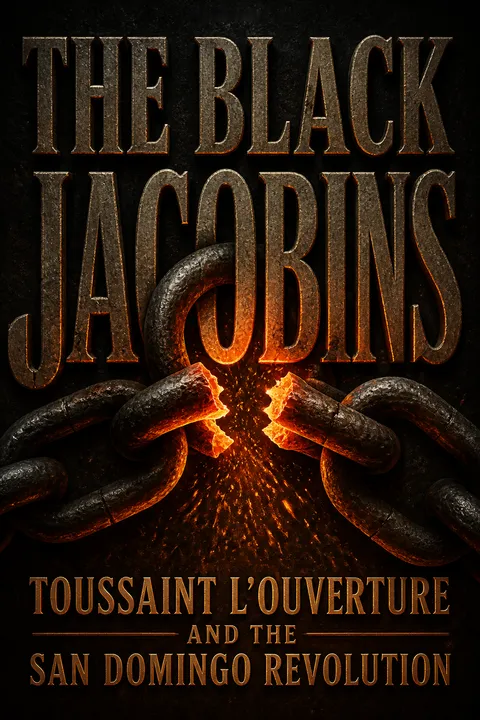


Key Takeaways
Treat enslaved people as historical actors, not beneficiaries of someone else's reform
The revolution's makers. In 1789, San Domingo generated roughly two-thirds of France's overseas trade, largely through the labor of about half a million enslaved people. When revolt began in 1791, the enslaved did not wait for French lawmakers or British reformers to free them. Their uprising became a long struggle against local slaveholders and invading Spanish, British, and French forces. Haiti declared independence in 1804.
A different history. James's central argument is that enslaved people made their own freedom through organized action. Toussaint L'Ouverture mattered enormously, but the revolution was not a gift from a great leader, a benevolent government, or an abolitionist movement. It was a mass struggle that reshaped the Caribbean and challenged the racial assumptions of the Atlantic empires.
What's striking is how this shifts the question from who granted freedom to who made it possible. That distinction matters beyond Haiti: histories centered on legislation can mistake official recognition for the source of change. James also avoids replacing one myth with another. The enslaved population was not a single, perfectly unified actor, and its leaders disagreed sharply. The book's insistence on agency is strongest when paired with attention to those disagreements, since collective power is built through coordination, not sameness.
When a colony's profits peak, look for the fractures beneath them
Prosperity's hidden costs. San Domingo's sugar and coffee made it one of the most profitable colonies in the world. By 1789, the enslaved population had grown to about 465,000, and production had surged. Yet the wealth depended on brutal labor, constant imports of enslaved Africans, and a system that prevented the colony from trading freely. French merchants controlled its commerce, while many planters accumulated heavy debts to them.
Contradictions compound. The colony's success sharpened conflicts among planters, merchants, royal officials, poorer whites, and free people of color. Planters wanted greater autonomy, while merchants wanted their monopoly protected. Meanwhile, more enslaved Africans arrived, and the violence needed to control them intensified. Prosperity did not stabilize this order. It helped load it with pressures that political upheaval in France would set off.
The useful insight is not that prosperity automatically causes revolt, but that economic growth can strengthen the very tensions that threaten an institution. San Domingo's owners needed more labor and more political control, while the colony's commercial dependence left them indebted and constrained. This is a recognizable institutional feedback loop: extracting more from a system can make it more productive and less governable at once. James's materialist lens clarifies those pressures, though it cannot alone explain why revolt took this form at this moment.
Elite infighting can open a door that oppressed people force wider
Rights with limits. The French Revolution brought arguments about liberty and citizenship into a slave society. White colonists fought over political control, while free people of color demanded equal rights and poorer whites resisted their claims. The planter class often opposed racial discrimination when it threatened its own autonomy, then defended it when equality might unsettle slavery. In 1791, the free man of color Vincent Ogé led a revolt for political rights; after his defeat, white authorities tortured and executed him.
A divided ruling order. As the colonial factions struggled, control weakened and the enslaved seized their chance. James shows that the political crisis in France did not simply spread to the colony like an idea. It created openings through conflict among people who had previously shared an interest in keeping the enslaved in bondage. The uprising then made those conflicts harder to contain.
The account shows how coalition politics can change quickly when groups share power but not interests. It also complicates a simple class explanation: racial hierarchy shaped who could claim rights, and free people of color could themselves own enslaved people. Their resistance to discrimination did not necessarily mean opposition to slavery. James is persuasive about elite division as an opening, but the lived force of racial status cannot be reduced to a convenient tool of property owners.
Organize revolt through hidden networks, shared discipline, and a credible promise of freedom
Preparation before eruption. Resistance predated the 1791 uprising. Maroons, meaning people who escaped slavery and formed independent communities, raided plantations and challenged colonial authority for generations. Earlier, the leader Mackandal built a network among enslaved people and planned a broad attack, though his scheme was exposed before it could succeed. In 1791, secret meetings and religious gatherings helped people exchange news and coordinate action.
From gathering to army. Under Boukman, enslaved people in the North planned a coordinated rising. Plantation groups attacked across a wide area, and within weeks the revolt had spread dramatically. The movement had learned from earlier failed efforts that isolated action was vulnerable. James emphasizes both the plantation workforce's proximity and the leadership's ability to organize it, while also recognizing that resistance took different forms in rural and maroon communities.
The episode illustrates a basic problem of collective action: people may share grievances yet remain unable to act together if communication is risky and trust is scarce. Religious gatherings and maroon communities offered social infrastructure as well as shared meaning. That helps explain how a revolt could move beyond scattered acts of defiance. It would be too neat, however, to treat any one network or religious practice as the sole cause. James's own account points to varied local conditions and strategies.
A gifted leader can redirect a revolution, but cannot manufacture it alone
Made by the moment. Toussaint was about forty-five when he joined the revolt. Before then, his work as a plantation steward had given him administrative experience, and he had learned to read and encountered political and historical writing. He initially held back as the rebellion began, then joined as its scale became clear. His rise depended on his judgment and ability, but also on a population already in revolt and an unstable colonial order.
Strategy without fixed allegiance. Toussaint served with the Spanish before joining the French after France formally abolished slavery in 1794. He used military training, political negotiation, and a disciplined army to defeat rivals and drive out the British. James presents him as an exceptional strategist, while stressing that the revolution created the conditions in which his abilities could become decisive.
James offers a useful middle ground between great-man history and explanations that reduce individuals to products of structure. Toussaint interpreted changing conditions and made choices that altered what was possible, but those choices mattered because thousands acted and fought. This resembles adaptive leadership: reading a moving situation, building coalitions, and revising tactics without losing a core objective. The danger is to let admiration for strategic brilliance turn the people around the leader into scenery. James's strongest formulation keeps both levels in view.
Abolition arrived when mass pressure challenged property’s political power
Principles versus profit. French lawmakers repeatedly hesitated to extend equal rights to free people of color because colonial commerce depended on slavery. In 1794, after the Paris masses had become more forcefully anti-slavery, the National Convention abolished slavery in France's colonies. The decision helped the French Republic gain the support of enslaved people already fighting for freedom in San Domingo.
Different motives, same contradiction. James also argues that Britain's campaign against the slave trade served strategic interests: British leaders hoped to weaken French colonial production, especially San Domingo's rapid growth. He does not claim that every abolitionist acted cynically. Rather, he contrasts popular humanitarian commitment with governments that weighed liberty against commercial advantage. The revolution's outcomes depended on which force could make its demands impossible to ignore.
The section usefully separates moral conviction from political effect. A reform can be supported by people moved by justice and by officials pursuing advantage, with the same policy emerging from different motives. That is a warning against explaining change through either pure virtue or pure cynicism. James's account is especially sharp about the power of mass movements to change the political cost of inaction. Its account of British strategy is also an argument that deserves historical scrutiny rather than automatic acceptance.
Protecting workers without hearing them can reproduce domination in revolutionary form
Freedom under discipline. Toussaint believed that restoring agriculture was essential to preserving the new society. He kept the large plantations intact, required laborers to work them, and gave them a share of the produce. This differed sharply from slavery: the workday was shorter, wages were due, and beating was forbidden. Yet movement was restricted, and the labor system remained coercive.
The cost of silence. Many former slaves wanted land and independence from their old owners, not simply improved conditions on plantations. Toussaint rarely explained his strategy to the people or even to his officers. When his nephew Moïse championed the laborers' grievances, Toussaint had him executed. The resulting alienation weakened the solidarity Toussaint needed as France prepared to invade.
This is the book's hardest political tension: economic recovery may require skills, coordination, and production, but a policy designed without the consent of those doing the work can reproduce the powerlessness revolution was meant to end. Toussaint's concern for the colony's survival was real, and his labor system was not equivalent to slavery. Still, material improvement cannot substitute for political voice. The case suggests a durable test for reform: do people gain the power to shape the institutions that govern their labor?
An empire's promises collapse when its expedition reveals the real policy
The invasion's purpose. Napoleon sent a large French expedition to restore control over San Domingo. Public assurances promised liberty, but secret instructions called for removing the Black generals and disarming the population. France had already restored slavery in other colonies, and reports of that decision reached San Domingo. For enslaved people and their descendants, the threat was no longer abstract.
Resistance becomes independence. Toussaint was captured and deported, but the struggle continued under leaders including Dessalines. French troops suffered heavy losses from war and disease, while local forces and communities resisted across the island. On January 1, 1804, the new state declared independence and took the name Haiti. The victory came at enormous human and economic cost, after French policy had made continued trust in the empire untenable.
The contrast between official language and secret orders is a lesson in evaluating power by incentives and actions, not assurances. Institutions often describe coercive projects in the vocabulary of protection or restoration. Here, the gap became visible through both policy elsewhere and the troops sent to the island. The story also shows why resistance can unite people who otherwise disagree: a credible threat to basic freedom can reorder political priorities. That unity does not erase the conflicts over who should govern afterward.
Win sovereignty, then confront the plantation economy's stubborn afterlife
Independence was not an ending. James's later appendix connects Haiti's revolution to a wider Caribbean struggle over national identity, linking Toussaint's era to the Cuban Revolution and to anti-colonial movements in Africa. The Haitian victory proved that a Black-led society could defeat imperial armies. Yet independence did not create an easy economic path. The plantation remained associated with slavery, while the turn toward subsistence production preserved autonomy but, in James's account, contributed to economic decline and political disorder.
A difficult inheritance. The founding years were also marked by isolation and the 1804 massacre of white residents, which James treats as a grave tragedy shaped by the French invasion and its violence, not as proof of an inherent racial character. His larger point is that political independence can break imperial rule without resolving the economic and social structures left behind.
The ending resists a tidy liberation story. Sovereignty can remove an external ruler while leaving a society to choose among painful economic options shaped by its history. James's account makes the plantation's meaning political as well as economic: returning to it risked reviving coercion, while abandoning it carried material costs. That dilemma is not unique to Haiti, though its exact terms were. The book's sweeping parallels to later Caribbean and African movements are illuminating, but they should be read as political interpretation, not as a claim that every struggle follows the same script.
Analysis
The book's enduring achievement is its combination of structural explanation and human agency. James links the wealth of San Domingo to the Atlantic economy, then shows how that order generated divisions among planters, merchants, officials, poor whites, and free people of color. Those divisions mattered because enslaved people could act within the openings they created. The account refuses two easy explanations: that emancipation was bestowed by enlightened rulers, or that a single extraordinary leader produced the revolution. Toussaint is both historically consequential and made possible by a movement larger than himself.
The narrative is also a study of leadership's double edge. Toussaint's administrative skill and military pragmatism helped transform revolt into government. His effort to restore production, however, narrowed workers' choices and weakened the trust on which resistance depended. James's analysis is most compelling when it treats this not as a private character flaw but as a conflict between economic reconstruction, popular freedom, and political legitimacy. His judgment that Toussaint should have communicated more openly is persuasive, though the perilous conditions make clear that no choice guaranteed success.
The book's Marxist framework gives it unusual force, particularly in exposing how property shapes supposedly universal principles. It can also compress racial antagonism, ideological conviction, and local variation into class alignments. James recognizes that race has real political power, yet sometimes interprets it chiefly through material interests. The introduction to this edition notes that later research revises some details, and James himself acknowledges the growing importance assigned to maroon communities. That makes the work better read as a landmark argument than as a final account.
Its later appendix extends the history into a political meditation on Caribbean identity and anti-colonial independence. That extension is inspiring but openly situated in James's own era and commitments. The central achievement remains the historical one: showing that the people treated as colonial property became the decisive makers of a new state, and that freedom required both defeating empire and confronting the institutions it left behind.
Review Summary
The Black Jacobins receives widespread acclaim as a landmark historical account of the Haitian Revolution, praised for its passionate prose, rigorous research, and Marxist analysis of race and class. Readers celebrate James's vivid portrayal of Toussaint L'Ouverture and his framing of enslaved people as agents of their own liberation. Common criticisms include difficulty following the complex cast of characters, occasional heavy-handed Marxist rhetoric, and insufficient attention to women's roles. Most consider it essential reading despite its limitations.
People Also Read


Glossary
The Black Jacobins
Revolutionary Black insurgentsJames's name for the enslaved people of San Domingo who took up the radical language of the French Revolution and fought for their own freedom. The phrase emphasizes that they were political actors, not passive recipients of French reforms. It also frames the Haitian Revolution as part of the wider revolutionary upheavals of the late eighteenth century.
Maroons
Communities of escaped enslaved peoplePeople who escaped slavery and established independent communities, often in mountains or forests. In San Domingo, maroons raided plantations and resisted colonial authority for generations before the 1791 uprising. James discusses them as an important tradition of resistance, while noting that historians continued to debate how central they were to organizing the revolution.
Exclusive
French colonial trade monopolyThe French system that restricted colonial trade to the mother country. San Domingo had to buy many goods from France and sell its produce through French channels, limiting its ability to trade with other nations. James presents the arrangement as a source of conflict between colonial planters and the French commercial interests that profited from the colony.
Negro Code
French rules governing slaveryJames's term for the colonial code enacted under Louis XIV in 1685 to regulate the treatment and status of enslaved people. The code prescribed certain provisions and limits on punishment, but James stresses that planters routinely ignored its protections. In practice, laws defending property and planter authority often outweighed the code's stated restrictions.
Negritude
Cultural affirmation of Black identityA term discussed in James's appendix for the affirmation of African heritage and Black identity in Caribbean and African thought. James traces its roots partly to Haiti's search for a national culture distinct from France, and connects it to writers and activists who challenged the idea that African inheritance was inferior. He presents it as one stage in a broader West Indian search for identity.
Download PDF
Download EPUB
.epub digital book format is ideal for reading ebooks on phones, tablets, and e-readers.








