

Key Takeaways
Treat the giants' tale as an ancient warning about power without restraint.
A desert discovery. In 1947, a Bedouin shepherd searching for a lost sheep found scrolls in a Judean Desert cave. Among the later discoveries at Qumran were fragments of the Book of Giants, an ancient Jewish story expanding the brief account in Genesis of heavenly beings and human women producing giants. In this version, the giants consume the earth's resources, prey on people and animals, and turn violence into a world-threatening crisis.
A myth with consequences. The story links extraordinary strength to appetite without limits. Its giants can overpower humans, but cannot escape the judgment they foresee. The tale's force lies less in proving that giants existed than in imagining what happens when power breaks its obligations to the rest of creation.
What's striking is how the story makes catastrophe a consequence of boundary-breaking, not merely a contest between strong and weak. The giants are frightening because their appetites scale with their strength: ordinary people and the natural world become expendable. That pattern gives the myth an ethical dimension that can be read without settling its supernatural claims. At the same time, the narrative's moral categories are stark. It offers little account of ordinary human responsibility apart from the giants' influence, a feature that makes it powerful as myth but less useful as a complete explanation of social harm.
Read the Book of Giants as damaged evidence, not a finished narrative.
Fragments leave gaps. The Aramaic Book of Giants survives in badly damaged pieces from Qumran. Words and whole passages are missing, and the original order is uncertain. Scholars have tried to reconstruct the sequence by comparing fragments with other versions. The book presents one likely arrangement, while acknowledging that parts of the story are guesses rather than a continuous recovered manuscript.
A reconstructed plot. The surviving material names giants such as Ohya, Hahya, Mahway, Gilgamesh, and Hobabis, also associated with Humbaba. Their dreams, including images of a flooded tablet and a destroyed garden, foretell disaster. Because gaps interrupt the evidence, the book sometimes uses the Manichaean retelling to help connect the Aramaic pieces. That can clarify the narrative, but it cannot make the lost wording certain.
The fragmentary state is not a minor inconvenience. It changes what readers can responsibly claim about plot, wording, and influence. A coherent retelling can help people understand the surviving material, but coherence may come partly from the editor's decisions rather than from an intact ancient text. This is a useful distinction across historical work: a reconstruction is an argument about evidence, not the evidence itself. The book is strongest when it marks uncertainty plainly, and less secure whenever a gap is filled as though only one narrative sequence were possible.
Watchers turn forbidden knowledge into a story about responsibility.
A fall at Hermon. In the Enoch story, two hundred Watchers, heavenly beings assigned to observe humanity, descend at Mount Hermon and take human wives. Their leader, often called Semjaza or Shemyaza, fears the penalty but joins the group in a shared oath. The resulting unions produce the giants, while the Watchers also teach people practices such as metalworking, weapon-making, astrology, and spells.
Knowledge has a moral setting. The text treats these teachings as part of a wider corruption: the Watchers disclose secrets they should not, and the giants use power destructively. Azazel, another Watcher, is especially associated with weapons and adornment. The story's concern is not simply that people learn skills. It is that knowledge arrives through transgression and serves domination, violence, and appetite.
This account places knowledge inside relationships of authority: who may teach, what is disclosed, and what purposes new capabilities serve. That makes the Watchers more than supernatural villains. They represent the danger of expertise detached from obligation. Yet the text's suspicion of particular arts should not be mistaken for a universal argument against learning. Its sharper insight concerns misuse and power asymmetry. Readers can preserve that insight while questioning the story's assumption that technical or esoteric knowledge itself is contaminating.
Use Enoch as the bridge between giant dreams and divine judgment.
Dreams seek an interpreter. The giants dream of destruction but cannot understand what they have seen. Mahway travels across a great desert to find Enoch, the ancient figure presented as a righteous scribe and interpreter. In one strand, he flies to reach him; in another, a voice warns him not to rise too high as the sun approaches. The dreams' images, such as a tablet submerged in water and a garden cut down to a few shoots, point toward the Flood and the survival of Noah's family.
A warning without escape. Enoch communicates judgment to the Watchers and their offspring. They plead for relief, but the message is that the coming destruction cannot be avoided. The Watchers are bound, and the giants face death; in the Enochic account, the giants' disembodied spirits become evil spirits on earth.
Enoch's role is structurally important: he is the channel through which the guilty learn that their own interpretations cannot overrule the judgment they fear. The story gives a mediator a task that is both intellectual and moral. He must read signs accurately, then deliver unwelcome news. That makes interpretation an act with consequences, rather than a display of cleverness. The episode also resists a simple redemption arc. The giants can recognize their fate and ask for help, but insight arrives too late to undo the harm attributed to them.
Follow each retelling to see how religions reshape inherited myths.
Mani's changed cast. The Manichaean version adapts the giant story to a religion built around a struggle between light and darkness. Since its system separates good from evil, the heavenly beings become demons rather than angels who fell from a good order. Iranian traditions also alter names and settings: Ohya becomes Sahm, Hahya becomes Nariman, and Baraq'el is represented by Virogdad. The story's broad pattern remains, but its moral universe changes.
Myths travel and transform. The Qumran material invokes Gilgamesh and Humbaba, figures known from Mesopotamian tradition. The Manichaean version survives in fragments and allusions in languages including Middle Persian, Sogdian, Uyghur, and Coptic. These versions show that ancient religious stories were not always copied unchanged. Communities refashioned familiar characters to make them intelligible within new beliefs.
The changing versions make religious transmission visible as creative work. A tradition survives partly because new communities can adapt it, not because every detail stays fixed. Comparing versions therefore reveals what a community needed the story to explain: in this case, the origin and persistence of evil. The comparison also cautions against assuming that shared names prove a simple line of borrowing. Stories can move through translation, oral retelling, and local reinterpretation, leaving similarities that are meaningful without making every connection equally certain.
Read 1 Enoch as a layered library, not one author's book.
Several works joined together. The book describes 1 Enoch as a composite collection assembled from writings created across several centuries. Its six main divisions are the Book of the Watchers, the Book of Parables, the Book of Astronomy and Calendar, the Book of Visions, the Book of Warnings and Blessings, and later Noah material. The sections address different concerns, from fallen angels and judgment to heavenly calendars and the history of Israel.
Different dates, different purposes. The source places the Book of the Watchers and the astronomy material around the late third or early second century BCE, the Visions around 165 to 160 BCE, and the Parables around the first century CE. These are proposed dates, not proof of a single author or writing session. Second and Third Enoch are separate works in the broader tradition, not simply further sections of 1 Enoch.
The collection's layered form helps explain why it can move from cosmic mechanics to political history and moral instruction without behaving like a modern, single-author treatise. Its unity is partly thematic: visions, judgment, and the boundary between earthly and heavenly orders recur across sections. Readers benefit from keeping composition and compilation distinct. A shared title can gather related writings into one influential book, while still leaving differences in date, outlook, and purpose intact.
Separate manuscript evidence from claims about Christian influence.
What Qumran establishes. Fragments of 1 Enoch and the Book of Giants among the Dead Sea Scrolls show that these traditions circulated in Jewish settings before or around the beginning of the Common Era. The book also notes that Jude directly echoes a passage attributed to Enoch, and that early Christian writers such as Justin Martyr and Tertullian treated Enochic ideas seriously. The Ethiopian Christian tradition preserved a complete form of 1 Enoch after it disappeared from much of Western Christianity.
Influence is not the same as canon. The book argues that New Testament writers, and even Jesus, knew and drew on Enoch. Some connections are compelling, especially Jude's wording, but broader parallels do not by themselves prove direct borrowing or universal acceptance as scripture. Enoch's history is better understood as varied reception: respected by some communities, rejected or neglected by others, and preserved in Ethiopia.
This section brings together three questions that need different answers: when a text existed, whether a later writer knew it, and whether a religious community regarded it as scripture. Manuscript dating can establish that a work predates a later text; verbal parallels can suggest contact; neither alone settles the status of a whole book. The distinction sharpens rather than diminishes Enoch's importance. Its influence can be substantial even when its authority was disputed, and a text's survival in one tradition can coexist with its absence from another.
Decode Enoch's animal vision as political memory, not a fixed prophecy.
History becomes a flock. In the Book of Visions, Enoch sees people and peoples represented as animals. Bulls and cows begin the account of humanity; sheep represent the Israelites; wolves and other predators embody forces that oppress them. The sequence retells episodes including Noah and the Flood, the patriarchs, the Exodus, the kings, and the destruction of the Temple. A flock's suffering turns national history into a moral drama about leadership, faithfulness, and loss.
The symbols remain debatable. The book offers possible readings of the sheep with a prominent horn: it may represent Jesus, or it may point to Judas Maccabaeus. Such disagreements matter because the vision is not a transparent code with one confirmed key. Its animal imagery preserves a community's interpretation of history, while leaving room for different readers to identify the figures and events.
Animal imagery compresses a long history into a form that makes relationships memorable: rulers become shepherds, empires become predators, and a community becomes a vulnerable flock. That compression also makes interpretation risky. Once a symbol is tied to a particular person or event, the reading can reflect the interpreter's own moment as much as the original author's. The book's competing identifications are therefore instructive. They show how apocalyptic writing can preserve political memory while remaining open to later communities' hopes and disputes.
Treat the 364-day calendar as theology expressed through astronomy.
Order written in the sky. The Book of Astronomy describes the sun, moon, stars, winds, and seasons as moving according to assigned patterns under angelic oversight. It sets out a year of 364 days, divided into four seasons of 91 days, and associates the heavenly cycles with doors, paths, and appointed times. The calendar is presented as more than a way to count days: it expresses the belief that creation follows an orderly design.
A schedule with religious stakes. The text warns that people may miscount the year and thereby observe festivals at the wrong time. Its detailed descriptions connect timekeeping with obedience and cosmic order. The book also acknowledges a four-day difference that readers must account for. This is an ancient religious calendar and cosmology, not a modern astronomical measurement; its importance here is the worldview it organizes.
The calendar shows how practical systems can carry theological meaning. Counting days is not neutral in a community where festivals, seasons, and sacred order depend on the result. The text turns the heavens into a kind of public clock, one that makes divine regularity observable. At the same time, precision within a system does not guarantee that its astronomical assumptions match current measurement. Separating the calendar's cultural function from its physical claims lets readers understand both what it meant and what it can establish.
Let final judgment challenge earthly power, without mistaking hope for proof.
The oppressed are remembered. Across the warnings and visions, the righteous suffer while rulers accumulate wealth, exploit workers, persecute the faithful, or corrupt religious leadership. Enoch's visions answer this imbalance with a future judgment in which deeds are recorded and the powerful are held accountable. The promised outcome is not merely punishment: the righteous are restored to a renewed earth, where peace, fertility, and justice replace violence.
An ethical warning in apocalyptic form. The book repeatedly condemns oppression, deceit, idolatry, and confidence in riches. Its images of books opened before judgment make hidden conduct visible, while its promise of vindication gives meaning to suffering that appears unanswered. These are religious claims about ultimate justice, not evidence that justice reliably arrives within ordinary history. The narrative asks readers to judge present conduct against a larger moral horizon.
Apocalyptic judgment gives the powerless an imagined forum in which rulers cannot control the record or the verdict. That imaginative reversal can expose how wealth and status distort everyday judgments of merit. It also carries a risk: confidence in future redress may encourage passivity if it displaces efforts to prevent harm now. The strongest ethical reading holds both ideas together. The promise that injustice is not invisible can console the injured, while the text's immediate condemnations of exploitation still press readers to resist it in the present.
Analysis
This volume is best read as a guided tour through a textual tradition, not as a single critical edition of one ancient work. It introduces the Qumran fragments, reconstructs a possible Book of Giants narrative, compares a Manichaean adaptation, and then inserts giant material into a modernized translation of 1 Enoch. That structure makes the subject accessible, but it also blends three activities that should remain distinct: reporting manuscript evidence, interpreting ancient religious ideas, and proposing speculative connections.
The strongest historical contribution is the picture of circulation and transformation. Aramaic fragments at Qumran establish that Enochic and giant traditions belonged to the religious world of ancient Judaism. Their survival in different languages and later communities illustrates how stories cross cultural borders. The Manichaean version is especially revealing because it changes the Watchers into demons to fit a strict opposition between light and darkness. The story's adaptability is itself a historical fact, even where the exact path of transmission is uncertain.
The book's confidence about New Testament influence needs more careful gradation. A close verbal echo, such as the passage associated with Jude, is stronger evidence than a shared theme such as judgment, angels, or a heavenly court. Evidence that a text circulated before Christianity does not prove every later writer read it, and resemblance alone cannot establish direct borrowing. Likewise, the Qumran fragments are too damaged to support every detail of the reconstructed giant narrative with equal confidence.
That caution does not make the material less valuable. The Watchers myth joins sexual transgression, secret knowledge, violence, and ecological ruin into one account of a world out of balance. The animal vision turns communal history into a memorable code, while the astronomy section treats time and nature as signs of divine order. Readers gain most by holding two perspectives together: these texts are historically situated artifacts, and they are also imaginative attempts to explain evil, suffering, and hope. The book's enduring subject is not simply whether giants existed, but how communities used stories about them to define responsibility and justice.
Review Summary
The Book of Giants receives mixed reviews, with an overall rating of 4.13/5. Readers find it informative and well-organized, praising its accessible format and insights into non-canonical literature. Some appreciate the additional clarity it provides on biblical topics. However, criticisms include difficulty comprehending broken text, typos, and confusion over the author's interpretations. Some readers found the content underwhelming or questioned its theological implications. Despite these criticisms, many readers consider it a valuable resource for those interested in ancient manuscripts and biblical studies.
Glossary
Watchers
Heavenly beings who descendIn 1 Enoch and related traditions, the Watchers are heavenly beings assigned to observe humanity. A group descends to earth, takes human wives, and fathers the giants. They also disclose forms of knowledge that the texts associate with human corruption. The tradition's accounts vary in how the Watchers are named, judged, and classified.
Nephilim
Giants of a divine-human unionThe Nephilim are the giant offspring associated in Genesis 6 and Enochic writings with unions between heavenly beings and human women. In the Book of Giants, their immense strength becomes destructive: they consume resources and attack living creatures. Later traditions differ on how these beings relate to demons or other classes of giants.
Book of Giants
A fragmentary giant narrativeAn ancient work known through damaged Aramaic fragments found at Qumran and through later Manichaean versions. It develops the story of the Watchers' giant offspring, including their dreams of impending destruction and their attempts to seek Enoch's interpretation. Since much of the text is missing, its original sequence and some details remain uncertain.
1 Enoch
A composite Enochic collectionAn ancient collection of writings attributed to Enoch, the figure in Genesis who is taken by God. Its sections address the Watchers, heavenly visions, astronomy and calendars, Israel's history, judgment, and blessings. The collection took shape over several centuries and survives in different textual traditions. It is distinct from 2 Enoch and 3 Enoch.
Manichaeism
A religion of light and darknessA religious movement founded by Mani that describes existence as a struggle between a spiritual realm of light and a material realm of darkness. The Manichaean version of the Book of Giants adapts earlier Watcher traditions to this worldview, presenting heavenly rebels as demons and changing some names and settings to reflect Iranian traditions.
Book of the Watchers
1 Enoch's angel-fall sectionThe opening major section of 1 Enoch, chapters 1 to 36, focused on the Watchers' descent, their unions with human women, the rise of the giants, and divine judgment. It also presents Enoch's visions and his role in conveying judgment. The source dates this section to the late third or early second century BCE.
FAQ
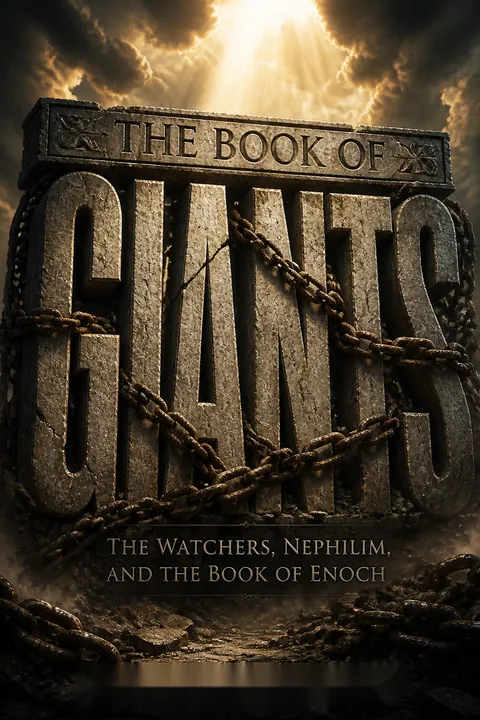
1. What is "The Book of Giants: The Watchers, Nephilim, and The Book of Enoch" by Joseph B. Lumpkin about?
- Exploration of Ancient Texts: The book examines ancient Jewish and Christian apocryphal writings, focusing on the Book of Giants, the Watchers, the Nephilim, and the Book of Enoch.
- Origins of Giants and Demons: It delves into the mythological origins of giants (Nephilim) as offspring of fallen angels (the Watchers) and human women, and how their spirits became demons.
- Comparative Analysis: Lumpkin compares different versions of the Book of Giants (Aramaic, Manichean) and integrates them with the Book of Enoch, providing historical and theological context.
- Influence on Religion: The book discusses how these texts influenced early Jewish and Christian beliefs about angels, demons, and the nature of evil.
2. Why should I read "The Book of Giants: The Watchers, Nephilim, and The Book of Enoch" by Joseph B. Lumpkin?
- Unveils Hidden Scriptures: The book brings to light lesser-known ancient texts that were influential in early Judaism and Christianity but are not part of the standard biblical canon.
- Deepens Understanding of Mythology: It provides insight into the origins of concepts like fallen angels, giants, and demons, which are foundational to Western religious and mythological thought.
- Historical and Theological Context: Lumpkin offers detailed background on the Dead Sea Scrolls, the Essenes, and the transmission of these texts, enriching the reader’s understanding of religious history.
- Bridges Gaps in Scripture: The book helps readers see connections between canonical and non-canonical texts, showing how ideas from Enoch and the Book of Giants shaped later religious beliefs.
3. What are the key takeaways from "The Book of Giants: The Watchers, Nephilim, and The Book of Enoch"?
- Fallen Angels and Human Women: The Watchers, a group of angels, descended to earth, mated with human women, and produced the Nephilim—giant, violent offspring.
- Origins of Demons: After the destruction of the Nephilim in the Flood, their spirits became the evil spirits or demons that afflict humanity.
- Multiple Versions and Adaptations: The Book of Giants exists in several versions (Aramaic, Manichean), each adapted to fit different religious and cultural contexts.
- Influence on Early Christianity: The Book of Enoch and related texts were highly regarded by early Christians and influenced New Testament writers, despite later being excluded from the canon.
4. How does Joseph B. Lumpkin explain the origins and significance of the Watchers and Nephilim in "The Book of Giants"?
- Watchers as Fallen Angels: The Watchers are depicted as angels who rebelled against God by descending to earth and breaking their heavenly vows.
- Creation of the Nephilim: By mating with human women, the Watchers fathered the Nephilim, who were giants known for their violence and corruption.
- Role in Human Corruption: The Watchers taught forbidden knowledge (magic, weaponry, astrology) to humanity, accelerating moral decay and leading to the Flood.
- Lasting Spiritual Impact: The spirits of the slain Nephilim became demons, continuing to influence and afflict humanity after their physical destruction.
5. What is the relationship between the Book of Giants and the Book of Enoch, according to Lumpkin?
- Shared Narrative Foundation: Both texts expand on the brief Genesis account of the "sons of God" and "daughters of men," focusing on the Watchers and their offspring.
- Possible Original Unity: Some scholars, and Lumpkin, suggest the Book of Giants may have originally been part of the Book of Enoch or a closely related supplement.
- Complementary Details: The Book of Giants fills in narrative gaps left by Enoch, especially regarding the giants’ dreams, their fate, and their interactions with Enoch.
- Integration in the Book: Lumpkin reconstructs and places fragments of the Book of Giants within the context of the Book of Enoch to provide a fuller story.
6. How does "The Book of Giants: The Watchers, Nephilim, and The Book of Enoch" address the different versions of the Book of Giants?
- Aramaic Version (Qumran): Lumpkin summarizes and translates the fragmented Aramaic texts found among the Dead Sea Scrolls, highlighting their Jewish context.
- Manichean Version: He explains how the Manichean religion adapted the story, recasting the Watchers as demons to fit its dualistic worldview, and notes the spread of the text into multiple languages.
- Comparative Analysis: The book compares the content, characters, and theological emphases of each version, noting how local myths and beliefs influenced the narrative.
- Reconstruction Efforts: Lumpkin discusses the challenges of reconstructing the storyline from fragmented manuscripts and how scholars attempt to piece together the original narrative.
7. What historical and archaeological context does Lumpkin provide for the Book of Giants and related texts?
- Dead Sea Scrolls Discovery: The book details the 1947 discovery of the Dead Sea Scrolls in Qumran, which included fragments of the Book of Giants and the Book of Enoch.
- Essenes and Qumran Community: Lumpkin explains the role of the Essenes, a Jewish sect, in preserving these texts and their possible authorship or custodianship.
- Dating and Transmission: He discusses the dating of the manuscripts (3rd century BCE to 1st century CE) and the transmission of the stories into various cultures and languages.
- Influence on Later Traditions: The book traces how these texts influenced later Jewish, Christian, and even Islamic thought about angels, demons, and the origins of evil.
8. How does Lumpkin interpret the theological and moral lessons of the Watchers and Nephilim stories?
- Warning Against Forbidden Knowledge: The Watchers’ imparting of secret knowledge to humanity is portrayed as a root of corruption and a cautionary tale about overreaching.
- Divine Justice and Mercy: The destruction of the Nephilim and the punishment of the Watchers illustrate themes of divine justice, while Noah’s survival shows God’s mercy.
- Origins of Evil Spirits: The transformation of the Nephilim’s spirits into demons provides an explanation for ongoing evil and suffering in the world.
- Call to Righteousness: The texts urge readers to pursue righteousness, avoid the paths of violence and sin, and heed divine instruction.
9. What are the main differences between the Aramaic and Manichean versions of the Book of Giants as presented by Lumpkin?
- Theological Framing: The Aramaic version presents the Watchers as fallen angels, while the Manichean version recasts them as inherently evil demons to fit dualistic cosmology.
- Character Adaptations: The Manichean version incorporates Iranian mythological figures and changes names (e.g., Ohyah becomes Sahm), reflecting local traditions.
- Narrative Variations: The Manichean text includes additional episodes, such as the giants’ battles and the survival of certain giants after the Flood, not found in the Aramaic version.
- Purpose and Message: The Manichean adaptation serves to reinforce its own religious teachings about the struggle between light and darkness, while the Aramaic version is more closely tied to Jewish apocalyptic themes.
10. How does "The Book of Giants: The Watchers, Nephilim, and The Book of Enoch" connect these ancient texts to the Bible and early Christianity?
- Direct Biblical Parallels: Lumpkin highlights how the Book of Enoch and the Book of Giants expand on Genesis 6:1-4 and are referenced in other biblical books like Jude and 2 Peter.
- Influence on New Testament: He shows that early Christian writers, including Jesus and the apostles, were familiar with and influenced by Enochian literature.
- Canonical and Non-Canonical Interplay: The book discusses how ideas from these texts were integrated into early Christian theology before being excluded from the official canon.
- Continuing Legacy: Lumpkin notes the ongoing influence of these stories in later Jewish, Christian, and even Islamic traditions regarding angels, demons, and eschatology.
11. What are some of the most significant quotes from "The Book of Giants: The Watchers, Nephilim, and The Book of Enoch" and what do they mean?
- "The angels saw the beauty of the daughters of men...": This quote encapsulates the central transgression of the Watchers, leading to the birth of the Nephilim and the spread of evil.
- "The giants, who are produced from the spirits and flesh, shall be called evil spirits on the earth...": This passage explains the origin of demons as the disembodied spirits of the Nephilim, a key theological point.
- "You have done great destruction on the earth: And you shall have no peace nor forgiveness of sin...": This pronouncement of judgment on the Watchers highlights the theme of divine justice.
- "And now, the giants, who are produced from the spirits and flesh, shall be called evil spirits on the earth...": This quote is repeated for emphasis, underlining the transformation of mythic history into ongoing spiritual reality.
12. How does Joseph B. Lumpkin's approach in "The Book of Giants: The Watchers, Nephilim, and The Book of Enoch" help modern readers understand these ancient texts?
- Accessible Translations and Commentary: Lumpkin provides modern English translations
Download PDF
Download EPUB
.epub digital book format is ideal for reading ebooks on phones, tablets, and e-readers.








