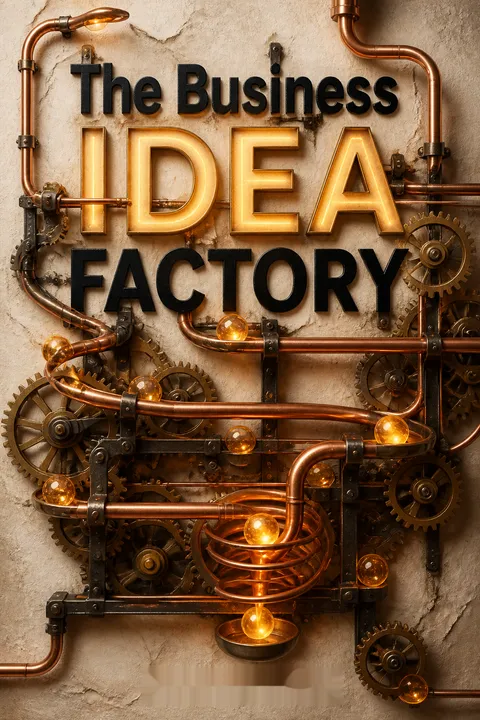


Key Takeaways
Stop waiting for a breakthrough; start with a small, testable business idea
Begin before certainty. Sedniev recounts meeting an entrepreneur who had built and sold several companies. The entrepreneur explained that his first two ventures were poor earners, but the skills they taught him helped make a later company successful. The same pattern appears in Bill Gates’s early venture, Traf-O-Data, which did not become Microsoft but gave him useful experience. The lesson is to begin with the resources and ideas already available, rather than wait for a flawless concept or a fortune-making insight.
Make the first step manageable. The book’s “$100 hour” exercise asks readers to spend an hour listing ways to earn an extra $100, then choose one idea to try. A modest target lowers the pressure and turns speculation into experience.
What's useful here is the shift from idea generation as a solitary flash to entrepreneurship as a learning process. Small experiments produce information about customers, selling, and delivery that abstract brainstorming cannot provide. This resembles the logic of a prototype: make something limited enough to test, then let real use expose what needs work. The caution is that beginning is not automatically wise; a small test still needs a clear cost limit and a way to tell whether it taught anything. The goal is not motion for its own sake, but learning that improves the next attempt.
Let ideas grow before your inner critic gets a vote
Separate creation from evaluation. Sedniev uses the Walt Disney strategy to describe three distinct modes of thought. The Dreamer imagines possibilities without worrying about feasibility. The Realist asks what would make an idea workable. The Critic looks for weaknesses and risks. The order matters: judging an idea while it is still forming can stop it before it has a chance to develop.
Give unlikely ideas a hearing. When Edwin Land’s young daughter wondered why a photograph could not be seen immediately, he did not dismiss the question as technically unrealistic. He explored how it might work, and the first Polaroid camera appeared four years later. The story illustrates why a rough idea deserves a practical attempt before a verdict.
This method makes room for divergent thinking, the generation of many possibilities, and convergent thinking, the selection and improvement of a few. Treating them as separate tasks reduces the chance that fear of looking foolish will narrow the search too early. It also keeps criticism useful: evaluation becomes a tool for strengthening or rejecting an idea, rather than a reflex that prevents exploration. The distinction is procedural, not a claim that people literally have separate creative and analytical brains. In practice, a timer or separate work sessions can help maintain the boundary.
Change the question when your thinking keeps returning empty-handed
Aim the search differently. Sedniev contrasts asking how to make horses faster with asking how to move people from place to place faster. The second question opens the door to solutions beyond improving horses. A better question can change the category of answers that seem possible.
Zoom in or out. The book recommends writing several versions of a problem, then changing its level of abstraction. A washing-machine maker might ask how to sell more of one model, increase total sales, or make the business more profitable. The “5 Whys” exercise traces a specific problem toward a deeper purpose. Breaking the larger task into smaller questions can then reveal concrete next steps, such as finding customers or arranging production.
Problem framing is a form of leverage: it changes what counts as a plausible solution before any solution is chosen. The best reframing often moves between levels. A narrow question helps someone act; a broader one can reveal that the original target was only a proxy for a more important need. There is a tradeoff: keep expanding the question and it becomes too vague to test. A productive sequence is to explore several frames, select one that matters to the customer, and translate it into a question specific enough to investigate.
Generate beyond the obvious before choosing what deserves your effort
Use a quota to push past clichés. In a workshop, Sedniev asked participants to invent 100 uses for a brick in 30 minutes. Early answers came easily from familiar experience. The exercise became more demanding as the obvious options ran out, which is exactly when participants had to stretch their associations. The book applies the same idea to business problems: set a target for the number of possible solutions and postpone judgment until the list is complete.
Expect plenty of misses. The author cites research on creative work in which highly productive scientists, artists, and composers produced more unsuccessful work as well as more successful work. A large pool of attempts does not guarantee a breakthrough, but it gives selection more to work with.
A quota works by changing the immediate objective from “find the answer” to “keep exploring.” That can reduce the pressure to defend the first plausible solution and make unusual combinations easier to consider. The principle is valuable when a task has many possible answers, especially in early ideation. Quantity alone, however, is not a measure of quality or progress. A useful process pairs a generous generation phase with criteria for later selection, so a large list becomes a resource rather than an excuse to avoid deciding.
Work hard on a problem, then give it room to incubate
Alternate focus and distance. Sedniev’s Think and Rest technique begins with concentrated work on a problem. The thinker records possibilities, then steps away and returns occasionally for brief bursts of attention. The “incubation period” is this interval away from deliberate effort, when the problem may continue to be reconsidered in the background. The author describes useful ideas arriving during sleep, exercise, walks, and everyday chores.
Return with fresh eyes. Sedniev’s own example is an unconventional request he sent to companies to gain access to costly equipment for a professional exam. He says the solution emerged after other approaches stalled. The method does not mean waiting passively: it combines preparation, a pause, and renewed attention.
Alternating effort with rest is a practical way to avoid mistaking prolonged concentration for progress. A break can loosen fixation and expose a problem to new associations, especially when it follows substantial preparation. But the background-mind explanation should not be treated as a guaranteed hidden worker producing answers around the clock. Sometimes the useful effect is simpler: rest restores attention, and changing activities changes what becomes noticeable. Incubation is most useful when paired with notes, so an emerging thought can be captured and tested rather than mistaken for a solution merely because it feels fresh.
Build new offers by recombining ideas customers already understand
Originality often has ingredients. In a story about a young inventor and a fictional judge called Market, Sedniev argues that customers care more about whether a product improves their lives than whether it is unprecedented. Many ideas modify or combine familiar ones. MTV joined music and television; drive-through banking brought banking services to people in cars.
Study, then adapt. Irina, the mother of a friend, visited pharmacies in Germany, observed how they operated, and adapted useful practices for her Ukrainian pharmacy. The book also points to businesses that adapted existing concepts for a new audience or region. Copying here means learning from a working model and changing it to fit a real context, not simply reproducing another company’s product.
The emphasis on recombination gives creativity a practical starting point: look for patterns across industries, places, and customer routines. It also counters the myth that an idea must appear from nowhere to be valuable. The important work often lies in recognizing which elements transfer and which depend on local conditions. That distinction matters ethically as well as commercially. Adaptation can create value, but a close imitation may disregard intellectual property, labor, or the needs that made the original work. The strongest borrowing changes the fit, not just the packaging.
Use constraints to expose options, then challenge inherited rules
Give creativity a boundary. Sedniev argues that an open-ended task with unlimited time and resources can be paralyzing. A deadline, budget, or specific target gives the search direction. He also warns against mistaking old habits for genuine limits: a rule that has always been followed may still be changeable.
Remake the usual offer. The Transformer technique asks people to list the assumptions built into a business, then question them. A zoo that normally operates by day can become a nighttime attraction. SCAMPER, another idea-generation method, prompts changes such as replacing, combining, shrinking, removing, or rearranging parts of a product or service. Applied to a café, these prompts can suggest delivery, a simpler menu, or a new use for the space.
Constraints can focus creative search by shrinking an overwhelming field of possibilities. They are most productive when they are explicit and revisable: a fixed budget may be real, while “customers would never accept that” may be an assumption worth testing. The methods here help turn vague demands to innovate into specific prompts. Yet changing a feature is not automatically an improvement. Each variation should be judged against the customer problem it is meant to solve, rather than novelty alone. Otherwise, a clever redesign risks becoming a solution in search of a need.
Capture ideas, then let trusted people and customers pressure-test them
Save the fragile thought. Sedniev urges readers to record ideas as soon as they appear, since a passing insight can be hard to reconstruct. A notebook or other reliable capture habit also makes it possible to revisit, combine, and revise ideas instead of relying on memory.
Filter in stages. The “3 categories technique” sorts ideas into promising, clearly weak, and uncertain groups. A trusted “creative buddy” can help spot problems or improvements, but the market provides the decisive test. Sedniev’s “100, 20, 5, 1” rule is a rough funnel: narrow 100 ideas to 20, select five to test, and expect one to stand out. His advice is to test promising ideas on a small scale before committing heavily.
This sequence combines memory, social feedback, and customer evidence, each of which catches a different kind of error. Notes prevent loss; a trusted partner can question blind spots; small tests reveal behavior that opinions may not predict. The sequence also protects the fragile early idea from being judged by an unhelpful audience too soon. Still, a pilot can mislead if it reaches the wrong customers or uses unclear success measures. Testing works best when the team decides in advance what evidence would justify expansion, revision, or stopping.
Treat failure as information, but keep each experiment affordable
Expect attempts to miss. Sedniev presents creativity as a process of generating and testing many possibilities. Thomas Edison, in the book’s account, produced thousands of prototypes before developing a commercially workable light bulb. The point is not that every failure is useful, but that a failed attempt can reveal what does not work and shape the next one.
Protect the ability to try again. James Dyson spent years refining a vacuum design and made 5,126 failed prototypes before reaching a working version. His persistence mattered, but so did continued effort toward a specific product. The book advises testing ideas on a small scale, letting weak ones fail early, and increasing investment only when evidence supports it.
The strongest version of persistence is adaptive persistence: stay committed to the problem while changing the approach in response to evidence. Dyson’s story is inspiring, but famous successes can hide the many people who persisted and still failed. That survivorship bias makes persistence a poor standalone strategy. Affordable experiments improve the odds by limiting the cost of being wrong and preserving resources for another attempt. Failure becomes valuable when it produces information that changes a decision; repeating the same failed approach without learning is merely expensive stubbornness.
Treat idea generation as play, not a high-stakes performance
Make exploration feel safe. Sedniev recalls a karate instructor who helped him treat sparring as a game rather than as a threat. He connects that change in attitude to ideation: fear of getting an answer wrong can make people cautious, while play encourages them to try more possibilities. The book describes a productive state as relaxed, energetic, curious, open, and confident.
Use cues to enter that state. Visualization, movement, humor, or recalling a moment of confidence can help someone feel more prepared to explore. The aim is not to guarantee a brilliant idea through positive thinking. It is to reduce self-consciousness enough to generate possibilities, then evaluate them separately.
Play lowers the social cost of proposing a strange idea, which matters in teams as much as in individual work. A playful setting can make experimentation feel less like a public test of intelligence and more like a shared search. This does not mean that confidence or visualization causes success by itself. Optimism without evidence can also encourage overcommitment. The useful distinction is between confidence in one’s ability to explore and certainty that a particular idea is right. The first supports learning; the second can interfere with it.
Train creative thinking daily and feed it varied raw material
Build the habit. Sedniev recommends spending at least 15 minutes a day thinking about ideas, rather than waiting until a business problem becomes urgent. Regular practice makes it easier to start and gives the mind more chances to form connections. He compares creative ability to a skill strengthened through repeated use, not a gift reserved for a few people.
Give thought something to work with. The book encourages reading, travel, new activities, conversation, exercise, sleep, and changes of scenery. These experiences supply what Sedniev calls raw materials: memories and ideas that can be combined into something useful. He also recommends thinking during routine activities, when attention is less tightly occupied by deliberate analysis.
Practice is more convincing when it means deliberate repetition with feedback, not merely accumulating hours. A daily session can build fluency, while varied experiences widen the pool of associations available for new combinations. Conversations add another advantage: other people notice patterns and needs that one person may miss. The author’s broad habit prescription is strongest when tailored to the actual work. A founder seeking product ideas needs contact with customers and real constraints, not novelty for its own sake. Creative range grows through exposure, but relevance comes from what the thinker chooses to observe.
Analysis
The book’s central contribution is not a mysterious recipe for genius but a repeatable workflow: gather material, frame a problem, generate alternatives, pause, refine, and test. Its stories make that workflow memorable, particularly the contrast between waiting for one life-changing idea and learning through modest ventures, or between rejecting an implausible suggestion and asking how it might be made workable. The strongest practical insight is the separation of idea generation from judgment, followed by small-scale market tests. That combination protects novelty without treating every novel thought as a business.
The account sometimes presents a simplified picture of cognition. Creativity is not cleanly divided between a fast subconscious and a slow analytical brain, and the text’s claims about vast differences in brain speed or guaranteed results from techniques should not be accepted literally. Its useful observations survive without those claims: people can become fixated on familiar answers, breaks can change perspective, and varied inputs can help produce associations. The described child-creativity statistics also do not establish that formal education alone destroys creativity; tests, definitions, and circumstances matter.
A more rigorous reading treats the methods as prompts, not laws. Quotas create room for options, but selection needs customer evidence. Incubation can help, but it does not replace research. Borrowing ideas can reveal possibilities, but responsible adaptation requires attention to context and ownership. Persistence is valuable when it responds to new evidence, not when it merely extends sunk costs. Taken together, the system is most persuasive as disciplined exploration: make the search broad, make the experiments cheap, and let experience improve the next question.
Review Summary
The Business Idea Factory receives mostly positive reviews, with readers praising its concise, practical approach to generating creative ideas. Many found the strategies and examples helpful for both business and personal growth. Readers appreciated the author's relatable writing style and the book's emphasis on developing creative thinking skills. Some criticisms include a lack of depth in certain areas and the absence of a specific system. Overall, reviewers found the book inspiring and valuable for anyone looking to enhance their idea generation abilities.
People Also Read







Glossary
Think and Rest technique
Alternate focus and incubationA process of concentrating on a problem, recording ideas, and then stepping away so attention can recover and new associations may emerge. The thinker returns occasionally for brief sessions. Sedniev presents rest, sleep, walking, and routine activities as useful intervals, while emphasizing that the problem must first be clearly considered.
incubation period
A break from deliberate focusThe interval after concentrated work when a person stops actively trying to solve a problem. Sedniev argues that ideas may emerge during this period, including while sleeping or doing routine activities. In the book’s process, incubation follows preparation and works alongside occasional returns to the problem.
Walt Disney strategy
Three modes for developing ideasA way to separate three kinds of thinking: imagining possibilities without constraint, working out how an idea could be made real, and identifying weaknesses. The strategy asks people to move through these modes in sequence so early criticism does not shut down idea generation before an idea has been developed.
ideas quota technique
Set a target for idea volumeA brainstorming method that sets a specific number of ideas to produce within a limited time. The quota is intended to push thinking past familiar, easily recalled answers and encourage less obvious possibilities. Ideas are generated first and assessed afterward, rather than filtered as soon as they appear.
Transformer technique
Challenge a business’s assumptionsA method for finding opportunities by listing the rules, features, or standard practices of a business, then asking what might change if those assumptions were reversed or removed. Sedniev uses examples such as changing a zoo’s operating hours to reveal a different visitor experience.
SCAMPER
Prompts for modifying existing ideasA structured set of prompts for altering a product, service, or process. It directs attention to substitutions, combinations, adaptations, changes in scale, alternative uses, removals, and rearrangements. Sedniev uses a café to show how such changes can suggest delivery, simplified menus, or different uses for the building.
ideas bombarding
Review many related examplesAn exercise in which a person rapidly examines a large number of ideas related to a task, then records possible applications, combinations, or modifications. Sedniev suggests reviewing about 100 examples in two hours. The purpose is to expose the mind to many reference points that can trigger new approaches.
3 categories technique
Sort ideas into three groupsA screening method that places each idea into one of three groups: promising, clearly weak, or uncertain. The promising options can be examined further, weak options set aside, and uncertain ideas retained for possible revision. The method allows a large list to be reviewed without treating every idea as equally viable.
100, 20, 5, 1 rule
A rough idea-selection funnelA rule of thumb for narrowing a large pool of ideas: begin with roughly 100, choose 20 promising options, reduce those to five worth trying, and expect about one to make a substantial difference. The numbers are estimates, not guarantees, and describe the book’s proposed path from brainstorming to implementation.
creative buddy
A trusted first reviewerA person with whom an idea creator can safely share early, even awkward, ideas. This partner offers candid feedback, notices possible weaknesses, and may suggest improvements. Sedniev recommends using this person’s judgment as useful input, not as a substitute for the creator’s own decision or evidence from customers.
high-performance state
A receptive, energized mindsetThe mental and emotional condition Sedniev associates with productive idea generation. It combines relaxation, energy, excitement, openness, and confidence. The book suggests using movement, memories, or visualization to help enter this state, while its practical purpose is to reduce inhibition and make exploration easier.
About the Author
Other books by Andrii Sedniev

Download PDF
Download EPUB
.epub digital book format is ideal for reading ebooks on phones, tablets, and e-readers.








