

Key Takeaways
Audit the Fed's claim to restrain inflation when it controls money creation
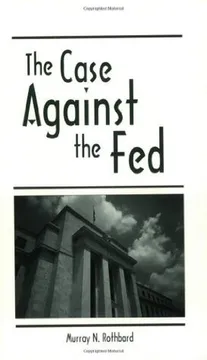
The book's central charge. Rothbard argues that the Federal Reserve is not an outside referee fighting inflation. Because it controls the creation of base money and supports commercial banks, he sees it as a central source of the monetary expansion it publicly promises to restrain. The book opens with a 1993 dispute: Representative Henry Gonzalez proposed audits and faster disclosure of Fed policy meetings, while President Clinton warned that greater scrutiny could unsettle markets.
Independence has a cost. Rothbard questions why an agency wielding public power should be shielded from elected oversight. He argues that invoking protection from election-cycle pressure can conceal decisions about who receives new money and who bears its costs. His remedy is not merely a more transparent Fed, but its abolition.
What's striking is how the opening reframes monetary policy as a question of governance, not just technical expertise. Central bank independence can help officials resist short-term political demands, but independence does not make distributional choices disappear. Decisions about interest rates, asset purchases, and emergency support benefit some balance sheets before others. Transparency therefore matters even when secrecy is not the central problem. Rothbard's indictment is forceful, though its broadest claims about Fed motives require evidence beyond the fact that the institution has considerable discretion.
More dollars do not create more goods, even when money makes trade easier
Money solves barter's bottleneck. Rothbard describes money as a medium of exchange that emerges when traders accept a widely marketable good, rather than as a useful object imposed by decree. Direct barter makes trade cumbersome: a farmer seeking tools must find a toolmaker who wants grain. A common medium lets each person sell and buy without matching desires. In a British prisoner-of-war camp during World War II, cigarettes became money through repeated trading, not official instruction.
A larger stock adds no output. Rothbard argues that once money is established, expanding its supply cannot by itself produce food, machinery, or skill. It mainly changes money's purchasing power. He also argues that rising productivity can make prices fall while living standards rise, so falling prices do not automatically signal economic collapse.
The distinction between money and real resources is a powerful antidote to the intuition that a bigger bank balance means society has become richer. The barter example also clarifies why money has genuine social value: it makes exchange and calculation easier. The harder question is how much liquidity an economy needs to transact smoothly, especially when prices and wages adjust slowly. A fixed or slowly growing supply may discipline money creation, but it does not make every change in the price level harmless.
Track who receives new money first, not just what happens to average prices
New money travels unevenly. Rothbard rejects the picture of money appearing in everyone's hands at once. A counterfeiter spends first; sellers receive the money next, while others encounter higher prices before their own incomes rise. People on fixed incomes may receive none of the new money at all. The example explains why the same overall price increase can leave different households in very different positions.
Spending patterns change, too. Rothbard draws on the Austrian tradition, particularly Richard Cantillon, to argue that early and late recipients do not buy identical things. As new money moves through the economy, it changes relative prices, incomes, and which projects look profitable. He treats this process as a hidden transfer from later recipients to earlier ones, as well as a potential distortion of production.
This account adds a missing question to headline inflation figures: whose income adjusts first, and whose costs rise first? Distributional analysis is valuable because an average price index cannot show how a monetary shock moves through particular markets. The size and direction of the effect depend on where new credit enters and who receives it, not on a single universal sequence. Rothbard's framework helps identify that mechanism, though calling the transfer a tax or theft also assumes a particular moral and legal account of money creation.
Separate genuine lending from storing money before judging bank deposits
A loan transfers use. Rothbard distinguishes loan banking from deposit banking. A lender gives funds to a borrower for an agreed period and receives repayment, usually with interest. If a bank lends money that its owners or depositors have genuinely made available for lending, Rothbard sees this as ordinary investment, not money creation.
Storage preserves ownership. A bailment is a legal arrangement in which a bailee holds someone else's property for safekeeping; the owner has not simply sold or lent it. Rothbard compares money deposits to a warehouse holding a chair or a grain elevator holding wheat. A warehouse receipt represents the stored good. In his view, issuing more redeemable receipts than stored money exists is not ordinary lending, but a breach of custody. He argues that courts treated bank deposits differently from comparable warehouse arrangements.
The useful move here is to ask what a customer believes a deposit promises, rather than treating every bank balance as self-explanatory. The warehouse analogy makes the distinction between custody and credit vivid. But a modern bank account is generally a contractual debt claim, not a claim to specific notes kept untouched in a vault. Whether a practice is deceptive therefore depends on the contract, disclosure, and reasonable expectations. Rothbard's legal critique is clearest when the promise is immediate redemption, but the analogy alone cannot settle every banking arrangement.
When banks promise instant redemption against partial reserves, runs become systemic
Claims can exceed cash. Fractional-reserve banking, in Rothbard's account, means a bank issues redeemable claims greater than the cash it holds. If customers use those claims as money, the system's money supply grows without a matching increase in cash. The mismatch becomes acute when many holders ask for redemption together. A bank run is a rush by customers to withdraw or redeem funds; because the bank cannot meet every demand at once, loss of confidence can become insolvency.
Competition also limits expansion. A bank that creates far more claims than its rivals risks having those claims presented for payment by customers of other banks. Rothbard argues that this can force a bank to contract or fail even without a public run. Banknotes and demand deposits are different forms of money claims, while a check is an instruction to transfer a deposit, not itself the deposit.
The mismatch between liquid promises and less-liquid assets is a genuine source of fragility, and the run scenario shows why confidence can matter as much as a balance sheet's long-run value. Modern bank runs can also spread through fast payments and public information, making timing important. Yet partial reserves do not by themselves establish fraud: banks can disclose that deposits are liabilities and operate under contracts that specify access and protections. The central policy question is how to manage liquidity risk without confusing a contractual risk with a crime.
A central bank can protect banks from the limits that constrain individual expansion
A shared backstop changes incentives. Rothbard describes central banks as performing two connected jobs: financing government and supporting commercial banks. As lender of last resort, a central bank lends to banks facing acute funding pressure. As a coordinating institution, it can increase reserves across the banking system, making it easier for banks to expand together without one bank immediately losing reserves to another.
The history began before the Fed. The Bank of England was chartered in 1694 partly to help finance government debt. Rothbard connects later central banking to the effort to relax the limits imposed by withdrawals and interbank redemption. In the United States, the Civil War-era National Banking System created a hierarchy of banks whose reserve deposits linked smaller institutions to larger ones, concentrating influence in major financial centers.
The cartel argument highlights an important political-economy question: institutions can stabilize a system while also protecting its participants from market discipline. A lender of last resort may stop a liquidity panic from destroying otherwise viable businesses, but repeated rescue can encourage greater risk-taking if losses are shifted to the public. The effects depend on the terms of support, oversight, and how solvency is assessed. Rothbard's account emphasizes protection for banks; the competing case emphasizes preventing a temporary funding shock from turning into a wider collapse.
The Fed's 1913 birth followed a long campaign, not just the Panic of 1907
The push predates the panic. Rothbard disputes the familiar story that the Panic of 1907 suddenly persuaded the country to create a central bank. He traces organized reform efforts to the late 1890s, when bankers and business leaders promoted an elastic currency through conferences, expert reports, and newspaper coverage. The campaign sought to make a central bank appear to answer a broad public need, rather than simply a banker-led proposal.
Jekyll Island supplied a plan. In 1910, Senator Nelson Aldrich and five other financial and policy figures met privately at a resort on Jekyll Island to draft a banking proposal. The Federal Reserve Act passed in 1913 after the plan was revised and presented under a different political banner. Rothbard interprets this history as a campaign for a government-backed banking cartel. His account connects the Fed to the wider Progressive Era drive for regulation and coordination.
The chronology usefully shifts attention from a single crisis to the organizing work that makes legislation possible: commissions, professional networks, public messaging, and draft bills. Those are observable political mechanisms, not inherently proof of secret domination. The Jekyll Island meeting is significant, but the broader claim that the Fed was primarily designed to cartelize banking is an interpretation of motives and outcomes. A careful reader should distinguish documented coordination from the stronger inference that it explains the whole law.
Read Fed asset purchases as reserve creation, not neutral bookkeeping
A purchase creates bank reserves. Rothbard explains open market operations, the Fed's buying or selling of assets, usually government securities. When it buys a bond, it pays by creating a deposit for the seller's bank. The banking system gains reserves, which can support additional lending and deposits. In the book's simplified example, a $1 billion purchase followed by a 10-to-1 expansion produces as much as $10 billion in new money.
The example is a model. The Fed's asset purchases directly change its liabilities and bank reserves; the broader increase depends on what banks and borrowers do. Rothbard also points to the period after the Fed's creation: he says the money supply roughly doubled during World War I, alongside a doubling of prices. He presents this as evidence that the new system enabled much larger wartime financing.
The balance-sheet explanation demystifies a policy often described in abstract language. It shows how purchasing an asset can create reserves without first collecting equivalent cash from taxpayers. The 10-to-1 figure, however, is a simplified multiplier, not a mechanical promise that each reserve dollar generates ten dollars of lending. Banks also face capital, risk, and borrower-demand constraints, while monetary policy operates through several channels. The accounting mechanism is clear; the size and timing of its effects are empirical questions.
Deposit guarantees move banking risk; they do not make it disappear
Insurance needs measurable risks. Rothbard argues that insurance works best when losses can be estimated across many cases and individual beneficiaries cannot control the event. He contrasts those conditions with business failures, which are difficult to predict as a uniform class and can be influenced by business decisions. He argues that calling bank-deposit guarantees insurance obscures the public backstop and can weaken incentives to avoid excessive risk.
The guarantee calms depositors. The Federal Deposit Insurance Corporation was created in 1933 to reassure depositors after bank failures. Rothbard claims that its resources at the time covered only a small fraction of the deposits it guaranteed, and he points to the collapse of the separate savings-and-loan insurance system as a warning. His concern is not just whether a fund can cover losses, but whether confidence in the guarantee encourages banks to take risks whose costs reach beyond their owners.
The moral-hazard concern is important: protection can change behavior, especially when the insured party chooses the risk. But deposit guarantees can also prevent panic withdrawals by small customers who cannot assess a bank's balance sheet. That benefit is not the same as eliminating risk; it depends on credible funding, supervision, and rules that limit excessive risk-taking. The strongest version of Rothbard's challenge asks who ultimately pays in a crisis. The answer may include taxpayers, other financial institutions, or the wider economy, not only the insurance fund.
Rothbard's remedy is gold redemption, bank failure, and no public bailout
The proposed exit is concrete. Rothbard calls for abolishing the Fed, ending deposit insurance, and returning to money redeemable in gold. Using figures from 1994, he proposes revaluing 260 million ounces of Federal Reserve gold to cover about $404 billion in liabilities. That calculation yields roughly $1,555 per ounce. He would exchange Federal Reserve notes for gold coin and distribute gold reserves to banks for redemption of deposits.
Failures must carry consequences. Under his plan, banks that cannot meet redemption demands would close and liquidate rather than receive a central-bank rescue. He does not propose immediately banning fractional-reserve banking; he expects redemption and the end of public guarantees to constrain it. He calls this a practical intermediate measure, short of treating every bank that issues excess claims as criminal.
The proposal follows directly from the book's governing principle: money claims should be redeemable, and losses should fall on the institutions that make the promises. Its arithmetic is specific, but a conversion price does not by itself answer how contracts, creditors, and bank capital would be treated during the transition. Gold also limits monetary discretion, which may constrain inflation while making adjustment harder when demand for money changes. The plan is best read as a coherent institutional alternative, not as a frictionless technical switch.
Analysis
Rothbard's case is strongest when it separates functions that are often blurred together. Lending saved funds is not the same activity as storing money, and a bank's loan portfolio is not the same thing as cash available for immediate redemption. That distinction gives the book a useful way to ask what a financial promise actually means. Its second major contribution is distributive: new money reaches some people before others, so its consequences cannot be captured by a single average price index. These ideas turn monetary policy into a question about contracts, incentives, and political power.
The book's polemical vocabulary can also narrow the analysis. Calling fractional-reserve banking counterfeiting or theft presumes that depositors expect custody and full redemption, whereas ordinary bank deposits are commonly understood as contractual liabilities. The legal and ethical judgment therefore depends on what was promised and disclosed. Likewise, the claim that central banking is principally a cartel device is a serious interpretation of institutional history, but evidence of banker influence does not, on its own, establish that this was the sole or decisive purpose of the Fed.
The mechanics deserve similar care. The Fed can create reserves by purchasing assets, but the book's 10-to-1 multiplier is a teaching model, not a guaranteed sequence of lending. Bank capital, borrower demand, risk, and policy choices affect how reserves translate into deposits and spending. Nor does showing that money creation can distort prices prove that every monetary expansion produces a damaging cycle.
The enduring value of the book is its demand for explicit accounting: Who creates monetary claims? What do those claims promise? Who gets new purchasing power first, and who absorbs the losses when promises fail? Readers can take those questions seriously without accepting Rothbard's entire diagnosis or his gold-standard remedy. His argument is most persuasive as a warning against treating technical authority as politically neutral.
Review Summary
Reviews for The Case Against the Fed are largely positive, with readers praising Rothbard's accessible explanation of complex monetary concepts, fractional reserve banking, and the Federal Reserve's origins. Many appreciate the book's concise yet informative nature, recommending it as an essential introduction to Austrian economics and central banking criticism. Common criticisms include the book's one-sided perspective, lackluster historical sections, and insufficient detail on post-Fed creation events. Some disagree with Rothbard's advocacy for 100% reserve banking, while others dismiss his arguments entirely as libertarian ideology.
Glossary
fractional-reserve banking
More claims than reservesA banking arrangement in which an institution holds only part of the cash needed to meet all outstanding claims at once. Banks use the remaining funds in lending or other activities. Rothbard treats issuing immediately redeemable claims beyond cash reserves as a form of counterfeiting; other interpretations view deposits as contractual bank liabilities.
bailment
Property held for safekeepingA legal arrangement in which one party temporarily possesses another party's property for a defined purpose, such as storage, while ownership remains with the original owner. Rothbard uses bailment to distinguish a deposit for safekeeping from a loan, arguing that money held in bailment should not be treated as the bank's own funds.
warehouse receipt
Claim to stored goodsA document or account entry that represents a claim to goods held by a warehouse. A holder may present it to receive the goods or transfer it to another person. Rothbard uses the term for banknotes and deposit claims, arguing that a receipt should be fully backed by the money it promises to redeem.
lender of last resort
Emergency bank lenderA central bank's role in lending to financial institutions that cannot readily obtain funds elsewhere. Such support can help a bank meet withdrawals or payments during a funding crisis. Rothbard argues that this function also shields banks from the consequences of issuing more redeemable claims than they can cover.
open market operations
Central bank asset tradesA central bank's purchases or sales of financial assets, commonly government securities, in the market. A purchase generally adds reserves to the banking system, while a sale generally removes them. Rothbard presents these operations as the Fed's main means of changing bank reserves and influencing the supply of money and credit.
money multiplier
Potential deposit expansionA simplified model describing how a change in bank reserves may support a larger change in deposits across the banking system. In Rothbard's illustration, a 10-to-1 multiplier turns a $1 billion reserve addition into up to $10 billion in money. Actual lending and deposit creation depend on bank decisions and other constraints.
Download PDF
Download EPUB
.epub digital book format is ideal for reading ebooks on phones, tablets, and e-readers.








