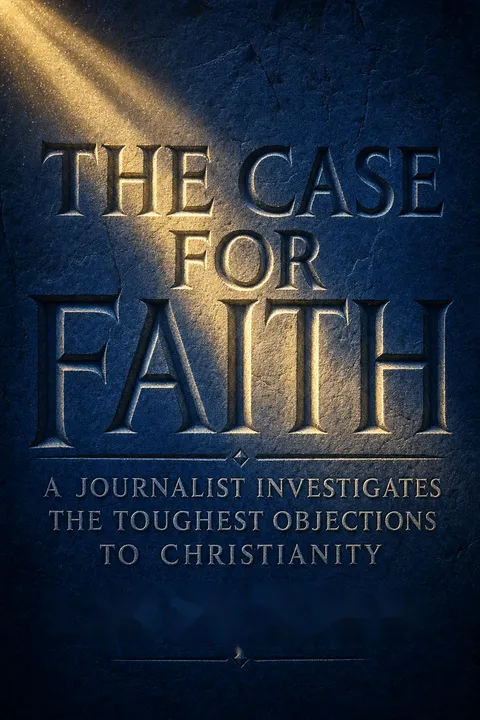


Key Takeaways
Weigh Christianity as a cumulative case, not a single unresolved objection
One question can dominate. The book begins with two former evangelists on opposite paths. Billy Graham confronted doubts about trusting the Bible and chose faith without resolving every question. Charles Templeton lost his faith after suffering, especially the image of a mother holding her child who had died in a drought. Strobel, a former atheist journalist, sees both the emotional force of objections and the danger of treating one objection as the whole case.
Investigate the whole record. The book examines eight major challenges, from suffering and miracles to church violence and personal doubt. Its central claim is that these objections should be weighed alongside the historical, philosophical, and experiential evidence Strobel believes supports Christianity. The method is closer to assessing a legal case than seeking one argument that settles everything.
The cumulative-case approach is useful because real decisions rarely rest on one isolated fact. A person may weigh testimony, historical records, moral intuitions, and lived experience together. Yet accumulation is not automatically proof: several weak arguments do not necessarily become strong through addition, and evidence must be assessed for independence. The opening stories also show that doubt is not purely intellectual. Templeton's grief and Graham's anxiety shape how each interprets evidence. That makes the inquiry more human, but it also means readers should distinguish what an argument establishes from what they hope or fear it establishes.
Treat suffering as a moral emergency, not a tidy syllogism
Pain is not abstract. Strobel's reporting on poverty, violence, illness, and bereaved families makes the problem of suffering personal. Philosopher Peter Kreeft answers that human freedom permits moral evil, while divine knowledge might allow some short-term pain for goods people cannot see. He compares limited human understanding to a trapped bear misreading a hunter's effort to free it.
The Christian answer is presence. Kreeft points to the crucifixion as the claim that God enters human suffering rather than observing it from a distance. He also argues that hardship can develop character, while insisting that suffering should prompt practical care for those in pain. His final response to a grieving person is first to listen, then to help, not to deliver a polished explanation.
The chapter distinguishes a logical challenge, whether suffering can coexist with an all-good God, from the lived challenge of pain that feels unbearable. The cross offers a distinctive answer to the second: companionship and solidarity rather than a complete account of cause. That can sustain people without solving the intellectual problem. The bear analogy, however, is limited. It suggests that apparently cruel actions may serve an unseen good, but it cannot establish that every instance of suffering is necessary or justified. The call to listen and relieve suffering is therefore crucial, not an optional afterthought.
Ask whether miracles are possible before declaring them unscientific
Define the claim first. Philosopher William Lane Craig defines a miracle as an event not producible by the natural causes operating at that time and place. He argues that natural science studies regular processes, while a miracle would be an exceptional action by a creator, not a refutation of the regularity science describes. The book distinguishes this from using God to fill gaps in current scientific knowledge.
Then weigh the evidence. Craig presents a cumulative case for God based on the universe's beginning, fine-tuning, objective morality, the resurrection, and personal experience. For the resurrection, he emphasizes early reports of Jesus' burial, an empty tomb, appearances, and the disciples' changed convictions. The argument is that a miracle becomes more plausible if God exists and the historical evidence favors it.
The distinction between scientific method and metaphysical naturalism is valuable. A method that seeks repeatable natural causes does not, by itself, prove that nothing beyond nature exists. Still, establishing possibility is different from establishing that a particular miracle happened. Historical claims need careful comparison with alternatives, and a religious setting may explain why a story was told without proving its truth. The chapter is strongest when it asks readers not to rule out explanations in advance. It is less decisive when it treats contested interpretations of historical evidence as settled conclusions.
Separate evolution from life's origin before claiming either proves God
Two scientific questions differ. The book separates small changes within populations, which it calls microevolution, from large-scale evolutionary change, which it calls macro-evolution. It then focuses on a further question: how nonliving chemistry first produced life. Walter Bradley argues that building a cell requires coordinated energy use, information storage, and replication, and that proposed chemical pathways do not adequately explain the needed complexity.
The book's inference is design. Bradley treats the coded information in DNA as evidence of intelligence, comparing it with meaningful written messages. He also challenges the Miller experiment, arguing that its simulated atmosphere did not match early Earth. From these arguments, the book concludes that a designer is the best explanation. It presents this as a critique of naturalistic origin-of-life theories, not merely as a debate over fossils.
Keeping biological evolution distinct from the origin of life prevents a common category error: explaining how life diversifies is not the same as explaining how life began. The book is right to identify abiogenesis as a difficult research question. Its stronger leap is from incomplete natural explanations to an intelligent cause. An unsolved problem does not, on its own, identify its solution, and the analogy between DNA and human writing may not capture how chemical information arises. Readers should therefore treat the design argument as a philosophical inference, not as a scientific consensus or a disproof of evolutionary biology.
Read violent scripture in context without letting context erase its moral cost
Description is not approval. Norman Geisler argues that biblical accounts can record wrongdoing without endorsing it. On passages about the destruction of ancient peoples, he stresses their violent setting, the warnings and opportunities to surrender, and the book's claim that God's judgment was directed at entrenched evil. He also argues that the apparent children in the story of Elisha were likely older youths threatening the prophet, based on his reading of the Hebrew wording and context.
Context can clarify, not settle. Geisler also points to archaeological findings as support for the Bible's historical reliability and says apparent contradictions may reflect different levels of detail or translation. These defenses invite readers to check context, genre, and wording before declaring a passage incoherent. They do not make the moral difficulty disappear, especially where the text depicts children dying.
Context is indispensable in reading ancient texts: translation, genre, political setting, and the difference between narration and approval all matter. Yet contextual explanation can become a shield if it is treated as a complete moral answer. The claim that a people deserved judgment does not automatically resolve what readers should think about collective punishment or the deaths of children. A careful reading can hold two judgments together: a passage may be more complex than a quick quotation suggests, and its ethical implications may remain troubling. That tension deserves examination rather than dismissal.
Respect religious neighbors without pretending incompatible claims are identical
Pluralism has limits. Ravi Zacharias argues that religions make distinct claims about God, human nature, morality, and destiny. A belief in a creator, for example, conflicts with a worldview that denies one. He says that calling every religion equally true does not remove disagreement; it adds another claim about what all religions mean. His four questions are origin, meaning, morality, and destiny, which he uses to compare Christianity with other traditions.
Exclusivity need not excuse arrogance. Zacharias acknowledges that Christians have often communicated their beliefs with hostility, contrary to the love they profess. On people who have never heard the Christian message, he suggests that God can reach sincere seekers through conscience, creation, or unexpected encounters, while leaving final judgment to God. The book presents this as a reason to hold a firm conviction with humility, not contempt.
The logical point is sound: contradictory propositions cannot all be true in the same sense at the same time. But that does not show which religion is true, nor does it make every religious disagreement equally important. The chapter's most useful distinction is between confidence in a claim and superiority toward people who reject it. Its treatment of those without access to Christianity is more speculative, because stories of unusual conversion do not establish a general rule. Intellectual honesty requires both acknowledging real differences and resisting the urge to claim certainty about other people's ultimate fate.
Test hell's justice against freedom, proportionality, and the cost of exclusion
Hell is framed relationally. Philosopher J. P. Moreland rejects the popular picture of God operating a torture chamber. He describes hell as lasting separation from God, understood as the consequence and punishment of a life that refuses relationship with God. He reads biblical images of fire, worms, and darkness as figures for judgment and loss, not literal descriptions of a chamber.
The defense rests on choice. Moreland argues that forcing everyone into heaven would override human agency, and that judgment varies according to people's actions. He addresses questions about children, finite wrongdoing, annihilation, and second chances, arguing that God gives people adequate opportunity and that the final outcome respects human freedom. The book does not hide the emotional weight of the doctrine: Moreland admits that hell remains sad and uncomfortable even if he believes it is just.
This account is more morally serious than a simple threat of physical torment because it connects judgment to relationship, character, and agency. It also raises a hard question: how free is a choice shaped by upbringing, trauma, limited information, or mental illness? Calling separation chosen may understate those constraints. The claim that eternal consequences fit finite lives also depends on a particular view of wrongdoing against God. Readers can assess the logic without pretending that the emotional objection is merely sentimental. The chapter's insistence that discomfort should motivate care is ethically important.
Judge Christianity by both its historical failures and its concrete service
The record contains real harms. Historian John Woodbridge does not excuse the Crusades, inquisitions, Salem witch trials, missionary abuses, or Christian anti-Semitism. He distinguishes institutional and cultural Christianity from sincere discipleship, but also admits that genuine Christians have acted against Jesus' teachings. He argues that political power, economic motives, and false beliefs often tangled with religious motives, making history more complicated than a single-cause explanation.
The record also includes service. The book points to early Christians caring for the poor and vulnerable, and to later hospitals, schools, relief work, and reformers who challenged abuses. Woodbridge's central plea is to remember both the people who harmed others in Christianity's name and those who served, repented, and opposed injustice. The distinction between professed faith and lived practice helps explain the record, but cannot erase responsibility.
Historical judgment benefits from the same discipline as individual judgment: examine motives, institutions, consequences, and counterexamples rather than selecting only the evidence that supports a preferred verdict. The book's account usefully rejects a simple story of uninterrupted virtue or uninterrupted oppression. Still, separating authentic believers from cultural Christians risks defining away inconvenient evidence. The more persuasive standard is to ask how institutions handled power, whether dissent was allowed, and whether wrongdoing was acknowledged and repaired. Humanitarian achievements matter, but they do not cancel harms as if history were a moral ledger.
Let doubt ask hard questions, then examine what your resistance protects
Doubt has several sources. Lynn Anderson describes intellectual questions, grief, family wounds, disappointment, temperament, and fear of commitment as different paths into uncertainty. He warns that neither constant religious certainty nor every expressed objection should be taken at face value. Strobel tells how he initially suspected that a reformed gang member was faking his change, partly because he did not want the story of Christian transformation to be true.
Faith can be tested in practice. Anderson advises seekers to clarify why they want or resist belief, learn from people whose lives they respect, investigate the reasons for trusting Jesus, and try living out Jesus' teachings. The book's final arc is investigation, decision, and transformation. Its stories of former criminals who turned themselves in or served others illustrate the claimed power of faith, though personal change alone cannot prove every doctrine.
The chapter's strongest insight is psychological: intellectual debate can sometimes conceal fear, grief, or self-interest, but the same diagnosis can be misused to dismiss legitimate criticism as bad motives. A fair inquiry tests arguments and examines motives without substituting one for the other. The proposed practice of living a teaching can reveal its effects and deepen understanding, much as practical learning differs from abstract study. Yet beneficial consequences do not establish that a belief is true. Transformation is meaningful evidence about a person's life, not a shortcut around historical or philosophical evaluation.
Analysis
The book is an apologetic work shaped as an investigative journey. Its strongest organizing idea is not that every objection has a knockdown answer, but that objections should be assessed within a larger case for Christianity. That approach is more realistic than demanding certainty on every point before making any commitment. The recurring stories also give intellectual questions emotional stakes: Templeton's grief, Graham's uncertainty, and the reported transformations of former criminals make faith a question of both evidence and life.
Its arguments vary in strength. The distinction between methodological naturalism and metaphysical naturalism is useful: science's focus on repeatable causes does not, by itself, rule out every supernatural claim. The distinction between evolution and life's first emergence is also important. But the book often moves too quickly from gaps in scientific explanation to design, and it presents disputed claims about evolution and origin-of-life research with greater confidence than the evidence warrants. Historical corroboration can support a text's knowledge of places and people, but it cannot by itself verify theological claims. Likewise, showing that a miracle is possible does not establish that it occurred.
The treatment of suffering and hell is most compelling when it refuses to offer emotional shortcuts. The cross is presented as divine solidarity with sufferers, while the account of hell stresses agency and relationship. Neither fully answers why particular tragedies happen or how a genuinely free choice can be separated from ignorance and circumstance. The history chapter similarly benefits from acknowledging both service and harm, though the distinction between authentic and merely cultural Christianity needs careful application to avoid circular reasoning.
The book's lasting value lies in modeling serious engagement with objections and in admitting that belief involves judgment under uncertainty. Its central invitation is to investigate fairly, notice personal motivations, and decide whether the total case merits trust. That is an account of responsible commitment, though readers should independently examine the quality and current status of the scientific and historical claims on which the case depends.
Review Summary
The Case for Faith receives mixed reviews, with Christians generally praising it and non-Christians criticizing it. Supporters find it intellectually stimulating and faith-affirming, appreciating Strobel's journalistic approach and the experts he interviews. Critics argue the book lacks objectivity, employs circular reasoning, and fails to address skeptics' concerns adequately. Some readers find it helpful in addressing doubts, while others view it as propaganda. The book's treatment of topics like suffering, science, and hell generates both praise and criticism. Overall, readers' pre-existing beliefs strongly influence their reception of the book.
People Also Read






Glossary
The Big Eight
Eight objections to ChristianityStrobel's organizing label for eight challenges he investigates: suffering, miracles, evolution, divine violence in the Old Testament, Jesus' exclusivity, hell, church history, and personal doubt. The label structures the book as a sequence of interviews with Christian scholars. It is the author's selected set of major objections, not an exhaustive list of every challenge to Christian belief.
properly basic belief
Belief grounded in experienceA belief a person may rationally hold without deriving it from other beliefs through an argument, because it arises directly from experience. In the book, William Lane Craig uses belief in the external world as an analogy for immediate belief in God. Such a belief can be meaningful to the person who has the experience, while remaining difficult to establish for someone who does not share it.
ceteris paribus
All other things equalA Latin phrase meaning that other relevant conditions are held constant. Craig uses it to explain why a natural law describes what happens under specified conditions, rather than every event regardless of intervention. On his account, a miracle need not disprove a natural law if a supernatural agent changes the conditions in a particular instance.
microevolution
Variation within a speciesThe book's term for changes and adaptations within existing species, such as selective breeding or bacteria developing resistance. Strobel distinguishes this from macro-evolution, which he uses for larger evolutionary change across groups of organisms. The distinction frames the book's critique, although contemporary evolutionary biology treats evolutionary change across scales as related processes.
macro-evolution
Large-scale evolutionary changeThe book's term for the development of diverse forms of life over long periods, including common ancestry across major groups. Strobel contrasts it with smaller changes within species and argues that evidence for the latter does not by itself establish the former. The term is used here in the book's framing, not as a claim that evolutionary biology recognizes a sharp divide between two unrelated mechanisms.
traducianism
Souls transmitted through parentsA theological view that human souls are transmitted through the reproductive process rather than individually created by God at conception. Moreland invokes this possibility in discussing why God might create family lineages that include people who reject God, if those lineages also lead to others who accept him. The book presents it as one possible account, not an agreed Christian doctrine.
cultural Christians
Christians by social identityWoodbridge's term for people who identify with Christianity through culture, institution, or public profession without necessarily living as sincere followers of Jesus. He uses the distinction to explain why actions carried out in Christianity's name may contradict Christian teaching. The distinction can clarify differences between belief and behavior, but it should not be used to dismiss historical wrongdoing simply by redefining perpetrators as inauthentic.
FAQ
What is "The Case for Faith" by Lee Strobel about?
- Investigating Objections: The book explores eight of the toughest objections to Christianity, such as the problem of evil, miracles, evolution, biblical contradictions, and the exclusivity of Jesus.
- Journalistic Approach: Lee Strobel, a former atheist and journalist, interviews leading Christian scholars and skeptics to provide evidence-based, reasoned responses.
- Personal Journey: Strobel shares his own transformation from skepticism to faith, making the investigation both intellectual and personal.
- Goal: The aim is to help both skeptics and believers understand and overcome obstacles to faith by presenting thoughtful answers grounded in history, philosophy, and theology.
Why should I read "The Case for Faith" by Lee Strobel?
- Addresses Common Doubts: The book tackles the "Big Eight" objections that often prevent people from embracing Christianity, such as suffering, hell, and the exclusivity of Jesus.
- Expert Insights: Strobel’s interviews with scholars like Norman Geisler, Ravi Zacharias, and J.P. Moreland provide credible, well-reasoned answers.
- Balanced Perspective: Both skeptical and faith-affirming viewpoints are presented, helping readers understand the complexity of faith.
- Relatable and Encouraging: Strobel’s personal journey from atheism to faith makes the book accessible and encouraging for those wrestling with similar questions.
What are the "Big Eight" objections to Christianity discussed in "The Case for Faith" by Lee Strobel?
- List of Objections: The book addresses: (1) Evil and suffering, (2) Miracles vs. science, (3) Evolution and God’s necessity, (4) God’s character and biblical violence, (5) Exclusivity of Jesus, (6) Hell and a loving God, (7) Church history and violence, (8) Doubt and faith.
- In-Depth Exploration: Each objection is explored through expert interviews and biblical analysis to provide reasoned answers.
- Reader Engagement: Strobel encourages readers to reflect on these objections and consider the evidence and arguments presented.
How does Lee Strobel address the problem of evil and suffering in "The Case for Faith"?
- Personal and Empathetic: Strobel shares real-life encounters with suffering to highlight the emotional weight of this objection.
- Philosophical Insights: Through interviews with philosophers like Peter Kreeft, the book discusses free will, the necessity of evil for greater goods, and character development.
- God’s Presence in Suffering: The book emphasizes that God entered human suffering through Jesus, offering hope and meaning amid pain.
- Purpose in Suffering: Suffering is presented as potentially purposeful, leading to spiritual growth and deeper faith.
What is Lee Strobel’s approach to miracles in "The Case for Faith"?
- Defining Miracles: Miracles are defined as events not producible by natural causes, distinguished from coincidences or natural phenomena.
- Science and Miracles: The book argues that miracles do not violate natural laws but supersede them, and that science studies regularities, not supernatural interventions.
- Historical Evidence: Strobel presents historical arguments for Jesus’ miracles, especially the Resurrection, supported by eyewitness testimony.
- Rational Credibility: The evidence for miracles is shown to be rational and intellectually defensible.
How does "The Case for Faith" by Lee Strobel address the challenge of evolution and belief in God?
- Micro vs. Macroevolution: The book distinguishes between small variations within species (microevolution) and the broader claim that all life evolved from simple organisms (macroevolution).
- Origin of Life: Strobel, through experts like Walter L. Bradley, highlights the scientific challenges in explaining the origin of life by chance or natural processes.
- Intelligent Design Argument: The complexity and information content in DNA are presented as evidence for an intelligent cause.
- Analogy and Reasoning: The book uses analogies, such as coded messages, to argue that information in DNA implies a designer.
How does "The Case for Faith" by Lee Strobel address concerns about God’s character, especially regarding biblical violence?
- Objections from Violence: Critics question how a loving God could command or allow acts of violence, including the killing of innocents in the Old Testament.
- Contextual Explanations: Norman Geisler explains that the Bible records events without necessarily approving them and that many violent acts were judgments on corrupt societies.
- God’s Justice and Mercy: The book emphasizes that God’s justice is righteous and necessary, and that His character is consistent across both Testaments.
- Human Sin and Suffering: Suffering and death are presented as consequences of human sin, not God’s original design.
How does Lee Strobel address the issue of biblical contradictions in "The Case for Faith"?
- Interpretive Principles: Norman Geisler outlines seventeen principles for interpreting Scripture, showing that many alleged contradictions arise from misinterpretations.
- Complementary Accounts: Differences in gospel details are explained as complementary rather than contradictory, reflecting different perspectives.
- Benefit of the Doubt: The book argues that critics often err in their objections and that the Bible deserves the benefit of the doubt.
- Human and Divine Elements: The Bible is seen as a human book with divine truth, written from various perspectives but without error in its message.
What is the Christian response to the objection that Jesus is "offensive" for claiming to be the only way to God, according to Lee Strobel?
- Truth is Exclusive: Ravi Zacharias explains that truth by definition excludes falsehood, making exclusivity a logical necessity, not arrogance.
- Other Religions’ Claims: Many world religions also make exclusive truth claims, so Christianity is not unique in this regard.
- Love and Humility: Christians are called to communicate exclusivity with love and humility, reflecting Jesus’ own approach.
- Coherence of Christianity: Christianity is presented as uniquely answering life’s fundamental questions in a coherent way.
How does "The Case for Faith" by Lee Strobel explain the doctrine of hell and its compatibility with a loving God?
- Hell as Separation: J.P. Moreland describes hell as eternal separation from God, emphasizing relational loss rather than literal torture.
- Justice and Free Will: Hell is seen as respecting human freedom; God does not coerce belief or love.
- Degrees of Punishment: The Bible teaches varying degrees of suffering in hell, proportional to one’s deeds and rejection of God.
- Metaphorical Language: Biblical imagery of hell is interpreted as metaphorical, conveying seriousness rather than physical torment.
How does "The Case for Faith" by Lee Strobel address the historical sins and violence associated with Christianity?
- Authentic vs. Institutional Christianity: The book distinguishes between true followers of Jesus and those who merely claim Christianity.
- Contextual Factors: Events like the Crusades and Inquisition are explained as involving political and cultural factors beyond pure religious motives.
- Confession and Repentance: The church has acknowledged past sins, and many Christians have worked to correct abuses and promote justice.
- Positive Contributions: Christianity’s role in humanitarian efforts, education, science, and human dignity is highlighted.
What are the key takeaways and practical reflections from "The Case for Faith" by Lee Strobel?
- Faith Can Withstand Questions: Christianity can respond thoughtfully and convincingly to the most difficult objections, making faith intellectually viable.
- Suffering and Evil: Suffering does not disprove God; it can have purpose, and God’s presence offers hope.
- Miracles and Resurrection: The evidence for Jesus’ miracles, especially the Resurrection, is strong and supports belief in a miracle-working God.
- Science and Faith: Challenges from science and evolution can be addressed without abandoning belief in God.
- God’s Character: Understanding God requires context, recognizing His justice, mercy, and love as integral and unchanging.
About the Author
Other books by Lee Strobel


Download PDF
Download EPUB
.epub digital book format is ideal for reading ebooks on phones, tablets, and e-readers.








