

Plot Summary
Melanie Enters the Marriage
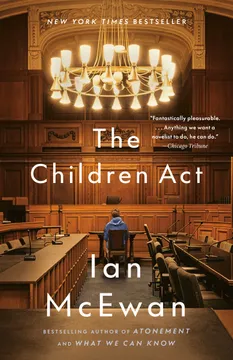
Fiona Maye,1 an exacting High Court judge, has spent the evening revising a ruling about two Haredi girls13 whose mother6 wants them educated beyond the limits their father7 accepts. Fiona1 has favored their chance to choose their adult lives.
Her own home offers no such clarity. Jack,2 her husband of thirty years,2 says he wants an affair with Melanie, a younger statistician, while insisting their marriage continue. Fiona1 refuses, then presses him to admit whether the affair has begun.
Before he answers, her clerk10 calls: seventeen-year-old Adam Henry3 needs an urgent hearing because he and his Jehovah's Witness parents4 reject blood treatment for his leukemia. Fiona1 lists the case for Tuesday. When she returns to the room, Jack2 has packed and leaves without a note.
The opening places Fiona between two forms of intimate judgment. At work, she can state a child's interests in precise legal terms; at home, she cannot make Jack's desire fit any orderly category. Her refusal to accept his proposed arrangement protects her dignity, but it also leaves her with no immediate way to repair the marriage. The urgent call offers work as both duty and shelter. That refuge is unstable: Adam's case will ask Fiona to decide how much a young person's declared belief can be trusted, just as she confronts how little she understands the person closest to her.
A Vote Against Blood
By Tuesday afternoon, Adam's3 blood counts have fallen so far that his consultant11 warns he may soon die or suffer blindness, brain damage, or organ failure. The hospital says transfusions would let it give him the full leukemia treatment, with a strong chance of recovery.
Adam's parents,4 Kevin4 and Naomi Henry,5 refuse because their Jehovah's Witness faith forbids taking in another person's blood. Their counsel argues that Adam3 is almost eighteen, intelligent, and entitled to refuse.
The hospital's barrister counters that Adam3 cannot grasp the suffering ahead and has grown up inside a community that discourages dissent. A social worker8 confirms his intelligence but sees a very young boy facing an adult decision. Fiona1 interrupts the legal arguments to say she will visit Adam herself before deciding.
The hearing makes the case harder than a contest between science and superstition. Kevin and Naomi describe a faith that gave order to a chaotic early marriage, while Adam's intelligence makes it impossible to dismiss his choice as simple obedience. Yet the evidence also exposes the limits of judging autonomy by eloquence alone. Adam can explain doctrine, but the consultant cannot ethically make him imagine every consequence of dying untreated. Fiona's decision to visit shifts her method from weighing testimony at a distance to encountering the person whose welfare the law claims to protect.
The Judge Sings Beside Adam
In the dim oncology room, Fiona1 finds Adam3 breathless but lively, surrounded by schoolwork, poems, and a beginner's violin. He argues that religion, science, and poetry all point toward a shared truth, then explains his refusal as obedience to God.
When Fiona1 asks whether he has faced the possibility of lasting disability, his confidence falters and he turns away in tears. He reads her a poem that makes his possible death seem meaningful to his congregation.
Before leaving, Fiona1 listens as he plays a rough version of The Salley Gardens, then sings with him. Back in court, she rules that his welfare outweighs his refusal: at seventeen, he is too young to make a fully informed choice about a potentially fatal ordeal, so the hospital may transfuse him.
The hospital visit changes the evidence by making Adam more than the eloquent position presented in court. Fiona sees his bravado give way when he considers disability, but she also encounters a boy whose humor, poetry, and music imply a future he cannot yet picture clearly. Their song briefly suspends the roles of judge and patient without erasing them. That intimacy helps Fiona see his life as a field of unrealized possibilities. Her ruling protects those possibilities, though it also demonstrates the court's power to override a young person's stated convictions.
Saved By the Court
Adam3 undergoes transfusions under the court order, and treatment begins to restore him. In a letter, he tells Fiona1 that his mother5 could not watch the procedure and cried outside; when he woke, both parents4 were at his bedside, weeping with relief. Their joy makes him question a faith that had prepared them to lose him, and he stops attending Kingdom Hall, though arguments with his parents4 follow.
Fiona1 does not answer his letter. At home, Jack2 returns with his suitcase after discovering that his pursuit of Melanie was a mistake. Fiona1 lets him in, but his apology cannot make her glad he is back. As the weeks pass, she asks Adam's social worker8 for an update, learns he is recovering, and keeps her distance.
Adam's recovery does not restore the beliefs that shaped his refusal. His parents' grief and happiness disclose a contradiction between the doctrine they defended and their love for their son, but the revelation brings conflict rather than easy freedom. Fiona, meanwhile, has made a consequential decision in court and still cannot answer the boy's need for contact. Her silence resembles professional caution, yet it also protects her from emotional responsibility. At home, Jack's return similarly restores proximity without repairing trust. Survival and reunion both occur, but neither provides the understanding that Fiona and Adam are seeking.
The Rainy Newcastle Visit
When Fiona1 travels north on judicial circuit, Adam3 tracks her from London to Newcastle, following her train and car before walking through a storm to the judges' lodging. He has left home after a fierce argument with his father4 and has already sent his mother5 a message saying he is safe. Adam3 explains that his former certainty had also fed a fantasy of dying nobly and being admired.
Fiona1 listens, but refuses his idea that he could live with her and Jack2 as a lodger. She arranges a hotel and a ticket to his aunt in Birmingham. As he is about to leave, Fiona1 kisses him on the lips instead of stepping away. The brief contact crosses a boundary she has spent her career defining, then she sends him on without offering the closeness he wants.
Adam's journey turns gratitude into a demand for belonging. He does not merely want to thank Fiona; he wants her to replace the community and certainties he has left behind. His admission that martyrdom once appealed to his vanity complicates the idea of a purely religious choice, but does not make him less vulnerable. Fiona recognizes the danger of his dependence and sets a practical boundary, then undermines it with a kiss. The contradiction reveals how easily compassion can become entangled with a wish to be needed, especially for someone whose private life has been narrowed by work and childlessness.
The Ballad Names Betrayal
After returning to London, Fiona1 receives Adam's unfinished ballad. Its speaker abandons a religious burden, accepts a kiss from a woman, then faces condemnation for being led astray. Fiona1 recognizes herself in the poem and keeps it, but does not answer.
She and Jack2 cautiously resume meals and conversation, though neither has repaired the injury between them. At rehearsal, her colleague Mark Berner9 describes defending Wayne Gallagher, a young man sentenced through joint enterprise for violence largely committed by others.
Mark9 believes class and a careless legal process have helped send Gallagher to prison, and he considers leaving the law. Fiona1 challenges his despair, then joins him in rehearsing for their Christmas concert. Music gives the three adults a shared task while the harder questions remain unanswered.
The poem gives Adam a way to make an emotional event legible through the religious language he is trying to escape. By casting Fiona as a betrayer, he turns confusion and longing into a moral story, but the unfinished ending signals that the story has not settled into meaning. Fiona's decision not to reply is partly protective and partly evasive. Mark's account of Gallagher's sentence echoes the novel's concern with institutions that claim to act justly while narrowing individual lives. Fiona can recognize injustice in another case more readily than she can face the consequences of her own blurred boundary.
The Final Song Returns
At the December concert, Jack2 has prepared champagne, candles, and a favorite piano record, a tentative invitation to begin their marriage again. Fiona1 and Mark9 perform their demanding program with unusual ease.
Before they go on, fellow judge Sherwood Runcie12 tries to tell Fiona1 something, but the concert absorbs her. She and Mark9 end their set with The Salley Gardens, the tune Fiona1 once shared with Adam.3 Afterward she calls Adam's social worker8 and learns that his leukemia returned weeks earlier.
Now eighteen, he refused another transfusion and died. At home, Fiona1 takes Adam's poem from her bedside table and deciphers its revised final line as a prediction of her own death. She tells Jack2 that she kissed Adam3 and that he has died, then flees to her bedroom in tears.
The performance brings Fiona briefly into the kind of shared attention she has lacked at home, but the returning song carries the past into that apparent renewal. Adam's death makes the poem's revisions feel less like adolescent melodrama and more like a warning Fiona failed to understand. The novel does not present his refusal as proof of a single motive: faith, identity, and self-dramatizing desire have all shaped him. Fiona's grief is sharpened by the knowledge that she once offered him protection in a judgment, then withdrew from the relationship he tried to build around that encounter.
A Confession by the Fire
After collapsing into sleep, Fiona1 wakes to find Jack2 beside her. The poem and Adam's3 death have forced her to see the limits of the protection she thought the court had provided. She had decided his treatment, but not what he needed once the hearing ended; when he sought her out, she sent him away, ignored his letters, and failed to recognize his poem's warning.
Jack2 does not ask her to excuse herself or pretend the kiss meant nothing. He draws her close and tells her he will continue to love her. Fiona1 then explains the whole story, including her shame and Adam's3 hunger for the life she had urged him to choose. Their marriage resumes uneasily, not healed by one night, but with Fiona1 no longer hiding what she has done.
The ending offers neither a verdict that absolves Fiona nor a reconciliation that erases Jack's earlier betrayal. Instead, intimacy begins again through disclosure: she allows another person to witness the part of the story she had kept outside both marriage and court. Her guilt is not simply that she kissed Adam. It is that she treated a legal order as the boundary of her duty, even after he returned seeking ordinary human attachment. Jack's presence makes no answer to the loss possible, but it gives Fiona a companion for facing it. The marriage remains uncertain, as does the moral meaning of her choices.
Analysis
The novel puts two kinds of authority under pressure: the court's power to protect a child and the private conviction of the person being protected. Fiona's1 judgment rests on a strong principle, that welfare must include a future in which a child can grow, revise beliefs, and build relationships. Yet the case exposes a difficulty the law cannot solve by citation: how to distinguish a young person's settled conviction from an identity formed inside a narrow world. Fiona1 can assess Adam's3 understanding, but she cannot know what his belief will mean to him after the hearing.
Her professional certainty contrasts with her private indecision. She can explain the claims of parents, evaluate evidence, and issue an order, but she cannot easily answer Jack's2 request for change or Adam's3 request for attachment. The novel suggests that empathy is not simply the opposite of distance. Fiona's1 visit helps her see Adam3 clearly, yet her emotional response later leads her across a boundary and then into silence. Good intentions do not guarantee good care; responsibility continues after the formal decision, especially when another person comes back asking to be heard.
The book also treats belief as a social inheritance rather than a set of ideas held alone. Adam's parents4 have found stability through their congregation, while Judith6 wants her daughters13 to retain choice beyond their community's expectations. Fiona's1 legal language tries to protect that choice, but the story keeps testing whether institutions can honor it without taking over. In the end, neither law nor faith supplies a complete account of what a life is worth. The novel's most demanding claim is that care requires more than choosing for someone. It requires remaining present to the consequences, admitting one's limits, and accepting that another person's future cannot be secured by a single ruling.
Review Summary
The Children Act receives mixed but generally positive reviews, averaging 3.74/5. Readers praise McEwan's exquisite prose, compelling character study of judge Fiona Maye, and the morally complex central case involving a Jehovah's Witness teenager refusing a life-saving blood transfusion. Many find the parallel marriage storyline less convincing. Critics note the writing can feel clinical and detached, while admirers celebrate its emotional depth, musical references, and philosophical richness. The 2018 film adaptation, starring Emma Thompson, is also well-regarded.
Characters
Fiona Maye
The welfare-minded judgeFiona is a senior family judge whose intelligence, disciplined prose, and attention to children's welfare have earned professional respect. She believes careful reasoning can protect people caught in the wreckage of adult conflict, yet her exactness also offers refuge from personal uncertainty. Her marriage to Jack2 is long and intimate, while her demanding career and childlessness have shaped the life they built together. Fiona is perceptive about other people's vulnerabilities but less practiced at exposing her own. Her central tension is between the distance needed for judgment and the human involvement that makes judgment meaningful.
Jack Maye
The restless academicJack is Fiona's1 husband, a professor of ancient history with charm, humor, and a taste for music, geology, and intellectual digression. His long marriage to Fiona1 gives him a deep knowledge of her habits, but that familiarity has also become a source of frustration. He wants more sensual vitality and is willing to risk the stability they share to pursue it. Jack can be affectionate and generous, particularly with children, yet his desire to remain loved while testing the marriage reveals a self-serving side. His relationship with Fiona1 is shaped by both genuine attachment and accumulated neglect.
Adam Henry
The gifted young patientAdam is a highly intelligent seventeen-year-old raised as a Jehovah's Witness. He is articulate about scripture, curious about science, and drawn to poetry and music, but his limited experience leaves him vulnerable to adult interpretations of what his choices mean. His seriousness sits beside a playful, theatrical streak; he can argue doctrine one moment and seek approval the next. Adam wants to be seen as an independent person, not merely as a son or a case before the court. His relationships with his parents4, religious community, and Fiona1 expose his hunger for both conviction and a wider life.
Kevin Henry
A father bound by faithKevin is Adam's father3, a practical businessman whose religious community helped him move beyond an unstable youth. He is proud of his competence and accustomed to solving concrete problems, but in the courtroom he defends beliefs that require him to accept a terrible risk to his son3. His plain-spoken certainty is not a pose; faith has given his family order and belonging. Kevin's account of love sits uneasily beside his insistence that religious law must be obeyed, making him neither a simple villain nor an easy advocate.
Naomi Henry
A mother inside the faithNaomi is Adam's mother3 and shares her family's Jehovah's Witness faith. She is more practically minded than Kevin4, managing hospital arrangements and attending to the daily needs of a seriously ill child. Her quiet manner makes her difficult for outsiders to read, but her presence in court and at Adam's3 bedside carries the strain of a parent trying to remain faithful while confronting fear. Naomi's love is shaped by a close-knit religious world that offers support as well as firm boundaries.
Judith Bernstein
A mother seeking wider choicesJudith is the mother of Rachel and Nora13, an observant Jewish woman who wants her daughters13 to have broader educational and professional choices than she had. She has pursued university study and a teaching career despite resistance from her husband's7 family and community. In court she can appear restless and combative, but her impatience grows from a fear that her daughters13 will inherit the limits she fought to escape. Judith remains committed to Judaism while challenging the assumption that religious continuity requires a closed future.
Julian Bernstein
A father guarding traditionJulian is Judith's6 estranged husband and the father of Rachel and Nora13. He values the disciplined, familiar world of the Haredi community and believes its traditions offer the girls security and a clear identity. Reserved in court, he relies on community witnesses to explain why their way of life should be preserved. His position is rooted in sincere religious commitment, but he struggles to distinguish the welfare of his daughters13 from the continuity of the culture that has formed him.
Marina Greene
The boy's independent guardianMarina is the court-appointed social worker assigned to represent Adam's3 interests. She is a careful observer who can respect a young person's intelligence without confusing it with adult judgment. Her practical, unshowy manner contrasts with the lawyers' elaborate arguments, and her work gives Fiona1 information grounded in direct contact with Adam3. Marina is also a parent herself, bringing ordinary knowledge of family life to a case dominated by legal and theological abstractions.
Mark Berner
Her musical legal allyMark is a senior barrister, a friend of Fiona's1, and her partner in amateur musical performances. His smooth advocacy can be forceful in court, while his work also leaves him troubled by the ways legal procedure can flatten individual differences. He is capable of loyalty and idealism, though he sometimes turns disappointment into sweeping judgments about the profession. Music gives him and Fiona1 a form of cooperation that their legal work rarely permits.
Nigel Pauling
The careful court clerkNigel is Fiona's1 efficient, hesitant clerk. He organizes hearings, relays urgent information, and manages the practical demands of her judicial work. His restraint helps Fiona1 maintain professional focus, while his concern for the people involved occasionally shows beneath his formal manner.
Rodney Carter
The urgent hematologistCarter is the consultant hematologist responsible for Adam's3 treatment. He is blunt, experienced, and impatient with legal delay because he sees a rapidly worsening medical emergency. His certainty about the clinical need for transfusion reflects both professional knowledge and the limits of a doctor's role when belief prevents treatment.
Sherwood Runcie
A colleague with blind spotsRuncie is a fellow judge whose warmth and humor make him an accepted member of the close legal community. His reputation is complicated by a grave earlier miscarriage of justice, a reminder that intelligence and good intentions cannot prevent institutional failure. He remains a colleague Fiona must encounter socially and professionally, even when the history between them is painful.
Rachel and Nora Bernstein
The Bernstein daughtersRachel and Nora are the young daughters at the center of their parents'6 dispute over education and religious upbringing. Their preferences are not easily separated from the competing worlds offered by their mother6 and father7. The case concerns the future room they will have to form convictions of their own.
Plot Devices
The Children Act
Welfare as legal compassThe law's instruction to make a child's welfare paramount shapes both the Bernstein6 schooling dispute and Adam's3 medical hearing. It gives Fiona1 a formal basis for intervening when parents cannot agree, but it does not tell her exactly what welfare requires. She must interpret it through a child's relationships, future choices, beliefs, and capacity to understand consequences. The Act therefore functions as a tool and a pressure: it authorizes protection while leaving the judge responsible for the moral risk of overriding a child's expressed wishes.
The Hospital Visit
Law made personalFiona's1 decision to visit Adam3 in hospital takes her beyond written testimony and medical evidence. Seeing his frailty, hearing his ideas, and sharing music with him make the decision more intimate than the hearing's abstract arguments. The visit also exposes Fiona1 to a relationship she cannot neatly file as either professional or personal. It is the point at which she sees Adam3 as a young person with a possible future, while also creating an emotional connection that complicates her later choices.
The Salley Gardens
A melody crossing yearsThe Irish song first connects Fiona1 and Adam3 during her hospital visit, when he plays it on his beginner's violin and she joins in. Its themes of youth, regret, and a life looked back upon give their brief encounter a language neither can easily manage in conversation. Fiona1 and Mark9 later perform the song at the Christmas concert. Its return links the public music event to Fiona's1 private memory of Adam3 and intensifies the significance of what she learns that night.
Adam's Letters and Ballad
Belief rewritten as longingAdam's3 letters record his changing relationship with his parents'4 faith and his growing wish to speak with Fiona1. His unfinished ballad turns their kiss into a religiously charged story of temptation and betrayal. Because Fiona1 does not answer, the writing becomes a one-sided record of a relationship she has chosen not to acknowledge. The poem's revised ending later carries a meaning she failed to recognize when she first read it.
Download PDF
Download EPUB
.epub digital book format is ideal for reading ebooks on phones, tablets, and e-readers.








