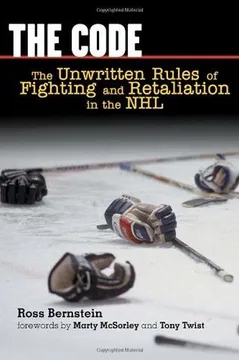


Key Takeaways
Read a hockey fight as the last link in an unwritten chain of accountability
A hidden rulebook. The Code is hockey’s unwritten system for deciding who must answer for a hit, a cheap shot, or disrespect toward a teammate. It sits beside the official rules: players can use physical force, but are expected not to exploit someone who cannot defend himself. Players learn the norms by watching, testing boundaries, and facing consequences, often in Canadian junior hockey before reaching the NHL.
Violence is old news. Fighting did not arrive as a modern sideshow. It was part of hockey from its early years, and in 1922 the NHL chose to regulate fighting with a penalty rather than ban it. The key point for a viewer is that a fight rarely explains itself. What looks sudden from the stands may be the end of a long sequence of slights and responses.
What's striking is that the book treats the code as an informal institution, not merely a collection of fighting customs. Like any shared norm, it can coordinate behavior without a written rule for every situation. Its authority depends on players believing that others will uphold it. But an unwritten system also leaves room for selective enforcement: whose conduct counts as disrespect, and who gets to decide the proper response? The code can restrain opportunism while also giving violence a moral vocabulary. That tension helps explain why the same players can describe fighting as both a safeguard and a source of danger.
Protect scorers with a credible threat, not a fight every shift
Presence can be protection. An enforcer’s job was not simply to fight. By being available to answer dangerous or disrespectful play, he could give smaller, skilled teammates room to skate, pass, and shoot. The book describes Anaheim bringing in Stu Grimson after Paul Kariya and Teemu Selanne had missed time with injuries. The next season, both ranked near the top of the league in scoring, and Anaheim made the playoffs. The example illustrates the intended logic of deterrence: opponents may think twice about targeting a star when consequences seem credible.
The threat matters most. Players describe an enforcer’s reputation, or even his presence at the end of the bench, as enough to discourage liberties. That does not prove Grimson alone caused Anaheim’s improvement. It does show why teams valued protection even when no fight occurred.
This is a useful distinction between an intervention and its deterrent effect. In many systems, a credible consequence can change behavior without being applied repeatedly. That logic makes the enforcer’s quiet presence as important as the spectacular fight. The difficult question is how to tell genuine deterrence from a story teams tell to justify violence. The Anaheim example is suggestive, not a controlled comparison: injuries, roster changes, and team performance all matter. The strongest version of the argument is narrower. Protection may create perceived space, but it does not establish that fighting is the only, or safest, way to create it.
Settle retaliation early, or a grievance can metastasize into assault
A grievance can grow. In February 2004, Colorado rookie Steve Moore hit Vancouver captain Markus Naslund in a play Vancouver considered dirty. When the teams met again in Vancouver, Moore fought enforcer Matt Cooke, apparently answering for the hit. But Todd Bertuzzi still believed Moore had not paid enough. Late in a lopsided game, Bertuzzi punched Moore from behind and drove him into the ice. Moore suffered fractured vertebrae and other serious injuries, and his playing career ended.
A fight is not an assault. The book argues that hockey’s system is supposed to give players a controlled way to answer for actions. Bertuzzi’s attack crossed a boundary because Moore was struck from behind and could not defend himself. The earlier grievance explains the atmosphere; it does not excuse the attack. The case exposes how unclear limits can turn retaliation into a disaster.
The episode shows how a norm meant to contain conflict can also intensify it. Each side may think its response is proportionate, while the target experiences a different chain of events and a different level of threat. Repeated media footage can flatten that chain into a single shocking image, but context explains rather than absolves. A further problem is that informal justice has no neutral judge and no reliable measure of proportionality. Once the code becomes a demand for repayment, every response can create a new debt. That makes a clear boundary between a consensual fight and an attack essential, not incidental.
Treat each fight as a tactical choice with costs, not spontaneous theater
Fights serve different purposes. The book identifies motives ranging from protecting a teammate and answering a dirty play to intimidating opponents, sending a message, or trying to change a game’s emotional tempo. A player might also fight to draw an opponent into a penalty, establish himself on a roster, or settle personal bad blood. These motives can overlap, but they are not interchangeable: defending a teammate is different from starting a fight simply to entertain a crowd.
Timing changes the calculation. A fight can energize a team, but losing one may drain confidence. A penalty can also leave a team shorthanded. In the playoffs, with a series at stake, players often avoid fights unless a serious violation demands a response. The book’s point is that fighters assess the score, the moment, and the team’s needs before dropping the gloves.
The catalogue of motives makes hockey fighting legible as strategy rather than instinct alone. That is valuable because it reveals incentives hidden from spectators: a fight may be a response, a performance, or a gamble on momentum. Yet the same variety complicates claims that fighting reliably protects players or cleans up play. A tactic chosen to spark a team can be framed afterward as justice, even if the original purpose was strategic. The distinction between motive and effect matters. A fight may rally teammates in one game and cost them an advantage in another, so its value cannot be inferred from the noise it produces.
Keep the code's boundaries visible: consent, parity, and a clean stop
There is etiquette to the fight. Players are generally expected to challenge rather than attack by surprise, fight opponents of comparable size, and avoid targeting someone exhausted at the end of a shift. An injured player may decline and offer a rematch. Once a fighter is down or clearly hurt, the other is expected to stop; officials separate the players when the danger rises. Players who caused a serious breach are expected to show up rather than hide behind teammates.
Respect has limits. These expectations distinguish a fight the participants accept from a sucker punch or an attack on someone unable to respond. But the code also pressures players to fight to prove courage, earn teammates’ respect, or keep a job. The book’s etiquette is therefore both a restraint on violence and a demand to participate in it.
The code’s strongest safeguards are procedural: give notice, allow a response, and stop when the contest becomes one-sided. Those constraints resemble the difference between a regulated contest and an ambush. But the language of consent needs care. A player may agree under pressure from teammates, coaches, or a precarious roster spot, so participation is not always freely chosen in the ordinary sense. The book recognizes this tension through stories of fear and job insecurity. A norm can make violence more predictable without making it harmless. The distinction is important for anyone judging what the code protects, and what it asks players to endure.
The instigator penalty curbs goons but can delay justice and dirty play
One penalty, competing effects. Introduced in 1992, the instigator rule adds a two-minute minor to a player judged to have started a fight. It was meant to discourage one-sided fights and the use of goons. Supporters say it gives officials, rather than enforcers, more control. Opponents say it can punish a player who retaliates after a cheap shot, making immediate accountability costly for his team.
Rules redirect behavior. The book describes players waiting for a better moment, opponents baiting fighters into penalties, and officials struggling to decide who initiated an altercation. Delayed retaliation can leave anger unresolved and make later responses more severe. After the 2004 lockout, fighting in the final five minutes or overtime brought even stiffer consequences, including an automatic suspension. The rule changes the incentives around fighting, but does not erase conflict.
This is a classic design problem: discouraging one harmful behavior can make other behaviors more attractive. If immediate retaliation carries a team cost, players may defer it, seek another target, or rely on officials. That does not prove the earlier system produced safer outcomes, however. The book presents players’ testimony and memorable incidents, not a clean comparison of injury rates under different rules. The sound conclusion is that policy changes the form and timing of conflict, sometimes in unintended ways. Good enforcement therefore needs more than a rule against fighting. It also needs credible ways to address dangerous conduct before players decide to settle it themselves.
An enforcer's toughness hides fear, injury, and a precarious job
The role takes a toll. Enforcers describe anxiety before games, especially when they expect to face a feared opponent. Stu Grimson said fear of humiliation could weigh more heavily than fear of pain. The physical costs were substantial: broken knuckles and fingers, facial injuries, shoulder damage, and concussions. The book recounts fighters whose repeated head injuries forced them to retire, including Adam Deadmarsh and Jeff Beukeboom.
Courage is also employment. Many enforcers received little ice time, yet knew a younger player could take their roster spot if they were injured or ineffective. Their work could be lonely, stressful, and difficult to leave at the rink. Several players describe these fighters as friendly and selfless off the ice, a sharp contrast with the violent role they performed. Toughness here is not the absence of fear; it is acting under pressure.
The stories complicate the familiar image of the fearless fighter. The job depends on emotional labor as well as physical risk: players must summon aggression on demand, then try to return to ordinary life. That contrast helps explain why the enforcer can be both a teammate’s protector and a worker exposed to unusual bodily harm. It also invites a labor question. When a team rewards a narrow role but offers little ice time or security, self-sacrifice may be praised more than it is protected. Admiration for courage should not obscure the working conditions that make repeated injury part of the job.
Never mistake the NHL's adult code for a safe model for children
The stakes change with age. The book separates professional hockey from youth play: children should not fight, and parents should explain that NHL players are adults working under a distinct set of rules. It reports a historical injury comparison, drawn from cited research, of 37,000 hockey injuries per million participants, compared with 18,000 in football. A study of young players also found that 26 percent said they might check from behind if angry or seeking revenge. These are not current universal estimates, but they show why imitation matters.
Teach the boundary. The book points to the Nanaimo youth association’s no-violence code and to jersey patches warning players against hits from behind. Parents and coaches should teach clean physical play, explain the risks, and address bullying without presenting NHL retaliation as a children’s lesson.
The book is right to distinguish professional spectacle from youth development. Children do not inherit the same context, safeguards, or capacity to judge risk, and imitation can carry a televised ritual onto a school rink. Still, telling parents simply to explain the difference places too much weight on individual instruction. Coaches, leagues, and selection systems shape what young players learn to admire. The Nanaimo example matters because it changes expectations collectively, not just one conversation at a time. If institutions reward clean skill and discourage retaliation, children receive a clearer lesson than they do from disclaimers alone.
After 2005, skating mattered more, and the pure goon had less room
A league reset the game. After a lockout canceled the 2004-05 season, the NHL tightened obstruction calls, removed the red line to allow two-line passes, restricted where goalies could play the puck, and reduced goalie equipment. The goal was faster play and more scoring, alongside financial reform through a salary cap. In the 2005-06 season, the book reports scoring up nearly 25 percent and fighting majors down 45 percent in the early months.
The role had to evolve. Teams could no longer justify a roster spot for a player who only fought and could not keep up. Enforcers had to skate, defend, kill penalties, or contribute in other ways. The change did not remove physical play, but it made versatility more valuable and narrowed the space for the one-dimensional goon.
The post-lockout changes illustrate how rules, finances, and style of play interact. A salary cap and faster game do not merely alter accounting or scoring; they change which kinds of players a team can afford to carry. That is a stronger explanation for the decline of the pure goon than a simple moral conversion by the league. The book’s early statistics are a snapshot from the first months of a new season, not proof of permanent effects. Still, the central adaptation is clear: when the cost of a roster spot rises, a specialist must offer value beyond his specialty.
Analysis
Bernstein’s central contribution is to make hockey fighting intelligible as a social system. The fight on television is often the visible endpoint of an earlier sequence involving a hit, a perceived insult, a teammate’s intervention, and a calculation about penalties. The Code supplies shared expectations where formal rules and officials cannot catch every act. It can deter, protect, and create solidarity. It can also make retaliation feel obligatory, magnify disputes, and leave injured players carrying the costs.
That mixture is why the book resists a simple verdict. The same norm that discourages a cheap shot may pressure a young player to fight, or license a later act of revenge. The same enforcer who protects a scorer may be employed chiefly for a dangerous, precarious role. The book’s strongest stories, especially the Moore and Bertuzzi attack, expose the weakness of a justice system in which the parties define the offense, choose the penalty, and enforce it themselves. Context helps explain conduct, but cannot determine whether a response was proportionate.
The account is also a 2006-era portrait, written just after a lockout and major rule changes. Its arguments about the effects of fighting rely heavily on interviews, vivid cases, and players’ interpretations. Those sources reveal motives and locker-room norms unusually well, but they do not establish that fighting consistently reduces dirty play or injuries. The post-lockout figures are early observations, not a long-term verdict.
The lasting question is not simply whether hockey should permit fighting. It is what legitimate accountability should look like when speed, limited visibility, team loyalty, and commercial incentives collide. The book shows why players distrust a system that punishes retaliation while overlooking the act that provoked it. It also shows why informal justice cannot be trusted to define its own limits. The most useful reading is therefore neither a celebration of violence nor a dismissal of player solidarity. It is a close look at how institutions shape aggression, and at who pays when their rules fail.
Glossary
The Code
Unwritten hockey normsThe informal expectations NHL players use to judge physical conduct and retaliation beyond the official rulebook. The Code includes protecting teammates, answering for perceived cheap shots, respecting an opponent’s willingness or injury, and stopping when a fight becomes unsafe. It is learned through experience and passed between players, but its unwritten character leaves its boundaries open to dispute.
Enforcer
Team protector and fighterA player whose role includes discouraging opponents from targeting teammates and responding to physical intimidation or perceived disrespect. Enforcers may fight, but the role also depends on reputation and presence: opponents may behave differently because they expect consequences. The book describes the position as demanding and often insecure, especially for players who cannot contribute much beyond fighting.
Instigator rule
Extra penalty for starting fightsAn NHL rule that adds a two-minute minor penalty to a player judged to have initiated a fight. Introduced in 1992, it aimed to discourage one-sided fights and goon tactics. Critics argue that it can also make immediate retaliation costly, shifting when and how players seek accountability. Later changes increased penalties for instigating fights near the end of games.
Agitator
Player who provokes opponentsA player who disrupts opponents through persistent verbal or physical annoyance, such as jabbing, slashing, or drawing attention away from the puck. The role is to unsettle opponents, provoke mistakes, or draw penalties. Under the Code, an agitator may invite retaliation, while the instigator rule can make it more difficult for an opponent to respond immediately.
Third man in rule
Penalty for joining a fightAn NHL rule that penalizes a player who joins an existing fight, helping prevent one-on-one altercations from expanding into larger brawls. Its introduction contributed to the decline of bench-clearing fights. The rule reflects a broader shift from players managing conflicts collectively toward officials and league discipline controlling escalation.
Download PDF
Download EPUB
.epub digital book format is ideal for reading ebooks on phones, tablets, and e-readers.








