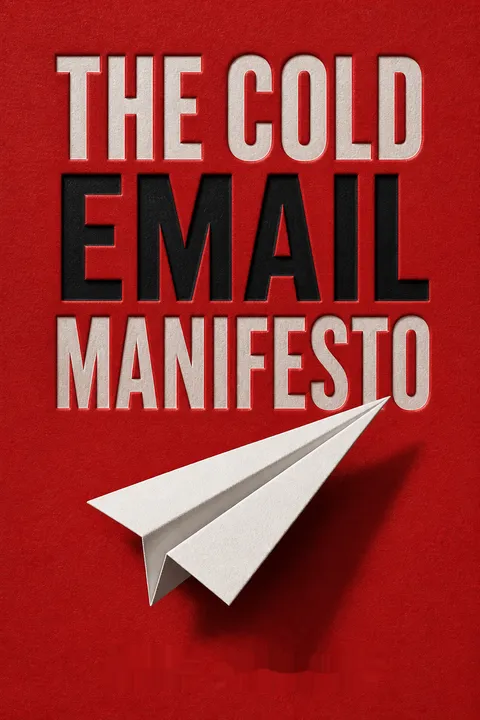


Key Takeaways
Use targeted email to create options when referrals and luck run dry
A channel built from scratch. Alex Berman opens with a collapse: a startup he believed was worth $100 million turned out to be a phantom operation, leaving him over $40,000 in debt and facing angry clients. After regrouping, he and a partner began contacting agencies directly. His first 20 emails produced a $10,000 deal, and the business grew from there. The lesson is not that email guarantees rescue, but that direct outreach can create opportunities without an existing network or advertising budget.
A repeatable way in. The book presents cold email as a practical route to reach buyers, employers, media, and potential partners. Berman also describes using it to build a New York network and get a job within two weeks of moving there. The larger promise is access: a well-aimed message can start a conversation that referrals might never produce.
What's compelling is the shift from imagined valuation to actual access to customers. That contrast makes the book's central promise concrete: a sales channel is more useful than a paper estimate of wealth. Yet the early wins are anecdotes, not a forecast. Results depend on the offer, market, timing, and execution, and the people who succeed are more visible than those who get no reply. Cold email is best understood as a low-cost way to test access, not financial insurance.
Sell a measurable result to one buyer, not a menu of services
Specificity makes the offer legible. A generic pitch such as building websites gives a prospect little reason to act. The book recommends defining a buyer, a problem, and an outcome, then supporting the offer with evidence. For instance, instead of selling broad development services, a firm might offer a defined migration or a system that reduces a particular operational burden. Berman describes an IT project for a university that consolidated work across six teams, beginning with a six-figure contract and growing into a substantial ongoing retainer.
Choose buyers who can buy. The book calls companies earning $5 million to $150 million annually Golden Geese: large enough to fund meaningful projects, but often less encumbered than global enterprises. It argues that outbound is most worthwhile for higher-value offers, generally $2,000 and above. A clear case study helps a stranger judge whether the promise is credible and relevant.
This is a practical application of product-market fit: sales language improves when it names a real customer, an urgent problem, and a result that can be evaluated. Specificity also helps a buyer quickly decide whether the offer is for them. The danger is mistaking a crisp claim for a validated one. A company should be able to substantiate its results, define what it controls, and avoid implying that one client's outcome will automatically recur elsewhere.
Spend more effort finding the right 100 people than blasting 10,000
The list shapes the response. Before writing copy, identify the industry, company size, and job title most likely to need and afford the offer. The book argues that a weak message sent to a clean, relevant list may still prompt interest, while irrelevant contacts and invalid addresses can damage both response rates and inbox reputation. One method is to work backward from a defined group, such as finding the organizers behind events in a particular city, then locating the people who make decisions.
Make research useful. A custom first line is a brief, individualized opening that shows the sender has a real reason to contact this person. The book suggests researching the company or recipient, and contacting only one person at a company at a time. It recommends verifying addresses and keeping bounced messages below 8 percent, while treating lead quality as more important than raw list size.
Targeting is not merely a conversion trick; it is a relevance test. In information theory, a useful signal stands out partly because it is aimed at the right receiver. That logic supports smaller, researched lists over indiscriminate volume. The ethical boundary matters too: a message can be technically personalized yet still unwanted. Relevant targeting, transparent identity, respect for opt-outs, and compliance with applicable privacy and marketing rules are part of responsible outreach, not optional polish.
Make each email prove relevance, credibility, and one easy next step
Earn the conversation quickly. The book's email structure moves from a short subject line to a personalized opening, a concise proof point, and a simple request for a meeting. The subject line Quick Question is offered as a frequent performer, though the author also urges testing alternatives. The proof point should connect a previous result to the prospect's situation, rather than merely listing credentials. The email's goal is to start a sales conversation, not to explain every feature or close a complex deal in writing.
Follow up with restraint. If there is no reply, the book recommends a small sequence of follow-ups in the same email thread: a brief reminder, another relevant result, and a final message that politely closes the loop. It advises no more than four follow-ups to an initial cold message. When a prospect expresses interest, respond quickly and offer specific meeting times to reduce unnecessary back-and-forth.
The strength of this format is cognitive economy. A recipient can quickly answer three questions: why this person, why trust the claim, and what happens next? That resembles good interface design, where each screen presents a clear action instead of a maze of choices. The case study carries much of the persuasive burden, so accuracy is crucial. Inflated metrics or vague attribution may generate a meeting but undermine trust once the prospect asks how the result was achieved.
Scale only after small batches show deliverability and response
Test before multiplying. The book recommends preparing a separate outreach domain, authenticating it, and warming the inbox for at least two weeks before sending. It then proposes beginning with 10 emails a day and adding roughly 10 each day until reaching about 100 customized emails daily. The point is to discover problems while the batch is small, instead of burning a large list or damaging the sender's reputation before the message has been tested.
Diagnose the funnel. The author's stated targets include an 80 percent open rate, at least 15 percent replies, and 4 to 8 booked meetings per 100 emails. These are benchmarks to investigate, not universal guarantees. Test one element at a time, such as audience, subject line, proof point, or send time. If replies are strong but meetings are scarce, improve follow-up; if replies are weak, revisit the offer and list first.
This is sound experimental discipline: small batches limit the cost of a bad hypothesis, while funnel metrics help locate where performance breaks. But open-rate data can be noisy, and platform rules, filters, and email tools change. The book's recommendation to use automated warm-up networks should not be confused with permission to evade provider safeguards. Proper authentication and responsible sending matter; artificial engagement can create unreliable signals and reputational risk.
Use the call to diagnose a costly problem before presenting your solution
Ask before prescribing. The book compares a sales meeting to a medical diagnosis. Rather than launching into a presentation, the salesperson asks about the prospect's role, goals, existing approach, measures of success, and what has prevented progress. The questions should fit the offer. An SEO provider, for example, might ask which site actions matter most and how the company evaluates organic growth. These answers reveal whether the problem is real, urgent, and within the seller's ability to address.
Tie the proposal to what you heard. The salesperson can then connect a relevant case study to the prospect's stated problem and outline the work, timeline, and price in a proposal. Berman recommends collecting 50 percent upfront for project work and structuring later payments by dates. The purpose of the call is not to overwhelm the buyer with claims, but to show that the proposed solution responds to a problem the buyer recognizes.
Discovery questions reduce the gap between what a seller assumes and what a buyer actually needs. They also give the buyer a chance to articulate the cost of inaction, which can clarify priorities without relying on pressure. The medical analogy has a limit: unlike a clinician, a salesperson has a financial incentive to recommend a solution. Credible discovery therefore includes willingness to conclude that the offer is not a fit, or that another intervention is more appropriate.
Split outreach, booking, and closing so specialists do their best work
Separate the work. As a sales operation grows, the book recommends dividing research, personalized openings, campaign management, appointment setting, and closing among people suited to those tasks. A strong closer should spend time in buyer conversations, not hours assembling contact lists. A customer relationship management system, or CRM, can track leads, messages, meetings, proposals, and ownership across the process.
Measure action and outcome. Lead measures are controllable activities, such as emails sent or calls made; lag measures are results, such as meetings booked or deals closed. Reviewing both helps managers see whether weak sales stem from too little activity, poor targeting, or a conversion problem. The book gives examples of role-specific targets, including about 200 researched leads a day, but these should be adjusted to the complexity and quality expected rather than treated as universal quotas.
Specialization can improve both learning and throughput: repeated practice helps people become faster at a defined task, while visible handoffs expose bottlenecks. The tradeoff is fragmentation. If each worker optimizes a local metric, the system can produce many leads that are poorly matched or meetings that never become customers. Shared definitions of quality and feedback from closed and lost deals help prevent a smoothly managed pipeline from becoming an efficient way to waste everyone's time.
Keep talent by giving capable people ownership, belief, and fair rewards
Make the work worth believing in. Berman describes a technical director who became more engaged after the company found projects related to his interest in music festivals. He also recounts employees whose initiative grew when managers supported their creative work instead of shutting it down. His leadership principle is to help people use their strengths, communicate a mission they can believe in, and give them room to take responsibility.
Align incentives with delivery. The book discusses commission-based sales teams and recommends tying commissions to clients who remain, using a clawback when a customer leaves. That is intended to discourage promises the business cannot fulfill. It also describes weekly reviews of activity and outcomes, competition among salespeople, and bonuses. These practices can motivate, but the central requirement is that the company deliver what its sales team promises.
The connection between autonomy and motivation is consistent with organizational psychology: people often engage more deeply when they have meaningful choice, competence, and a sense of purpose. The book is strongest when it treats employees as contributors rather than interchangeable labor. Its preference for aggressive churn and commission-only sales, however, can shift business risk onto workers and reward short-term selling. Fair pay, ethical targets, and quality of service need to count alongside revenue.
Use cold email to request access, not just to sell
A meeting can have value without a sale. The book applies the same direct approach to job searches, podcasts, and publicity. Berman describes emailing a marketing leader at Betterment to ask for a short conversation about work at the company. He did not get that job, but the contact introduced him to people in New York's startup scene, and he soon found work elsewhere. The useful outcome was access and a growing network, not just an immediate hiring decision.
Make the request specific. For a podcast pitch, identify a relevant episode and offer a topic the host's audience might value. For a job conversation, name the role or team and ask for a brief meeting rather than asking a stranger to solve an undefined career problem. The same logic applies to press or partnership outreach: show why the recipient is relevant and make the next step easy to accept or decline.
This broadens outreach from customer acquisition to deliberate network building. Social capital often forms through small interactions that create introductions, information, or credibility before they create a direct transaction. The key is reciprocity: a request should have a plausible benefit for the recipient, not just the sender. Direct access can also bypass useful screening processes, so job seekers should respect hiring norms and avoid treating a personal reply as a substitute for demonstrated qualifications.
Analysis
The book is part entrepreneurial memoir, part operational manual. Its narrative engine is a sharp reversal: the author moves from a supposedly valuable company and extravagant lifestyle to debt, disappointed clients, and a return to his parents' home. Cold email then becomes both the practical tool that rebuilds his business and the organizing metaphor for agency: instead of waiting to be selected, make a relevant request directly. That story gives the tactics emotional force, though it also makes exceptional outcomes feel more predictable than they are.
The most durable contribution is not a magic subject line. It is the linked discipline of choosing a narrow buyer, stating a concrete outcome, supporting it with evidence, and learning from small campaign batches. The method treats outreach as a funnel with diagnosable stages, from list quality and deliverability to replies, meetings, and closed work. It also recognizes that fulfillment and employee belief determine whether sales become durable revenue. A persuasive campaign cannot compensate indefinitely for an offer that disappoints customers.
The book's confidence needs calibration. Its conversion benchmarks and success stories are reported as practical targets, not independent evidence that a typical firm can reproduce them. Results vary with price, brand credibility, market maturity, data quality, and competition. Similarly, cold email is not inherently harmless because it is asynchronous. Poorly targeted messages still impose attention costs, while law and platform rules differ across jurisdictions and change over time. Domain protection and message craft do not replace compliance or respect for opt-outs.
Read the system as a testable sales hypothesis, not a guaranteed escape hatch. Start with a small, relevant audience; make claims that can be verified; monitor both customer outcomes and sender reputation; and stop or revise when the evidence is poor. The broader lesson is precise: direct outreach can reduce dependence on luck, but only when relevance, credibility, and delivery travel together.
Review Summary
The Cold Email Manifesto receives mostly positive reviews for its practical advice on B2B cold outreach. Readers appreciate its straightforward approach, actionable insights, and focus on personalization. Many find it helpful for improving sales strategies and team building. Some criticisms include repetitive content, broken links, and excessive product promotion. The book is praised for its specific techniques, but some reviewers note its limited applicability outside the US due to privacy laws. Overall, it's considered valuable for those in sales and marketing, particularly for high-ticket products or services.
People Also Read






Glossary
Golden Geese
Mid-sized, well-funded prospectsThe book's label for companies with roughly $5 million to $150 million in annual revenue. They are presented as large enough to afford substantial services, yet usually less bureaucratic than very large enterprises. The range is a targeting heuristic, not a universal qualification rule; the right company size depends on the offer and its buying process.
custom first line
Personalized email openingA short, researched opening sentence that signals why a particular recipient or company is being contacted. It may refer to a company achievement, a relevant product, or the recipient's professional background. In the book's approach, this small element adds personal relevance to an otherwise repeatable campaign without requiring a fully unique email for every prospect.
Cold Calling Reboot
Research-led outbound sellingThe book's name for updating traditional cold outreach by selecting likely buyers, learning enough about them to make a relevant approach, and using email to arrange a sales conversation. Unlike indiscriminate dialing, the approach emphasizes targeted prospects, a customized opening, and a defined offer. The label describes the authors' method rather than a separate sales technology.
no-brainer offer
Low-friction, valuable proposalAn offer framed around a specific customer problem and a clear potential benefit, often with a limited initial commitment, refund, or other reduction in perceived risk. The book's examples include a short diagnostic or a defined trial of work. The aim is to make the value understandable quickly, while the seller must ensure the promise is realistic and deliverable.
Affiliate Army
Commission-based sales groupThe author's term for a distributed group of salespeople who are compensated primarily through commissions rather than fixed salaries. The model is presented as a way to expand sales capacity without paying large salaries in advance. It requires a sellable product, reliable delivery, clear compensation terms, and management that addresses underperformance without encouraging misleading promises.
FAQ
What's "The Cold Email Manifesto" about?
- Purpose and Focus: "The Cold Email Manifesto" by Alex Berman is a guide on how to effectively use cold email to fill your sales pipeline, convert leads, and grow your business within 90 days.
- Target Audience: The book is aimed at business owners, sales professionals, and entrepreneurs who want to leverage cold email as a tool for business growth.
- Content Overview: It covers everything from crafting the perfect cold email to building a sales team and using cold email for various purposes beyond sales, such as generating backlinks and getting a dream job.
- Authors' Expertise: Alex Berman, known as the Cold Email King, and Robert Indries, CEO of multiple businesses, share their proven strategies and experiences in generating millions through cold email.
Why should I read "The Cold Email Manifesto"?
- Proven Strategies: The book offers tested and proven strategies that have helped the authors and their clients generate significant revenue through cold email.
- Comprehensive Guide: It provides a step-by-step guide on everything from writing effective emails to building a sales team and scaling your efforts.
- Versatile Applications: Beyond sales, the book explores how cold email can be used for various purposes, such as securing backlinks, landing podcast interviews, and even getting a dream job.
- Real-Life Examples: The authors share real-life case studies and examples, making it easier to understand and apply the concepts in your own business.
What are the key takeaways of "The Cold Email Manifesto"?
- Specific Offers: Crafting a specific and compelling offer is crucial for the success of a cold email campaign.
- Personalization: Personalized first lines and targeted emails significantly increase response rates and engagement.
- Follow-Up Strategy: A structured follow-up process is essential to convert initial interest into meetings and sales.
- Team Building: Building a specialized sales team and using segmentation can enhance efficiency and results.
How do I craft the perfect cold email according to "The Cold Email Manifesto"?
- Subject Line: Use a direct and curiosity-inducing subject line like "Quick Question" to increase open rates.
- Personalized Compliment: Start with a personalized compliment to grab attention and show genuine interest.
- Case Study: Include a relevant case study to establish authority and demonstrate the value of your offer.
- Call to Action: End with a clear and simple call to action, prompting the recipient to book a meeting.
What is the importance of a specific offer in cold emailing as per "The Cold Email Manifesto"?
- Clarity and Relevance: A specific offer clearly communicates what you are selling and why it is relevant to the recipient.
- Problem-Solving: It should address a specific problem or need of the target audience, making it a no-brainer for them to respond.
- Competitive Edge: A well-defined offer helps you stand out from generic pitches and shows that you understand the recipient's industry and challenges.
- Higher Conversion Rates: Specific offers are more likely to convert because they resonate with the recipient's needs and demonstrate your expertise.
How does "The Cold Email Manifesto" suggest building a sales team?
- Segmentation: Break down the sales process into specialized roles, such as lead generation, email outreach, and closing deals.
- Role Specialization: Assign tasks based on individual strengths to maximize efficiency and results.
- Compensation Structure: Use a combination of salary and commission to incentivize performance and align team goals with business objectives.
- Training and Support: Provide ongoing training and support to ensure the team is equipped with the skills and knowledge needed to succeed.
What are the common mistakes in cold emailing according to "The Cold Email Manifesto"?
- Lack of Personalization: Sending generic emails without personalization leads to low engagement and high spam complaints.
- Poor Targeting: Failing to identify and target the right audience results in wasted efforts and resources.
- Ineffective Follow-Up: Not having a structured follow-up process can lead to missed opportunities and lost sales.
- Over-Reliance on Referrals: Relying solely on referrals limits growth potential and leaves businesses vulnerable to market changes.
How can cold email be used beyond sales as per "The Cold Email Manifesto"?
- Generating Backlinks: Use cold email to reach out to websites and request backlinks, improving SEO and online visibility.
- Podcast Interviews: Pitch yourself as a guest on relevant podcasts to expand your reach and build authority in your industry.
- Job Opportunities: Use cold email to connect with potential employers and land your dream job by showcasing your skills and enthusiasm.
- Networking and Partnerships: Reach out to industry leaders and potential partners to build valuable relationships and collaborations.
What are the best quotes from "The Cold Email Manifesto" and what do they mean?
- "Cold email is the ultimate safety net." This quote emphasizes the versatility and reliability of cold email as a tool to generate business and overcome financial challenges.
- "You cannot be all things to all people." It highlights the importance of targeting a specific niche and crafting tailored offers to achieve success in cold emailing.
- "Where there’s life there’s hope, and you can just pick yourself up, dust yourself off, and start again." This quote encourages resilience and persistence in the face of setbacks and challenges.
- "Trust yourself." It underscores the importance of self-belief and taking control of your destiny through proactive actions like cold emailing.
How does "The Cold Email Manifesto" address mindset and mentality?
- Positive Outlook: Maintaining a positive mindset is crucial for success in cold emailing and any business endeavor.
- Resilience: The book emphasizes the importance of resilience and learning from setbacks to improve and succeed.
- Self-Belief: Trusting yourself and your abilities is key to overcoming challenges and achieving your goals.
- Continuous Improvement: Adopting a mindset of continuous learning and improvement helps you refine your strategies and achieve better results.
What tools and resources does "The Cold Email Manifesto" recommend?
- Email Warmup Tools: Use tools to warm up your email inbox and improve deliverability rates.
- Lead Generation Databases: Utilize databases to find and verify leads, ensuring high-quality contacts for your campaigns.
- CRM Software: Implement CRM software to track and manage your sales process and team performance.
- Additional Courses: The book offers additional courses and resources at ColdEmailManifesto.com for further learning and support.
What is the role of follow-up in cold emailing according to "The Cold Email Manifesto"?
- Structured Process: A structured follow-up process is essential to convert initial interest into meetings and sales.
- Persistence: Following up multiple times increases the chances of getting a response and booking a meeting.
- Value Reinforcement: Use follow-up emails to reinforce the value of your offer and address any objections or concerns.
- Final Breakup Email: A final breakup email can create urgency and prompt a response from the recipient.
Download PDF
Download EPUB
.epub digital book format is ideal for reading ebooks on phones, tablets, and e-readers.








