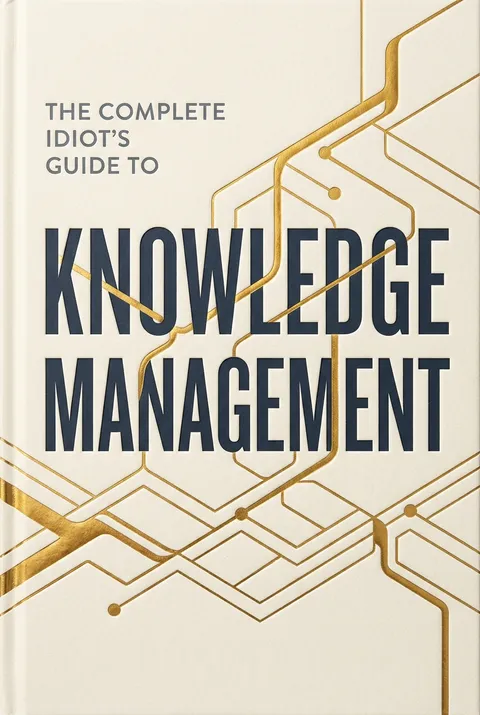


Key Takeaways
Treat knowledge management as a way to make expertise usable, not merely stored.
Context makes knowledge. Data are observations, information is organized data, and knowledge is information interpreted in context so someone can act. The practical test is whether employees can use what they find to make a decision, solve a customer problem, or repeat a success. A search that returns more than a thousand results is not useful knowledge access if no one can tell which result matters.
Notice invisible assets. Swedish publisher Karl-Erik Sveiby found that his company’s accounts valued its brand at one small coin while omitting employees’ competence and valuable relationships. Knowledge management is the systematic work of creating, capturing, sharing, and using the know-how an organization needs. Its point is not to manage people’s minds like inventory, but to make valuable expertise easier to apply.
The distinction between stored information and usable understanding anticipates a central problem of modern work: abundance can make retrieval harder, not easier. Decision science likewise treats information as valuable when it changes a choice, rather than when it merely accumulates. The emphasis on context also guards against a common mistake in analytics, treating a metric as self-explanatory. One caution: usefulness should not be reduced to immediate profit. Some learning has delayed value, and a narrow action test can undervalue exploration that creates options for an uncertain future.
Choose whether to document knowledge or connect people who carry it.
Two forms of knowing. Explicit knowledge can be explained, written down, and shared, as with a procedure. Tacit knowledge includes experience, judgment, intuition, and practical skill that can be difficult to put into words. A CPR checklist can describe the steps, but it cannot by itself provide the judgment of an experienced emergency clinician.
Match the method. Repeated, stable processes may benefit from documentation and searchable records. Work that depends on subtle judgment is more likely to require access to experienced colleagues, observation, conversation, or practice. The book cites an estimate that as much as 80 percent of important organizational knowledge may be tacit. Whether or not that estimate applies to every workplace, it warns against assuming that a database can contain everything people need to know.
This distinction is useful because it turns a vague technology debate into a design question: what kind of knowledge does the work require? Research on expertise similarly distinguishes declarative knowledge, knowing that, from procedural knowledge, knowing how. Documentation is powerful for consistency and scale, while apprenticeship and consultation help transmit judgment. The boundary is not absolute. Experts can often articulate parts of their practice, and written guidance can support tacit learning. The strongest approach usually combines both instead of treating codification and personal connection as rival camps.
Let people learn together before trying to turn experience into manuals.
Knowledge grows through exchange. The knowledge spiral is a model of how personal and documented knowledge can develop through interaction. People first learn by working alongside someone skilled. They then explain what they have learned, combine those explanations with existing documents, and gain deeper practical understanding by applying the material themselves.
A bread machine needed a baker. Matsushita engineers could not solve a machine that produced overcooked crust and undercooked bread, despite extensive technical investigation. Developer Ikuko Tanaka trained with an Osaka baker and observed how he stretched dough. Engineers adapted the machine to reproduce that movement, and the product succeeded. The breakthrough came from observing practice, translating it into a design, and testing it, not from adding more data to the original search.
The story shows why innovation often depends on crossing professional boundaries. Engineers had technical expertise, but the baker possessed embodied knowledge of the dough. The solution emerged when observation translated between those forms of understanding. This resembles design research, where watching users perform a task can reveal constraints that interviews or specifications miss. The model is valuable as a reminder, not a mechanical recipe: some expertise resists complete explanation, and some cannot be safely learned by trial and error. Practice needs appropriate coaching and safeguards.
Start with a business problem, then prove the approach in a pilot.
Tie learning to strategy. A knowledge management plan should support the organization’s actual goals, such as lowering costs, serving customers, or developing products faster. It should identify the knowledge gap, the people and tools needed, and how success will be judged. A pilot gives the organization evidence before it commits to a large rollout, while giving the team a chance to learn from implementation.
Proof earns room to grow. Hewlett-Packard Consulting tested its approach with SAP consultants in Project Owl. The group’s implementation cycles fell from 18 months to 6, helping justify a broader program. Chevron focused on sharing operational improvements, and by 2000 estimated annual operating-cost reductions of $2 billion. These examples support testing practical value, not simply launching a repository or announcing a knowledge initiative.
A pilot is a form of organizational experimentation: it makes assumptions visible while limiting the cost of being wrong. This aligns with implementation science, which asks not only whether an intervention works, but under what conditions and for whom. The caution is that a deliberately favorable pilot can exaggerate the likelihood of success elsewhere. A strong evaluation records the context, participation, and constraints that produced the result. Replication should test whether the method travels, rather than assuming a small win automatically scales across different teams or cultures.
Support practitioner communities that solve real work, not just socialize.
Voluntary expertise networks. A community of practice is a group whose members share an area of competence, build relationships, and develop ways of doing the work together. Unlike a task team, it is usually voluntary, has broader aims, and can continue as long as members find it useful. Its shared work may produce practical tools, problem solutions, and tested practices.
Coordination takes effort. A community needs someone to connect members, organize useful exchanges, welcome newcomers, and help the group maintain its focus. The book notes that coordination can take 15 to 25 percent of a person’s work time, sometimes more during launch. At SAP America, consultants shared current information through scheduled calls, experts, and an online resource space. The community supported faster learning and better service, not simply another meeting on the calendar.
Communities of practice make social learning part of organizational infrastructure. They can spread knowledge across formal reporting lines, particularly when work is specialized or geographically dispersed. Their voluntary character is a strength because participation can reflect genuine interest, but it also means a community cannot be sustained by branding alone. Time, facilitation, and visible usefulness matter. There is also a boundary to watch: close networks can become inward-looking. Linking communities to customer needs and inviting fresh perspectives helps prevent shared expertise from turning into shared blind spots.
Change daily work by addressing culture, incentives, and middle managers.
Culture sits beneath slogans. Organizational culture includes visible artifacts, stated values, and deeper shared assumptions about how work should be done. A company may praise collaboration while rewarding only individual output. In that case, employees are likely to follow the reward system rather than the slogan. Past failures and successes also shape assumptions, sometimes making familiar habits feel safer than necessary change.
Work habits are the practical target. Instead of trying to transform an entire culture at once, identify the behaviors a specific business goal requires. Leaders must model those behaviors, and middle managers need to make room for them in everyday work. Change also requires training, feedback, and time for people to adjust. The book’s lesson is to use cultural strengths where possible, while taking resistance seriously rather than treating it as a communication problem alone.
The distinction between stated values and enacted incentives is central to organizational behavior. Employees infer priorities from what receives time, attention, promotion, and protection. Middle managers are especially influential because they translate broad policy into daily permissions and constraints. This also explains why culture change is difficult: routines are not only habits, they are adaptations to prior conditions. Still, culture is not immovable. When a new practice repeatedly helps people succeed and is supported by credible leaders, behavior can shift. The test is whether systems reinforce the desired conduct after launch attention fades.
Make technology easy to find, useful, and subordinate to human work.
Technology enables, people make use. Intranets, databases, collaborative tools, and portals can help employees locate information and work across distance. But installing a system does not create knowledge sharing. The system must fit real tasks, contain useful and current material, and be designed with its users. A search engine helps retrieve content; a taxonomy, a structured way to group related material, can help people navigate it.
Design for the situation. E-mail can handle routine exchanges, while richer tools such as video meetings can help with complex discussion, trust, or problem solving. The right choice depends on the work and the people involved. The knowledge management lead should partner with information technology leaders, who must balance user needs with security, compatibility, cost, and maintenance. Technology is an essential enabler, but it cannot substitute for relationships, coaching, or clear business purpose.
This is a socio-technical view of technology: systems work through the interaction of tools, people, and organizational practices. It remains relevant even as specific platforms change. Search quality, content upkeep, privacy, and usability are still consequential design issues. A further implication is that technology can shape behavior, not merely support it. Surveillance-based expertise systems, for example, may help identify skill but can also undermine trust if employees do not understand what is collected or who can see it. Useful infrastructure requires both technical reliability and social legitimacy.
Measure whether knowledge improves work, not merely whether people use tools.
Measures need a purpose. Before collecting numbers, decide what decisions they should inform. A useful measurement set includes both lagging indicators, which show what happened, and leading indicators, which help anticipate what may happen. The book recommends using established organizational measures when they already capture relevant results, and combining quantitative data with stories that explain why results changed.
Keep the scorecard balanced. The balanced scorecard links strategy to financial results, customer outcomes, internal processes, and learning and growth. These perspectives help show that current financial performance depends partly on capabilities being built for the future. Measures can also distort behavior: if only individual sales count, employees may neglect team contributions. A metric is not useful merely because it is precise. It must measure the intended outcome and support a decision or action.
The warning about measurement is a version of Goodhart’s law: once a measure becomes a target, people may optimize the number rather than the underlying goal. Balancing outcome measures with indicators of learning and process can reduce that risk, though no scorecard eliminates it. Qualitative accounts add context and can reveal mechanisms hidden by averages. They should complement, not replace, systematic evidence. The most defensible measurement design is modest: a small number of indicators, clear definitions, and a plan for what managers will do when results improve, worsen, or stay unchanged.
Capture at-risk expertise by prioritizing consequences, not documenting every job.
Prioritize knowledge loss. When experienced employees are nearing retirement, trying to document everything is usually unrealistic. The Tennessee Valley Authority’s approach began by identifying where departures were most likely to threaten important work. It then examined what expertise might disappear, what the business consequences would be, how quickly the gap would matter, how difficult recovery would be, and how hard the knowledge would be to transfer.
Choose a proportionate response. Some gaps required no intervention, while others called for later or immediate action. Responses could include mentoring, on-the-job training, appointing experts, documenting procedures, or redesigning work to reduce reliance on scarce knowledge. For rare, high-stakes tasks, British Petroleum created knowledge assets: focused packages that combine guidance, case histories, useful materials, and connections to experienced people. The aim is enough relevant knowledge for the task, not an archive of everything.
This approach treats expertise retention as a risk-management problem rather than a documentation contest. Criticality, urgency, and recoverability are sensible criteria because knowledge has different consequences in different roles. The distinction between codified instructions and expert judgment is especially important in technical or safety-critical work. There is a limit, however: a knowledge package can preserve access to expertise, but it cannot instantly reproduce years of practice. Succession planning and supervised experience remain necessary wherever performance depends on diagnosis, timing, or judgment.
Build your own knowledge portfolio through learning, relationships, and useful exchange.
Personal knowledge is an asset. Personal knowledge management means taking responsibility for what someone knows, who they know, and what those contacts know. The book describes personal capital through three elements: knowledge stock, the person’s explicit and tacit expertise; knowledge currency, the ability to think, relate, and act; and knowledge flow, the processes of acquiring, storing, sharing, and putting knowledge to use.
Networks are reciprocal. Professional groups, communities, alumni networks, and mentors can expose a person to information and opportunities unavailable through formal channels. Useful networking starts with listening, helping, and connecting people who can benefit from one another. It also requires diversity: a network made only of familiar peers may reinforce existing assumptions. The practical aim is to keep learning, let go of outdated knowledge, and maintain relationships by contributing value rather than treating contacts as a list to harvest.
The personal dimension prevents knowledge management from becoming solely a corporate project. Skills move with workers, and relationships often provide access to context that no document contains. Network diversity can also improve access to unfamiliar ideas, while reciprocity makes relationships more durable than one-sided requests. Still, the language of personal capital has a possible blind spot: not every relationship should be evaluated for economic return. Trust and mutual support often grow through attention that is not strategically calculated. The most sustainable network is useful to its members, but not reducible to a transaction.
Analysis
This book’s lasting contribution is less a single tool than a change in managerial attention. It asks organizations to stop treating knowledge as a substance that can be poured into databases and instead examine how people create, interpret, and use expertise in actual work. That move connects strategy, learning, technology, organizational culture, and measurement. It also explains why the book resists universal templates: context determines which knowledge matters, how it can travel, and what evidence will count as success.
Its strongest practical pattern is a cycle of inquiry. Begin with a business need, identify the knowledge required, connect the people who possess it with those who need it, test an intervention, and use evidence to refine or expand the approach. The case studies make the logic tangible: a baker’s technique helps engineers solve a product problem, and operational lessons become savings when teams can find and reuse them. The book also recognizes that transfer depends on trust, incentives, leadership, and time, not simply on installing tools.
The framework is broad enough to be useful but can also feel managerial in its confidence that expertise can be identified and leveraged. Some knowledge is hard to locate until a novel problem makes it visible; some should not be shared widely because of privacy, security, or professional boundaries. Financial returns are persuasive, yet not all valuable learning produces a quick, separable return. Measurement therefore needs restraint as well as rigor.
Published in 2001, the book’s technical descriptions reflect an earlier generation of intranets and collaborative software. Its deeper questions have aged better than its technology: Who needs to know what? How can they find the right person or practice? What makes sharing safe and worthwhile? The contemporary lesson is to design knowledge systems as human systems supported by technology, with outcomes judged in the context of real work.
Review Summary
The reviews for The Complete Idiot's Guide to Knowledge Management are mixed, with an average rating of 3.48 out of 5. Readers find it a good introduction to knowledge management, providing practical tips for implementation. However, some criticize it for being dated and simplistic in its theoretical approach. The book is praised for its broad overview and use of company examples, making it suitable for beginners. While it offers a light and fun explanation of complex topics, it lacks depth for those seeking more advanced knowledge.
Glossary
knowledge management
Organizational knowledge in actionThe systematic processes an organization uses to identify, create, capture, acquire, share, and apply knowledge needed for success. The aim is not merely to store information, but to make relevant expertise available for decisions and work, and to help the organization repeat successful practices.
tacit knowledge
Experience-based practical knowingKnowledge rooted in experience, judgment, intuition, skill, and context. People may use it effectively without being able to explain it fully or transfer it through a procedure. Observation, practice, conversation, and access to experienced colleagues can help others develop it.
explicit knowledge
Knowledge expressed in wordsKnowledge that can be described, written down, and transmitted, such as procedures, rules, and documented instructions. It can be stored and searched more readily than tacit knowledge, though records still need context, maintenance, and clear links to the work they are meant to support.
intellectual capital
Knowledge with organizational valueThe knowledge, capabilities, relationships, and innovations an organization can use to create value. The book groups it into employee competence, internal structure, and external structure. These assets can affect performance even when traditional accounting statements do not show them clearly.
knowledge spiral
Knowledge developed through conversionA model associated with Ikujiro Nonaka describing how tacit and explicit knowledge interact to create organizational knowledge. People share experience, express what they know, combine explanations and records, and learn through application. The model emphasizes repeated movement between personal skill and shared, usable knowledge.
community of practice
Practitioners sharing a disciplineA group of practitioners connected by a shared area of competence, relationships, and a developing practice. Members commonly join voluntarily and exchange expertise, solve problems, and create useful methods or resources. Unlike a temporary task team, the community may continue as long as members find value in it.
social capital
Trust-bearing connections between peopleThe relationships among people and the norms of trust and reciprocity that make cooperation possible. In organizations, social capital can help employees find expertise, ask for help, share knowledge, and coordinate work. It may exist in formal groups and informal networks.
knowledge asset
Focused package of reusable expertiseIn the British Petroleum approach described in the book, a knowledge asset is a package of accumulated knowledge about a narrowly defined task, prepared for a particular audience. It can combine practical guidance, case histories, useful records, and links to people or communities that can provide further context.
balanced scorecard
Strategy-linked performance measuresA measurement approach that connects organizational mission and strategy to performance indicators across four perspectives: financial results, customers, internal processes, and learning and growth. It combines measures of results with measures of capabilities and processes that can influence future performance.
personal knowledge management
Managing one's own expertiseThe practice of taking responsibility for acquiring, creating, organizing, and sharing personal knowledge, while developing networks and collaborating with others. It treats an individual’s expertise and relationships as resources that need to be renewed, applied, and adapted as work and career needs change.
FAQ
What's The Complete Idiot's Guide to Knowledge Management about?
- Focus on KM: The book provides a comprehensive overview of knowledge management (KM), emphasizing its role in creating, capturing, sharing, and leveraging knowledge within organizations.
- Practical Guidance: It offers practical advice on implementing KM strategies, including developing a strategy, building infrastructure, and managing organizational culture.
- Real-World Examples: The author shares success stories from various organizations, illustrating how effective KM can lead to significant improvements in efficiency and innovation.
Why should I read The Complete Idiot's Guide to Knowledge Management?
- Comprehensive Resource: This book serves as a practical guide for understanding and implementing KM, suitable for both beginners and experienced professionals.
- Expert Insights: Written by Melissie Clemmons Rumizen, an expert in the field, it draws on years of experience and research to present effective KM practices.
- Actionable Strategies: Readers will find actionable strategies and frameworks that can be directly applied to their organizations to enhance KM efforts.
What are the key takeaways of The Complete Idiot's Guide to Knowledge Management?
- Importance of Knowledge: Knowledge is identified as a critical asset for organizations, emphasizing the need for effective management.
- Role of Culture: The book highlights the significance of organizational culture in KM, underscoring the collective responsibility in knowledge sharing.
- Measurement Matters: It stresses the importance of measuring KM success, indicating that effective metrics are crucial for demonstrating the value of KM initiatives.
What is knowledge management according to The Complete Idiot's Guide to Knowledge Management?
- Definition of KM: Knowledge management is defined as the systematic processes by which knowledge needed for an organization to succeed is created, captured, shared, and leveraged.
- Components of KM: The book outlines key components of KM, including identifying, creating, capturing, sharing, and leveraging knowledge.
- Focus on Actionable Knowledge: It emphasizes that knowledge must be actionable, leading to decisions and actions that benefit the organization.
What are some successful knowledge management strategies mentioned in The Complete Idiot's Guide to Knowledge Management?
- Start Small: The book advises starting with pilot projects to test KM strategies before scaling up, allowing organizations to learn and adapt.
- Communities of Practice: It highlights the effectiveness of communities of practice as a “killer application” for KM, fostering collaboration and knowledge sharing.
- Use of Technology: The author discusses leveraging technology, such as intranets and collaborative tools, to facilitate knowledge sharing and access.
How does The Complete Idiot's Guide to Knowledge Management define a Chief Knowledge Officer (CKO)?
- Role of CKO: A Chief Knowledge Officer is described as a senior corporate executive responsible for leading a knowledge management program.
- Importance of the Position: CKOs are essential for addressing organizational knowledge issues and ensuring alignment with business goals.
- Skills Required: Successful CKOs are characterized by their ability to communicate effectively, build relationships, and drive cultural change.
What are the barriers to effective knowledge management discussed in The Complete Idiot's Guide to Knowledge Management?
- Cultural Resistance: Organizational culture can be a significant barrier, as employees may be reluctant to share knowledge due to fear of losing their value.
- Lack of Leadership Support: Strong leadership support is crucial; without it, KM initiatives are likely to falter.
- Measurement Challenges: Many organizations struggle with measuring KM success, which can hinder their ability to demonstrate value.
What is the significance of communities of practice in knowledge management according to The Complete Idiot's Guide to Knowledge Management?
- Definition and Purpose: Communities of practice are groups of practitioners who share a common interest and work together to enhance their knowledge and skills.
- Benefits of Participation: These communities foster collaboration, innovation, and the sharing of best practices, making them vital for KM.
- Role of Community Coordinator: An effective community coordinator is crucial for facilitating interactions and ensuring the community thrives.
How does The Complete Idiot's Guide to Knowledge Management suggest measuring knowledge management success?
- Developing Metrics: The author emphasizes the need to develop specific measures that align with organizational goals.
- Examples of Measurement Approaches: The book provides examples of qualitative and quantitative methods to assess the impact of KM initiatives.
- Continuous Improvement: Organizations are encouraged to regularly review and adjust their measurement strategies to ensure they remain relevant and effective.
What are the best quotes from The Complete Idiot's Guide to Knowledge Management and what do they mean?
- "What gets measured gets done.": This quote underscores the importance of measurement in KM, ensuring initiatives are effectively implemented.
- "Knowledge is information in context to produce an actionable understanding.": This highlights that knowledge must be contextualized to be useful in decision-making.
- "A taxonomy is a hierarchical structure for a body of knowledge.": This emphasizes the role of taxonomies in organizing knowledge for easier access and utilization.
What is a taxonomy in knowledge management as described in The Complete Idiot's Guide to Knowledge Management?
- Hierarchical Structure: A taxonomy organizes knowledge into categories and subcategories, helping users understand relationships.
- Facilitates Navigation: It provides a clear framework for navigating large volumes of information, enhancing efficiency.
- Dynamic Nature: Taxonomies should be adaptable to changes, reflecting new information and relationships as knowledge evolves.
How does organizational culture impact knowledge management according to The Complete Idiot's Guide to Knowledge Management?
- Influences Behavior: Culture shapes employee behaviors and attitudes towards knowledge sharing, encouraging collaboration.
- Resistance to Change: Entrenched cultural norms can create resistance to KM initiatives, requiring strategies to address these barriers.
- Cultural Assessment: Assessing the current culture helps identify strengths and weaknesses related to knowledge sharing, informing strategies for improvement.
Download PDF
Download EPUB
.epub digital book format is ideal for reading ebooks on phones, tablets, and e-readers.








