

Key Takeaways
Read America's medicine, music, clothes, and food as Black women's history
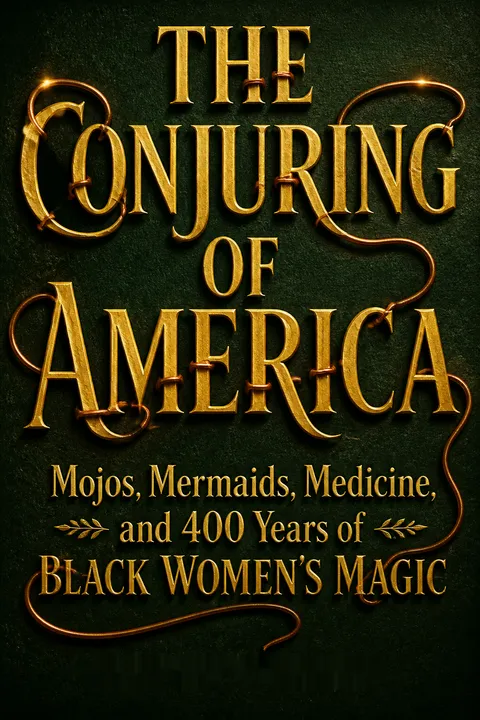
A hidden cultural foundation. Lindsey Stewart traces four centuries of Black women shaping American life through healing, spiritual practice, textile work, music, birth care, and cooking. She calls the traditions that carry this influence conjure: a changing blend of spiritual beliefs, herbal practices, and therapeutic knowledge developed by Africans and their descendants in the Americas. The book follows conjure women through five social roles: the enslaved healer, the Voodoo Queen, the mojo worker, the Granny Midwife, and the Candy Lady.
Not just survival. These women did more than endure oppression. They used knowledge and community ties to address illness, protect relationships, support births, earn money, and resist control. Stewart argues that familiar American staples, including Vicks VapoRub, blue jeans, blues, and soul food, bear traces of their work, even when the people responsible were left out of the story.
What's striking is the scale of the argument: ordinary objects become evidence of who made American culture, who profited, and who received credit. This is a material-history approach, reading a jar, a garment, or a meal as a record of labor and power. It also invites care. A cultural resemblance alone cannot prove a specific line of influence, and a single account cannot represent every Black woman or every tradition. The book is strongest when it shows how material traces, family memory, and historical records converge.
Credit the healers whose plant knowledge became household medicine
Care before the clinic. On plantations, enslaved women known as Negro Mammies often treated everyday illness with gathered herbs, teas, salves, baths, and massage. They also cared for children, assisted births, and offered spiritual counsel. Harriet Jacobs recounts that after a snakebite during her escape, a local woman healer recommended a vinegar treatment that helped her remain in hiding. Such care could address both bodily symptoms and the social dangers surrounding a patient.
A disputed origin story. Stewart argues that enslaved women’s remedies helped shape the formula and method behind Vicks VapoRub, including the use of turpentine, camphor, and menthol-like plants, applied through rubbing and inhalation. A family tradition attributes the salve to Wiley and her daughter Miley Stancil, rather than to Lunsford Richardson alone. The book presents this as a plausible claim, not a conclusively documented transfer.
The Vicks story makes a larger point about how innovation can become invisible when knowledge moves from an enslaved community into a commercial product. Family testimony matters, especially where formal records preserve the successful businessman but not the healer. At the same time, oral history and ingredient overlap cannot by themselves establish precisely who devised a recipe or how it changed hands. That uncertainty strengthens the case for careful attribution, not confident accusation. The question is not only who invented a product, but which kinds of evidence historians treat as worthy of belief.
Let mermaid stories expose the violence polite history leaves underwater
Water carries memory. Stewart connects African water spirits, including Oshun and the mermaid figure Mami Wata, to stories of protection, vengeance, and disrupted family bonds. Mami Wata is a water spirit shaped by traditions carried across the Atlantic and combined in the Americas. In a Gullah Geechee folktale, a conjure woman warns Charleston that a captive mermaid must be released. The story turns a storm and a public protest into an indictment of the separation of enslaved mothers from their children.
A political symbol. New Orleans Voodoo Queens, including Marie Laveau, were associated with mermaid figures and water ceremonies. Stewart reads these stories as a way communities pictured Black women's power in a society that denied them control over their bodies and families. The folktale is not proof that the reported events happened exactly as told. Its historical value lies partly in what it reveals about the fears, grievances, and hopes that communities preserved in narrative.
The mermaid works here as more than a symbol of representation. She makes a private injury, the forced separation of mother and child, legible as a public wrong that can mobilize a community. Folklore can preserve moral knowledge even when it does not function as a literal report. That distinction matters: treating the tale as documentary fact would weaken its interpretation, while dismissing it as fantasy would erase the history encoded in its images. The account also resists a single origin story for mermaids by showing how traditions change through contact, migration, and survival.
Turn a racist mascot into evidence, not an innocent memory
Two meanings on one stage. Aunt Jemima was created as a marketing character based on the minstrel-show image of the Black domestic servant. At the 1893 Chicago World's Fair, formerly enslaved Nancy Green played the role, cooking pancakes and telling stories to crowds. The exhibit helped sell a product by offering white audiences a comforting fantasy of plantation life, while African Americans read the character through a different history of Black performance and resistance.
A symbol can be contested. Stewart sets the brand against Billy Kersands's earlier song and dance about Aunt Jemima, which carried a pointed message about broken promises of freedom. She also discusses Betye Saar's 1972 artwork, which reimagines the mascot as a figure of Black power. The character therefore holds both racist commercial nostalgia and a history of Black critique. Reclaiming the image does not erase the labor or harm behind its creation.
The useful move is to resist treating a familiar image as either harmless nostalgia or a symbol with only one fixed meaning. Its commercial history and its meanings within Black performance can coexist, though they are not morally equivalent. The character's popularity depended on a caricature that made Black women's labor seem willing and comforting. Reinterpretation can expose that lie, but it can also risk keeping the caricature at the center. Saar's transformation is powerful because it changes the viewer's relation to the object rather than merely polishing its reputation.
Defend birth workers' knowledge when institutions claim exclusive authority
Midwifery meant agency. Enslaved midwives cared for pregnant women and newborns using practical skills, plant remedies, massage, and spiritual rituals. They also helped women seek reproductive control, including by providing abortion-inducing herbs. Mary Gaffney recalled chewing cotton root to avoid bearing children into slavery, then having five children after emancipation. Her account shows how decisions about pregnancy were shaped by coercion and the conditions of bondage, not simply by abstract medical rules.
Professional power displaced them. Stewart describes how doctors blamed midwives for poor outcomes while overlooking slavery's violence and the failures of medical care. The 1857 Texas abortion ban restricted care by midwives and strengthened doctors' authority. Later, Granny Midwives, Black community birth workers, faced licensing rules and state supervision. The book does not present every traditional remedy as safe or effective by modern standards. It asks readers to notice who had authority to define expertise and whose care was excluded.
This history shows that medical authority is also institutional authority: licensing, law, and access determine whose knowledge counts. The midwives' work cannot be reduced to a choice between tradition and science, since they practiced in settings where professional care was often unavailable, discriminatory, or dangerous. Nor should their expertise be romanticized as uniformly effective. A stronger account holds both realities together: patients need evidence-based safety, and medical systems need accountability for how race, gender, and economic power shape whose knowledge they recognize.
Treat hair and cloth as archives, not decoration
Textiles held knowledge. Stewart traces blue jeans to cotton and indigo textiles made under slavery, while pointing back to West African traditions of dyeing, weaving, and spiritual design. Enslaved women reused worn clothing in quilts that could provide warmth, communal support, and spiritual protection. Patterns and knots carried meanings rooted in African traditions, while the quilting itself offered time to share skills, stories, and memory.
Hair continued the craft. The book connects Yoruba hair styling to textile arts, describing braids and wrapped styles as ways of shaping hair, identity, and spiritual meaning. It presents hairdressers as trusted community figures who could offer care and counsel as well as styling. That history complicates the idea that Black women's hair choices can be reduced to a simple measure of assimilation or resistance. Hair and cloth record practical decisions, aesthetic invention, cultural memory, and personal choice.
Calling textiles and hairstyles archives expands what counts as historical evidence. A garment can record labor and trade; a hairstyle can preserve technique and communicate belonging; a quilt can hold both use and memory. This perspective is particularly valuable where written records were produced by people with power over the makers. Still, symbolic readings need to remain historically specific. Not every pattern or style carries the same meaning for every wearer, and interpreting Black women's grooming chiefly through politics can reproduce the scrutiny it aims to challenge.
Build local power through food, care, and small commerce
A kitchen could be infrastructure. The Candy Lady sold sweets but also offered children food, supervision, home remedies, and a model of Black entrepreneurship. Her predecessors, New Orleans market women known as marchandes, sold prepared foods and ingredients, sometimes using earnings toward freedom. Their cooking and commerce helped popularize dishes that became part of the region's shared food culture.
Food carried social meaning. Stewart traces black-eyed peas as a food associated with abundance and good fortune, and describes how red beans and rice became linked to Monday washing and spiritual practice in Louisiana. Leah Chase's restaurant, Dooky Chase, carried this tradition into the Civil Rights era. Its gumbo fed organizers and provided a place where Black and white activists could meet despite segregation. Food here is sustenance, income, memory, and a setting for political work.
The Candy Lady's importance lies in a combination often overlooked by formal economic histories: modest sales, informal care, and community trust reinforce one another. Small commerce can function as a safety net when public institutions fail, while food provides a reason for people to gather and exchange information. Yet that care can depend on women's underpaid or unrecognized labor. The story is most illuminating when it honors the agency of these entrepreneurs without implying that communities should have to replace reliable public services with unpaid family and neighborhood work.
Keep inherited practices alive by adapting them, not freezing them
Motherwit joined old and new. Onnie Lee Logan, a twentieth-century Granny Midwife, used skills passed down by her mother while also adopting practices such as handwashing and prenatal care promoted by public health programs. She retained methods she trusted, including massage and spiritual support. Logan called this blend motherwit: practical judgment and insight shaped by experience, care, and inherited knowledge.
Adaptation could be resistance. State officials inspected midwives' bags and restricted their use of herbs and teas. Margaret Charles Smith and others sometimes carried a state-approved bag for inspections and a separate bag for home deliveries. This strategy let them work within the licensing system while preserving practices they believed patients needed. Their choices were not a rejection of every medical advance. They show how a community can evaluate outside instruction while keeping local knowledge in active use.
This account avoids the false choice between uncritical traditionalism and total assimilation. Logan's practice suggests that knowledge can be revised without severing its lineage: hygiene and prenatal care can coexist with spiritual reassurance and skilled manual support. The two-bag strategy also makes power visible at the level of objects and regulations. A useful contemporary question is how institutions can collaborate with trusted practitioners without demanding that they erase their identities. The necessary limit is safety: inherited methods deserve respect, but their risks and benefits still require honest scrutiny.
Recover ancestral stories as tools for imagining freedom now
Conjure did not disappear. Stewart argues that its practices changed form and survived in family remedies, food customs, hair care, gardening, art, music, and storytelling. She points to contemporary examples such as entrepreneur Bea Dixon, whose Honey Pot products draw on ancestral herbal knowledge, and artists who bring Yoruba imagery or Black textile traditions into their work. Some Black Christians have condemned these connections as witchcraft, revealing that the meaning of ancestral practice remains contested.
Memory can expand possibility. The book presents stories of mermaids, healers, midwives, and market women as more than records of past suffering. They show how people created resources and meaning under constraints, then passed those tools to others. Recovering this history is not a demand that every reader adopt a spiritual tradition. It is an invitation to recognize Black women's contribution, question inherited stereotypes, and imagine freedom as something built through knowledge, care, and collective action.
The contemporary examples keep the history from becoming a museum exhibit. They show inheritance as a living process, shaped by commerce, art, religious disagreement, and changing needs. That openness is a strength, but the language of recovery can conceal real differences among Black communities and between African diasporic traditions. No single practice can stand for everyone, and ancestral authority should not silence present-day disagreement. The book's most durable proposition is narrower and stronger: cultural memory gives people resources for interpreting their lives, even when they choose different ways to use them.
Analysis
The book's central achievement is to make familiar objects disclose unfamiliar labor. A chest salve, a pancake mascot, a pair of jeans, a quilt, a pot of greens, and a braided hairstyle become entry points into Black women's history. This structure makes a large historical argument tangible: cultural influence does not require public recognition, and domestic work is not separate from medicine, economics, politics, or spiritual life. The recurring figure of the conjure woman links periods that might otherwise seem disconnected, while her changing roles show adaptation rather than a fixed tradition.
The argument also gains force from its attention to control. Enslaved healers cared for people whom doctors often harmed; midwives defended reproductive agency against slaveholders and professional gatekeepers; market women turned cooking into income; and stories of mermaids and mojos offered imaginative language for resistance. The repeated conversion of ordinary materials into tools of care or protection is the book's most memorable interpretive thread.
Its evidence, however, varies in kind. Archival documents, family oral histories, folkloric narratives, and the author's interpretation do not establish identical levels of certainty. The proposed link between enslaved women's remedies and Vicks, for instance, is plausible within the described history but cannot be treated as a fully documented patent lineage. Likewise, a folktale can preserve communal memory without certifying each event as literal fact. The most responsible reading distinguishes documented institutional actions from traditions that reveal how communities understood power and injustice.
That distinction does not diminish the book's contribution. It clarifies what kind of truth different sources can carry. Oral history restores voices that formal records often omit, while folklore can make suppressed conflicts narratable. Together, they challenge histories that equate written documentation with sole ownership of knowledge. The book ultimately asks readers to notice both cultural inheritance and the unequal systems that convert shared knowledge into private wealth, then leave its original practitioners unnamed.
Glossary
Conjure
African American healing traditionA changing African American tradition combining spiritual beliefs, herbal practices, and therapeutic care. Stewart traces its development among enslaved Africans and their descendants, where it addressed physical illness, social conflict, spiritual concerns, and the management of danger. Conjure adapted to new plants, Christian beliefs, and changing social conditions rather than remaining a single fixed system.
Hoodoo
Southern conjure traditionA regional form of conjure associated in the book with the Deep South and lower East Coast. It combines African spiritual and herbal traditions with other influences, including Protestantism. Hoodoo practices include rootwork and the use of charms, often called mojos, for healing, protection, luck, love, or resistance.
Voodoo
New Orleans spiritual traditionThe book describes New Orleans Voodoo as a local tradition combining Roman Catholicism with African and Caribbean spiritual practices. These include Yoruba orishas, Haitian and Fon deities, Congolese spirit-filled objects, and Islamic magical charms. The tradition supported healing and worship, and its gatherings were feared by slaveholders because they brought enslaved and free Black people together.
aje
Power to transform outcomesIn the book's account of Yoruba religion, aje is a form of spiritual power associated especially with women and linked to Oshun. It can be expressed through healing, herbal knowledge, protection, and the ability to influence social circumstances. In the origin story of the iyami aje, women receive this power so they can resist exclusion and oppression.
ashe
Divine energy in all thingsA Yoruba concept describing divine power or energy that flows through people, plants, animals, water, and spiritual beings. The book uses ashe to explain healing as a process of restoring balance among a patient's body, relationships, environment, and spiritual connections. A healer must understand how these forces interact rather than treating symptoms in isolation.
iyami aje
Powerful Yoruba womenA term translated in the book as roughly meaning mysterious or powerful mothers. In Yoruba stories discussed by Stewart, these women are associated with Oshun, spiritual power, herbal knowledge, and communal well-being. They can challenge injustice and are sometimes described in folklore as transforming into birds. The book presents them as an ancestral model for later conjure women.
Mami Wata
African diasporic water spiritA water spirit that took shape through the merging of African and diasporic traditions across the Atlantic world. In the book, Mami Wata carries qualities associated with Yoruba Oshun, Congolese simbi spirits, and other water deities. She can heal and protect, but also punish social wrongdoing, making her a figure of both comfort and vengeance.
mojo
Protective spiritual charmA charm used in African American conjure, often made as a small bundle containing objects such as roots, herbs, cloth, or personal materials. The book traces the mojo to African spiritual practices, including Congolese minkisi. People used mojos for purposes such as protection, healing, luck, love, or resistance to an oppressor.
gris-gris
Spiritual charm or workingIn nineteenth-century New Orleans, gris-gris referred broadly to objects or practices believed to affect someone through spiritual means, including charms and amulets. The book traces the term's use across several African traditions. Marie Laveau's gris-gris was associated both with healing and with protection, romantic autonomy, and assistance to enslaved people seeking escape.
Ring Shout
Sacred counterclockwise danceA religious practice among enslaved African Americans involving counterclockwise movement in a circle, rhythmic clapping or stomping, and responsive singing. The book connects it to West African traditions and describes it as a way for enslaved people to worship, experience spiritual possession, strengthen community ties, and imagine freedom beyond the plantation's rules.
Granny Midwife
Community birth attendantA Black woman who provided pregnancy, childbirth, and postpartum care, especially in rural Southern communities. Granny Midwives inherited knowledge from enslaved midwife-weavers, including practical techniques, herbal remedies, and spiritual support. During the twentieth century, state licensing and medical supervision restricted their work, even as many communities continued to trust and rely on them.
motherwit
Practical inherited judgmentOnnie Lee Logan's term for knowledge that combines practical judgment with insight gained through experience, care, and spiritual understanding. In the book, motherwit describes how Granny Midwives adapted inherited methods to changing medical conditions. It allowed them to adopt useful public health guidance while retaining practices they believed supported mothers and babies.
Download PDF
Download EPUB
.epub digital book format is ideal for reading ebooks on phones, tablets, and e-readers.








