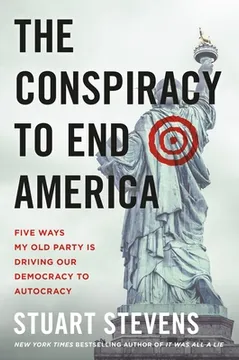


Key Takeaways
Treat autocracy as a coordinated system, not five unrelated warning signs.
A connected threat. Stuart Stevens, a longtime Republican campaign strategist, frames the danger through five autocratic building blocks: propagandists, support from a major party, financiers, legal theories that legitimize power grabs, and shock troops willing to use force. His point is that each becomes more dangerous when it reinforces the others. Media spreads claims, party leaders validate them, donors sustain the machinery, legal arguments reshape the rules, and political violence pressures opponents.
An insider's reckoning. Stevens recalls expecting Republicans to accept Joe Biden's 2020 victory, then watching elected officials deny it. His earlier work helping build the party makes this not just a warning about opponents, but testimony about complicity. The book asks readers to see the pattern as a whole, rather than treating each episode as a contained scandal.
What's striking is the book's systems lens. A propaganda outlet alone cannot make a government authoritarian, nor can a wealthy donor or a violent crowd. The danger lies in coordination, including the way each institution can make the next step seem more ordinary. This is a useful corrective to event-by-event news consumption. The framework is strongest as a diagnostic map, though the presence of all five elements does not by itself prove that every participant shares a single plan.
Media can amplify the lie, but party leaders make it politically authoritative.
A market, not a mastermind. Stevens argues that right-wing media did not create the Republican movement so much as serve and strengthen it. Fox News's most-watched program drew about 3.5 million viewers, a small fraction of the country's population. In 2021, Fox lost 29 percent of its total audience compared with the prior year as some viewers moved to Newsmax, which repeated election fraud claims more aggressively. Internal messages revealed executives worrying that truthful coverage might cost viewers and revenue.
The party's choice. Stevens places greater responsibility on Republican officeholders who knew Biden had won but declined to say so. In his account, had party leaders affirmed the result, the media ecosystem would have had less political cover. He connects this to his own career in political consulting, where persuasion often mattered more than journalistic standards of verification and context.
The distinction between producing a belief and rewarding it is important. Media businesses respond to audience incentives, while elected officials can convert a claim into a party position with institutional consequences. The two forces then reinforce one another. This account also guards against blaming technology as if citizens and leaders were passive recipients of content. Still, audience size alone cannot measure influence: a smaller outlet can shape political elites, and repeated messages can circulate far beyond their original viewers.
Replace democratic optimism with grievance, and defeat starts to look illegitimate.
From promise to persecution. Stevens contrasts Ronald Reagan's hopeful story of an immigrant-built America with Donald Trump's picture of a country cheated by outsiders and hostile forces. Political theorist Timothy Snyder's terms help name the shift. The politics of inevitability assumes progress is the country's natural direction; the politics of eternity casts the nation as a permanent victim trapped in recurring threats. Stevens argues that MAGA politics draws strength from the second story.
Failure becomes proof. Trump did not deliver many of his promises, and he left office after a historic employment decline during the pandemic. For supporters, Stevens argues, such failures could be recast as proof that a corrupt system had blocked their champion. A study of 31 Iowa counties that shifted from Obama to Trump found economic distress was not a significant explanation; anti-immigrant sentiment was stronger.
Political identity is not merely a list of policy preferences. It also gives people a story about who belongs, who has been wronged, and what losses mean. The book shows how that story can make contrary evidence feel like further evidence of persecution. That is a powerful account of belief maintenance. It also needs careful handling: economic explanations can be incomplete without being irrelevant, and a study of one state's counties cannot stand in for every Trump voter.
A party that trades principles for loyalty becomes a leader's enforcement tool.
Loyalty replaces program. In 2020, the Republican National Convention adopted no new platform. Its resolutions instead affirmed support for Trump and attacked media coverage. Stevens contrasts this with a party that once contained markedly different views, including Republicans who opposed war, supported civil rights legislation, or backed abortion rights. He draws on Hannah Arendt's account of authoritarian movements, in which demands for total loyalty leave little room for independent judgment.
The failed bargain. Republican leaders initially believed they could use Trump's popularity while controlling him. Stevens compares that calculation to conservative elites who helped bring Hitler to power, a comparison about political miscalculation rather than an assertion that the two situations are identical. After January 6, Mitch McConnell condemned Trump's role, then voted against conviction. For Stevens, that gap between words and consequences captures how party loyalty can neutralize dissent.
A platform gives a party standards by which voters and members can judge its leaders. When loyalty becomes the standard instead, disagreement looks like betrayal and policy becomes secondary to proximity to power. Stevens's historical analogy emphasizes elite miscalculation, though analogies to Nazism can obscure important differences if treated as equivalences. The more transferable lesson is narrower: leaders who normalize an extremist for short-term advantage may discover that the movement they empower is harder to control than the one they imagined.
Follow political money into the institutions and candidates it makes possible.
Power beyond donations. Stevens distinguishes a direct bribe from the broader way money can shape elections and policy. Outside groups can fund candidates while leaving them less accountable to their state party or constituents. Peter Thiel spent about $30 million through super PACs supporting J. D. Vance in Ohio and Blake Masters in Arizona. Neither had previously held office; Thiel's support helped make their primary campaigns viable. Masters lost the general election, while Vance won.
Networks outlast candidates. The Koch brothers built policy groups, campaign operations, and a nationwide staff network. Mike Pence benefited from that support, yet as vice president served Trump rather than the Kochs' preferred agenda. Corporate donors also resumed giving to some lawmakers who opposed certifying Biden's victory, despite earlier promises to pause contributions. The book's concern is not money alone, but money that sustains anti-democratic politics without meaningful consequences.
The focus on political infrastructure is more revealing than a simple tally of campaign contributions. Money can fund the candidate pipeline, policy organizations, and communications networks that shape which choices reach voters. It also clarifies why a donor's stated intentions may matter less than the effects of continued support. Stevens's account is strongest when it traces these mechanisms. Yet funding does not guarantee control: Thiel's candidate lost in Arizona, and voters remain agents rather than passive objects of wealthy influence.
Democracy can be dismantled through legal changes too incremental to alarm voters.
Erosion by procedure. Stevens calls the use of law to weaken democratic checks autocratic legalism. He treats the 2000 Bush v. Gore decision as a turning point in how campaigns and courts became entangled, then traces a longer legal and political project. The Federalist Society grew into an influential network for conservative judicial nominations; REDMAP targeted state legislative control ahead of redistricting; and the Supreme Court later barred federal courts from reviewing partisan gerrymandering claims.
Small cuts accumulate. The book emphasizes that a single voting restriction or court decision may not look like the end of democracy. Over time, however, rules that limit participation, insulate maps from challenge, and shape judicial appointments can reinforce one another. Stevens argues that this gradual process is easy to miss precisely because it lacks the spectacle of a coup. The danger is a changed system that still appears to follow legal forms.
The emphasis on accumulation helps explain why democratic decline can be hard to recognize in real time. Formal legality and democratic legitimacy are related, but not identical: rules can be lawfully altered in ways that reduce genuine competition. The book also shows how institutional design creates long time horizons, since judicial appointments and district maps persist beyond one election. Care is needed not to treat every conservative legal organization or ruling as anti-democratic; the relevant question is how specific changes affect competition and accountability.
Protect the count, because voting rules can decide who gets represented.
The election machinery matters. Stevens argues that efforts to cast doubt on fraud can justify restrictions on voting and greater partisan control over election administration. The Brennan Center counted 34 laws restricting voting access in 19 states during 2021, alongside hundreds of proposed bills. In Florida, voters restored voting rights to many people with felony convictions, but a later law required payment of fines and fees. DeSantis's election crimes office then arrested 20 former felons who had voted, charging them with voting before resolving those obligations.
A legal boundary. The independent state legislature theory proposed that state legislatures should have near-absolute authority over federal elections, potentially limiting state court oversight. In 2023, the Supreme Court rejected the broadest version of that claim in Moore v. Harper. Stevens presents the ruling as a democratic check, while warning that continuing efforts can seek the same power by other means.
Election administration is easy to dismiss as technical housekeeping, yet details such as registration, ballot access, and who certifies results determine whether formal voting rights can be exercised. The Florida example makes the distance between a right on paper and a usable right concrete. The Supreme Court's rejection of one sweeping theory also shows that institutions can resist. The account should not imply that all election rules are designed for partisan advantage; evaluating their actual burden and administration is essential.
Treat January 6 as a mainstream warning, not a fringe anomaly.
The crowd was broader. A University of Chicago study examined 716 people charged with illegally entering the Capitol by January 1, 2022. Forty-three percent worked in white-collar occupations, and 87 percent had no identified membership in militant groups such as the Proud Boys or Oath Keepers. Many came from counties Biden won. The findings challenged the assumption that the attack was carried out only by isolated extremists on society's margins.
Violence has a history. Stevens links the attack to earlier anti-government movements, including the Posse Comitatus movement, Ruby Ridge, the Branch Davidian siege, and the Oklahoma City bombing. He argues that political leaders and party officials helped bring such hostility into mainstream politics by defending the rioters as legitimate protesters or promising pardons. The chapter's term shock troops describes supporters prepared to use force for an autocratic movement, whether or not they belong to a formal militia.
The study's profile matters because it challenges the comforting idea that extremism is safely contained in a small, socially distant fringe. The distinction between formal membership and movement alignment is especially useful: people can act together without belonging to the same organization. At the same time, charges and occupational categories describe the people studied, not every participant's motive or every member of a political coalition. Recognizing broad support for violence should sharpen analysis, not erase differences among individuals.
Make acceptance of electoral defeat the minimum test of political loyalty.
Losing is democratic work. Political scientist Adam Przeworski defines democracy by parties' ability to lose elections and still trust the rules enough to compete again. Stevens uses that idea to argue that acceptance of defeat is not a courtesy to an opponent; it is a condition that lets political conflict remain peaceful. His proposed first test for Republican renewal is direct: acknowledge that Biden won a free and fair election in 2020.
Do not reward denial. In the book's 2023 conclusion, Stevens argues that defeating Trumpism matters more than preserving party balance for its own sake. He urges readers to vote for Democratic candidates rather than abstain or cast a protest vote, reasoning that electoral defeat is the pressure that could force Republicans to reconsider their direction. This is a partisan prescription, not a neutral account of all possible remedies, but it follows from his central claim that democracy cannot defend itself through denial or accommodation.
This closing standard is concrete and testable. Political leaders may disagree sharply about policy, but a shared commitment to counting votes makes those disputes reversible rather than existential. Stevens's recommendation to vote Democratic is intentionally partisan, grounded in his assessment of the parties at the time of writing. Readers can debate that prescription while still applying the underlying test to every party: does it accept a legitimate loss, and does it protect the conditions for a future contest?
Analysis
The book's central contribution is a shift in scale. Instead of treating propaganda, election denial, wealthy donors, court strategy, and political violence as separate pathologies, Stevens asks readers to examine how they can function as a mutually reinforcing system. This is a useful model of democratic vulnerability because erosion rarely depends on one institution failing all at once. A party can legitimate a media narrative, donors can build durable organizations around it, and legal changes can make the resulting advantages harder to reverse. The book's insider perspective adds force: Stevens is not simply condemning a party he observed from outside, but confronting the political craft and compromises through which he helped build it.
The argument is also openly polemical. Stevens writes as a former Republican who believes the party has crossed from ordinary ideological conflict into an autocratic movement. His evidence includes election data, legal developments, reported communications, historical comparisons, and personal recollection, but those forms of evidence do not carry identical weight. The coordination among the five building blocks is an interpretive thesis, not proof that every donor, media figure, lawyer, or voter participates in one centrally directed conspiracy. That distinction matters if the framework is to illuminate rather than flatten political diversity.
The sharpest analytic value lies in the book's attention to incentives and normalization. Leaders who excuse a false claim to retain office, corporations that resume support after condemning election denial, or media firms that fear losing an audience can each make the next breach less costly. Still, the book gives comparatively little space to the conditions that might make the Republican coalition change course, or to failures and democratic risks within the opposing party. Those limits reflect its urgent warning and partisan purpose. Its enduring test is narrower and more durable than its party diagnosis: a democracy requires political actors to accept losing, preserve fair competition, and resist turning opponents into enemies of the state.
Review Summary
The Conspiracy to End America receives mostly positive reviews, with readers praising Stevens' insider perspective on the Republican Party's shift towards autocracy. Many find the book's warnings about threats to democracy alarming but necessary. Critics appreciate Stevens' analysis of propaganda, financiers, legal theories, and shock troops in undermining democratic norms. Some reviewers note the book's reliance on existing information, while others commend its concise presentation. A few dissenting voices question Stevens' credibility given his past work for the GOP.
Glossary
five autocratic building blocks
a system of authoritarian powerStevens's five-part framework for examining the forces that can move a democracy toward autocracy: propagandists, support from a major political party, financiers, legal theories that legitimize power grabs, and shock troops willing to use force. The framework stresses interaction. Each element can increase the reach and durability of the others.
politics of inevitability
belief in automatic progressA term Stevens draws from historian Timothy Snyder for a worldview in which a nation assumes its progress and success are natural or assured. Problems may be serious, but the overall direction is presumed to be positive. Stevens contrasts this optimism with a politics organized around recurring victimhood and fear.
politics of eternity
identity built on recurring victimhoodA term Stevens draws from Timothy Snyder for a national story that places one group at the center of repeated victimization. Rather than trusting that the future will bring progress, its adherents see threats as permanent and history as a cycle of injury and revenge. Stevens uses it to explain MAGA's grievance-centered identity.
autocratic legalism
using law to weaken democracyThe use of legal powers, statutes, courts, and official procedures to protect a leader and weaken democratic checks. In Stevens's account, the process can appear lawful at each step while gradually reducing fair political competition, independent oversight, or the ability to hold officials accountable.
independent state legislature theory
near-absolute legislative election controlA constitutional interpretation asserting that state legislatures have exclusive or near-absolute authority to regulate federal elections. As Stevens describes it, adopting this theory could restrict state constitutional protections and court review of legislative election rules. The Supreme Court rejected its broadest version in Moore v. Harper in 2023.
REDMAP
Republican redistricting strategyThe Redistricting Majority Project, a Republican effort launched ahead of the 2010 census to win state legislative chambers where control of post-census district maps could be decisive. By targeting state-level races, the strategy sought to shape congressional districts for long-term partisan advantage.
shock troops
supporters prepared to use forceStevens's term for people willing to deploy violence or intimidation in support of an autocratic political movement. It includes organized militia members, but is not limited to them. The term emphasizes that political violence can draw on a wider movement whose members may have no formal affiliation with extremist groups.
About the Author
Other books by Stuart Stevens
Download PDF
Download EPUB
.epub digital book format is ideal for reading ebooks on phones, tablets, and e-readers.








