Key Takeaways
1. The Supreme Court's Anti-Democracy Turn
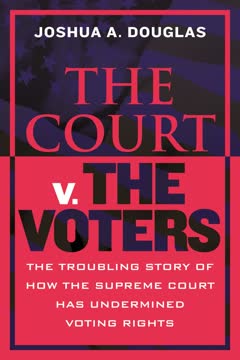
The Supreme Court of the United States is anti-democracy and anti-voter—and has been for far longer than you might think.
A troubling trend. The Supreme Court, once seen as a bulwark for democracy, has actively undermined voting rights over the past five decades, laying the groundwork for electoral crises like the January 6th insurrection. Despite public trust in the Court to protect democracy, its rulings have consistently favored state legislatures and entrenched politicians over the fundamental right to vote. This shift has allowed lawmakers to craft self-serving election rules that suppress votes and entrench power.
Chipping away at rights. Historically, the U.S. has expanded the franchise, notably with the 19th Amendment and the Voting Rights Act of 1965, moving towards greater inclusion. However, the Court's incremental decisions have reversed this progress, approving measures that deny voting rights, endorse strict voter ID laws, sanction gerrymandering, and dismantle crucial civil rights protections. These rulings, often subtle, have cumulatively created a legal doctrine that gives politicians wide leeway to manipulate the electoral system.
Real-world consequences. The Court's decisions have tangible impacts on who can vote and how elections are run. For example, after the Shelby County case, Georgia limited ballot drop boxes, and North Carolina passed a massive voter suppression law. Texas enacted a strict voter ID requirement where a gun license counts but a student ID does not. These examples illustrate how judicial decisions empower state legislatures to erect significant barriers to the ballot box, particularly for marginalized communities.
2. Eroding Fundamental Voting Rights: The Anderson-Burdick Test
Instead of requiring states to satisfy the “strict scrutiny” standard from the 1960s, which is the highest measure that is most skeptical of state rules burdening the right to vote, the Court eventually used a watered-down interpretation of the Anderson test to give states more power to run their elections as they wish and to make it easier for them to defeat lawsuits challenging their voting processes.
A new, weaker standard. The 1983 case Anderson v. Celebrezze, involving independent presidential candidate John Anderson, marked a pivotal shift in the Supreme Court's approach to voting rights. While Anderson ultimately won ballot access, the Court introduced a less stringent "balancing test" instead of the robust "strict scrutiny" previously applied to fundamental rights. This test requires courts to weigh the burden on voters against the state's asserted interests in regulating elections.
States gain leeway. This new test, further solidified in Burdick v. Takushi (1992), allowed states to justify voting laws with vague rationales like "administrative efficiency" or "election integrity," rather than specific, compelling interests. Alan Burdick's attempt to secure write-in voting in Hawaii, even for a protest vote, was rejected because the Court prioritized the state's generalized interests over the voter's expressive rights. This created the "Anderson-Burdick" test, which significantly lowered judicial protection for the right to vote.
The "Donald Duck" effect. The Burdick case famously involved a hypothetical discussion about voting for "Donald Duck," which Alan Burdick himself found dismissive of his serious intent. The Court's majority viewed the ballot instrumentally, as merely a tool to elect someone, rather than a means of expression. This narrow interpretation devalued the constitutional right to vote, opening the door for states to impose restrictions without meaningful judicial oversight, even if they disproportionately affected certain voters.
3. Voter ID Laws: Prioritizing Speculation Over Voter Access
The only kind of voter fraud that [Indiana’s new voter ID law] addresses is in-person voter impersonation at polling places. The record contains no evidence of any such fraud actually occurring in Indiana at any time in its history.
Upholding strict ID. In Crawford v. Marion County Election Board (2008), the Supreme Court upheld Indiana's strict photo ID law, despite acknowledging a complete lack of evidence of the specific type of fraud it aimed to prevent: in-person voter impersonation. The Court accepted the state's generalized interests in "election modernization," "voter fraud prevention," and "safeguarding voter confidence," without requiring concrete proof of a problem. This decision effectively shifted the burden, demanding plaintiffs prove significant voter disenfranchisement while allowing states to rely on speculation.
The "meme of voter fraud." The Court's reliance on historical anecdotes, like 19th-century Tammany Hall fraud, and irrelevant examples, such as absentee ballot fraud, to justify a modern photo ID law, highlights the "meme of voter fraud." This narrative, often peddled by politicians, creates public concern about election integrity, which is then used to justify restrictive voting laws. This vicious cycle allows politicians to enact laws that benefit them, even if based on false pretenses.
Disproportionate impact. Strict voter ID laws, like Indiana's, disproportionately affect marginalized communities, including:
- Racial minorities
- Indigent individuals
- Older voters
- Students
These groups are statistically less likely to possess the required government-issued photo ID, and obtaining one can involve significant time, cost, and access barriers. The Crawford ruling, by giving tacit approval to such laws, enabled a nationwide spread of strict ID requirements, making voting harder for millions without clear benefits.
4. Felon Disenfranchisement: A Constitutional Blessing for Unequal Citizenship
The Constitution itself, the Court found, has a built-in allowance for felon disenfranchisement.
An obscure clause. In Richardson v. Ramirez (1974), the Supreme Court upheld California's practice of felon disenfranchisement, even for individuals who had completed their sentences. The ruling hinged on an obscure phrase in Section 2 of the Fourteenth Amendment, "or other crime," which exempts states from losing congressional representation if they deny voting rights based on "participation in rebellion, or other crime." The Court broadly interpreted this phrase to allow states to disenfranchise anyone convicted of a felony, regardless of the crime's severity or the individual's rehabilitation.
Disproportionate and pervasive. Felon disenfranchisement laws have a long, often racist, history, originally targeting specific "infamous crimes" or former enslaved people. Today, these laws are widespread, with 48 states disenfranchising individuals for various felonies, often for life. This practice disproportionately impacts racial minorities:
- Approximately 8% of the overall U.S. population has a felony conviction.
- 33% of Black men have a felony conviction.
- Black people are disenfranchised at a rate 3.7 times higher than other groups.
These laws perpetuate a system of unequal citizenship, denying millions a voice in democracy.
Political ramifications. The Ramirez decision has had immense political consequences. For instance, in the razor-thin 2000 Florida presidential election, if disenfranchised felons had been allowed to vote, Al Gore likely would have won the state and the presidency. While some states have eased their felon disenfranchisement rules, the Ramirez precedent continues to underpin legal challenges, making it difficult to argue against the practice's constitutionality. The Court's ruling solidified a system where a past mistake can permanently strip a citizen of their most fundamental right.
5. Money Talks: Citizens United and the Rise of Wealthy Influence
The fact that speakers may have influence over or access to elected officials does not mean that these officials are corrupt.
Unleashing unlimited spending. Citizens United v. Federal Election Commission (2010) dramatically reshaped American campaign finance by ruling that corporations and unions have a First Amendment right to spend unlimited amounts of money on independent political advertisements. The Court, building on Buckley v. Valeo (1976), narrowed the definition of "corruption" to only direct quid pro quo exchanges, effectively dismissing the idea that independent expenditures could lead to undue influence or the appearance of corruption. This decision opened the floodgates for "dark money" and super PACs.
The "corporate personhood" myth. While often mischaracterized as declaring corporations "people," Citizens United instead affirmed that First Amendment rights do not depend on the identity of the speaker, extending political speech rights to corporate entities. The ruling's true impact lies in its rejection of the government's compelling interest in preventing the distorting effects of massive corporate wealth on elections. This has led to a system where wealthy interests, rather than individual voters, disproportionately influence political discourse and outcomes.
Skewed representation and influence. The decision has fueled an explosion of spending by super PACs and other "dark money" groups, often without disclosing their donors. This influx of money has several detrimental effects:
- It drowns out the voices of ordinary citizens.
- It makes candidates more beholden to wealthy donors than to constituents.
- It creates "shadow parties" that operate outside traditional campaign finance limits.
- It makes it harder for individuals, especially women and minorities, to run for office due to fundraising barriers.
The result is a democracy where political equality is undermined, and the powerful consolidate even more power.
6. Bush v. Gore: A Political Intervention with Lasting Legal Scars
Although we may never know with complete certainty the identity of the winner of this year’s Presidential election, the identity of the loser is perfectly clear. It is the Nation’s confidence in the judge as an impartial guardian of the rule of law.
Halting the recount. In 2000, Bush v. Gore saw the Supreme Court intervene in the Florida presidential election dispute, halting a statewide recount of "undervotes" (ballots not registered by machines) and effectively handing the presidency to George W. Bush. The 5-4 majority cited an Equal Protection Clause violation due to varying recount standards across counties, but controversially refused to remand the case for a constitutionally compliant recount. This decision, issued just days before the "safe harbor" deadline, was widely criticized as partisan and lacking sound legal basis.
A "one-off" ruling. The Court explicitly stated its decision was "limited to the present circumstances," suggesting it should not serve as binding precedent. For over two decades, the Supreme Court itself largely avoided citing Bush v. Gore in majority opinions, treating it as an "embarrassing judicial fart." However, this "one-off" nature paradoxically encouraged an explosion of post-election litigation, as political actors saw the judiciary as a viable tool to contest election results, regardless of merit.
Fueling election disputes. The Bush v. Gore precedent, despite its disavowal, contributed to a culture of endless election challenges. The 2020 election saw over seventy lawsuits filed by Donald Trump and his allies, most of them frivolous, yet they fueled a narrative of a "stolen election" that culminated in the January 6th Capitol riot. The case's legacy is not just its outcome, but its role in normalizing the use of courts to undermine election finality and legitimacy, shifting power from voters to litigious political operatives.
7. Dismantling the Voting Rights Act: Shelby County's "Umbrella in a Rainstorm"
Throwing out preclearance when it has worked and is continuing to work to stop discriminatory changes is like throwing away your umbrella in a rainstorm because you are not getting wet.
Gutting Section 5. In Shelby County v. Holder (2013), the Supreme Court, by a 5-4 vote, invalidated Section 4 of the Voting Rights Act (VRA), which contained the formula determining which jurisdictions needed federal preclearance for voting changes. Chief Justice Roberts, writing for the majority, argued that "things have changed in the South" and that the formula, based on decades-old data, was unconstitutional due to a new "equal sovereignty" principle. This effectively rendered Section 5, the VRA's most powerful tool against discrimination, inoperable.
Ignoring persistent discrimination. Justice Ruth Bader Ginsburg's fiery dissent famously likened the decision to "throwing away your umbrella in a rainstorm because you are not getting wet." She argued that the VRA's success in curbing overt discrimination did not mean discrimination had ceased; rather, it had become more subtle, manifesting as "second-generation" barriers like:
- Racial gerrymandering
- At-large election systems
- Strict voter ID laws
- Cuts to early voting opportunities
Congress had amassed a voluminous record in 2006 justifying the VRA's reauthorization, but the Court dismissed these findings, prioritizing deference to states over protecting minority voting rights.
Immediate backsliding. The impact of Shelby County was immediate and severe. Within hours of the ruling, states like Texas and North Carolina, previously subject to preclearance, announced plans to implement new voting restrictions and redistricting maps that had been blocked under Section 5. These laws, later found by courts to be discriminatory, were enforced for several election cycles, demonstrating the critical deterrent effect of preclearance. The decision signaled that states could now enact restrictive voting rules without federal oversight, making it harder for advocates to challenge unfair practices.
8. Weakening the Voting Rights Act's Core: Brnovich's Activist "Guideposts"
The majority fears that the statute Congress wrote is too ‘radical’—that it will invalidate too many state voting laws. So the majority writes its own set of rules, limiting Section 2 from multiple directions.
Rewriting Section 2. In Brnovich v. Democratic National Committee (2021), the Supreme Court further weakened the Voting Rights Act by upholding two Arizona voting laws—a ban on ballot collection and a rule discarding out-of-precinct provisional ballots—against a Section 2 challenge. Justice Samuel Alito, writing for the 6-3 majority, introduced five new "guideposts" for evaluating vote denial claims under Section 2. These guideposts, which lacked clear legal precedent, effectively rewrote the statute and made it significantly harder for plaintiffs to prove discriminatory impact.
Alito's "guideposts" for vote denial:
- Burden size: Only "highly relevant" if the burden is substantial, not just "usual burdens of voting."
- Historical practice: Rules routine in 1982 are less likely to be discriminatory, insulating older laws.
- Disparity size: Small disparities in impact on racial groups are less likely to indicate discrimination.
- Overall system: Courts must consider a state's entire voting system, not just the challenged provision.
- State interests: The strength of the state's asserted interests (e.g., election integrity) is a major factor.
These factors tilt the scales heavily in favor of states, allowing them to justify restrictive laws with vague rationales and minimal evidence of fraud, while demanding extensive proof of harm from plaintiffs.
Judicial activism and its consequences. Justice Elena Kagan's dissent sharply criticized Alito for "making up the law," arguing that the majority's new framework was an act of judicial activism designed to limit Section 2's reach. The Brnovich decision, following Shelby County, leaves voting rights advocates with severely diminished tools to combat discriminatory voting laws. While Section 2 technically remains, its practical application has been so narrowed that it will be exceedingly difficult to challenge subtle forms of voter suppression, further entrenching the power of state legislatures.
9. Partisan Gerrymandering: A Green Light for Politicians to Choose Voters
The Supreme Court of the United States announced that political gerrymandering is perfectly constitutional.
Abdicating responsibility. In Rucho v. Common Cause (2019), the Supreme Court, by a 5-4 vote, declared that federal courts have no role in policing partisan gerrymandering. Chief Justice Roberts, writing for the majority, argued that such claims are "nonjusticiable" because there are no judicially manageable standards to determine when partisan line-drawing goes "too far." This decision effectively gave a "green light" to state legislatures to draw district maps explicitly designed to entrench their own political party in power, regardless of the popular vote.
Sophisticated manipulation. Modern gerrymandering, aided by advanced computer technology and granular voter data, allows map drawers to precisely manipulate district lines through "packing" (concentrating opposing voters into a few districts) and "cracking" (spreading opposing voters across many districts). This ensures predictable electoral outcomes, making it nearly impossible for voters to "vote the bums out" when the system is rigged against them. The Court's refusal to intervene ignores the profound impact on democratic representation and accountability.
Consequences for democracy. The Rucho decision has profound implications for the fairness of elections:
- It entrenches incumbents, reducing electoral competition.
- It distorts the will of the people, allowing a minority of votes to control a majority of seats.
- It exacerbates political polarization and dysfunction.
- It disproportionately affects minority representation.
While Chief Justice Roberts suggested state courts or ballot initiatives could address the issue, many states lack these mechanisms, leaving politicians free to prioritize self-interest over fair representation. The Court's stance reinforces the idea that in election law, politicians' power outweighs voters' rights.
10. The Independent State Legislature Theory: A Looming Threat to State Constitutional Protections
The Elections Clause does not insulate state legislatures from the ordinary exercise of state judicial review.
A radical interpretation. The "independent state legislature" theory, a legally dubious idea, posits that state legislatures have unfettered authority to regulate federal elections, immune from review by state courts or even state constitutions. This theory stems from an ultra-literal reading of the U.S. Constitution's Elections Clause (Article I, Section 4) and Article II, which state that the "Legislature" of each state prescribes the "Times, Places and Manner" of elections and directs the appointment of presidential electors. This would mean state supreme courts, the ultimate interpreters of state law, could not invalidate state election laws, even if they violate state constitutional protections.
Historical rejection and modern revival. The Supreme Court has consistently rejected the broadest form of this theory, notably in Smiley v. Holm (1932) and Arizona State Legislature v. Arizona Independent Redistricting Commission (2015), affirming that state legislatures operate within the bounds of their state constitutions. However, a subset of conservative justices, particularly in Bush v. Gore (2000) and during the 2020 election litigation, revived and championed this theory. They argued that state courts overstepped their authority by interpreting state election laws in ways that differed from the legislature's intent.
A "win" with a dangerous caveat. In Moore v. Harper (2023), the Supreme Court ostensibly rejected the independent state legislature theory, ruling 7-2 that "The Elections Clause does not insulate state legislatures from the ordinary exercise of state judicial review." This was a relief for voting rights advocates, preserving state courts' ability to protect voters under state constitutions. However, Chief Justice Roberts's majority opinion introduced a critical caveat: state courts "may not transgress the ordinary bounds of judicial review." This vague standard grants the U.S. Supreme Court the power to intervene and overturn state court decisions if it deems them to have "gone too far," creating a new, uncertain battleground for election disputes and potentially undermining state judicial independence.
11. Reclaiming Democracy: Paths to Reform and Voter Empowerment
Although the Supreme Court has made our jobs much harder, we can still out-organize, out-mobilize, and outvote those who espouse anti-democracy views.
A Court out of step. The Supreme Court's current conservative majority, solidified by recent appointments, has consistently issued rulings that prioritize the power of politicians and wealthy interests over the fundamental right to vote. This anti-democracy trend has narrowed constitutional protections, weakened federal oversight, and given state legislatures immense leeway to enact restrictive voting rules and gerrymandered maps. The cumulative effect is a governmental structure less focused on "We the People" and more on "We the Politicians."
Three paths to reform: To counter this judicial assault on democracy, a multi-pronged approach is necessary:
- Legislative Compromise: Seek bipartisan "Grand Election Compromises" at the state level, like Kentucky's, that expand access while addressing security concerns. This avoids litigation and builds consensus around core democratic ideals: minimal voter burden, fraud deterrence, voter education, and acceptance of results.
- Court Reform: Implement meaningful, non-partisan reforms to the Supreme Court itself.
- Term Limits: Establish 18-year term limits for justices to ensure regular rotation and reduce the political stakes of individual appointments.
- Panel System: Increase the number of justices and have them sit in smaller, randomly selected panels, similar to federal appeals courts, to broaden perspectives and reduce ideological entrenchment.
- Rotating Judges: Allow appellate and district court judges to sit "by designation" on the Supreme Court, bringing diverse experience and reducing ideological capture.
- Voter Mobilization: Use the Court's anti-democracy rulings as a catalyst for a massive political movement. Educate the public on how cases like Citizens United impact their lives and mobilize voters to support pro-democracy candidates at all levels, aiming for significantly higher turnout to overcome structural hurdles.
Keeping the republic. Benjamin Franklin's famous warning, "A republic, if you can keep it," resonates deeply today. While the Supreme Court has become a significant threat to political rights, the ultimate power still rests with the people. By pursuing legislative compromise, advocating for sensible Court reforms, and engaging in unprecedented voter mobilization, citizens can reclaim their democracy and ensure that the will of the people, not entrenched power or judicial ideology, determines the nation's future.
Last updated:
Similar Books