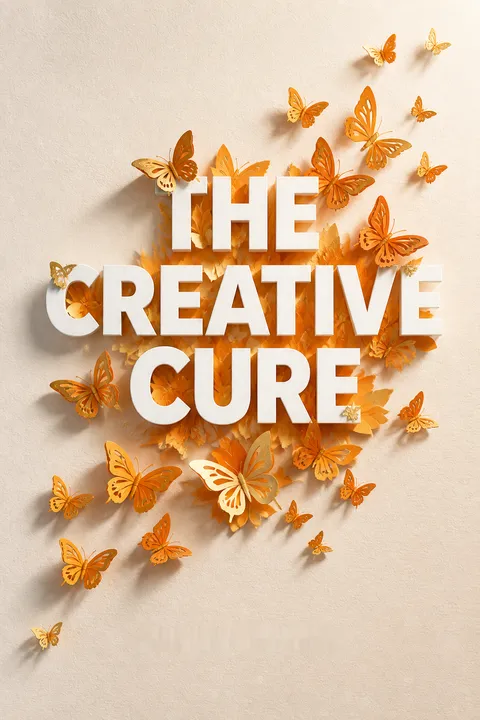


Key Takeaways
Use everyday creativity to reconnect with yourself, not to prove you are an artist.
Creativity is more than art. Nordby defines creativity as bringing imagination into reality. It can mean writing or painting, but also shaping a meal, a home, a relationship, or a new response to a problem. His idea of the inner creative self is the curious, playful source of imagination that people can lose touch with, but not lose entirely.
A life can change course. At 34, Nordby was a successful mortgage-company CEO, but he was exhausted, overweight, and living by a version of success that felt false. A retreat brought him face to face with the child he had been and the joy he had abandoned. When the 2008 financial crisis later destroyed his business and much of his status, the loss forced a painful reset. He found that creative self-expression helped him rebuild his sense of identity and direction.
The strongest claim here is not that making art cures every wound, but that creative activity can restore agency: a person makes choices, gives form to experience, and encounters possibilities beyond habitual responses. That resembles the logic of expressive therapies, where creating can help people approach feelings that are difficult to articulate directly. The book’s broad definition is useful because it removes the gatekeeping of talent and professional achievement. Still, creative practice should be understood as a source of support, not a universal treatment. Severe depression or trauma may call for skilled clinical care alongside personal expression.
Let joy test whether your ambitions belong to you.
Success can be inherited. Nordby argues that social expectations, painful experiences, and rejection can teach people to distrust their preferences and fear mistakes. The result may be a life organized around approval rather than genuine desire. As a child, he wanted to write, but he absorbed the idea that writers struggle financially. He later decided he needed enormous wealth before he could pursue that dream, and spent years chasing a version of success defined by other people.
Joy offers a compass. The book treats joy not as constant pleasure, but as a clue to what feels meaningful and alive. Asking what would bring joy can clarify small choices and larger priorities. The author recommends noticing inner commands such as should and shouldn't, then checking whether they reflect personal values or an inherited standard. Joy can point toward difficult work, too, rather than simply toward comfort.
Joy works best here as a source of information, not as a moral authority. Motivation research often distinguishes autonomous goals, pursued because they matter to the person, from goals adopted mainly for approval. The former tend to feel more sustaining, which supports the book’s emphasis on examining whose ambition is being served. Yet joy alone cannot settle every decision. Caregiving, financial limits, and obligations can matter even when they are not immediately pleasurable. A useful test is whether a choice feels aligned with deeper values, not whether it promises a constant good mood.
Make room for boredom, play, and odd constraints to revive imagination.
Imagination needs practice. Nordby contrasts children who see many possibilities in a chalk dot with older students who give the single obvious answer. He cites a creativity test built for NASA in which five-year-olds scored 98 percent, using it to illustrate how imagination can be narrowed by training in correctness. The point is not to reject logic, but to keep it from crowding out alternative ways of seeing.
Give the mind material. The book suggests setting playful limits, changing perspective, or using random prompts. In one exercise, a parent working through homework conflict draws the random word basket and uses its associations to imagine a flexible homework container and a scheduled time to review it. Nordby also recommends occasional periods of doing nothing, without reaching for a device, so the mind has room to wander and form its own connections.
These exercises resemble divergent thinking, the generation of multiple possible answers before selecting one. Constraints can help because they reduce the blank-page problem, while random prompts interrupt the mental grooves that keep a person circling the same explanation. Boredom may also create space for incubation, the familiar experience of a solution surfacing after attention shifts away from a problem. None of this means every idle moment produces insight. For someone experiencing acute anxiety, unstructured silence can intensify distress, so the practice should be adjustable rather than treated as a test of discipline.
Treat emotions as useful signals, then check them against reality.
Feelings carry information. Nordby encourages readers to notice emotions and bodily sensations instead of dismissing them as irrational. A feeling can point toward a need, a boundary, a danger, or a source of desire. The book also describes intuition as a kind of knowing that may arise before conscious reasoning. A friend’s quick leap over a barrier, followed by the discovery of a rattlesnake beneath it, illustrates how a person may respond to a pattern before consciously identifying it.
Signals are not verdicts. The author describes a card-game study in which participants’ bodies reacted to a risky deck before they could explain the pattern. His practical advice is to name feelings specifically, notice where they register in the body, and record them. A daily check-in can reveal mixed emotions, such as grief and relief at once. He explicitly treats emotion and intuition as partners to logic, not replacements for it.
This is a helpful middle ground between emotional suppression and the idea that every gut feeling is correct. Bodily responses can reflect learned pattern recognition, but they can also reflect fatigue, fear, bias, or past experiences that do not match present conditions. Naming an emotion may create enough distance to examine its source rather than obeying it automatically. That makes the book’s sequence valuable: notice, describe, and then interpret. The distinction between a feeling being real and its explanation being accurate is especially important when intuition is used in high-stakes decisions.
Rewrite the meaning of painful events without pretending they did not hurt.
Identity is partly a story. Nordby describes how repeated comments can become private rules about who someone is. A friend, for example, repeats his grandmother’s description of him as broad in interests but shallow in skill, as if it were an established fact. The book calls the deliberate revision of such narratives conscious storytelling. The aim is not to change what happened, but to examine the meaning attached to it.
Revise with care. Nordby proposes three lenses: acceptance of what is felt, curiosity about other interpretations, and compassion toward the person who lived through the event. He reframes the collapse of his business from proof of personal failure into a painful turning point that helped him recover a sense of self. He also uses imperfect poems and deliberately failed first attempts as ways to practice expression without demanding polished results.
Narrative revision has a close cousin in cognitive behavioral approaches, which help people distinguish an event from the conclusions they draw about it. That can loosen rigid self-judgments and make new action imaginable. The method is most ethical when it preserves the facts and acknowledges harm. A forced uplifting interpretation can silence grief or shift responsibility away from people and systems that caused injury. The book’s emphasis on acceptance and compassion helps guard against that mistake: a new story should widen perspective, not erase evidence or require gratitude for suffering.
Start with a tiny creative ritual, and repeat it before inspiration arrives.
Practice beats permission. Nordby presents creative practice as regular activity that develops a capacity, not a project that must reach a finished product. It can be a few minutes of journaling, a sketch, or a deliberate experiment with an art form. His Creative Self journal is meant as a private conversation, not polished writing. One simple sequence asks: What am I feeling? What do I need? What would I love?
Make starting easy. The book draws on B. J. Fogg’s Tiny Habits approach: choose an action so small it is easy to repeat. Someone interested in dance, for instance, might practice one move a day. Nordby suggests treating the first awkward attempts gently and adjusting the activity if it does not fit. Regular practice can make creativity part of ordinary life, rather than something postponed until confidence or inspiration appears.
Small actions reduce the psychological cost of beginning, and repetition creates opportunities to discover what a person actually enjoys. This is more reliable than waiting for a dramatic burst of confidence. The journaling prompts are particularly useful because they move from observation, to need, to possibility, a sequence that can turn vague distress into a more specific question. There is a limit, though: repetition alone does not make every practice nourishing. The book’s invitation to experiment and change course matters; a routine should serve self-discovery, not become another standard to fail.
Choose creative company that welcomes imperfect work instead of ranking it.
Conditions shape creativity. Nordby calls the setting that supports a creative habit its creative context: the space, time, rituals, and relationships around the activity. A writer who feels stuck in a home office might change locations, while a small ritual can mark the start of protected creative time. Julia Cameron’s artist dates, which the book recommends, are solitary outings chosen to refresh attention and delight the senses.
Connection matters, too. The book challenges the image of the artist as a permanent loner. Nordby describes creative clusters, small groups where people share work and encourage one another. His group emphasizes showing up, honesty, speaking from the heart, and sharing experience rather than giving unsolicited advice. Confidentiality and direct discussion of conflict help preserve trust. The aim is not to eliminate solitude, but to combine independent work with the safety and energy of supportive company.
Creative work is often imagined as a private contest between an individual and a blank page. A better model includes both solitude and social scaffolding: peers can normalize awkward beginnings, provide accountability, and help people persist through uncertainty. The group rules are important because feedback can either expand experimentation or trigger self-protection. Encouragement does not mean automatic praise; useful communities make room for honesty without treating a draft as a verdict on its maker. Not everyone needs the same amount of company, so the right context is personal rather than prescribed.
Align a vivid desired outcome, honest feelings, and a workable next step.
A process can be mapped. Nordby’s creative formula is imagination plus feelings and intuition plus story, leading to action and results. In practice, a person first pictures a result they would love, notices the emotions and intuitive responses it brings up, and examines the story they tell about whether it is possible or deserved. They then choose an action. The same sequence can support a small goal, such as making a neglected backyard inviting, or a major project, such as writing a book.
Turn the picture into movement. Nordby describes imagining his completed book and the readers it might help. The image shifted his feelings from overwhelm toward curiosity, and journaling helped him address discouraging self-talk and return to the work. He also describes a ceramic artist who realized she did not need to build a studio alone and joined a collective instead. The gap between present conditions and a desired outcome can feel uncomfortable, but it can also clarify the next small move.
The formula is most persuasive as a planning aid, not a law that guarantees results. A vivid goal can focus attention, emotions can reveal motivation or resistance, and a more flexible story can make action seem possible. Those processes help explain why the framework may feel like magic without requiring supernatural causation: people notice options, ask for help, and take steps they previously overlooked. Still, imagination cannot substitute for money, time, health, or fair opportunity. The formula is useful when it organizes action while leaving room to revise the goal in response to real constraints.
Analysis
The book’s central contribution is a broad, practical definition of creativity: not a rare talent that produces impressive objects, but an everyday capacity to imagine alternatives and act on them. This reframing gives the reader a route into the subject without requiring artistic skill. Nordby’s personal arc supplies the emotional proof of concept. Outward success did not protect him from exhaustion or emptiness; losing the business he had built created the opening to question the identity that success had supported.
The strongest parts of the method connect inner attention to behavior. Journaling helps turn diffuse feelings into named needs. Play and random prompts loosen fixed interpretations. Rewriting a personal story can weaken the grip of inherited judgments. Tiny practices, rituals, and trusted groups then give these insights somewhere to go. The creative formula gathers these moves into a memorable sequence, from imagined possibility and feeling, through narrative, to action. Its usefulness lies less in novelty than in making an often vague process visible and repeatable.
The book is also most credible when it presents joy as a clue rather than a guarantee. Joy can expose the difference between a personally meaningful desire and an ambition adopted for approval. But immediate pleasure is not always the best guide, and some worthwhile responsibilities feel difficult or frightening. Likewise, the claim that creativity heals should be read as an invitation to support well-being, not as evidence that artistic practice resolves trauma on its own. The text sometimes speaks with more certainty than that distinction warrants.
A careful reader can retain the humane core without accepting every spiritual explanation. Creative work may help people approach emotion, revise self-understanding, and test new actions. It cannot remove structural barriers or replace treatment when suffering is severe. The book’s most durable advice is therefore modest: notice what is happening inside, make room for a different possibility, and take one small action that expresses it. That is not a cure-all. It is a repeatable way to participate in shaping a life.
Review Summary
The Creative Cure receives overwhelmingly positive reviews, averaging 4.06 out of 5. Readers consistently praise its accessible approach to unlocking creativity, with many highlighting the practical exercises included in each chapter. Reviewers appreciate Nordby's compassionate voice and personal authenticity, noting the book addresses how societal pressures and past experiences suppress natural creativity. Many compare it favorably to Julia Cameron's The Artist's Way. The book resonates across experience levels, from seasoned writers to complete beginners, with several readers recommending it to clients, students, and book groups.
People Also Read


Glossary
inner creative self
Source of personal imaginationNordby’s term for the curious, playful source of imagination that he believes is present in everyone. It is not limited to people who identify as artists. Creative practice is the way a person reconnects with this inner source and expresses it through art, choices, relationships, work, or everyday problem-solving.
Creative Self journal
Private self-discovery journalA journaling practice designed to help a person converse with themselves without an audience or pressure to write well. It can be handwritten, typed, or recorded. Prompts invite the writer to identify present feelings, name current needs, and imagine what they would love, making the journal a space for reflection and creative possibility.
creative formula
Imagination-to-action frameworkNordby’s framework for turning a desired outcome into action: imagination, feelings and intuition, and story combine to shape actions and results. It can be used to plan a goal or examine a block. If progress stalls, the person can ask whether the desired result is clear, the emotions acknowledged, or the guiding story too restrictive.
conscious storytelling
Intentional narrative revisionThe deliberate examination and revision of the stories people tell about themselves and their experiences. It does not alter the events themselves. Nordby recommends approaching a story with acceptance, curiosity, and compassion to notice inherited judgments, consider other truthful interpretations, and reduce the power of self-limiting conclusions.
creative context
Conditions supporting creative practiceThe environment surrounding a creative habit, including where and when it happens, the rituals that mark it, and the people involved. A supportive context can make practice easier to begin and sustain. Nordby encourages readers to adjust their setting rather than assume that a lack of inspiration means they lack creativity.
creative clusters
Small creative support groupsA term Julia Cameron uses for groups that support people in their creative work. In Nordby’s discussion, these groups offer accountability, encouragement, and a place to share art or ideas. Trust depends on honest communication, confidentiality, and listening without automatically turning another person’s experience into a problem to solve.
artist dates
Solo creative-nourishment outingsA technique associated with Julia Cameron in which a person sets aside time alone for an enjoyable, curiosity-provoking outing. The activity is chosen to refresh the senses and provide new experiences, not to produce work or perform for others. Nordby recommends scheduling these appointments as part of a broader creative practice.
sangha
Community of practitionersA Buddhist term for a community of people practicing together. Nordby uses it to illuminate the value of creative community: supportive relationships can help people feel safe enough to share work, take risks, and persist. In this sense, connection complements solitude and individual practice rather than replacing them.
Download PDF
Download EPUB
.epub digital book format is ideal for reading ebooks on phones, tablets, and e-readers.








