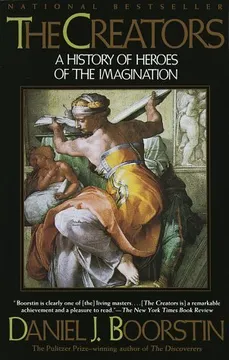


Key Takeaways
Read art history as an ever-growing inheritance, not a race with one winner.
Art adds; it rarely replaces. Boorstin’s central distinction is between science, where new findings can displace old ones, and art, where new works enlarge what people can experience. Homer remains alive beside Joyce; Picasso changes how viewers see Leonardo without making Leonardo obsolete. The history of art is therefore not a ladder toward one correct answer, but a growing collection of visions, each capable of changing how earlier work is understood.
Creation stays mysterious. Boorstin surveys makers across literature, painting, architecture, music, and other arts, but treats the impulse to create as something no single theory explains. His focus is on people who introduced a new possibility, whether through a medium, a form, or a way of seeing. Their work survives not because it defeats the past, but because later creators and audiences keep finding uses for it.
What's striking is the model of culture as cumulative rather than competitive. It resembles biological evolution in one respect: new forms often emerge through variation on inherited material, not from nothing. Yet the analogy has limits. Artistic history is shaped by institutions, wealth, censorship, and accidents of preservation, not only by creative merit. Boorstin’s chosen “heroes” make the story vivid, but a reader should also ask whose work was never collected, copied, or admitted into the canon.
Ask what a culture believes creation is before judging what it creates.
Belief shapes possibility. Boorstin begins with cultures’ different answers to the riddle of creation. Hindu traditions respond to the world’s dazzling variety with many divine forms and the practice of darśan, seeing the deity. Confucius turns attention toward ethical life; the Buddha declines to answer questions about cosmic origins when they do not help relieve suffering. Taoist thought emphasizes natural transformation, including ch’i, the vital force moving through the world.
One answer changes the West. The Hebrew tradition presents one Creator who makes a covenant with people made in the divine image. Christianity develops this into a basis for human creative power. Islam, by contrast, treats the Koran as uncreated and reserves the power of creation to God. These are not merely abstract doctrines: they shape attitudes toward images, innovation, and the creator’s role.
The useful insight is that ideas about creation can authorize some forms of making and discourage others. Similar questions arise in modern debates about artificial intelligence: is a machine producing, copying, or merely executing? Still, Boorstin’s East-West contrasts are broad strokes. Hinduism, Buddhism, Islam, and Christianity each contain internal disagreements, and artistic practice often exceeds official doctrine. The comparison works best as a map of influential possibilities, not as a complete description of entire civilizations.
Choose whether your buildings should resist time or renew themselves.
Materials carry a time horizon. Stonehenge was once attributed to advanced outsiders because scholars doubted prehistoric people could build it. Radiocarbon dating instead placed it around 2000 B.C., making it evidence of creative capacity beyond established centers of civilization. Egyptian pyramids turned stone into durable tombs and public projects. Roman builders used volcanic material in concrete to create arches, vaults, and domes that enclosed vast interior spaces.
Renewal can be its own monument. Japan’s Ise shrines take another path: they are rebuilt roughly every twenty years, preserving craft through repetition rather than preserving the same structure. The contrast is not simply between durable stone and fragile wood. It is between different ways of living with time: defy it, adapt to it, or make renewal part of tradition.
What's striking is that architecture can embody a society’s theory of time. Contemporary sustainability debates add a practical question: should buildings last for centuries, or should they be designed for repair, disassembly, and renewal? Neither answer is automatically virtuous. Durable monuments can concentrate political power, while periodic rebuilding can consume resources and labor. The Ise example is especially useful because it shows that preservation need not mean keeping original material intact. Continuity can also live in skills, rituals, and repeated acts.
Read images as arguments about power, memory, and the sacred.
Images are never neutral. Egyptian statues could function as substitute bodies for the dead, while conventional royal figures displayed an unchanging social order. Greek sculptors, working from athletic ideals, made the active human body a model for both gods and people. Roman portrait sculpture took another direction: family masks and public likenesses preserved particular individuals and their place in civic history.
The sacred image divides traditions. Early Christians feared idolatry, then defended icons as images that could direct devotion toward their prototypes. Byzantine rulers who rejected icons sparked a conflict over whether sacred images were aids to faith or forbidden rivals to God. Islamic traditions often opposed images of living beings, even as rulers and artists produced courtly paintings. Across these cases, an image can be a memorial, a political claim, a devotional object, or a threat.
Images work like compressed social arguments: they tell viewers whom to honor, what counts as a person, and where authority resides. Modern portrait photography and public monuments continue that work, even when they claim simply to document. Boorstin’s examples also show that prohibitions rarely erase visual desire; they redirect it into other forms, such as calligraphy or symbolic design. The caution is that surviving images overrepresent patrons with money and institutions with the power to preserve them.
Make the audience part of the medium, not merely its consumer.
Performance changes the story. Before writing existed, Homeric bards composed epic poems anew from familiar themes and stock phrases, adapting each performance to listeners who knew the conventions. Greek drama grew from communal ritual when some participants became spectators, creating a new art of watching. In Shakespeare’s London, commercial theaters gathered people from different social ranks to hear plays written for performance.
Readers can shape the work. Dickens published novels in installments, so each new section met an expectant public rather than an imagined future reader. When Martin Chuzzlewit sold poorly, he sent its characters to America, using a subject likely to interest his audience. The book’s form made response immediate. Across oral epic, theater, and serialized fiction, audiences were not outside the creative process; their attention, recognition, and judgment helped give the work its shape.
This anticipates modern feedback loops in television, online publishing, and interactive media: audiences can affect not only a work’s reception but its production. Such responsiveness can sharpen a creator’s sense of what resonates. It can also reward sensationalism or flatten experimentation into market testing. Boorstin’s examples are strongest when audience response expands a form, as in theater and serial fiction. The public is a creative partner, but not always a wise editor.
Treat inherited forms as raw material, then change what they let people see.
Innovation begins in inheritance. Giotto used familiar Christian stories but gave their figures bodily weight and human feeling. Brunelleschi studied Roman buildings before adapting their forms and techniques for Florence. Alberti drew on ancient writing about architecture and optics, while Brunelleschi’s experiments with perspective helped painters organize a convincing three-dimensional scene on a flat surface.
The artist’s role shifts. Earlier creators often worked within guild rules, shared models, and commissions that specified what to make. Renaissance figures increasingly gained recognition for an individual way of seeing. Leonardo’s close study of nature and Michelangelo’s dramatic inventions made the artist seem less like a skilled servant and more like a source of new worlds. The change was not creation from nothing; it was inherited knowledge put to unfamiliar use.
The section’s strongest corrective is to the myth of originality as solitary invention. Giotto, Brunelleschi, and Alberti worked through shared traditions, patrons, workshops, and prior technologies. Their achievement lay in recombination and in making old forms disclose new possibilities. Modern design follows the same pattern: constraints and conventions can generate originality when they are understood well enough to be altered. The heroic artist remains a compelling figure, but the surrounding network deserves equal attention.
Give ordinary lives the narrative scale once reserved for heroes.
The novel widens the cast. During the Black Death, Boccaccio framed a hundred stories told by ten young people who have left plague-stricken Florence. Their tales range from desire and deception to generosity and luck. Chaucer’s pilgrims likewise represent clerics, merchants, professionals, and laborers, each revealing a different voice through the story they tell. The frame makes the tellers as interesting as their tales.
Private people become epic subjects. Cervantes sends a book-addled country gentleman and his practical squire into a world where fantasy collides with daily life. Balzac turns French society into a vast mosaic of interconnected lives; Dickens makes the suffering of children, clerks, and debtors central to public attention. The novel does not need a king or a battle to make experience consequential. It can make the ordinary life of a person its own kind of history.
The novel’s democratizing force lies in its willingness to make private motives historically significant. It supplies a counterweight to public records, which tend to preserve rulers, laws, and institutions more reliably than domestic life. Yet narrative attention is not automatically democratic. Boccaccio, Chaucer, Balzac, and Dickens all work within limits of class, gender, and readership. Their achievement is not universal inclusion, but a widening of what readers can regard as worthy of sustained attention.
Write the self as a moving target, not a finished portrait.
Self-knowledge keeps changing. Montaigne made his own shifting thoughts the subject of short, exploratory essays rather than a polished moral system. Rousseau turned confession into public literature, while Benjamin Franklin presented a life as a sequence of practical choices and self-improvement. Boswell’s Johnson biography found drama in conversation and daily habits, not only in public achievements.
Memory creates another self. Proust used involuntary memory, the sudden return of the past through a present sensation, to make experience the engine of narrative. Joyce and Virginia Woolf brought readers closer to thought as it moves, wanders, and contradicts itself. These forms do not reveal a single final self. They show identity being reconstructed through recollection, language, and the act of telling.
Modern psychology treats autobiographical memory less as a recording than as reconstruction: present concerns shape how the past is retrieved and organized. That helps explain why these writers can be truthful without being transparent. Montaigne’s self-testing and Proust’s memory scenes expose the process of interpretation itself. The limit is that self-revelation can also be self-defense. Readers should take a confession seriously as evidence of a person’s perspective, not automatically as a complete or neutral account of events.
Let new instruments change who can make music and who can hear it.
Music changes its social contract. Gregorian chant kept music closely tied to sacred words and communal worship. The organ gradually brought instruments into church, while Protestant hymns gave congregations a stronger role in singing. As instruments multiplied and improved, composers could create sonatas and symphonies for specialized performers and audiences. The orchestra itself became a new instrument, shaped by composers who learned to combine strings, winds, brass, and percussion.
The public becomes a patron. Haydn developed symphonies within the patronage of the Esterhazy court, then won a wider audience in London. Mozart and Beethoven worked in a more public musical world. Beethoven’s Ninth Symphony joined orchestra and voices in a work meant to reach beyond the concert hall’s musical specialists. Stravinsky’s experiments later showed the other side of innovation: a composer can gain influence among musicians while losing the larger public.
The changing instruments matter, but so do the institutions around them. Organs, concert halls, printing, and public ticket sales alter who performs, who listens, and who pays. This resembles the shift from patronage to markets in other arts, with a similar tradeoff: independence grows, but so does pressure to satisfy an audience. Stravinsky’s case complicates the idea that innovation naturally wins popular approval. Artistic influence and mass popularity are separate measures of success.
Treat technology as a new artistic language, not just a faster tool.
New tools change what can be seen. Brunelleschi’s perspective experiments turned a painted surface into a carefully organized view from a chosen position. Photography used light to record moments that a hand could not reproduce with the same speed or precision, then multiplied those images for broad circulation. Film combined moving images with editing, letting creators rearrange time and location into new forms of public storytelling.
Technology also changes the city. Steel-frame construction made taller buildings practical, while elevators made their upper floors usable. The skyscraper reshaped not only the skyline but the way business and public life occupied urban space. Across painting, photography, film, and architecture, a device or material becomes artistic when creators discover what it allows them to notice, combine, or imagine.
A technology does not dictate its art. The camera can document, flatter, distort, or invent; steel can produce a monotonous tower or a new civic landmark. Artistic change comes from the choices built around a tool, including who controls it and who can access its results. This is a useful lens for digital media, where speed and reproducibility are often mistaken for creativity. New technical capacity expands the field, but it does not decide what deserves attention.
Analysis
The book’s central argument is that artistic creation is cumulative, plural, and inseparable from changing ideas about what humans are allowed to make. Its route from creation myths to buildings, images, literature, music, and the camera is not a conventional chronology of masterpieces. It is a history of changing permissions: whether people may depict the sacred, imitate nature, invent beyond inherited forms, or treat private experience as worthy of art.
That structure makes the book especially useful for readers accustomed to histories organized by style or period. Stone, paper, the printing press, the piano, the camera, and steel do not merely serve artists. Each alters what can be made, who can participate, and what audiences learn to notice. Equally important are social arrangements: temples, guilds, courts, churches, theaters, publishers, and concert halls. The celebrated creator is rarely independent of these systems, even when the story foregrounds individual genius.
The book’s breadth is also its chief limitation. Boorstin writes from a Western perspective and often organizes non-Western traditions as contrasts to the West. His distinctions are illuminating, but Hindu, Buddhist, Chinese, Islamic, and Christian cultures contain internal debates that resist simple oppositions. His portrait of artistic history also favors named figures and surviving monuments. Anonymous makers, collaborative labor, and art excluded from institutions receive less narrative space.
The lasting insight is not that creativity follows a single path, but that each generation inherits a different set of materials, audiences, and assumptions. The artist changes the world partly by changing the terms through which it can be seen. The reader, viewer, or listener completes that change by bringing new questions to old works. Art history therefore remains unfinished, not because every work is equally successful, but because no final interpretation can exhaust what a work makes possible.
Review Summary
Reviews of The Creators: A History of Heroes of the Imagination are largely positive, with readers praising its ambitious scope, readable short-chapter format, and value as a gateway to further exploration. Many appreciate Boorstin's encyclopedic coverage of art, literature, music, and architecture across history. Common criticisms include its Western-centric perspective, lack of illustrations, arbitrary selection of subjects, and limited representation of women and non-Western creators. Several readers note it functions better as an introductory survey than a definitive history.
Glossary
darśan
Seeing a deityA Hindu practice and idea of sacred seeing. The worshipper goes to a temple or holy place to see the deity, while the deity is also understood to see the worshipper. Boorstin uses darśan to explain why visual encounter can function as religious contact, rather than as a lesser substitute for hearing sacred words.
kathenotheism
One god worshipped at a timeA term used to describe a Hindu pattern of worship in which one deity is addressed as supreme during a particular act of devotion, without denying the existence or importance of other deities. The term helps distinguish this practice from strict monotheism and from a simple hierarchy of gods.
ch’i
Vital force in natureIn Chinese thought as presented here, ch’i is the material and vital force moving through the cosmos and its forms. It connects natural processes, human life, and society. Taoist and later Confucian thinkers use it to explain transformation and continuity without requiring a single creator to make the world from nothing.
Inlibration
God embodied in scriptureBoorstin’s term for the Muslim understanding of divine presence in the Koran. Where Christians understand Jesus as God made flesh, Muslims regard the Koran as the embodiment of God’s word. The concept helps explain the book’s sacred status and the doctrine that it is uncreated and eternal.
Iconoclasm
Opposition to sacred imagesA religious and political movement against the use or veneration of sacred images, especially prominent in the Byzantine Empire during the eighth and ninth centuries. Its opponents argued that images of Christ and the saints affirmed the Incarnation and could direct devotion toward the holy figures they represented.
paratactic style
Images from multiple viewpointsA feature of Egyptian painting and relief in which different body parts are shown from the angle thought to reveal them most clearly, rather than from one consistent viewpoint. A face might be in profile while an eye and torso are shown frontally. The result records stable features rather than the shifting appearance created by perspective.
the Human Comedy
A panorama of everyday lifeA literary idea associated in this book with Boccaccio, Chaucer, and especially Balzac: a broad, largely secular depiction of ordinary human behavior, social types, and private motives. Unlike a moral allegory with fixed levels of virtue and sin, it presents experience as varied, contradictory, and open to readers’ judgment.
ballet d’action
Dance that tells a storyA form of ballet developed to make connected dramatic action, rather than a sequence of decorative dances, the center of a performance. Jean-Georges Noverre advocated expressive movement, less restrictive costumes, and clearer storytelling through the body. His reforms helped move ballet toward a more coherent theatrical art.
stream of consciousness
Thought shown in motionA literary method that presents the movement of a character’s thoughts and impressions, often with associative jumps and contradictions, rather than arranging experience as a tidy external plot. In the book, Proust, Joyce, and Virginia Woolf use inward narration to make memory and consciousness central materials of fiction.
Gesamtkunstwerk
A unified work of artRichard Wagner’s ideal of a dramatic work that combines poetry, music, dance, architecture, and visual design into an integrated whole. Rather than treating music as decoration for a libretto, Wagner sought a form in which the arts would cooperate from the beginning. His project reflects the book’s recurring interest in how media combine.
Download PDF
Download EPUB
.epub digital book format is ideal for reading ebooks on phones, tablets, and e-readers.








