

Plot Summary
The Reporter at the Turnstile
Before Jacinda Harville arrives, Marco Taresque, the caravan's new knife thrower, has already stirred gossip and longing among the performers. Then Jacinda's unusual motorized conveyance appears on the moor.
A widowed adventurer and journalist, she wants to write a book about the people behind Criminy Stain's famous show. Criminy first threatens her, but her nerve and a crossbow persuade him to negotiate. He agrees to the project if Lady Letitia approves, every performer chooses whether to participate, and Jacinda respects the caravan's boundaries.
Letitia, a fortune-teller known as Tish, gives her permission and expresses sympathy for her loss. With access secured, Jacinda enters a closed world whose residents have stories to tell and secrets to protect.
The bargain establishes the book's central tension between witnessing and intrusion. Jacinda believes that careful reporting can restore people to the truth of their own lives, while Criminy understands that exposure can endanger those who have sought refuge. His conditions make consent part of the story's structure, not merely a courtesy. Jacinda's crossbow also complicates the conventional image of a reporter as observer: she is an experienced survivor who can negotiate with force as well as words. Her widowhood quietly explains why the assignment matters beyond professional ambition. She has built a life around movement and inquiry, but the caravan may demand that she listen rather than simply extract a story.
The Daggerman's Missing Assistant
The tightrope walker Emerlie leads Jacinda to the caravan's rumors: Marco is said to have vanished from the south after his assistant disappeared in a blood-soaked wagon. Imogen, a reserved performer who runs a clockwork butterfly show, lends Jacinda an old newspaper.
Its wanted notice identifies the missing assistant as Petra Incanta, but offers no witnesses, reporting, or reliable account of what happened. The sensational image bears little resemblance to the man Jacinda has seen, and the absence of evidence makes her distrust the accusation rather than accept it.
Marco refuses her first attempts to interview him. When she challenges his skill by throwing one of his knives, he answers her nerve with a card and a dangerous wager: a question in exchange for a knife throw.
Jacinda's investigation begins with a useful distinction between a public accusation and an established fact. The newspaper has the shape of evidence, a name, an image, a reward, yet its thinness exposes how easily spectacle can masquerade as knowledge. Jacinda does not assume Marco is innocent simply because she finds him attractive; she objects to the absence of substantiation. That ethical instinct gives her pursuit more weight than romantic curiosity alone. At the same time, the wager reveals Marco's preferred method of controlling disclosure. He will not submit to an interview on her terms, but he is willing to create a test in which danger, attention, and truth become entangled.
Nine Knives and a Kiss
Marco straps Jacinda to his rotating target while she holds a Queen of Hearts card. His knife strikes the wood where the card had been, but she has dropped it, so he refuses to count the shot as a miss. Before leaving her suspended, he kisses her and answers her question about the supposed victim: there was no body.
Jacinda is left to work out how to free herself until Demi Ward, a contortionist with a crush on Marco, helps turn the target and undo its straps. Jacinda notices that the wooden flower pins he used carry a carved P, strengthening her suspicion that Petra matters. She warns Demi that her longing for Marco may be misplaced and learns the young performer yearns for a life beyond the caravan.
The scene turns Jacinda's professional investigation into a physical contest over who gets to set the terms of knowledge. Marco's precision makes the danger real, while his refusal to count the dropped card lets him keep the advantage even after she has accepted his rules. The kiss does not resolve the mystery; it makes the exchange harder to interpret, adding desire to a situation already structured around risk. His claim that no body existed weakens the newspaper's implied murder narrative but leaves the blood unexplained. Demi's intervention shifts the focus briefly from the charismatic daggerman to the caravan's younger women, whose lives are shaped by both protection and confinement.
The Show Behind the Show
That evening, Jacinda watches Marco's act from the audience as he sends knives through a painted countryside with effortless accuracy, then repeats the feat blindfolded. After the crowd disperses, she helps collect his blades and trades flirtation with him behind the stage. She kisses him before his next performance, but afterward follows him to his wagon, determined to turn their attraction into a route toward his secrets.
Marco draws out their physical encounter with deliberate control, then stops when she breaks the limits he set. He sends her away without giving her the intimacy or answers she expected. Jacinda leaves angry and embarrassed, recognizing that her usual confidence cannot make Marco yield on demand.
The contrast between Marco's public act and private refusal sharpens the difference between performance and access. In front of the crowd, his danger is carefully choreographed into entertainment; alone with Jacinda, he uses control to protect a boundary she assumed she could negotiate through charm. Her frustration is not simply wounded pride. She has treated sexual confidence as a tool that usually restores her agency, and Marco's refusal exposes how readily that strategy can become another attempt to direct someone else's choices. His restraint makes him more than the rumor's dangerous object, though it does not yet explain his motives. The closed door forces Jacinda to reconsider what persistence can ethically claim.
A Story for Demi
The next morning, Jacinda turns from Marco and gathers bludbunnies for the caravan, then interviews Torno, the strongman, whose past includes a lost sweetheart and a life shaped by hardship. She asks Demi and Cherie, Demi's contortionist partner and closest friend, about their own histories.
Demi explains that Criminy rescued her after a bludbunny attack, but her daily routine now feels like a cage; she wants fame and a life beyond the caravan. Jacinda offers to make her story vivid for city readers and points out Luc, a daimon performer, as someone Demi might choose to know. As Jacinda leaves the dining wagon, Marco slips a note into her pocket, inviting her back to the target. She makes him wait before accepting.
Jacinda's interviews widen the meaning of her book. Torno's grief and Demi's restlessness are not decorative anecdotes; they show that the caravan can shelter its people while also narrowing the futures they imagine. Jacinda recognizes in Demi a younger version of her own appetite for movement, but she does not simply prescribe escape. Instead, she helps Demi see that her life already contains material worth telling and opens a small possibility of connection with Luc. This care distinguishes reporting from extraction: Jacinda offers attention without demanding disclosure. Marco's note arrives as a counterpoint. While she is learning to attend to other lives, he quietly reopens the private contest she had tried to leave behind.
The Target Takes Blood
Jacinda accepts Marco's second wager, negotiating nine knives for one question instead of the twelve he proposed. As she spins on the target, she asks where Petra is; Marco says he does not know. She then asks why he will not clear his name, and he admits that pride keeps him silent. Rather than risk losing the opening, Jacinda asks why he has not fled from her, and Marco reveals that he cannot stop returning to her.
He continues throwing, placing the blades close around her body, until one cuts her ankle. He releases her immediately, carries her to his wagon, and cleans the wound. Jacinda interprets his concern as evidence that his menace hides tenderness, but his refusal to explain himself still leaves her uncertain.
The target is both instrument and metaphor, but its consequences remain concrete: Jacinda is physically exposed, and Marco chooses exactly how close danger will come. Her questions move from the external mystery of Petra to the internal mystery of Marco's silence. His answer about pride gives the silence a psychological cost, yet it also shows how shame can preserve a false public story long after the original event. The cut breaks the controlled game and makes care unavoidable. Jacinda's wound does not prove Marco harmless; it reveals that he responds to harm with responsibility. Their attraction grows through a conflict neither can fully name, as each tries to maintain agency without admitting dependence.
A Door Opens Between Them
While Marco tends Jacinda's ankle, she makes clear that she wants him for herself, not merely as material for her book. He admits there is an obstacle but will not explain it, and Jacinda apologizes for pushing, offering to leave the matter alone. Marco then pulls her back, deciding he no longer wants to keep running from what he feels.
They sleep together, and spend the afternoon discovering each other through music, poetry, and stories. Marco later admits that the cut was deliberate: he wanted her in his arms, but also wanted to give her a reason to flee if she wished. He promises to reveal his past in time. That night, he sends a note directing her to a seaside cottage, where he says he is ready to tell her everything.
This shift matters because intimacy begins only after Jacinda recognizes that desire does not entitle her to Marco's explanation. Her offer to stop pressing gives him room to make a choice of his own, even though the earlier wound complicates the encounter with manipulation. Marco's confession about the deliberate cut does not erase that complication; it exposes his fear of being wanted without a way to escape. Their afternoon together broadens sex into reciprocal knowledge, with art and personal history replacing the target's adversarial rules. The invitation to the cottage promises an end to concealment, but the isolated setting also removes the protections of the caravan. Emotional openness and physical danger now approach together.
Petra Returns with Knives
At the cottage, Jacinda finds Petra alive, armed, and holding Marco against a wooden target with ropes and knives. Petra had intercepted him on his way to Jacinda and has tied him up, then explains that they grew up in neighboring caravans.
She loved Marco, but he treated her as a sister; when she tried to force a relationship, she attacked him with his own knives. His blood stained the wagon, and he fled rather than expose her to punishment or admit that she had wounded him.
Petra's version of events explains the rumor without making her safe. When she turns to throw again, Jacinda uses the hidden dart tube in her bracelet. Petra's knife strikes Jacinda's armored corset with its blunt side, while the dart paralyzes Petra and lets Jacinda free Marco.
Petra's return converts a story built around rumor into an immediate test of judgment. The bloodstained wagon was real, but the public interpretation reversed victim and aggressor; Marco's silence protected Petra and trapped him inside the reputation that followed. His decision to flee reads as both compassion and self-punishment, since he accepts public disgrace rather than expose her violence. Jacinda's response depends on skills the narrative has established: alertness to danger, a habit of carrying weapons, and the ability to act while frightened. Her bracelet is not ornamental but a concealed tool, making the climax a payoff to her self-reliance. Petra is subdued, not killed, leaving her alive for Criminy's judgment.
The Secret Behind His Silence
After tying Petra securely to the cottage target, Jacinda and Marco return to her conveyance so she can clean and bandage his wounds. There, Marco explains that his grandmother, a palm reader, warned him that the woman who took his virginity would bind him to her for life.
He had refused Petra, whom he loved as family, and was too ashamed to explain why when she attacked him; instead, he let the world call him a murderer. Jacinda tells him that her late husband, Liam, died defending her, a loss that drove her to learn how to protect herself.
Marco comforts her without asking her to forget Liam. Once Petra can be delivered to Criminy, he offers to join Jacinda's travels. She returns to her notebook, ready to write about the caravan and the man she now knows.
The final explanation reframes Marco's restraint as a choice made under inherited pressure, not proof of indifference. The prophecy has shaped his understanding of sex as an irreversible bond, turning his apparent freedom into a long practice of avoidance. His silence about Petra compounds that burden: he protects someone who harmed him, but also refuses to trust others with the truth. Jacinda's grief offers a parallel, though not an equivalent one. She has learned to survive loss by mastering movement, weapons, and observation; Marco's care lets her speak about Liam without treating memory as a rival. Their promised future does not erase either past. It begins with a more honest account of what each carries.
Analysis
The story places two forms of performance beside each other. Marco's knife act turns danger into a spectacle whose rules he controls; Jacinda's journalism tries to recover the lives obscured by spectacle. Her investigation exposes how a public narrative can be built from a bloodstain and an accusation, while the truth depends on listening to people who have reasons to remain silent. The caravan itself is neither simple sanctuary nor simple prison. It shelters people from a hostile world, yet Demi's restlessness shows that protection can become enclosure when no one asks what a person wants next.
Jacinda and Marco's attraction develops through contests over control. She treats curiosity and sexual confidence as instruments for opening him; he answers by setting limits and withholding answers. Their connection changes only when Jacinda offers to stop pressing, making room for Marco to choose disclosure and intimacy. That shift does not make his earlier games harmless. The cut he deliberately gives her demonstrates how fear can turn desire into manipulation, even when care follows. The story allows tenderness and coercion to remain in tension rather than pretending one cancels the other.
The mystery's resolution also distinguishes guilt from shame. Marco did not cause Petra's disappearance, but he accepts the public identity of a murderer because exposing her would endanger her and expose his own humiliation. His silence protects another person while damaging himself and misleading everyone around him. The prophecy deepens this pattern by making commitment feel like a fate he must fear, until choosing Jacinda becomes more meaningful than obeying the prediction. The ending does not erase grief, danger, or the unresolved demands of the caravan. Instead, Jacinda and Marco move toward a life in which truth can be shared without being extracted, and where love need not require abandoning the past.
Review Summary
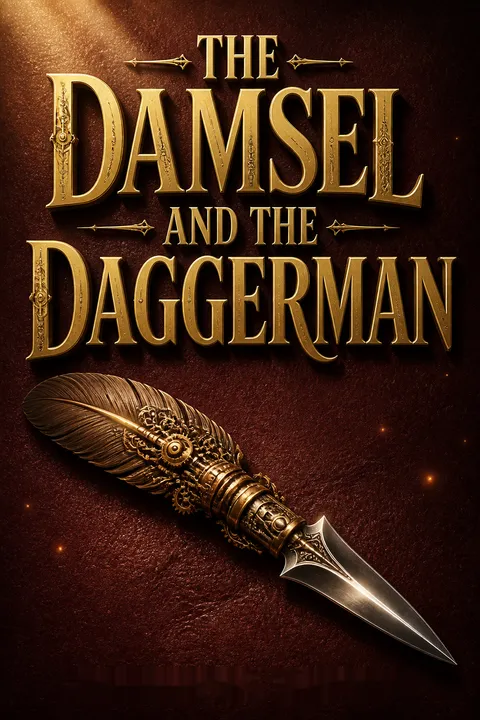
The Damsel and the Daggerman is a novella in Delilah S. Dawson's Blud series, set in Criminy's Clockwork Caravan. Readers praise the steamy romance between journalist Jacinda and mysterious knife-thrower Marco, as well as the intriguing world-building and plot twists. Many reviewers find it a satisfying addition to the series, enjoying the return to the carnival setting and the glimpses of familiar characters. While some felt the ending was rushed, most recommend it for fans of paranormal romance and steampunk, noting Dawson's skill in creating vivid characters and atmospheric storytelling.
Characters
Jacinda Harville
Relentless caravan journalistA widowed adventurer and journalist, Jacinda arrives at Criminy's caravan intent on writing about the people hidden behind its spectacle. She is observant, socially agile, and hard to intimidate, with practical skills earned from years of travel. Her work is both craft and survival strategy: gathering stories gives shape to a life altered by loss. Jacinda can be bold to the point of intrusion, especially when attraction and curiosity reinforce each other, but she is capable of recognizing when persistence has crossed a boundary. Her relationship with Marco tests her confidence in persuasion, while her conversations with Demi show her capacity to make room for someone else's ambitions. She values the truth, but learns that trust cannot be forced from a subject.
Marco Taresque
Guarded knife virtuosoMarco is the caravan's new knife thrower, a magnetic performer whose precision and reserve make him an object of rumor. Accused in the press of involvement in his assistant's disappearance, he refuses to explain himself or seek public vindication. His pride, self-control, and reluctance to disclose his past make him difficult to know, though his care for the people around him repeatedly surfaces beneath his guarded manner. Marco manages danger as carefully as he manages his knives, setting rules and deciding how close others may come. Jacinda unsettles that system because she meets his evasions with curiosity rather than fear. His attraction to her exposes the vulnerability he works hardest to conceal.
Criminy Stain
Wolfish caravan ringmasterCriminy runs the Clockwork Caravan and protects its performers with an intimidating mixture of animal instinct, theatrical menace, and genuine loyalty. He distrusts journalists because careless exposure could endanger people who rely on the caravan for refuge. His bargain with Jacinda is strict but not arbitrary: performers must choose whether to speak, and his wife must approve her entry. Beneath the threats, Criminy has a wry sense of humor and a strong investment in the people he shelters.
Letitia Stain
Fortune-telling gatekeeperKnown affectionately as Tish, Letitia is Criminy's wife and a fortune-teller whose glances help determine who may enter the caravan's private circle. She receives Jacinda with warmth, senses her grief, and gives her cautious permission to proceed. Tish's gentle manner contrasts with Criminy's threats, but her concern is not naïve. She acts as a moral and intuitive guard for the community, offering reassurance while reminding Jacinda to be careful.
Demi Ward
Restless contortionistDemi is a contortionist in the caravan and Cherie's closest friend. Rescued after a bludbunny attack and taken in by Criminy, she has spent years building a life in the show. She is confident enough to want fame and a wider world, yet her routine leaves her feeling trapped and unsure how to begin. Her infatuation with Marco reflects the pull of danger and novelty, but Jacinda helps her consider other possibilities without dismissing her ambition. Demi's humor and appetite for attention coexist with a genuine longing for independence.
Cherie
Demi's loyal partnerCherie is Demi's contortion partner and closest friend, a gentle performer who values the security and companionship of caravan life. She is quick to caution Demi about Marco and attentive to her friend's moods, but she is also willing to share her own history when Jacinda asks with care. Her quieter temperament balances Demi's restless energy. Cherie's loyalty is practical and affectionate, grounded in years of performing and living alongside Demi.
Petra Incanta
Marco's absent assistantPetra is Marco's former knife-throwing assistant, whose unexplained disappearance fuels the newspaper accusation against him. She grew up in a neighboring caravan and learned the craft of throwing knives alongside him. The public knows little beyond her name and the bloodstained wagon, making her absence a central question in Jacinda's investigation. Petra's history with Marco is intimate and complicated, bound to shared training, long familiarity, and expectations that were never mutual.
Imogen
Quiet butterfly performerImogen runs the caravan's butterfly circus, a delicate act built with the help of the artificer Mr. Murdoch. A reserved Londoner, she is more comfortable with books and machines than with strangers, but she responds warmly to Jacinda's respectful curiosity. Her careful manner reflects the caravan's broader need to decide what can safely be shared with outsiders.
Mr. Murdoch
Reclusive clockwork inventorThe caravan's artificer, Mr. Murdoch designs its clockwork guards and performance machinery. He is shy, guarded, and protective of his inventions, treating Jacinda's curiosity with dry suspicion. His mechanical defenses help maintain a boundary between the public show and the performers' private lives. He is also closely connected to Imogen's butterfly act.
Torno
Tender-hearted strongmanTorno is the caravan's strongman, whose imposing physique conceals a tender nature. In Jacinda's interview, he recounts a life of travel and hardship, including the loss of a sweetheart. His willingness to tell the story makes him an early example of the trust Jacinda hopes to earn from the performers.
Liam
Jacinda's late husbandLiam was Jacinda's husband and traveling partner, a scholar who shared her appetite for exploration and reporting. His death remains a deep source of grief, but also shapes Jacinda's insistence on learning to defend herself. She remembers their partnership as intellectually and emotionally intimate, not merely as a loss she must outgrow.
Nonna Taresque
Palm-reading grandmotherMarco's grandmother is a fortune-teller who reads palms and offers warnings that shape his view of love and commitment. Jacinda encounters her briefly before reaching the caravan, where Nonna points her toward Criminy's community and cautions her to take care.
Luc
Daimon performerLuc is one of the caravan's young daimon performers. Jacinda notices his interest in Demi and gently encourages her to consider him, offering a possible connection beyond her fixation on Marco.
Plot Devices
Marco's spinning target
Turns danger into bargainingMarco's rotating target is both a performance machine and a private arena for negotiating with Jacinda. A participant is strapped into place while he throws knives around the body, and a wager can earn a question in exchange for accepting the risk. The device makes their conflict physical: Jacinda seeks information, while Marco controls the timing and terms of each answer. The target also connects Marco's skill to Petra's past as his assistant, and its repeated use turns a polished act into a test of trust, power, and vulnerability.
The wanted notice
Makes rumor look officialA sensational newspaper notice links the Deadly Daggerman to the disappearance of his assistant, Petra Incanta, and advertises a reward for his capture. It offers a dramatic image and a blood-soaked story but little verifiable reporting. Jacinda's examination of the notice gives her a concrete reason to investigate Marco while also showing how public opinion can be manufactured from missing facts. The notice's omissions matter as much as its claims: it tells readers what to fear without explaining who was hurt or what actually happened.
Nonna's prophecy
Makes intimacy feel bindingMarco's grandmother warns him that the woman who takes his virginity will be bound to him for life. He grows up treating the prediction as a curse and avoids sexual commitment, including with Petra, whom he regards as family. The prophecy gives emotional and practical force to his guardedness, but it does not remove his responsibility for keeping his reasons secret. Its meaning becomes clear only after Jacinda and Marco have already crossed the boundary he feared. It frames their future as a choice shaped by belief, not simply as a supernatural certainty.
Jacinda's dart bracelet
Hides a weapon in plain sightJacinda wears a bracelet built around a small reed dart tube, a weapon she learned to use during her travels. Its unassuming appearance lets her carry it without drawing attention, while the dart's poison can incapacitate an attacker. The bracelet is an extension of her self-reliance: she does not depend on Brutus, her clockwork dog, to protect her in every crisis. At the cottage, she uses it when Petra turns to throw a knife, allowing Jacinda to stop the attack and free Marco.
Blud Series
Download PDF
Download EPUB
.epub digital book format is ideal for reading ebooks on phones, tablets, and e-readers.








