

Plot Summary
Prologue
In December 1859, Prince Albert adds Charles Darwin to Queen Victoria’s New Year honors list, despite the uproar over On the Origin of Species. The prime minister’s aide notices the name and carries the list toward Downing Street.
That evening, a courier rides toward Oxford with a sealed message for Bishop Wilberforce. The novel opens on a fact its invented history will strain to explain: Darwin never receives the knighthood. Between Albert’s decision and that omission, a secret campaign will turn scientific disagreement into murder.
The opening gives the mystery its destination before revealing its route. Darwin’s missing knighthood is presented not as a historical footnote but as evidence that powerful people can alter public memory by acting outside its record. Albert’s quiet insertion of the name makes the honor a personal choice, while the courier’s journey suggests that the choice has already provoked a response. The prologue therefore turns scientific recognition into a political stake: the book asks not only who tried to stop Darwin, but what kind of power feared his ideas enough to erase the consequences.
The Queen's False Shot
On a sweltering June day, Chief Detective Inspector Charles Field spots pickpocket Stevie Patchen beside Queen Victoria’s carriage. Field tackles him, but the gunman fires twice at the Queen while the police are distracted. The Queen survives; Patchen does not. Someone has cut his throat and taken his left ear, leaving Field bloodied beside the body and under suspicion.
His joke about a butcher’s delivery helps him identify a stolen apron and barrow as part of the disguise. At Smithfield Market, apprentice Tom Ginty glimpses a tall, smooth-moving man with coal-dark eyes. When the stranger catches Tom looking, he signals the boy to stay silent. Field has a corpse, a decoy, and a witness who does not yet know how much danger he is in.
The opening attack teaches Field to distrust the easiest explanation. The gunman appears to be the whole story, but Patchen’s staged role and mutilated corpse reveal a second operation concealed inside the public spectacle. The clue is practical, not mystical: a butcher’s missing delivery links the street murder to the market. Tom’s encounter supplies the human cost before he understands the conspiracy; his silence is not complicity but the instinct of a vulnerable boy who has recognized danger without any power to name it. Violence here works by diverting attention as much as by injuring bodies.
A Conspiracy Takes Shape
At Buckingham Palace, Commissioner Mayne doubts Field’s claim that the shooting involved a conspiracy. Prince Albert listens, then grants the detective room to investigate. In Newgate Prison, would-be assassin Philip Rendell insists an angel supplied his pistol, offering no useful explanation.
Field’s inquiries at Smithfield reveal that a stranger bought butcher Dennis Merrydew drinks, then took his apron and barrow. The man’s gliding walk, surgical knives, and resemblance to a gentleman point toward a medical professional.
Field also meets Karl Marx, who rejects the idea that revolutionaries attacked the Queen but argues that Darwin’s theory threatens the social order. At the Royal College of Surgeons, Sir Richard Owen and Sir Jasper Arpington-Dix confront Decimus Cobb, the surgeon behind the killings, and order him to redirect his plan toward the royal family’s autumn journey.
Field’s method joins apparently incompatible worlds: palace protocol, market gossip, prison delusion, and radical politics. Marx does not solve the crime, but his account of Darwin’s leveling implications gives Field a motive that a lone madman cannot explain. The secret meeting at the College reveals an uneasy alliance between intellectual authority and inherited power. Owen and Arpington-Dix regard Cobb as an instrument, yet his menace is already evident in their fear of him. The section’s central distinction is between the elites’ calculated conspiracy and the surgeon’s own, more intimate fixation.
The Boy in the Coffin
Cobb abducts Tom on the way to Smithfield and confines him in a coffin in his shuttered house at Half Moon Street. The household calls the surgeon Master and includes the quick-fingered Belinda, the pox-scarred John Getalong, and the elderly Hamlets. After three days, Cobb releases Tom, feeds him, and alternates kindness with threats against the boy’s mother, Martha.
He presents obedience as a chance to help stop a powerful enemy. Tom is soon taken to Newgate, where Cobb makes him assist in killing Rendell and removing the prisoner’s ear. When Tom balks, Cobb reminds him that Martha is within reach. The boy follows, sickened and frightened, while Cobb prepares him for a larger assignment.
Cobb’s control depends on making care and cruelty indistinguishable. Food, clean clothes, and a bed follow the coffin, so Tom is pressured to experience captivity as rescue and obedience as gratitude. The household’s theatrical names and roles make domination feel like a private institution with its own rules. Tom’s forced participation in Rendell’s murder is the point at which fear becomes moral injury: he is no longer merely a witness to violence but has been made to help conceal it. His attachment to his mother remains the lever Cobb uses to keep him compliant.
The Warning That Failed
Oxford scholar David Gates hears retired Captain Robert FitzRoy threaten Charles Darwin, then overhears Bishop Wilberforce, Owen, and Arpington-Dix discussing plans involving the royal danger. Though unsure whether his tutor is implicated, David travels to Down House to warn Darwin.
Darwin is away at Richmond Spa, so David speaks with Emma Darwin, who recalls his childhood friendship with their daughter Annie and admits her fear for her husband’s soul.
On the return coach, Cobb rides with Tom and bludgeons David with the brass-headed walking stick he has stolen from an elderly passenger. He stages the killing as highway robbery and forces Tom to search David’s pockets. In Oxford, David’s lover, Jack Callow, identifies the body and learns that David had tried to protect Darwin.
David’s courage is deliberately modest: he acts without certainty because the possible cost of silence seems greater than the risk to his scholarship. His visit to Emma binds the public danger to private grief, since the memory of Annie links him to the Darwin household and its history of loss. Cobb turns that ethical impulse into a trap, making Tom participate in the murder and converting the return journey into a false robbery. David’s death shows how easily a truth-seeker can be dismissed when violence is dressed as ordinary crime.
The Debate Turns Deadly
At the British Association meeting in Oxford, Bishop Wilberforce attacks Darwin’s theory before a packed audience, while Captain FitzRoy interrupts with furious appeals to scripture. Thomas Huxley counters the bishop’s claims about differences between human and ape brains, exposing errors borrowed from Owen.
Field and Constable Josiah Kilvert search the crowd for FitzRoy and spot Tom, now disguised as a choirboy beside Cobb. Field tries to persuade Tom to leave with him, but the boy runs back to Cobb during the disorder.
Kilvert recognizes the walking stick used to kill David; Cobb has touched Huxley and unsettled him with a threat about his children. Before Field can act, Cobb stabs Kilvert. The constable dies as Field is struck down by Oxford police, and Cobb escapes with Tom.
The public debate stages the novel’s central conflict as a contest over evidence, but the violence around it exposes the limits of reasoned exchange. Huxley identifies a specific anatomical error; Wilberforce’s rhetorical authority cannot make it true. Yet Cobb exploits the packed room’s confusion, turning the audience’s attention into cover for murder. Tom’s retreat to his captor is painful because Field offers safety in words while Cobb has trained the boy to expect punishment for trusting anyone. Kilvert’s death makes that mistrust costly for the people trying to rescue him.
Field Loses His Badge
Field blames himself for Kilvert’s death and clashes with Commissioner Mayne, who orders him to abandon the conspiracy inquiry. Field rejects the order, then is publicly rebuked by Charles Dickens for being mistaken for the fictional Inspector Bucket.
Humiliated and unemployed, he accepts work guarding the Fortune of War, only to discover that landlord Mickie Goodfellow runs a profitable body-snatching operation for nearby medical schools. Meanwhile, Llewellyn follows a recovered telegraph pouch and learns that one delivery went to Decimus Cobb’s address.
He and Oxford Sergeant Willette find Cobb’s abandoned guest house, a hidden corpse, and signs that Tom had been there. Field, meanwhile, understands that Darwin’s theory threatens the social hierarchy his enemies are trying to preserve, and that Albert’s support makes the Prince a target.
Field’s crisis is not simply professional. Dickens’s fictional Bucket has become a public version of him that Field cannot control, while Marx’s criticism forces him to examine how badly he needs approval from men above him. His work for Goodfellow places him on the criminal side of the line he once enforced, but it also exposes the city’s accepted traffic in the dead. Llewellyn’s methodical investigation continues without institutional backing. Their parallel failures and persistence make the police force itself part of the story’s question: what does justice mean when authority protects reputation instead of truth?
The Prince's Dangerous Journey
Prince Albert summons Field and Llewellyn after learning that a royal groom has heard warnings of an attack. Field urges cancellation of the trip to Germany, but Albert refuses to abandon a long-planned family visit. He instead brings Field, Llewellyn, and groom Peter Sims along, officially to protect Victoria.
Before departure, Jane Field takes in Martha Ginty and the woman calling herself Miss Coffin, not knowing that Coffin is connected to Cobb. Aboard the royal yacht, Field challenges the French travel planner’s widely shared itinerary, fearing that its many transfers give an assassin predictable opportunities.
Albert accepts his precautions but insists the tour proceed. The Queen remains wary of the detectives’ presence, while Field sees that the journey’s elaborate schedule leaves the royal couple exposed at every change of ship, carriage, and train.
Albert’s decision is a compromise between prudence and the symbolic demands of sovereignty. Canceling the journey would protect him physically but concede that an unseen enemy can govern royal movement. Field understands that the itinerary’s public complexity is also a vulnerability: every servant, station, and transfer widens the circle of people who know where the monarchs will be. At home, Jane’s hospitality creates a second front without her knowledge. The contrast is sharp: the palace manages danger through protocol, while the Field household admits it through compassion.
A Boy Joins the Stable
In Belgium and Germany, Field’s protective cordon is tested by crowds, delays, and officials who resent his interference. German Police Union officers seize Llewellyn and Sims for questioning, then tell Field that a young woman was found murdered near Sint-Niklaas with her left ear removed.
The clue points toward Cobb, who has been traveling with Tom and murdering beyond the original conspiracy. Tom, meanwhile, is disguised as a stableboy and placed among the royal horses; Peter Sims trusts him and lets him tend a chestnut mare he names Lily.
Cobb has studied German routes and now watches the royal party from across Antwerp harbor. When a separate armed man attacks near the train crossing, German police kill him, and Albert believes the danger has passed. Field does not.
The journey gives Tom skills and relationships outside Cobb’s immediate control. His care for Lily is a small but consequential form of attachment, grounded in memory of his own family rather than fear of his master. The German police offer Field useful intelligence, yet their unauthorized seizure of Llewellyn shows how easily security becomes coercion. The dead attacker creates a false ending: the court accepts a visible corpse as proof that the threat is gone. Field’s refusal to share that certainty preserves the distinction between solving an incident and understanding the whole pattern.
The Carriage on Fire
At Rosenau, Cobb tricks Albert into traveling alone in a small carriage, with Tom driving and Lily harnessed beside another horse. He tells the Prince he means to kill him for supporting Darwin and threatens him with surgical instruments and a garrote.
Field reaches the carriage and forces his way inside, but Cobb wounds him and nearly strangles Albert. Tom has already loosened Lily’s harness to make an escape; instead, he returns to the carriage, distracts Cobb, and helps Field pull the Prince free.
Cobb bites away part of Tom’s ear, then falls onto a scalpel during the struggle. The carriage crashes on the railway crossing and is destroyed by a train. The royal party conceals the assassination attempt, and Cobb is presumed dead, though Field cannot confirm the body is his.
Tom’s decisive act is not a sudden transformation into a fearless rescuer. He initially plans to free himself and Lily, then chooses to return when he sees Albert’s danger. That choice gives his resistance a credible cost and makes it distinct from obedience. Field’s intervention alone cannot defeat Cobb; the rescue depends on the boy’s knowledge of the harness and his willingness to reenter the carriage. The court’s cover story protects political stability, but it also leaves the central uncertainty unresolved. A public fiction saves the monarchy’s reputation while preserving the killer’s chance to survive.
The Mother at Bow Street
While the royal party remains in Germany, Cobb’s mother, posing as Miss Coffin, arrives at Bow Street and promises Martha that Tom is prospering abroad. Jane recognizes her as the dangerous Mrs. Andrews and invites her inside to learn what she wants.
Bessie finds a telegram hidden in Andrews’s boot, revealing that she has been preparing a trap. When Andrews threatens Jane and Martha with harm to their children, Martha cuts her throat with the carving knife. The women hide the immediate evidence and pass the body through Llewellyn to Goodfellow’s network.
Meanwhile, Cobb survives the carriage wreck, reaches Hamburg badly disfigured, and kills a woman who recognizes his injuries. He continues sending severed ears to Darwin, turning the naturalist into his next target.
The domestic subplot reverses the expected roles of helplessness and protection. Jane’s hospitality is not naïveté alone; it is an attempt to gather information, while Bessie’s loyalty gives the household a chance to see through the disguise. Martha’s violence is an act of defense under immediate threat, but it also binds the women to a secret that could destroy them. Cobb’s survival makes the earlier carriage crash a false resolution. His messages to Darwin transform mutilation into argument, as if he can refute a theory by making living bodies into evidence.
The Ears From Ostend
Back in England, Field and Llewellyn learn that Cobb has sent Darwin two preserved ears from women, each marked by the anatomical feature Darwin studies. The notes challenge the naturalist’s work and threaten him personally.
Field visits Down House, where Darwin confirms the parcels and explains why the feature supports, rather than disproves, his inquiry into human origins. Field recognizes Cobb’s handwriting and realizes the supposed death at Coburg did not end the danger. At the same time, Cobb’s mother has vanished from Bow Street, and Jane reports that a veiled woman questioned the household.
Belinda disappears, leaving a note in Cobb’s hand demanding to know what happened to his mother. Field understands that Cobb has returned to punish the people who escaped him and races toward Half Moon Street.
The severed ears collapse the distance between scientific specimen and human victim. Darwin’s work depends on comparing bodily forms, but Cobb turns comparison into a grotesque performance of domination. Darwin responds by interpreting the evidence carefully, refusing to let its violence dictate its meaning. Field’s return to the case is driven by personal danger as well as professional duty: Jane and Belinda are now within reach of the killer. The old uncertainty about Cobb’s survival becomes immediate fact through the note, which makes the antagonist’s private grief as dangerous as his public ideology.
The Half Moon Street Fire
Field smashes into the boarded house on Half Moon Street and finds Cobb’s mother, Tom, and Belinda inside. Cobb appears in a veil and women’s clothing, using Belinda as a shield while demanding an account of his mother. Field distracts him long enough to pull Belinda away, then fights Cobb on the stairs. Llewellyn arrives and accidentally ignites the gas line with a lantern, sending fire racing through the house.
Field breaks into Cobb’s locked room, where Tom lies trapped in a coffin, and pries the lid open. He carries the boy down through the flames as Cobb catches fire and falls with the collapsing staircase. The house burns, and Cobb’s body is later recovered among its ruins. Tom and Belinda survive, while Field is badly injured.
The final rescue reverses the coffin scene that began Tom’s captivity: this time Field opens the box, and Tom is brought back into a world where other people can protect him. Fire destroys Cobb’s carefully curated private domain, including the rooms where he turned bodies into possessions. Yet the rescue is collective rather than heroic in isolation. Belinda escapes through Field’s quick choice, Llewellyn’s arrival changes the balance, and Tom’s survival depends on another person refusing to leave him behind. The fire ends Cobb’s immediate power, but it cannot erase what he has taught his captives to fear.
A Household Reassembled
After the fire, Field reaches Windsor and finds Mary Withers working among the royal household, close to the gravely ill Prince Albert. He accuses her of harming Albert, but the novel provides no proof that she poisoned him; the Prince’s health was already failing, and the cause of his death remains uncertain. Albert dies, and Field is kept away from the royal family.
Back in London, Tom struggles to return to butchery, so Field helps him find work at a flower stall and pays rent for Martha. Belinda joins the Field household and learns to read. At Christmas, Tom, Martha, Belinda, Jane, Field, Llewellyn, and their friends gather for supper. Tom smiles again, and the people Cobb tried to isolate share a home.
The ending refuses to turn suspicion into certainty. Field’s accusation against Mary Withers reflects both genuine danger and the detective’s exhaustion after years of incomplete evidence; the book does not establish that she caused Albert’s death. That ambiguity contrasts with the concrete acts of care that follow. Field finds work for Tom, Jane teaches Belinda, and the household makes room for Martha. These are modest repairs rather than a return to innocence. The Christmas gathering matters because it gives the survivors a shared structure of daily life after Cobb’s regime had made every relationship conditional.
Epilogue
The afterword returns to the historical record that framed the opening. Darwin is never knighted. Victoria survives other assassination attempts but spends the rest of her life mourning Albert. Owen’s reputation eventually suffers from plagiarism, while FitzRoy dies by suicide and Wilberforce dies after a fall from his horse.
The book also follows Button, the mudlark who found the telegraph pouch: he later discovers a chest of coins and rises in the world, though he remains outside respectable society. His story offers a final reminder that the people history remembers are not always the people who shaped it.
The afterword separates the novel’s invented conspiracy from the historical lives it borrows, but it does not restore a clean boundary between them. Darwin’s missing knighthood remains the opening’s unresolved fact, while the fates of Owen, FitzRoy, and Wilberforce place personal ambition and public memory beside one another. Button’s rise is deliberately smaller than the royal and scientific plots, yet it gives the social margins their own afterlife. The closing emphasis is not that history is secretly controlled by one hidden hand, but that official records preserve only some consequences and leave other lives to rumor, fiction, or chance.
Analysis
The novel makes Darwin’s theory a matter of political power by showing who fears the social consequences of shared ancestry. Sir Jasper worries that a common origin will weaken inherited rank; Owen resents a rival whose work threatens his authority; Wilberforce fears an intellectual challenge to religious certainty. Their differences matter. The conspiracy is not a single coherent ideology so much as a coalition of interests, held together by the desire to control what the public may consider true.
Cobb turns that abstract conflict into bodily violence. As a surgeon, he handles the body as evidence, but he also treats it as property. His mutilations expose the contradiction in his thinking: he claims to defend fixed categories while obsessively collecting the anomalies that trouble them. Tom becomes the human cost of that contradiction. Cobb teaches him skills and supplies him with food, then demands obedience as payment. Tom’s eventual resistance begins not with an argument about evolution but with an emotional choice to help another person despite his fear.
Field’s parallel struggle concerns status and selfhood. Dickens’s fictional detective gives him recognition, but also a borrowed identity he cannot fully inhabit. Marx’s challenge makes Field see how much he has sought approval from those above him, while the investigation asks him to act without assurance that institutions will reward him. Llewellyn’s steadier work and Jane’s practical courage provide alternatives to individual heroics. Their persistence matters when official authority turns away.
The ending preserves uncertainty where the evidence does. Cobb’s crimes are exposed, but the suspicion that Mary Withers harmed Albert is never confirmed. This restraint prevents the story from making every misfortune part of one master plot. Its more durable resolution is social and intimate: Tom and Belinda find shelter, Martha finds support, and Field returns to a household built on care rather than control. The book’s deepest counterargument to Cobb is not a theory alone. It is the possibility of relationship without ownership.
Review Summary
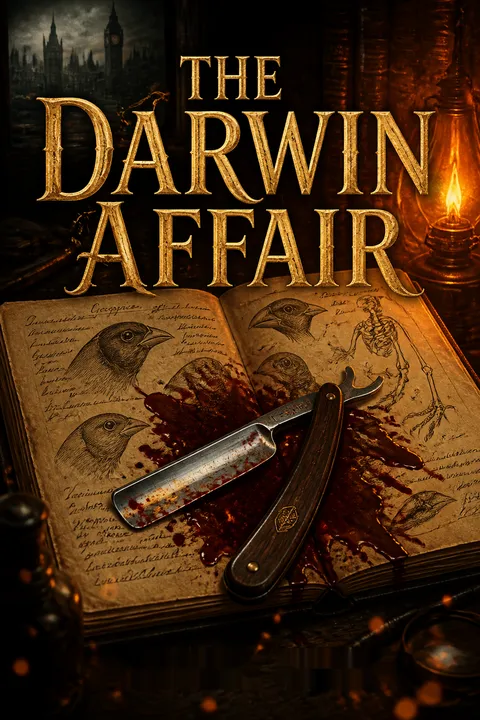
The Darwin Affair is a historical thriller set in Victorian London, featuring Detective Charles Field investigating assassination attempts on Queen Victoria. The plot intertwines Darwin's controversial theory of evolution with a conspiracy involving high-ranking officials. Reviews praise the atmospheric setting, intricate plot, and compelling characters, particularly the villainous Chorister. Some critics found the numerous historical figures and plot twists overwhelming. While many readers enjoyed the fast-paced narrative and historical details, others felt the violence was excessive and the story occasionally far-fetched.
People Also Read
Characters
Charles Field
The theatrical detectiveChief Detective Inspector Charles Field is an observant, imposing London policeman whose knack for disguise and performance helped make him the model for Dickens’s fictional Inspector Bucket. He grew up under a brutal father and once dreamed of acting, so public recognition carries unusual emotional weight for him. Field reads people through habits and inconsistencies, but his temper and pride can undermine the patience his work requires. He is loyal to his wife, Jane, and to his colleague Llewellyn, and he has a particular tenderness toward children in danger. His struggle is to separate the self he has built for others from the man who must keep acting when admiration and certainty disappear.
Decimus Cobb
The surgeon turned predatorDecimus Cobb is a gifted anatomist and surgeon whose calm manners conceal an appetite for control. He treats bodies as puzzles to be opened and classified, and people as instruments he can train, threaten, or discard. His expertise earns him access to hospitals and elite institutions, while his cultivated gentility allows him to move through them unnoticed. Cobb’s beliefs about fixed forms and human difference make Darwin’s theory feel personally threatening, not merely intellectually incorrect. He gathers dependents around himself and calls them children, confusing provision with ownership. His quietness is not restraint: it is the polished surface of a mind that has made cruelty part of its method.
Tom Ginty
The stolen apprenticeTom Ginty is a fourteen-year-old butcher’s apprentice, raised by his widowed mother, Martha, in the crowded world around Smithfield Market. Strong, observant, and accustomed to work, he notices the strange man before adults grasp the danger. Tom’s practical intelligence develops through close attention to tools, animals, routes, and people, but captivity teaches him to hide what he knows. He is fiercely attached to his mother and deeply responsive to small gestures of kindness, especially from Belinda and Mary Withers. His relationship with violence is complicated by the skills Cobb forces him to learn. Beneath his guardedness, Tom retains the capacity to choose whom he will help.
Sam Llewellyn
Field's steadfast partnerSam Llewellyn is a young Welsh constable who serves under Field and remains committed to the case even when the Metropolitan turns against his chief. His decency is practical: he follows records, questions witnesses, and keeps working when the more celebrated detective falters. Llewellyn’s loyalty is not blind. He challenges Field when the inspector’s pride or drinking puts others at risk, yet continues to protect him and honor their shared work. His friendship with Field gives the investigation a second center of judgment, grounded in patience rather than performance.
Jane Field
The detective's clear-eyed wifeJane Field is a former Crimean nurse whose independence and practical intelligence complement her husband’s theatrical instincts. She recognizes distress quickly, offers shelter to Martha Ginty, and tries to make sense of danger within the domestic world Field often leaves behind. Her compassion can bring risk into her home, but it is not passivity: she observes, follows clues, and acts when the household is threatened. Jane also sees how much Field’s identity depends on his work and public standing. Her care is affectionate without being deferential, and she is willing to confront the man she loves when he mistakes shame for failure.
Prince Albert
The reform-minded consortPrince Albert is Victoria’s German-born husband, a disciplined adviser who takes the duties of monarchy seriously and has a strong interest in science and public progress. He admires Darwin’s work and is willing to use royal influence to recognize it, despite the opposition that such support provokes. His seriousness can make him seem remote, but his private devotion to Victoria and his children is unmistakable. Albert believes public office carries responsibilities beyond ceremony, and he is wary of the political consequences of ignorance and prejudice. His commitment to principle is tested by the tension between protecting his family and refusing to let fear dictate the Crown’s actions.
Queen Victoria
The watchful monarchQueen Victoria is forceful, observant, and accustomed to living under the threat of assassination. She is devoted to Albert and protective of her children, while maintaining a sharp sense of how the court should function. Her dislike of overheated rooms and formal excesses gives her a domestic presence amid the pageantry. Victoria does not share Albert’s sustained fascination with Darwin’s science, but she understands the weight of royal decisions and expects her household to respect her authority. Her resilience is real, though it does not make her immune to grief or danger.
Charles Darwin
The embattled naturalistCharles Darwin is a private, chronically ill naturalist whose book has made him the focus of public argument and personal threats. He is careful with evidence and reluctant to enter public controversy, preferring the work of observation to the performance of debate. The memory of his daughter Annie continues to shape his grief and his response to other families. Darwin’s relationship with Emma includes a painful difference in religious belief, though their mutual affection remains strong. He sees nature as capable of both astonishing variation and severe cruelty, a tension that informs his scientific patience and his compassion.
Sir Richard Owen
The envious anatomistSir Richard Owen is a prominent anatomist and natural historian whose scientific authority gives him influence at court and within the Royal College of Surgeons. He is ambitious, competitive, and keenly protective of his standing. Owen’s opposition to Darwin is not only a matter of interpretation; professional rivalry and his desire to control the terms of scientific debate shape his conduct. He can recognize genuine scholarship while still resenting the attention given to a rival. His alliance with powerful men places him between scientific inquiry and the social interests that wish to direct it.
Sir Jasper Arpington-Dix
The guardian of hierarchySir Jasper Arpington-Dix is an aging aristocrat tied to the East India Company and determined to preserve the political and commercial order that sustains his class. He sees liberalism, revolution, and Darwin’s theory as connected threats to established authority. Unlike Owen, he is less invested in the technical details of anatomy than in the public consequences of ideas. His manner is blunt and his confidence rests on wealth, connections, and the assumption that others can be hired to solve problems. He treats violence as a tool best kept deniable.
Samuel Wilberforce
The bishop in debateSamuel Wilberforce, Bishop of Oxford, is an accomplished public speaker and a leading Anglican figure. Known for his quick wit and political skill, he can communicate complex positions with ease, but his confidence sometimes outruns his command of scientific evidence. He opposes Darwin’s theory on religious and institutional grounds and is sensitive to the threat it poses to familiar accounts of humanity. Wilberforce is not simply a caricature of dogma: he cares about faith, public reputation, and his relationships with the royal family. His instincts are shaped by a church trying to defend its authority in a rapidly changing intellectual world.
David Gates
The conscientious scholarDavid Gates is a scholarship student at Oxford, a divinity scholar, and the son of a village haberdasher. He is thoughtful and earnest, more inclined to act from conscience than from certainty. His childhood friendship with the Darwin family, especially Annie, gives his concern for Charles Darwin a personal history. David is also Jack Callow’s lover, though he guards that relationship from the scrutiny of college life. His social position makes the risks of speaking up tangible: he has much to lose, but his belief that people can face difficult truths gives him the courage to move.
Jack Callow
David's Oxford belovedJack Callow is David Gates’s fellow student and lover, a handsome, athletic undergraduate from a comfortable country family. He is confident in sport and study, but David’s moral seriousness gives their relationship a depth Jack did not expect. Jack is protective, though he sometimes mistakes caution for wisdom and worries that David’s actions are reckless. His grief reveals how much of his own sense of purpose had become bound to David. He is a bridge between the intimacy of the Oxford story and its public consequences.
Mary Withers
The solitary historianMary Withers is a literate former servant who has repeatedly lost places in households where illness and death followed. Others mistake her for a source of misfortune, while she sees herself as hardworking, observant, and deserving of ordinary companionship. In the attic where she is confined, she writes an immense history of the world, trying to impose sequence on a life repeatedly disrupted. She is gentle with Tom and knows how captivity distorts trust. Her faith, loneliness, and desire to serve a kind family coexist with a fierce commitment to the story she is making.
Belinda
The quick-fingered street girlBelinda, whom Cobb calls Blinky, is a young girl who survives through speed, observation, and petty theft. She lives in Cobb’s household as both dependent and errand runner, learning to read danger in the moods of the adults around her. Belinda longs for affection and makes an impulsive, childlike gesture of attachment toward Tom. Her loyalty is real, but she has been trained to expect that promises can be withdrawn without warning. Beneath her nervousness, she is resourceful and brave, with a strong wish to be known by her own name.
Martha Ginty
Tom's fiercely protective motherMartha Ginty works in the Fortune of War’s scullery and raises Tom alone after losing her husband and daughter to illness. Her love for Tom is fierce and consuming, shaped by the knowledge that poverty leaves little room to protect a child from danger. When he disappears, grief unsettles her sense of time and place, but her persistence keeps his absence visible to the people around her. Martha is practical, proud, and unwilling to accept that a working-class boy’s safety matters less than a royal concern.
Robert FitzRoy
The troubled Beagle captainRobert FitzRoy is the former captain of the Beagle and Darwin’s one-time friend. He feels that Darwin’s success has eclipsed his own contributions and resents being remembered mainly as the man who helped launch another’s work. His religious conviction is tangled with wounded pride, loneliness, and a history of professional disappointment. FitzRoy’s attachment to the past is genuine, but his bitterness distorts it into grievance. He remains an emotionally unstable presence whose memories carry both tenderness and danger.
Mickie Goodfellow
The pub's accommodating landlordMickie Goodfellow owns the Fortune of War and knows how to turn a busy public house into a profitable enterprise. He is genial, shrewd, and skilled at making dubious arrangements seem like ordinary business. His familiarity with Field reaches back to the detective’s family history, which lets him offer help while also exploiting vulnerability. Goodfellow’s pragmatism rarely extends to moral scruples.
Mrs. Andrews
Cobb's hidden accompliceThe woman known as Mrs. Andrews appears in Oxford as the proprietress of a nearly empty guest house and in London under the name Miss Coffin. She is severe, manipulative, and skilled at moving through other people’s grief without drawing immediate suspicion. Her connection to Cobb gives her a personal stake in his plans, while her use of false identities makes trust difficult for everyone around her. She sees loyalty to her son as a justification for nearly any action.
Thomas Huxley
Darwin's public defenderThomas Huxley is a direct, forceful naturalist who comes to defend Darwin’s work in public debate. He values evidence and is impatient with claims that sound authoritative but collapse under examination. His loyalty to Darwin combines intellectual conviction with personal friendship. Huxley’s confidence can make him combative, especially when he believes a rival is using status to evade scrutiny.
Plot Devices
The Honors List
Royal recognition as motiveAlbert’s attempt to place Darwin on the New Year honors list gives the conspiracy a concrete political trigger. The recognition would publicly associate the Crown with Darwin’s theory, making it harder for its opponents to dismiss the work as an eccentric scholar’s speculation. The list links the novel’s opening to its final historical irony: Darwin never receives the knighthood. It also clarifies why Albert, rather than Darwin alone, becomes a target.
The Missing Ears
A killer's bodily signatureThe removal of a victim’s left ear marks Cobb’s killings and gives Field a recurring clue that can cross social settings and national borders. The mutilation also reflects Cobb’s fixation on anatomy and his effort to turn human bodies into objects of study. When ears arrive as parcels for Darwin, the signature becomes both threat and argument: Cobb tries to use physical remains to intimidate the scientist whose work he rejects.
The Telegraph Pouch
A paper trail across bordersA missing delivery pouch carries fragments of a route, addresses, and messages that the police can piece together after the courier is found in the Thames. Llewellyn follows those scraps when formal channels fail him, connecting Cobb’s house to a larger network. Telegraph communication also lets the conspirators coordinate rapidly, while its delivery system creates physical evidence that can be intercepted, lost, or discovered by someone as marginal as Button.
The Dickensian Double
Fame complicates identityField’s resemblance to Dickens’s Inspector Bucket gives him public recognition and access to the powerful, but it also makes him feel trapped inside somebody else’s invention. People address him by a name he rejects, and even Dickens challenges his claim to the character’s fame. The device sharpens Field’s struggle to distinguish personal worth from public image. It also lets the novel make fiction itself part of the investigation: the detective must decide whether he is living his own life or performing the role others have assigned him.
The Royal Itinerary
A map of changing dangerThe royal party’s itinerary creates a moving landscape of exposure: docks, transfer points, railway stations, coaches, and family visits. Field studies each transition because a route known to many people can be exploited by an attacker. The schedule also gives Cobb a series of opportunities to approach Albert while disguising his movements among servants and travelers. As the journey advances, the itinerary becomes both a practical security problem and a measure of how little control even a monarch has over the machinery surrounding him.
Download PDF
Download EPUB
.epub digital book format is ideal for reading ebooks on phones, tablets, and e-readers.








