Key Takeaways
1. Plato's Phaedo elevates Socrates' death as a dramatic defense of philosophy.
While all of Plato’s dialogues celebrate the philosophic life as a whole and the life of Socrates in particular, none does so more dramatically or more movingly than the Phaedo.
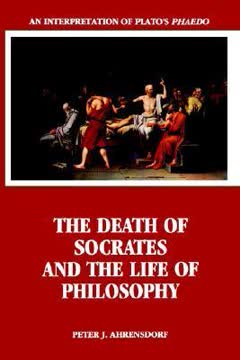
A heroic portrayal. Plato's Phaedo is not merely a historical account of Socrates' final hours but a profound dramatic work designed to transform the public perception of philosophy. Before Plato, philosophers were often ridiculed or viewed with suspicion. Through Socrates' noble and serene confrontation with death, Plato recast the philosopher as a hero, worthy of admiration and respect, securing a place for philosophy among the great ideals of Western civilization.
Beyond mere argument. The dialogue's dramatic setting—Socrates' last day, surrounded by grieving friends—underscores the emotional weight of his arguments. The narrative structure, with Phaedo recounting the events long after, suggests that Socrates' influence transcends his physical death. This storytelling approach ensures that the Phaedo evokes sentiments of pity and fear, making Socrates' actions as compelling as his words, and inviting readers to revere him as a martyr for truth.
A lasting legacy. Cicero and Jacques Maritain, among others, lauded Socrates' death as sublime, a testament to human wisdom. Nietzsche noted that "The dying Socrates became the new ideal," and Voltaire declared it "the apotheosis of philosophy." This dramatic portrayal by Plato ensured that Socrates, and by extension the philosopher, would be continuously ranked among history's most glorious heroes and holy martyrs, comparable to figures like Alexander, Cato, and even Jesus.
2. The impiety charge against Socrates is central, prompting a defense of the philosophic life.
The Phaedo comes to sight as a eulogy for the philosopher Socrates, but it is, in fact, an apology of Socrates.
A reenactment of the trial. The Phaedo is fundamentally a re-enactment of Socrates' trial, but with a crucial difference: here, Plato presents a detailed version of the prosecution's case, specifically the impiety charge, through the mouths of Socrates' devoted companions, Simmias and Cebes. This internal accusation lends greater credibility to the charge, forcing readers to seriously consider whether Socrates was justly condemned.
The philosopher's vulnerability. The persecution of philosophers was a persistent pattern in ancient Greece, particularly in Athens. Anaxagoras, Protagoras, Diagoras, and Aristotle all faced accusations of impiety. This hostility stemmed from the popular belief that philosophers reduced the divine to "unreasoning causes," undermining traditional religion, moral codes, and the legitimacy of the city's laws. Socrates' execution served as a stark reminder of the dangers inherent in the philosophic life.
A challenge to wisdom and justice. Socrates' friends, witnessing his impending execution, question the wisdom and goodness of a life that exposes one to such dangers and accusations. They wonder if it is wise to pursue a path that makes one vulnerable to persecution by men and punishment by the gods. Socrates' decision not to escape prison further fuels their doubts, suggesting he might despair of philosophy itself, thus necessitating his final, comprehensive defense.
3. Socrates' calm acceptance of death stems from a complex, often unstated, hope for the afterlife.
Socrates, this is the last time your friends will speak to you and you to them.
Dismissing earthly attachments. Socrates' seemingly indifferent dismissal of his wife, Xanthippe, and her lament, suggests a detachment from earthly pleasures and pains. He implies that his happiness in facing death means his friends' sorrow is misplaced. This posture, however, raises questions about the depth of his affection for his friends, hinting that his serenity might stem from a belief in a greater good beyond this life.
The nature of pleasure and pain. Socrates' reflection on the strange relationship between pleasure and pain—that one almost always follows the other—suggests a resignation to natural necessity. He implies that fleeting earthly pleasures are not worth clinging to, and that true contentment might lie in transcending this cycle. This philosophical stance underpins his readiness to die, viewing death not as an end to pleasure, but as an escape from the inevitable pain that accompanies it.
A pious hope. Socrates explicitly states his hope to join "gods who are wise as well as good" and "human beings among the departed who are better than those here." This declaration, though tentative, reassures his friends that his readiness to die is not a rejection of divine care but a pursuit of a better, more just community in the afterlife. His piety, therefore, is directed towards a transcendent realm, offering a justification for his detachment from earthly ties and his calm acceptance of death.
4. Socrates' arguments for the soul's immortality are presented, yet subtly undermined.
Yet, as Socrates himself seems to acknowledge in the dialogue and as ancient, modern, and contemporary commentators have observed, the arguments in the Phaedo fail to establish that the individual soul is immortal.
The cyclical argument's limitations. Socrates first proposes the ancient argument that "the living come back into being out of the dead." While Cebes initially agrees, Socrates' formulation subtly shifts from "coming back into being" to simply "coming into being," implying a transformation rather than a continuous individual existence. This suggests that while life may be cyclical, the individual self might not persist, leaving the question of personal immortality unresolved.
Recollection and pre-existence. The argument that "learning is recollection" posits that the soul existed before birth, possessing innate knowledge of "forms" or "ideas." This implies the soul's capacity to exist apart from the body. However, Socrates' examples of recollection often involve sensory experience, suggesting that knowledge is acquired through the body, not just recollected from a disembodied past. This tension weakens the claim that the soul is purely independent of the body.
The affinity argument's ambiguity. Socrates argues the soul is "more similar" to the invisible, unchanging, and divine than the body. Yet, he consistently qualifies this, stating the soul is only "nearly" indissoluble. He also highlights the soul's susceptibility to bodily passions, suggesting a composite nature. This implies that if immortal beings are truly non-composite and unchanging, the soul, being affected by the body, cannot be fully immortal, leaving its ultimate fate uncertain.
5. The danger of misology arises from disappointment in reason's perceived limits.
For if, he explained, “the argument (ho logos) should die for us and we should be unable to bring it back to life,” then they should both cut their hair and mourn the death of the argument on this day.
Distrust of all arguments. Simmias and Cebes' objections to Socrates' immortality arguments lead his companions to a crisis of faith in reason itself. They fear that if even such persuasive arguments can be refuted, then all arguments are untrustworthy, and perhaps "the things themselves" (truth) are unknowable. This extreme reaction, termed "misology" (hatred of arguments), reveals a deep-seated desire for absolute certainty, especially regarding the soul's fate.
Misanthropy as a parallel. Socrates links misology to misanthropy, explaining that both stem from an "artless" trust in something (either a person or an argument) as "altogether" true, followed by repeated disappointment. The misanthrope, seeking a perfectly good human companion, eventually hates all humanity. Similarly, the misologist, seeking a perfectly true argument, concludes that no argument is sound, preferring to believe in universal flux rather than admit the limits of human reason.
The cost of misology. Socrates warns that misology is an "evil second to none," as it deprives one of "the truth and knowledge of the beings." By rejecting reason, individuals cut themselves off from the very means of understanding the world and themselves. This warning serves as a powerful exhortation to persevere in the rational pursuit of truth, even when faced with apparent contradictions or the inability to achieve absolute certainty.
6. Socrates employs irony and "noble deception" to guide his friends toward truth.
And they must especially be on guard lest he be led by his eagerness to persuade himself of the soul’s immortality to deceive them and also himself into embracing what might be a false belief about the fate of the soul.
A calculated confession. Socrates openly admits his "eagerness to persuade himself" of immortality, even suggesting he might be "unphilosophic" and "in love with victory" rather than truth in his final arguments. This ironic confession, however, serves a deeper pedagogical purpose. By explicitly stating his potential for self-deception, he implicitly warns his friends to critically examine his arguments, rather than passively accepting them.
Empowering independent thought. Socrates' "deception" is not malicious but designed to foster intellectual independence. His deliberately inadequate arguments for immortality, coupled with his encouragement to question them, force his friends to engage deeply with the material. This process, rather than a direct revelation of truth, cultivates their own capacity for critical thinking and the pursuit of wisdom, preparing them for a life of philosophy without his direct guidance.
Protecting philosophy. Socrates' public affirmation of belief in immortality, despite his private doubts, serves a strategic purpose: to defuse the impiety charge against philosophers. By appearing pious, he aims to protect his friends and future philosophers from persecution. This "noble lie" ensures the survival of philosophy by making it seem compatible with traditional religious beliefs, even if its deeper truths challenge them.
7. Socrates' "second sailing" shifts focus to understanding "ideas" through "speeches."
Accordingly, it seemed to him that he ought to flee into the speeches or arguments in order to examine in them the truth of the beings.
From natural science to forms. Socrates recounts his "second sailing" in search of causes, a shift from natural science (studying material elements) to examining "ideas" or "forms" through "speeches" (logoi). He realized that understanding things solely by their material components "blinded" him to their true nature. For example, understanding "two" requires grasping the idea of two, not just adding two units.
The limitations of material causes. Socrates found that material explanations were insufficient to explain why things "are" or "become." He couldn't explain why two is necessarily even by its elements (one and one, which are odd). This led him to conclude that the "form" or "idea" of a thing is its true cause, determining its essential characteristics. This shift emphasizes that understanding requires looking beyond the perceptible.
Ideas in speeches. The "fleeing into speeches" means examining how language and human discourse reveal the "class-character" or "idea" of things. Speeches classify and distinguish, offering a path to understanding universal concepts (e.g., "human being," "beautiful"). This approach allows for the pursuit of wisdom in this life, through rational inquiry and dialogue, rather than solely relying on a disembodied soul's recollection or an afterlife.
8. The philosopher's true wisdom lies in accepting human, not divine, limitations.
For, if there is nothing rarer than a human being or a dog or any other thing that is extremely big or small, fast or slow, ugly or beautiful, and black or white, and hence since we perceive that, with respect to such qualities, the extremes are rare while the vast majority are in the middle, it is reasonable to conclude that, if there were a contest for wickedness, very few would win it.
Critique of misanthropy. Socrates criticizes the misanthrope for seeking an "altogether" truthful, sound, and trustworthy human companion, a quest destined for disappointment. This unrealistic expectation leads to hatred of all humanity. Socrates argues that "the art concerning human things" teaches that most people are "in between"—neither extremely good nor extremely bad. This implies that true wisdom involves accepting human imperfection rather than demanding divine perfection.
Humanity's inherent goodness. By demonstrating that extremes are rare in nature, Socrates subtly argues against the misanthrope's belief that humanity is "altogether bad." This perspective encourages an appreciation for human nature as it is, rather than despising it for failing to be something it cannot be. This acceptance of human limitations is crucial for avoiding misanthropy and, by extension, misology.
Wisdom in this life. If perfect, divine wisdom is unattainable in this life, and the hope for it leads to misology, then true wisdom must lie in pursuing what is humanly possible. This means seeking an "imperfect, human wisdom" through reason and sensory experience, recognizing that knowledge is always limited. The goodness of the philosophic life, therefore, is found in the intrinsic rewards of this pursuit, not in the promise of an afterlife.
9. Socrates' death transforms philosophy's reputation, ensuring its survival.
And these men who lived together with the word [/ogos] are Christians, even if they were believed to be atheists, as, among the Greeks, Socrates, Heraclitus, and those similar to them.
A posthumous defense. Socrates' final speeches and calm demeanor in the Phaedo serve as a powerful posthumous defense against the charge of impiety. By appearing to die fearlessly, believing in an afterlife, and urging his friends to live virtuously, Socrates cultivated a reputation for piety. This portrayal, crafted by Plato, aimed to protect philosophy from future persecution by demonstrating its compatibility with, or even superiority to, traditional religious values.
Plato's strategic achievement. Plato's depiction of Socrates as a pious figure was instrumental in changing philosophy's standing in the ancient world. Despite initial hostility, philosophers eventually gained respect and even admiration. Plato's Academy flourished for centuries, attracting prominent students. Plutarch credits Plato with removing the "slander" that philosophy was impious, making it acceptable to "all men."
Enduring influence. The religious reputation of Socrates and Plato, largely established by works like the Phaedo, transcended the pagan world and appealed strongly to early Christians. Figures like Justin Martyr, Clement of Alexandria, and St. Augustine praised Socrates and Plato, seeing them as precursors to Christian thought. This integration into Christian intellectual tradition ensured philosophy's survival, transforming the Church into a vessel for its endurance rather than a persecutor.
Last updated:





