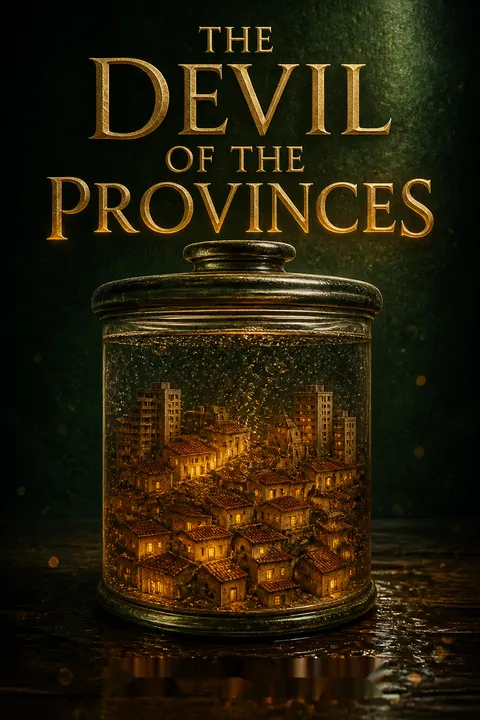


Plot Summary
The Return to Dwarf City
After fifteen years abroad, the biologist returns to his provincial hometown with no academic post and little money. His childhood friend warns him against going back, but the biologist has run out of alternatives and moves into his mother’s house.
A temporary biology and ecology position at an all-girls boarding school gives him work, though the poor pay and long hours make clear how far he has fallen from the life his degrees promised. On his drive to the school, coffee fields and mountain air briefly make home seem livable. The optimism lasts only a moment. To him, the country already feels like a place where every apparent opportunity may conceal another trap.
The return is not a homecoming chosen from affection but a retreat forced by the collapse of professional identity. The biologist treats his move as another experiment in adaptation, yet the language of evolution cannot make economic defeat feel voluntary. His brief pleasure in the landscape shows that he remains receptive to the place even while mocking it. That divided response establishes the novel’s central tension: he wants the detachment of a scientist, but the forces shaping his life are intimate, political, and difficult to observe from a safe distance.
Avocados Without Elephants
In class, a visibly pregnant student asks whether every living thing has a purpose. The biologist answers with the avocado, whose enormous seed once suited extinct gomphotheres but now persists without its original partner.
The example briefly sparks the girl’s interest, and classmates turn it into a joke about tiny mountain avocados waiting for miniature elephants. At home, his mother celebrates the city’s new malls and housing as proof of progress, while the biologist finds their new house sterile and wanders its corridors without settling.
Alone outside, he smokes and thinks about his failed career, divorce, and younger brother, whose death left their mother grieving the son she considered her pride. A political entrepreneur his mother knows may have recommended him for the school, but the biologist cannot establish whether that connection is real.
The avocado lesson gives the biologist a precise image for a world in which adaptation outlives its purpose. His student hears a scientific explanation and turns it into comedy, a response that unsettles his authority but also shows how knowledge changes when it enters another person’s life. At home, his mother’s faith in visible development clashes with his suspicion that new buildings cannot repair old losses. The uncertain job recommendation links private dependence to political patronage: even his apparent return to merit-based work may have been arranged through relationships he cannot see.
The Bar's Old Ghosts
At a downtown bar, a media producer from his youth recognizes the biologist and invites him to a weekend gathering at her family’s hacienda. She had once appeared to be his younger brother’s girlfriend, though the biologist remembers the two of them sharing a strange, grief-soaked intimacy at the brother’s wake.
He leaves her to meet his drug dealer, whose new habit of showering in darkness has become a private spiritual practice. Their walk through the empty historic center turns into a drunken debate about faith and national happiness with clerks and a delivery worker.
A striking teller draws the biologist into dancing; he wakes the next morning in her apartment and slips away without saying goodbye. The invitation to the hacienda remains the one clear path forward from a night he barely understands.
The biologist moves through these encounters by letting other people lead: the producer takes his arm, the dealer sets the pace, and the teller pulls him onto the dance floor. His passivity is not simple indifference. It protects him from having to name what he wants, including his unresolved bond with his brother and his unease about returning to a place that formed him. The dealer’s darkness ritual offers a rival kind of knowledge, bodily and improvised rather than professional. The biologist jokes at it, but the night leaves him more open to experiences he cannot classify.
The Hacienda's False Past
The biologist arrives at the hacienda expecting a reunion and finds a television production team debating how to dramatize slavery on the very estate where enslaved people once labored. Their arguments about historical accuracy and racial representation expose how quickly they turn suffering into a marketable genre.
The producer’s politically powerful older sister dominates the dinner, dismisses climate science, and treats the household staff as invisible; the producer later notes that none of the waiters is white.
Amid the party, the biologist learns from a Black coproducer that two fourteen-year-old students from his school were killed months earlier. He had heard nothing. The news drains the color from the gathering and makes his new workplace feel less like a temporary teaching post than a place surrounded by concealed violence.
The hacienda compresses the novel’s social contradictions into one setting: a plantation’s material history becomes scenery for a show whose creators cannot agree on how to represent it. Their dispute is not merely about taste. It reveals how institutions can acknowledge injustice while still converting it into entertainment and prestige. The revelation about the murdered students breaks the biologist’s assumption that his ignorance is harmless. He has been teaching in a community whose most consequential facts were withheld from him, and his outsider status now looks less like freedom than exposure.
The Leg She Lost
Later that night, the producer leads the biologist into a room prepared as a television set, where he finds his first girlfriend, whom he has not seen in fifteen years. She walks with a prosthetic leg and explains that she wrote to him after an accident; her third letter, describing the crash and amputation, never reached him.
He had left her earlier letters unanswered, and neither can know what he might have done if he had learned the truth in time. The next morning she offers him work on a study of palm weevils, insects damaging oil-palm plantations.
Her team has found that the pheromone traps no longer work because the weevils have adapted. His expertise in the biochemical signaling of bears could help solve the problem, but the work would tie him to an industry he distrusts.
The lost letter makes absence concrete: the biologist’s silence was real, but the information that might have changed it failed to arrive. Their reunion therefore resists a simple reckoning between guilt and forgiveness. The prosthesis is not presented as a symbol to decode; it is part of the altered body his former girlfriend has learned to inhabit, while he must confront the limits of his imagined version of her life. Her job offer tempts him with both intimacy and renewed scientific purpose. It also places that purpose inside an industry whose ecological damage makes technical success morally complicated.
A Child in the Classroom
At school, the biologist receives a package of herbs and a nearly unreadable note from his uncle at a group home. Its broken sentences seem to point toward the brother and a mysterious killing, but the biologist cannot decipher the message or reach the home by phone.
Distracted, he teaches climate change and refuses a pregnant student’s urgent request to leave class, mistaking it for another attempt to test his patience. When he finally sees her distress, her labor has begun. He drives her toward a clinic with the director beside them, but the baby arrives beside a roadside bread stall.
The newborn is healthy, yet his face is covered in long hair and small hard growths mark the back of his head. The mother refuses the clinic, fearing that a religious group called the Knight of Faith will take her child.
The biologist’s error is specific and consequential: he interprets a student’s bodily emergency through the classroom’s routine of discipline, and the delay makes him part of the crisis rather than a neutral observer. The birth then defeats the tidy categories he normally trusts, without confirming any supernatural explanation. The uncle’s disordered note and the mother’s fear of the Knight of Faith arrive as competing fragments of evidence. Instead of solving the scene, they multiply its possible causes, showing how quickly care, institutional authority, and rumor can become entangled.
The Clinic's Convenient Story
At the Faithful Servants emergency room, the director leaves the biologist with the mother and baby, then disappears from the scene. A doctor praises the biologist’s composure, assumes he is the child’s father, and promises routine tests.
Soon the same doctor reports that mother and baby have been transferred to another clinic, while repeating the false impression that the biologist is a parent. The patient’s fear, the director’s retreat, and the doctor’s rehearsed explanation make the transfer feel arranged, though the biologist cannot prove by whom.
He leaves the hospital and walks through abandoned zoo cages and an empty university sports complex, unable to turn suspicion into evidence. The experience convinces him that the school is no longer a place he can safely return to.
The clinic scene does not disclose a conspiracy; it shows how institutional language can make one feel present before the facts are known. The doctor’s mistaken identification and the unexplained transfer offer the biologist enough irregularity to distrust the official account, but not enough to replace it with a reliable alternative. His skepticism therefore becomes unstable. He recognizes that conspiracy theories simplify complex events, yet he also sees how official explanations can function as a cover for decisions no one will explain. His walk through rational, empty spaces mirrors a mind seeking order without finding a usable method.
His Brother's Sealed Room
The biologist returns to his childhood home and searches his brother’s room for evidence of the person hidden beneath the lawyer’s suits, cologne, and orderly files. A decade earlier, the brother had been found shot in a ditch.
Investigators first linked the killing to a land dispute involving palm-oil interests and a Black farming collective; later they accepted a kidnapping story supplied by three prisoners, who subsequently died in separate, unexplained circumstances. The changing accounts never established a motive, and a reporter who challenged them was threatened into abandoning journalism.
The biologist finds no private letter or object that can resolve the mystery. He remembers the gentler boy who watched birds with him and invented a father at a circus, then meets the dealer, who argues that some stories remain only fragments.
The room turns investigation into an encounter with absence. The brother’s files provide a convincing public identity but no key to the private person the biologist longs to recover. Each official theory supplies a different version of the killing, and each version serves a different social interest, from land ownership to the rehabilitation of family reputation. The biologist’s preference for the imaginative, tender brother is emotionally honest, but it cannot establish historical truth. By the time the dealer compares stories to scattered beginnings, the novel has made uncertainty not a temporary obstacle to detection but the condition in which memory and power operate.
The Museum's Empty Courtyard
Over breakfast, the biologist’s mother reveals that she has already heard about the palm-weevil position and presses him to consider it. He remains wary of an industry tied to stolen land, deforestation, and exhausted soil.
At the Archdiocese museum, he waits for the school director, who asked for a private meeting but never arrives. He studies religious artworks, including a painting that frames a martyrdom through a narrow opening, then sends messages saying he is leaving the school and asking the director to contact him another way.
His doubts about the research remain unresolved as he walks through a miniature model of the city. Near the park, two men approach from opposite directions, force him into a pickup, cover his head, take his phone, and bind his wrists.
The museum offers the biologist images of authority that demand interpretation but refuse a single stable viewpoint. His decision to reject the school is clearer than his decision about the research: he can name the institution he is leaving, but not the system that may be drawing him toward another job. The director’s absence turns a promised conversation into another informational void. His abduction follows while he is still trying to read signs, making the detective’s familiar promise of a clue feel cruelly misplaced. He is no longer an observer choosing what to investigate; other people have taken control of his body and the terms of the story.
The Jar and Machete
The men take the biologist to a warehouse stocked with dog food and jars of clear liquid, then bring him before an older technician who has the museum visitor’s face. The captor gives him an empty jar and tells him a fable about an executioner, a singing machete, a sick grandfather, and a girl whose blood quiets the blade.
He retells the tale with altered emphasis until the biologist understands that the parts can be reassigned: he may be the child, the blood, or the silence after the song.
The captor frames the choice before him as that of a practical technician or a man searching for wisdom, while urging him to take the palm-weevil job. The biologist calls himself the drop of blood and the quiet that follows. The captor lets him leave without explaining the threat.
The interrogation replaces evidence with participation. By revising the machete fable, the captor makes the biologist perform the interpretive work that a conventional detective would use to uncover a culprit. Yet understanding the story does not reveal what the warehouse intends to do or why the biologist was chosen. His answer accepts the technician’s limited role while also recognizing that he has been made part of the violence that quiets the blade. The empty jar sharpens the threat without completing it: the captor has taken possession of the possibility of what may be put inside.
The Job He Accepts
Released at the edge of a pasture, the biologist crosses a dry pine plantation filled with hundreds of restless chickens. That week he accepts his former girlfriend’s research position, earns more than he did at school, and moves into the old family house, where he allows its caretaker and the caretaker’s son to stay.
He adopts a stray dog and a pregnant cat, and the cat’s surviving kittens fill the rooms with new life. He visits his uncle each Sunday, drawing plants and sharing quiet time, while his former girlfriend admires the uncle’s sketches at the lab.
A television preacher later presents the hairy-faced baby as a miracle, and the biologist dreams of a bear’s claw suspended in a jar. He wakes without remembering the dream, dressing in his brother’s clothes as he prepares to live in the house again.
The resolution looks like a return to stability, but it is assembled from choices that do not settle the book’s moral questions. The biologist accepts work that helps crops survive while remaining aware of the monoculture that made the weevil’s devastation possible. He calls himself a technician because the role offers income and relief from endless interpretation, though his experiences have shown that technical work is never wholly separate from political consequences. The uncle’s drawings, the adopted animals, and the brother’s clothes make the old house livable without restoring the family it once contained. His dream persists as an image he cannot retain, a final limit on certainty.
Analysis
The novel borrows the shape of a detective story and repeatedly denies its central comfort: that careful observation will produce a stable culprit, motive, and moral order. The biologist investigates his brother’s death, the strange birth, the school’s connection to violence, and the people who abduct him, but each line of inquiry opens onto competing explanations rather than closure. His scientific training remains useful, especially when he studies pheromones, yet it cannot protect him from systems that manipulate evidence or assign value to human lives.
The book’s ecological imagery is not a decorative parallel to its politics. Monocultures, whether fields of palm, cane, or repetitive housing, make visible a social order that prizes uniform production while displacing other forms of life. The weevil adapts to the plantation, just as institutions adapt to survive scrutiny. The biologist’s choice to accept work mitigating the weevil problem is therefore neither simple compromise nor clean redemption. It is a decision made within a damaged landscape, where even useful labor can reinforce the conditions that caused harm.
Family memory offers no firmer ground. The biologist loves his brother, but the public record and the private memories do not align into a complete person. His mother’s protection, his uncle’s political naturalism, and his own selective recollections each preserve one version while obscuring another. The novel suggests that memory is not a transparent archive; it is an active choice about which relationships and histories deserve continuation.
The final movement toward work, pets, the old house, and Sunday visits creates modest forms of care rather than a solved mystery. The biologist becomes more willing to inhabit uncertainty, but he does not master it. His lasting change is not that he learns what happened. He learns that observation carries him only so far, and that the demand for a complete explanation can itself become another instrument of power.
Review Summary
The Devil of the Provinces receives mixed reviews, with praise for its vivid imagery and exploration of themes like ecology, colonialism, and identity. Many readers find it challenging and unconventional, comparing it to Lynch's work. Some appreciate its subversion of genre expectations, while others feel confused or unsatisfied. The novel's surreal elements and lack of resolution divide readers. Many note the quality of the writing and translation but struggle with the narrative's ambiguity and seemingly disconnected events.
People Also Read
Characters
The Biologist
Exiled field biologistA trained naturalist returning to his provincial hometown after fifteen years abroad, he has expertise in animal behavior and biochemical signaling but little confidence in his own place in the world. He watches people as carefully as he watches organisms, often translating discomfort into scientific language or irony. His education gives him tools for noticing patterns, not necessarily for deciding what those patterns mean. He is grieving a brother, estranged from a former love, and dependent on a mother whose generosity can feel like a judgment. His central defense is restraint: he waits, observes, and lets others set the terms. That habit makes him perceptive, but also vulnerable to institutions and people who act before he does.
The Mother
Mother and political brokerThe biologist’s mother measures security through visible progress, respectable connections, and the advancement of her children. She has made a comfortable home and knows how to cultivate influential acquaintances, but her care is inseparable from strong expectations about who her sons should become. Grief has sharpened her investment in family reputation and in the son she once regarded as especially promising. She rarely confronts the biologist directly; instead, she steers conversation, supplies information, and leaves him to infer what she wants. Her practical skill protects the family, yet it also turns affection into a form of pressure that her son both resents and needs.
The Younger Brother
Favorite younger sonThe biologist’s younger brother once shared his fascination with birds, stories, and invented family histories. As they grew older, he pursued the respectable ambitions their mother valued, including law and politics, while distancing himself from the childhood sensitivity he had shared with his brother. The biologist remembers him through competing versions: the imaginative companion of their youth and the polished adult who guarded his public image. That tension makes him an enduring presence in the family even when he is absent from the action.
The Uncle
Uncle naturalistThe brothers’ maternal uncle is a politically restless naturalist who cultivated a garden as a living system for birds, insects, and plants. He introduced the boys to scientific exploration and to the idea that studying nature could carry political meaning. His failed ventures and conflict with conventional respectability made him a family outsider, but his attention to small creatures left a lasting mark on the biologist. As his health declines, his drawings and fragmented messages continue to draw his nephew toward the family history he has avoided.
The First Girlfriend
First love, fellow biologistThe biologist’s first girlfriend shared his early commitment to studying the natural world. When he left the country, she tried to maintain their connection through letters, even as loneliness and changing circumstances altered her life. She later becomes an accomplished researcher with a clear sense of her own work and its practical demands. Her reunion with the biologist is marked by candor rather than sentimentality: she is willing to discuss the past, but she does not allow nostalgia to substitute for present choices. Her scientific offer gives their renewed connection a concrete purpose.
The School Director
School directorDecisive and efficient, the director runs the boarding school with an administrator’s attention to schedules, staffing, and emergencies. She gives the biologist his temporary position and takes command when a student goes into labor. Her practical authority is genuine, but her silences and sudden departures leave the biologist unsure what she knows or whom she serves. She represents an institution that can respond quickly to visible crises while remaining opaque about the conditions surrounding them.
The Dealer
Streetwise dealerThe biologist’s closest local companion sells drugs and speaks in a flexible street vernacular shaped by the city’s changing language. He is observant about his own habits and increasingly drawn to private spiritual experiments, especially silent showers in darkness. His humor can sound careless, but he takes his altered perceptions seriously and offers the biologist a different way to think about what counts as real. Their friendship grows through shared smoking, walking, and conversation rather than confession or conventional advice.
The Pregnant Student
Pregnant studentA student at the boarding school whose visible pregnancy shapes how classmates and teachers see her, she is curious about the relationship between divine purpose and natural evolution. She returns to the biologist’s avocado example because it has unsettled her assumptions. Her classroom questions show an active mind, even when the adults around her are distracted by procedure or discipline. She is also a young person navigating institutions that may not protect her or respect her choices.
The Producer
Television producerA childhood acquaintance of the biologist, she has built a career in media production and can gather writers, actors, and influential relatives around a project. Their shared past includes the biologist’s younger brother, though the exact meaning of their old relationships remains complicated. She invites the biologist to a hacienda gathering and reconnects him with people from the life he left behind. Her authority in the production room is balanced by frustration with the social and political behavior of her family.
The Coproducer
Black coproducerA Black woman involved in the hacienda television project, she challenges the production team when its references and assumptions reproduce racist depictions of slavery. She speaks with impatience when colleagues treat historical violence as a genre problem, and she notices the racial hierarchy embedded in the household’s staffing. Her directness gives the biologist information others have failed to provide, including the killings connected to his school. She is one of the few people at the gathering who engages him with genuine interest.
The Grande Dame
Political grande dameThe producer’s older sister is a powerful politician accustomed to having a room attend to her. She dismisses climate science, promotes extravagant claims, and uses family status to command the dinner gathering. Her performance of piety and authority exposes how political influence can thrive alongside deliberate disregard for evidence.
The Interrogator
Warehouse interrogatorAn older man the biologist has seen at the museum, he later questions him in a warehouse and controls the terms of their meeting through a fable and an empty jar. He presents himself as a practical worker rather than a grand authority, making his power more unsettling, not less.
The Teller
The biologist's brief companionA woman the biologist meets during a drunken discussion of faith and happiness, she draws him into dancing and spends the night with him. Their brief encounter offers temporary warmth without becoming a lasting relationship, and he leaves before morning conversation can give it a clearer shape.
Plot Devices
The Avocado and Gomphothere
Evolution without a planThe biologist explains that avocados once depended on enormous mammals capable of dispersing their large seeds, yet the fruit persists long after those animals vanished. The example begins as a biology lesson, becomes a joke among the students, and returns as a model for the novel’s unsettled relation between survival and purpose. A trait can outlast the conditions that gave rise to it, and a living system can continue without understanding that its world has changed. The analogy also shadows the biologist’s own return: he carries old skills and habits into a setting where their former value is uncertain.
The Brother's Unsolved Case
Truth buried in competing storiesThe brother’s killing attracts incompatible explanations involving a land dispute, a kidnapping ring, and his hidden private life. Each account changes what the family and public can believe about him, while none is supported strongly enough to settle the case. The file therefore does not function as a puzzle whose clues will eventually produce one answer. Instead, it demonstrates how officials, journalists, businesses, and relatives reshape a crime according to their interests. The biologist’s search through his brother’s room yields no final proof, only objects that support the public persona and memories that support a different, more intimate one.
The Palm Weevil
Adaptation inside a monocultureThe weevil damages oil-palm plantations, and researchers have attempted to control it with traps baited by pheromones. When the traps stop working, the biologist’s former girlfriend suspects that the insects have altered their chemical signals. The problem gives him a compelling scientific role and a reason to return to research, but the crop itself is tied to ecological devastation and contested land. The project thus binds technical ingenuity to an ethical question: whether solving a pest problem can serve an agricultural system that is itself destructive. The weevil’s adaptation echoes the novel’s broader interest in organisms and institutions changing to preserve themselves.
The Jar and Machete Fable
Captivity through interpretationDuring the warehouse interrogation, the captor gives the biologist an empty jar and repeatedly retells a fable about a singing machete that falls silent after receiving a child’s blood. The details shift, changing who appears to be the victim, the weapon, or the sacrifice. The biologist is pressured to assign himself a place in the story, and his answer becomes participation rather than escape or proof. The jar makes the threat tangible while remaining empty, so the captor controls the possibility of future contents without explaining his plan. The device turns the expected detective’s search for a stable solution into a trap built from shifting roles.
The Dark Shower
A rival way of knowingThe dealer’s silent showers in darkness begin as a personal experiment in sensation. He describes the lights and patterns he sees with closed surroundings, treating the experience as a route toward a different understanding of his own mind. The biologist jokes about the practice, but later the dealer’s account gives him a way to consider how much of reality is assembled through thought and language. The ritual is not presented as scientific evidence or as a reliable revelation. Its importance lies in its contrast with the biologist’s professional habits: it asks him to remain inside uncertainty rather than turn every perception into a testable explanation.
Download PDF
Download EPUB
.epub digital book format is ideal for reading ebooks on phones, tablets, and e-readers.








