

Plot Summary
The Missing Third Friend
American adventurer Rex Van Ryn returns to London to reunite with the Duke de Richleau, his older French friend and fellow survivor of a dangerous Russian escape. Their old companion Simon Aron, usually part of every reunion, has withdrawn from them and bought a strange house in St. John’s Wood.
De Richleau has learned that Simon is living with Damien Mocata, a bald, wealthy occultist, and has acquired a mute Malagasy servant. The changes unsettle both men, especially because Simon has avoided his closest friends for months. Rex, who once risked his life alongside Simon and the Duke, refuses to accept polite excuses. The two set out that night to confront him, turning an unexplained absence into an urgent rescue.
The story begins with a disturbance in friendship rather than a supernatural spectacle. Simon’s silence matters because this trio has been forged by shared danger; withholding himself is already a break in their mutual code of care. De Richleau reads the change as a threat, while Rex’s insistence on acting makes loyalty a practical force, not a sentimental memory. The contrast between Simon’s old, trusted relationships and his new, opaque household establishes the novel’s central conflict: whether a person’s freedom should be respected when his choices appear to be shaped by an unseen power.
The Observatory’s Secret
At Simon’s house, Rex recognizes Tanith, a beautiful young woman he has glimpsed in several cities, among a gathering of masked-seeming eccentrics led by Mocata. Simon claims the visitors belong to an astronomy circle, but their talk of initiation and a coming ceremony gives De Richleau reason to distrust the cover story.
In the observatory, a pentagram on the floor and two live, bound birds expose the gathering’s purpose to him. He confronts Simon, who insists he cannot leave, then knocks him unconscious when persuasion fails.
Rex carries Simon downstairs as the Malagasy servant attacks; De Richleau throws the servant aside, and both friends escape with Simon to the Duke’s flat. There, De Richleau hypnotizes Simon and puts a protective charm around his neck.
The rescue makes the friendship’s ethical problem explicit: De Richleau violates Simon’s immediate wishes in order to protect the person he believes Simon still is beneath coercion. That choice is troubling as well as courageous, since hypnosis and physical force reproduce the very control the Duke condemns in Mocata. The birds, geometrical markings, and evasive explanations make the danger legible through material evidence before the supernatural is demonstrated. Rex remains more impressed by his friend’s desperation than by the occult explanation, preserving a skeptical perspective that the story will test rather than simply dismiss.
The House Answers
Simon removes the charm and slips away, apparently drawn back by Mocata’s influence. De Richleau and Rex return to the empty house, where they search for papers and find a concealed cache of old ritual objects and books beneath the observatory floor.
As they examine it, freezing air fills the room and a violet mist takes the shape of the Malagasy servant, towering above them with burning eyes. Rex cannot move or look away until De Richleau throws the recovered charm into the pentagram, breaking the apparition’s hold.
The pair flee. Rex, who had treated black magic as nonsense, now accepts that something beyond ordinary trickery has attacked them. With Simon missing again, he proposes finding Tanith, the only member of the gathering he has managed to meet.
The apparition changes the story’s epistemology. Until this point, Rex can explain Simon’s behavior through secrecy, hypnosis, or an elaborate fraud. The manifestation gives him an experience that resists those explanations, but it does not make him instantly knowledgeable; he remains frightened and dependent on De Richleau’s judgment. The hidden objects also complicate the distinction between scholarship and danger. De Richleau’s antiquarian curiosity helps identify the threat, yet entering the house without adequate preparation nearly overwhelms them. Knowledge here is useful only when joined to discipline and humility.
The Countess’s Invitation
Rex finds Tanith and the elderly Madame D’Urfe at Claridge’s. D’Urfe mistakes him for a powerful rival adept and reveals that the occultists are seeking a talisman through Simon, while Tanith serves as Mocata’s unusually effective medium. Rex plays along, exaggerating De Richleau’s rank to win a meeting with Tanith.
He learns that she expects to attend a major gathering that night, but neither woman knows where Mocata has taken Simon. Tanith believes the Duke can protect her, so Rex persuades her to ride with him toward the country house at Pangbourne, claiming De Richleau is waiting there. His deception works only briefly. Once she discovers the Duke is absent, Tanith realizes Rex has tricked her and runs from the house.
Rex’s bluff succeeds because the occult group is organized around status, secrecy, and fear of retaliation. He borrows the language of rank to make Tanith feel safer, but the tactic is unstable: trust built on falsehood collapses as soon as she checks the facts. His attraction to her is already shaping his judgment, making the rescue mission personal before he understands her motives. The Countess’s eagerness to defect also shows that belief does not produce solidarity. Within the circle, members calculate their own safety and advancement, just as outsiders do.
Tanith’s Fatal Calendar
Rex catches Tanith before she can escape and admits that he wants to keep her from the gathering as well as learn Simon’s whereabouts. At Pangbourne, he holds her there until De Richleau can arrive, and they spend the afternoon together on the river. Tanith explains that she pursued occult powers after her mother’s death, first hoping to contact her, then seeking mastery over other people’s lives.
She believes she will die before the year ends and sees the coming ritual as a final chance to gain power. Though she cannot give Rex Simon’s location, she knows where the Sabbat will be held and agrees to guide him there if he does not restrain her once they arrive. While Rex telephones the Duke, Tanith steals his car and drives away.
Tanith’s fatalism gives her occult ambition a psychological logic: if she believes her future is already closed, ordinary pleasures and obligations lose force, while dangerous experience becomes a substitute for a life she expects not to have. Her longing for power is not merely vanity; it grows from grief, isolation, and a desire to make the unknowable answer back. Rex offers affection and a vivid alternative to her ritualized world, but he also confines and deceives her. The scene leaves her agency genuinely contested rather than reducing her to either a helpless victim or a willing villain.
The Stolen Rolls Chase
Tanith’s escape strands Rex in Savernake Forest, but De Richleau has already arranged discreet surveillance through a former Scotland Yard investigator, Clutterbuck. His agents track several cars associated with the cult, while police pursue the stolen Rolls after the Duke reports it.
Tanith evades roadblocks and crashes near Easterton, then disappears into the downs on foot. De Richleau and Rex reach Chilbury, where Clutterbuck has located a country house holding a large gathering.
The Duke refuses to recruit the detectives for an occult raid, but uses their ordinary investigative work to find the destination. Before entering the grounds, he equips Rex with a crucifix and protective objects, then they cross a broken wall and watch masked guests preparing to move out.
The chase joins rational procedure to occult danger without making either sufficient on its own. De Richleau’s network of observers, police communications, and maps gives the friends a concrete route through a crisis that otherwise seems governed by invisible forces. Yet he draws a strict boundary around what the authorities can understand, using them only where a recognizable crime exists. Tanith’s crash is a consequence of Rex’s intervention, but it also frees her from the car and leaves her exposed to the same powers she has chosen to serve. The pursuit makes time itself a tactical resource.
The Walpurgis Sabbat
The masked guests leave Chilbury for a hollow in the downs, where a hundred worshippers gather around blue-burning candles and a monstrous Goat of Mendes. De Richleau and Rex spot Simon among them but cannot reach him through the crowd.
The assembly desecrates Christian objects, feasts in a frenzy, and begins preparations for Simon’s initiation. When the Duke falters at the sight of the Goat and the coming sacrifice, Rex takes responsibility for acting.
They return to the Hispano and drive it straight into the gathering, switching on its powerful headlights. Rex hurls a crucifix at the apparition and pulls Simon into the car. The Goat vanishes in a scream, the worshippers scatter, and the three escape across the plain before the cult can recover.
The Sabbat turns spectacle into a weapon. Its rituals strip participants of ordinary restraint and make the group’s collective behavior seem more powerful than any single person’s conscience. De Richleau’s knowledge cannot overcome his fear at the crucial moment; Rex, less informed but newly committed, acts anyway. The headlights are a deliberately modern counter-image to the cult’s candles, while the crucifix makes the rescue depend on both practical force and symbolic defense. Simon’s extraction is not a victory over the system that captured him. It is a narrow interruption, and the friends leave without knowing what larger purpose the cult serves.
Stonehenge’s Dawn Vigil
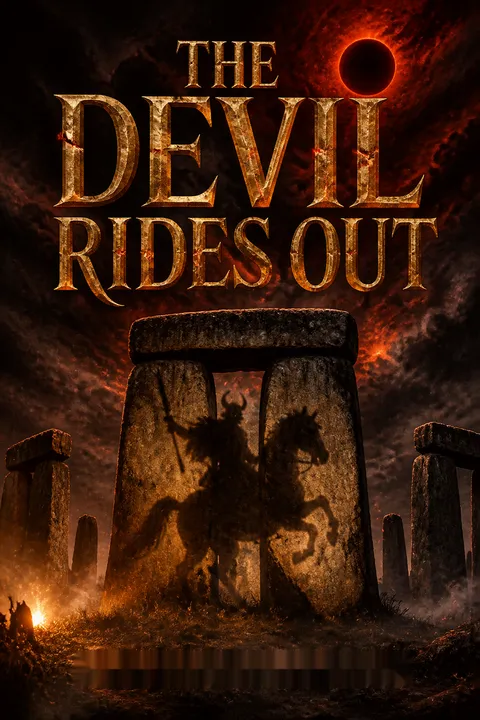
De Richleau takes the exhausted Simon and Rex to Stonehenge, where he performs protective rites and watches for Simon to wake. Simon recalls that his interest began with alchemy and Jewish mysticism, after he challenged the Duke’s account of historical transmutation.
In Paris, Mocata showed him a mirror that appeared to predict financial quotations, then offered to guide him toward contact with a spiritual guardian. Simon accepted Mocata’s advice, made money, and gradually allowed the hypnotist to dominate his thoughts.
He now explains that Mocata needs him for a Saturn ritual to locate the Talisman of Set, an object associated with catastrophic forces. De Richleau understands that this is no longer only about saving Simon; the group must prevent Mocata from finding the talisman.
Simon’s account recasts his fall as an exploitation of intellectual curiosity, not simple credulity. He seeks evidence, tests claims, and is drawn in by apparent results that reward his skepticism with practical gains. Mocata converts that curiosity into dependence by making knowledge profitable and personal. The talisman raises the stakes from one man’s compromised autonomy to potential public catastrophe, expanding the moral frame without erasing Simon’s responsibility. Stonehenge offers a temporary sanctuary, but it also underscores the limits of protective ritual: the friends have bought time, not certainty.
Mocata Visits Cardinals Folly
The group take Simon to the country home of Richard Eaton, the Duke’s old friend, and Richard’s wife, Marie Lou. Rex leaves for a nearby inn, where he finds Tanith alive after her journey across the downs. She confesses that the Sabbat horrified her and asks Rex for protection. At the house, Mocata visits in daylight and tries to persuade Marie Lou that Simon needs his care.
His gaze begins to hypnotize her, but their young daughter Fleur bursts into the room and breaks his concentration. Richard confronts Mocata and drives him out. Mocata threatens to send a supernatural messenger that night. As Rex stays with Tanith at the inn, the others prepare to defend Simon, while Tanith’s exhaustion and Rex’s devotion leave both vulnerable.
The two households expose different forms of intimacy under pressure. Marie Lou protects her family by acting quickly and reading Mocata’s charm as a tactic; Rex protects Tanith through attention and affection, but underestimates the danger of his own exhaustion. Fleur’s interruption is ordinary childhood behavior with extraordinary consequences, a reminder that Mocata’s influence is not omnipotent. Richard’s skepticism begins to fracture, yet he still prefers direct confrontation to De Richleau’s ritual precautions. The scene builds suspense from imperfect protection: every character makes a reasonable choice that also creates a new vulnerability.
The Pentacle Under Siege
At night, the Duke seals the Eaton library with a carefully measured pentacle, candles, horseshoes, holy water, and protective symbols. He warns the family that fear and doubt may be used to lure them outside it.
The attacks begin by exhausting their confidence: the lights fade, a freezing wind circles the room, and a voice imitating Rex calls from beyond the window. A shapeless, foul apparition appears, then takes the form of Fleur to draw Marie Lou out of the circle. De Richleau stops her from approaching it.
Simon, seized by an unseen force, struggles toward the window and has to be tied down. Finally, a riderless black stallion charges the barrier. Richard fires at it, and the Duke invokes a last defense that carries the company into a shared astral ordeal.
The siege attacks perception before it attacks bodies. The counterfeit Rex and counterfeit Fleur exploit attachment, while Simon’s involuntary movement turns his earlier loss of agency into an immediate danger for everyone. Richard’s gun is a practical response that briefly illuminates the room but cannot settle what is real. De Richleau’s protective system depends on exactness and collective obedience, yet its success is never presented as a simple triumph of technique. The transition into the astral ordeal marks a shift from defending a room to confronting the source of the threat on its own imagined terrain.
Fleur’s Empty Cot
Within the unfolding ordeal, Rex arrives carrying Tanith, who appears dead after Mocata has used her as a medium. De Richleau tests her with garlic and a crucifix, then summons her spirit to learn that Mocata is nearby and wants to restore her through a Black Mass and a child’s sacrifice.
Before she can say more, Fleur disappears from her cot. A letter from Mocata demands that Simon return willingly and forbids the family from involving the police. Marie Lou and Richard disagree over whether to defy the threat; Rex recommends waiting rather than provoke Mocata.
Simon nevertheless leaves at the appointed time, hoping to save Fleur. The others follow his trail, first to Paris, where De Richleau forces banker Castelnau to reveal Mocata’s secret meeting place.
The ordeal compresses incompatible duties into a single impossible choice: protect a child, respect Simon’s self-sacrifice, or resist a coercive bargain. Simon’s departure expresses loyalty, but also repeats the pattern by which Mocata has made him feel responsible for outcomes beyond his control. Rex’s counsel of delay is strategic rather than passive; he hopes to preserve options and avoid giving the enemy leverage. Tanith’s spirit can provide information but cannot freely direct events, so knowledge arrives under constraints. The missing child converts abstract occult danger into a parent’s immediate terror.
The Temple at Asnières
At Castelnau’s warehouse, the friends find an underground temple furnished for Satanic rites and discover Simon unconscious near its altar. De Richleau hypnotizes him long enough to recover the ritual’s account of the Talisman of Set: it lies beneath a chapel in a monastery near Metsovo, Greece.
Before they can leave, Castelnau returns with the French police chief, who has been led to believe the group are criminals caught in the temple. De Richleau is shot in the arm during the fight, but Rex and Richard overpower the officers, while Simon and Marie Lou subdue Castelnau.
The friends escape before reinforcements arrive. Tanith’s vision places Mocata in Paris and then moving east, so Richard flies the group across Europe, following the same route toward Greece.
The Paris episode shows how easily institutions can be recruited into Mocata’s strategy. The temple is genuine evidence of criminality, but the police arrive at a moment and under a framing that make the rescuers appear guilty. De Richleau’s injury gives the escape a physical cost, while Simon’s hypnotic testimony supplies the next destination. The friends now rely on a mixed method: coercive interrogation, air travel, maps, and Tanith’s partial vision. The sequence refuses a clean divide between legitimate and illegitimate force; under pressure, the rescuers use tools that resemble those employed against them.
The Monastery of Set
The group fly from Paris through central Europe to a fogbound landing ground near the Greek town of Yanina, then continue by car and an old carriage into the mountains. Local people fear the ruined monastery where Mocata’s followers have settled.
In its crypt, the friends find the central altar but discover that Mocata has already reached the side chapel and removed the Talisman of Set from beneath its altar stone. He has Fleur with him and is preparing the Black Mass that, according to Tanith, could exchange her soul for Tanith’s and force Tanith back into her body.
Mocata traps the rescuers inside a glowing circle, then invokes the Goat of Mendes. They can only watch as he lays the talisman on the apparition and prepares Fleur for sacrifice.
The journey’s relentless movement makes the talisman feel less like a collectible object than a concentration of accumulated danger. Each new mode of transport buys minutes but cannot erase Mocata’s lead. The monastery’s isolation also strips away familiar institutions and ordinary help, leaving the group to rely on one another. Mocata’s plan binds Tanith’s fate to Fleur’s innocence, making his ambition depend on treating lives as exchangeable ritual materials. The friends’ physical confinement dramatizes the story’s central question: whether a powerful will can be opposed by love when direct force and expertise have both failed.
A Word of Protection
As Mocata raises his knife over Fleur, Marie Lou remembers a sentence from the Red Book of Appin and speaks an unfamiliar word. The crypt convulses, knocking the talisman from the Goat’s head and breaking Mocata’s control. The Goat strikes him down, and a radiant spiritual figure appears through Fleur, telling the company that their protection came from love without self-interest.
They awaken in the library at Cardinals Folly, realizing that their flight and battle formed a shared astral journey, not a physical trip. Tanith is alive and wakes beside Rex. The Duke finds Mocata’s body outside, then discovers the Talisman of Set in his own hand and destroys it in the furnace. Rex and Tanith face the future with renewed hope.
The climax makes its decisive power neither technical knowledge nor domination, but Marie Lou’s uncalculated concern for a child who is not hers alone to protect. The unfamiliar word is effective because she uses it without seeking status or advantage. The awakening reframes the preceding action without nullifying it: the journey was astral, yet the talisman and Mocata’s death leave material consequences. The novel keeps the boundary between dream and reality porous, allowing spiritual conviction to produce worldly evidence. Rex’s renewed hope for Tanith is emotionally earned, though her earlier prophecy remains a source of uncertainty rather than a fully explained mechanism.
Analysis
The novel organizes its horror around a conflict between influence and agency. Mocata rarely begins with open force. He offers Simon evidence and financial advantage, gives Tanith the promise of spiritual advancement, and approaches Marie Lou with a reassuring explanation. In each case, coercion first disguises itself as a desirable form of knowledge. The friends’ counterforce is not simply disbelief or faith, but a combination of attention, loyalty, and willingness to act when certainty is unavailable.
The plot repeatedly tests whether protection can be separated from control. De Richleau hypnotizes Simon for his own safety, Rex lies to Tanith to keep her from the Sabbat, and the group debates whether Simon should be allowed to surrender himself. Their intentions are compassionate, yet their methods risk repeating Mocata’s assumption that another person’s will may be overridden for a supposedly higher purpose. The story’s moral distinction rests less on technique than on motive and consequence, though it does not entirely resolve the discomfort this creates.
The supernatural system gives material form to psychological states. The cult’s rituals turn status hunger, grief, resentment, and sexual appetite into collective performance. By contrast, the protective circle demands restraint and mutual attention. Yet the circle is vulnerable to doubt, exhaustion, and false images, suggesting that no defense is merely an object placed on a floor. It depends on people sustaining trust in one another under pressure.
The ending’s astral journey destabilizes the boundary between imagination and event. The friends awaken in the library, but Mocata’s death and the Talisman’s presence make it impossible to dismiss the experience as inconsequential. The novel’s deepest claim is not that every supernatural belief is safe or true, but that human beings are changed by what they permit themselves to serve. The power that finally answers the crisis is linked to care without personal advantage, sharply opposed to Mocata’s effort to make other lives instruments of his ambition.
Review Summary
The Devil Rides Out receives mixed reviews, with many praising its thrilling occult storyline and atmospheric writing. Critics note Wheatley's engaging storytelling, detailed research, and memorable characters. However, some find the writing dated, with racist and classist elements. The book's influence on horror fiction and film is widely acknowledged. Readers appreciate the suspenseful plot and vivid descriptions of black magic rituals, though some find the pacing slow at times. Overall, it remains a classic of the genre, despite its problematic aspects.
People Also Read


Characters
Duke de Richleau
Occult scholar and protectorA French aristocrat living in England, De Richleau combines cultivated manners, sharp intelligence, and the instincts of a veteran adventurer. He is deeply attached to Rex and Simon, whom he regards with almost parental affection, and treats their safety as a personal duty. His knowledge of esoteric traditions gives him a framework for recognizing dangers others dismiss, but knowledge does not make him fearless or infallible. He can be impatient, secretive, and willing to override another person’s wishes when he believes a greater danger is near. His character is shaped by the tension between disciplined thought and spiritual conviction: he studies the unknown carefully, yet knows that preparation cannot guarantee control.
Rex Van Ryn
Loyal American adventurerRex is a physically powerful, risk-loving American whose humor and impulsiveness conceal a fierce loyalty to his friends. His past adventures with De Richleau and Simon have taught him to trust them under pressure, though he initially doubts the Duke’s occult explanations. He responds to danger through action: pursuing Tanith, driving into the Sabbat, and trying to protect those he loves. His directness is both strength and liability. Rex dislikes deception, yet uses it when he thinks it may save Tanith or Simon, and his attraction to Tanith forces him to confront how affection can cloud judgment. Beneath his bravado, he is emotionally generous and capable of taking responsibility when a trusted leader falters.
Simon Aron
Curious friend in dangerSimon is a thoughtful, financially capable English Jew whose curiosity about alchemy and mysticism grows from a habit of testing claims rather than accepting them on faith. He is shy and sensitive, with a strong attachment to De Richleau and Rex, and has previously stood beside them in danger. His interest in hidden knowledge makes him susceptible to promises that appear verifiable, especially when they bring practical rewards. Simon’s loyalty is profound, sometimes to the point of self-erasure; he is inclined to accept blame and sacrifice himself when friends are threatened. His story asks how intellectual openness can be manipulated into dependence, and how friendship may help restore a person’s capacity to choose.
Tanith
Psychic seeker of powerTanith is a young, well-traveled woman with a striking presence and a serious interest in psychic practice. Her childhood isolation and her mother’s death leave her hungry for contact with what lies beyond ordinary life. She pursues occult knowledge not simply for spectacle, but because she believes she has little future in which to pursue conventional happiness. Her intelligence and conviction coexist with vulnerability: she can recognize Rex’s warmth yet remain drawn to the promise of mastery offered by Mocata’s circle. Tanith’s changing loyalties are shaped by grief, fear, desire, and the difficult distinction between genuine spiritual curiosity and a group’s exploitation of that curiosity.
Damien Mocata
Charismatic occult adversaryMocata is a cultivated, persuasive occultist who uses charm, hypnotism, and promises of knowledge to draw others into his influence. His polished manners and apparent intellectual range make him more dangerous than a crude fanatic; he understands what his targets desire and presents control as enlightenment. He treats people as instruments in a larger pursuit, exploiting Simon’s curiosity and Tanith’s psychic sensitivity. Mocata’s confidence depends on making his authority seem inevitable, while his concealed cruelty reveals the cost of the power he seeks. He embodies a form of manipulation that works through attraction and rationalization before it resorts to overt menace.
Richard Eaton
Practical friend and fatherRichard is an English country gentleman, a skilled pilot, and an old friend of Simon’s. He begins from a rational skepticism that makes him question De Richleau’s occult claims, but his loyalty keeps him involved even when he is unconvinced. His protective instincts become especially clear when his household is threatened. Richard prefers concrete action and ordinary explanations, yet he can revise his judgment when events contradict it. His marriage to Marie Lou gives him a steady emotional center, while his love for Fleur makes the stakes immediate and personal.
Marie Lou Eaton
Intuitive mother and allyMarie Lou is Richard’s Russian-born wife and Fleur’s devoted mother. Small in stature but quick-minded, she notices danger in Mocata’s manners and resists him even when his hypnotic influence begins to take hold. Her belief in the supernatural comes from childhood experience, not from De Richleau’s lectures, and she is willing to trust her instincts when other characters hesitate. Her warmth toward Simon and the Duke broadens her sense of family beyond the household she shares with Richard. Marie Lou’s strength is relational: she protects people by recognizing what they mean to one another.
Fleur Eaton
Innocent child at the centerFleur is the young daughter of Richard and Marie Lou, affectionate toward the adults who gather at Cardinals Folly. Her curiosity and unguarded presence can interrupt the careful schemes of more powerful people. She sees Simon as a beloved family friend and brings ordinary childhood needs into a story dominated by occult fear. Fleur’s innocence is important not because she understands the conflict, but because the adults’ choices become morally clear when they must protect her.
Madame D’Urfe
Ambitious occult initiateAn elderly, wealthy occultist, Madame D’Urfe moves among Mocata’s followers while remaining alert to shifts in power. Her interest in ritual and advancement is practical and self-serving, and she tests Rex’s claims when she mistakes him for an adept. She helps reveal the cult’s hierarchy and its belief that Simon is essential to its plans. Her readiness to seek a new patron shows how fear and ambition can coexist within the same allegiance.
Laurent Castelnau
Banker with a hidden templeCastelnau is a French banker and Mocata associate whose respectable public life conceals involvement in occult gatherings. A portion of his ear has been removed, making him identifiable to Tanith’s psychic vision and linking him to Simon’s history with Mocata. He is guarded, politically alert, and unwilling to reveal the cult’s meeting place while conscious. Castelnau represents the story’s recurring overlap between elite respectability and secret criminality.
Clutterbuck
Discreet private investigatorA former Scotland Yard superintendent, Clutterbuck provides surveillance and vehicle tracking without being told the occult nature of the case. His practical work helps De Richleau locate the cult’s gathering, showing how ordinary investigative skill can support a struggle it cannot itself explain.
Mizka
Tanith’s childhood guideMizka is an elderly Romani fortune-teller who taught Tanith about divination when Tanith was a lonely child in the Carpathians. In Tanith’s later crisis, the remembered figure of Mizka becomes connected to the supernatural forces that first drew her toward occult practice.
Max
De Richleau’s trusted servantMax is De Richleau’s loyal manservant, discreet and attentive to his employer’s instructions. His actions around Simon’s stay at the Duke’s flat inadvertently expose the fragility of the protection De Richleau has arranged.
Malin
Eaton household butlerMalin is the butler at Cardinals Folly. He carries messages and enforces Richard’s orders about keeping the household away from the library, offering a practical link between the family’s private crisis and their servants’ ordinary routines.
Chief Daudet
Paris police chiefDaudet leads the Paris police party that enters Castelnau’s secret temple. Political suspicion makes him receptive to a misleading account of the people he finds there, turning an official raid into another danger for the rescuers.
The Malagasy servant
Mocata’s silent enforcerA mute Malagasy manservant in Simon’s household, he is physically imposing and unnerving to the Duke. His appearance links Simon’s new domestic arrangements to Mocata’s occult circle, while his silent violence foreshadows the danger surrounding it.
Plot Devices
The Talisman of Set
Occult power made portableThe Talisman of Set is an ancient object Mocata seeks through a ritual requiring Simon’s unusual birth circumstances. De Richleau connects it to the myth of Set, Osiris, and Isis, and warns that its power is associated with war, plague, famine, and death. The object gives the story’s private rescue plot a larger public consequence: stopping Mocata becomes necessary not only to free Simon but to prevent a wider catastrophe. Its hidden location beneath a Greek monastery altar leads the friends through the final pursuit. Its physical appearance after the shared astral ordeal also makes the story’s uncertain boundary between dream and reality consequential. This device includes plot revelations.
Hypnosis and mediumship
Will turned into a weaponHypnosis is the mechanism Mocata uses to make Simon and Tanith more responsive to his influence, and the Duke also uses it in attempts to protect Simon and extract information. The novel treats it as a continuum rather than a simple trick: concentration can calm or direct someone, but repeated use can weaken their ability to judge and resist. Tanith’s mediumship allows distant perception, while her vulnerability gives Mocata a channel through which to gather information and exert pressure. The same practices can therefore serve care or coercion depending on who controls them and why. The device drives both the rescue attempts and the story’s continuing concern with consent.
Protective ritual objects
Boundaries against intrusionDe Richleau uses crosses, holy water, candles, horseshoes, herbs, salt, mercury, and carefully drawn circles to defend people and places from occult attack. Their precise arrangement matters within the story’s magical logic, and the protections give the group concrete actions to perform when fear threatens to overwhelm them. They do not make the characters invulnerable: the library’s lights fail, false images appear, and Simon is nearly pulled out of the circle. The objects instead create temporary boundaries that require vigilance and cooperation. Their mixture of Christian symbols, older motifs, and practical household materials reflects the Duke’s belief that protection depends on context, tradition, and disciplined intent.
Tanith’s visions
A partial map through dangerTanith’s clairvoyance and mediumship provide glimpses that ordinary investigation cannot: she perceives Rex at Claridge’s, recognizes Mocata’s movements, and later offers clues about his route. These visions are never a complete or perfectly timed guide. The characters must interpret what she sees, compare it with evidence, and decide whether the risk of acting on it is worthwhile. Her psychic ability is both her skill and the reason Mocata values her as a medium. The device advances the pursuit while emphasizing that knowledge gained outside ordinary perception can remain fragmentary, emotionally charged, and open to misinterpretation.
The Red Book of Appin
A remembered key at crisisMarie Lou dreams of an old book whose text she can understand while wearing an iron circlet, and the image returns during the ordeal in the monastery crypt. At the moment Mocata is about to sacrifice Fleur, Marie Lou recalls a sentence from the book and speaks an unfamiliar word. Its effect overturns the ritual and frees the Talisman from the Goat’s head. The book connects a fragment of private dream imagery to the climax, but the story offers no ordinary explanation for how Marie Lou receives or retains this knowledge. It gives her a decisive role without making her a trained occult specialist. This device reveals the climax.
Duke de Richleau Series
Download PDF
Download EPUB
.epub digital book format is ideal for reading ebooks on phones, tablets, and e-readers.








