

Key Takeaways
Build intellectual independence, but keep inquiry answerable to historical reality
Funding bought room to dissent. In 1923, Felix Weil helped establish Frankfurt's Institute for Social Research with money from his wealthy family. Its endowment allowed scholars to study labor, capitalism, and culture without depending on a political party or a conventional university career. Under its first director, Carl Grünberg, the Institute pursued a comparatively orthodox Marxist research program. Max Horkheimer's appointment in 1930 shifted the emphasis toward interdisciplinary social theory, including psychology and philosophy.
Exile tested the design. When the Nazis closed the Institute in 1933, funds transferred abroad helped it regroup in Geneva and, from 1934, at Columbia University in New York. A shared journal and research program kept the group together across borders. The Institute's independence was therefore not just an ideal. It was an institutional resource that helped preserve work that could not safely be done in Germany.
The Institute's history makes independence look less like a personality trait than an organizational achievement: money, editorial control, and a durable group gave critique time to develop. That structure also creates a tension. Private wealth can protect research from party pressure, but it can insulate scholars from the people and institutions they claim to analyze. The Institute's experience is a useful reminder that intellectual autonomy needs accountability as well as protection. Its work gained coherence through distance, while that same distance sometimes narrowed its contact with political life.
Treat theory as a changing critique, not a finished political doctrine
Critical Theory stayed unfinished. The term names the Institute's attempt to analyze society historically while exposing its contradictions, rather than treating existing arrangements as natural or permanent. Horkheimer rejected both a closed Marxist doctrine and social science that merely collected facts without asking what those facts served. The Institute argued that knowledge is shaped by social conditions, and that a researcher cannot simply stand outside the society under study.
Theory and action remained divided. In Marxist vocabulary, praxis means self-directed action informed by theory, not behavior controlled by external forces. The Institute hoped that theory and praxis could eventually meet, but warned that political allegiance could turn scholarship into propaganda. Its members sought a position between uncritical solidarity with movements and an independence that ignored the possibility of change. That balance became harder to sustain as the working class seemed less likely to act as Marxism predicted.
This approach usefully rejects two comfortable myths: that data speak for themselves, and that political commitment guarantees good analysis. It also exposes a harder problem. If every inquiry is socially situated, critical scholarship needs standards for distinguishing a persuasive account from a preferred one. The Institute's answer was ongoing criticism, attention to contradictions, and willingness to revise concepts as conditions changed. That method is demanding, but it does not fully solve the gap between a theory's claim to truth and its political consequences.
Use psychology to explain why unjust systems recruit ordinary loyalties
Economics alone could not explain obedience. The Institute turned to Freud to understand why people might support authority even when their material interests seemed to point elsewhere. Erich Fromm argued that the family helps translate social pressures into character and political attitudes. His early work combined psychoanalytic ideas, including repression and the Oedipus complex, with analysis of class and economic change. The goal was to explain how social arrangements become emotionally compelling, not to replace social explanation with individual diagnosis.
The synthesis produced a split. Fromm later rejected central parts of Freud's libido theory and emphasized alienation, relatedness, and human potential. Horkheimer and Adorno instead valued Freud's account of conflict and destructive impulses, which they thought revisionist psychology softened. Marcuse eventually gave Freud a more utopian interpretation, arguing that social change could loosen repression. Their disagreements show that the Frankfurt School was a collaboration, not a single settled doctrine.
The Institute's strongest contribution here is its insistence that political behavior has emotional as well as economic causes. This helps explain why people may defend institutions that frustrate them, or direct anger toward vulnerable outsiders rather than powerful structures. The disagreement among Fromm, Horkheimer, Adorno, and Marcuse also matters: psychological concepts do not dictate one politics. Their theories can illuminate social pressures, but they can also overreach when a speculative account of family life is treated as a universal explanation.
Test workers' declared politics against the authority habits shaping them
Slogans concealed mixed loyalties. In the early 1930s, Fromm led a survey of German workers and salaried employees. Roughly 3,000 questionnaires were distributed, although only about 700 responses were available for analysis. The researchers classified about 10 percent as authoritarian, about 15 percent as psychologically committed to anti-authoritarian goals, and most of the rest as ambivalent. The findings suggested that the working class's militant political language did not guarantee resistance to a right-wing takeover.
Family life mattered politically. The Institute's 1936 Studies on Authority and Family combined theoretical essays with research on family, law, economics, and youth. Its authors argued that family relations could reinforce submission, but also preserve care and independence. They treated the empirical findings cautiously, as material for refining theory rather than conclusive statistical proof. The central question was how changing institutions formed habits of obedience before those habits appeared as explicit political opinions.
This is an early version of a valuable distinction between what people say they believe and the dispositions that guide action under pressure. The survey's mixed categories also resist the easy story that workers were either revolutionary or politically inert. Its evidence is suggestive, not definitive: a limited sample and interpretive classifications cannot establish how people would behave in every crisis. The study's lasting value lies less in predicting the exact course of Nazism than in showing why political rhetoric alone is a poor measure of resistance.
Explain Nazism through both economic ownership and political command
The Institute disagreed about capitalism's fate. Friedrich Pollock argued that Nazi Germany represented state capitalism: government planning and political command had displaced much of the market's coordinating role, and power increasingly mattered more than ordinary profit seeking. In his account, the regime had created a new economic order whose survival could not be explained by the old expectation that capitalism would collapse from its own contradictions.
Neumann saw old ownership beneath new controls. In Behemoth, Franz Neumann argued that private property and monopoly business remained central. He described the regime as totalitarian monopoly capitalism, with business, party officials, the military, and bureaucracy sharing power and benefits. Otto Kirchheimer traced parallel changes in law, where administrative decisions and racial ideology weakened general legal rules. These competing accounts agreed that Nazi rule fused economic interests with coercive politics, but they differed over which side had become dominant.
The disagreement is more useful than a neat consensus would have been. Pollock foregrounds the state's capacity to reorganize economic life; Neumann foregrounds the persistence of private ownership and powerful business interests. Together, they prevent a false choice between a regime controlled entirely by capital and one in which economics no longer mattered. Their debate also shows why labels can obscure as much as they reveal: identifying a system as capitalist or state-directed is only the start of explaining who commands, who benefits, and how conflicts are contained.
Treat mass entertainment as a political force, not a neutral pastime
Culture could disguise social power. The Institute argued that art was neither a sealed-off realm nor a simple reflection of class interests. Some difficult, formally demanding art preserved a sense that society could be different. Adorno feared that commercial entertainment instead repeated familiar patterns, encouraging passive recognition and making manufactured culture appear spontaneous. He called this system the culture industry. His severe criticism of jazz, however, often treated commercial popular music as if it exhausted the whole tradition.
Benjamin saw another possibility. Mechanical reproduction, especially film, weakened the unique presence and historical tradition Benjamin called an artwork's aura. He worried about the loss, but also thought film could bring art to mass audiences and change how they responded to it. Adorno was more skeptical, seeing mass media as a tool of standardization. Their disagreement captures the Institute's central question: can widely distributed culture create new forms of participation, or does it mainly package conformity?
The culture-industry argument is strongest when it asks who controls production and how repetition narrows what audiences encounter. It is weaker when it assumes that popular audiences receive media passively or that one commercial form speaks for all popular culture. Benjamin's disagreement keeps that question open. A medium can be standardized by its owners and still be used in unexpected ways by its audiences. The important distinction is not simply high art versus entertainment, but who shapes cultural choices and whether those choices preserve room for interpretation.
Measure prejudice beneath stated beliefs, then scrutinize the measuring instrument
The F Scale sought hidden predispositions. For The Authoritarian Personality, Adorno and colleagues combined questionnaires, interviews, and projective tests. Their F Scale aimed to identify authoritarian tendencies without asking respondents directly about minority groups. It assessed traits such as rigid conventionalism, submission to idealized authority, hostility toward rule-breakers, superstition, and projective suspicion. The study included 2,099 people, most of them white, native-born, gentile, and middle-class Americans. Its purpose was to investigate a personality pattern, not simply count openly prejudiced opinions.
The method had limits. Critics questioned the sample's narrowness, the interpretation of interviews, and whether some categories risked circular reasoning. The study also did little to measure authoritarianism on the political left. Its authors described the work as an initial investigation, not a final verdict on how common authoritarianism was in American society. The F Scale made an influential research program possible, but its results depended on choices about what counted as an authoritarian trait.
The study's methodological ambition was unusual: it tried to connect public attitudes with less visible patterns of personality, rather than treating survey answers as transparent windows into belief. That move can reveal important structures, but it also raises a classic measurement problem. If researchers define a trait through the same answers they later use to confirm it, theory can become self-validating. The narrow sample and weak treatment of left-wing authoritarianism further limit its reach. A useful scale is not a neutral instrument; its categories deserve the same scrutiny as its findings.
Do not confuse reason's command over nature with human emancipation
Enlightenment could turn into domination. In Dialectic of the Enlightenment, Horkheimer and Adorno argued that Western thought's drive to make nature measurable and controllable could also reduce people to objects of administration. Reason narrowed into instrumentality: a way to calculate efficient means without questioning the ends. In their reading of the Odyssey, Odysseus's encounter with the Sirens becomes an image of self-denial and labor: the sailors block out the song, while Odysseus hears it but is restrained from responding.
They did not simply reject reason. The Institute distinguished calculating reason from a fuller form capable of judging purposes and imagining a less dominating society. Mimesis, a receptive imitation of the natural world associated with early human experience, could be valuable, but could also return in distorted forms when suppressed. The authors offered no practical blueprint for reconciliation. Their argument was instead a warning that technological progress by itself does not guarantee freedom.
This critique offers a sharp way to examine technology: efficiency is never the same as justice, and greater control over the environment can coexist with diminished human agency. It also helps explain the Institute's suspicion of progress narratives that count only what can be measured. The risk is overextension. If every form of rational planning is treated as domination, the critique loses the distinctions needed to defend medicine, public infrastructure, or democratic regulation. The Institute's own distinction between instrumental and substantive reason is therefore essential, even when it remains difficult to apply.
Protect critical distance, but ask what action it can still guide
Exile preserved a collective voice. After leaving Nazi Germany, the Institute maintained its identity in Geneva and New York, in part by continuing to publish largely in German. That choice preserved a connection to German intellectual culture but limited its American audience. The group also resisted full integration into Columbia's academic structure, protecting its independence while deepening its isolation. Walter Benjamin, who remained in Europe despite the Institute's efforts to bring him to America, died by suicide in 1940 while fleeing the Nazi advance.
Return did not resolve the political problem. Horkheimer and Adorno reestablished the Institute in Frankfurt in 1950, and the organization gained a new public and academic life. Yet the core question remained: if no reliable revolutionary movement could be identified, what could theory do? The Institute increasingly treated critical thought itself as a form of resistance. Jay's history presents that choice as intellectually consequential, but also as a retreat from the earlier hope of uniting theory with political action.
The Institute's story makes marginality neither a badge of honor nor merely a failure. Distance helped its members resist party discipline, conventional academic pressures, and the seductions of mass culture. But criticism can become a protected position from which no effective action is imaginable. The return to Frankfurt brought influence and institutional security, while raising a new risk of being absorbed into the academy. The enduring question is practical: how can intellectual independence inform collective action without becoming propaganda, and how can action remain open to criticism?
Analysis
Jay's book is most persuasive when read as a history of institutional conditions for thought, not as a single account of Frankfurt School doctrine. The Institute's endowment, editorial control, and internal collaboration made an unusual intellectual project possible. Its history then tests that independence against exile, changing research methods, and the collapse of confidence in a revolutionary public. The central narrative is not simply that Marxism became pessimistic. It is that each failed political expectation forced the group to relocate the source of domination, from economic relations toward authority, culture, technology, and the human relation to nature.
That movement produced insight and cost. Psychology helped explain why material interests do not automatically create political resistance. Cultural analysis showed that domination can operate through entertainment and habits, not only through law or force. Yet the Institute's theoretical breadth could also blur distinctions. Pollock and Neumann's disagreement over Nazi political economy demonstrates that the group never possessed one settled explanation of modern power. The different diagnoses should not be tidied into a single thesis merely because they shared an institutional home.
The empirical turn is similarly double-edged. The Authoritarian Personality translated a philosophical concern into research procedures and helped establish a durable field of inquiry. But the narrow sample, contested coding, and limited treatment of left-wing authoritarianism show how a theory can shape what a measure is capable of seeing. Jay's account is especially valuable because it makes these tensions historical rather than incidental. Research methods, political commitments, and institutional pressures were intertwined.
The book's lasting challenge is therefore not to choose between theory and evidence, or between independence and engagement. It is to recognize that each can correct and corrupt the other. Critical distance helps expose assumptions that practical movements may overlook; without contact with collective life, however, critique can lose the capacity to distinguish an urgent political problem from a permanent philosophical impasse. The Institute's achievement lies partly in keeping that contradiction visible, even when it could not resolve it.
Review Summary
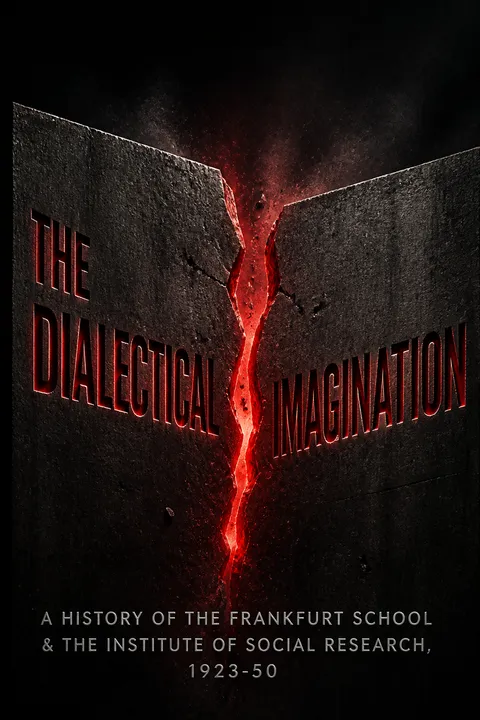
The Dialectical Imagination by Martin Jay is a comprehensive history of the Frankfurt School, focusing on its early years and exile in America. Readers praise Jay's thorough research, clear explanations of complex ideas, and insightful analysis of key figures like Adorno, Horkheimer, and Marcuse. The book explores the school's development of critical theory, their critique of mass culture, and their integration of Marxism and psychoanalysis. While some find it dense and challenging, most consider it an essential work for understanding the Frankfurt School's intellectual legacy.
Glossary
Critical Theory
historical social critiqueThe Institute's interdisciplinary approach to analyzing society through its history, institutions, and cultural forms. It rejects the idea that social research can be wholly detached from social interests, and it examines contradictions between a society's stated ideals and its actual conditions. It is a critical method and orientation, not a fixed political program.
praxis
theory-informed actionIn the Marxist usage discussed by Jay, praxis is self-directed action informed by theoretical understanding, rather than behavior driven by forces outside a person's control. The hoped-for unity of theory and praxis meant that social analysis would help guide transformative action. The Institute increasingly questioned whether that unity was possible under modern political conditions.
state capitalism
politically directed capitalismFriedrich Pollock's term for an economic system in which government planning and command displace much of the market's coordinating role. In his analysis, political power becomes more important than the traditional profit motive, while domination persists rather than giving way to socialism. Franz Neumann disputed Pollock's application of the concept to Nazi Germany.
authoritarian personality
predisposition to authoritarian beliefA psychological pattern the Institute investigated as a basis for prejudice and susceptibility to authoritarian politics. The proposed traits included rigid conventionalism, submission to idealized authority, aggression toward people who violated norms, stereotyped thinking, and projection of threatening impulses onto others. The study treated it as a predisposition, not a simple synonym for a particular political opinion.
F Scale
authoritarian tendency measureA questionnaire scale developed for The Authoritarian Personality to detect potential authoritarian dispositions without directly asking respondents about minority groups. Its items were designed to indicate traits such as conventionalism, submission, aggression, superstition, and projective suspicion. The scale made the theory measurable, but its narrow sample and disputed interpretation limited what its results could establish.
culture industry
mass-produced commercial cultureHorkheimer and Adorno's term for entertainment produced and distributed through industrial systems. They argued that repeated formulas and manufactured differences could make commercial culture seem spontaneous while encouraging passive consumption and acceptance of existing conditions. Their critique concerned the organization and social function of mass culture, although Adorno's own judgments about popular music could be sweeping.
affirmative culture
consolation without social changeA cultural arrangement in which art and ideals promise a superior realm of value while remaining separated from material life. Individuals may be offered inward consolation or a sense of dignity without changing the social conditions that produce hardship. The Institute argued that this separation could make culture appear critical while helping people accommodate themselves to injustice.
aura
artwork's singular presenceWalter Benjamin's term for the unique presence and historical authority associated with an original work of art. Its authenticity is bound to its particular existence and its place in tradition. Mechanical reproduction weakens that singular quality, but Benjamin also considered whether mass reproduction could give art new political uses and reach new audiences.
mimesis
receptive imitation of natureA mode of relation based on imitation or responsiveness, discussed by Horkheimer and Adorno as an alternative to purely instrumental control. They associate early mimetic capacities with learning and adaptation, while arguing that their suppression can lead to distorted returns in social behavior. Mimesis is not simply a call to abandon reason or submit to nature.
Download PDF
Download EPUB
.epub digital book format is ideal for reading ebooks on phones, tablets, and e-readers.








