

Plot Summary
Jinhae's Debris, Jungle's Warning
After a tsunami devastates Jinhae, disaster-tour operator Jungle sends Yona Ko, a veteran itinerary designer, to assess the wreckage for a future package. Back in Seoul, her boss Kim demotes her to clerical work after sexually harassing her, and she fears his retaliation more than she trusts the company’s confidential HR process.
HR adviser Choi urges her to let it go; colleagues who have suffered worse ask her to join a protest, but Yona refuses, then watches them disciplined. Her refusal leaves her isolated rather than safe.
When she handles a bereaved customer’s cancellation, Jungle’s rigid rules and her own anger finally push her to resign. Kim counters with a paid evaluation trip to Mui, a failing disaster package, turning her attempted exit into another assignment.
Yona’s expertise begins as a way to make catastrophe legible: she sorts losses into categories and turns them into itineraries. At work, however, the same habit helps her classify abuse as a career risk instead of a violation. Her silence is not simple consent. Jungle has trained her to calculate the cost of every response, while Kim controls the conditions under which she can object. The bereaved customer briefly interrupts this logic by making policy feel cruel in a particular human case. Yona’s resignation is therefore both a protest and an attempt to recover agency, though Jungle converts even that gesture into labor.
Mui's Beautiful Wound
On the long journey to Mui, Yona meets Lou, the Korean guide, Junmo Hwang, a freelance screenwriter hired to fill the small group, a college student, and a teacher traveling with her young daughter. The island’s resort seems unexpectedly luxurious, but its disaster attractions are underwhelming.
In the white-sand dunes, Lou recounts a 1963 massacre and the sinkhole that swallowed the victims’ severed heads; the crater is now a lake. The group’s homestay then turns that history into a staged overnight experience, complete with props and a reenactment.
When Yona’s camera goes missing, the travellers search local homes before the child returns it, exposing how easily their curiosity becomes intrusion. Afterward, the group drills a well for residents, but their volunteer work cannot resolve the unease of being tourists inside someone else’s hardship.
Mui’s packaged past arrives already edited for consumption: an atrocity becomes a scenic lake, then a reenactment with lodging and souvenir opportunities. Yona is more perceptive than the other visitors about the gulf between promotional promise and lived reality, yet she still participates in the group’s search through local homes. The camera incident makes that contradiction tangible. It is not merely that tourists misunderstand the island; their assumptions grant them access and authority over residents. The well offers a more material form of help, but even useful labor occurs inside a commercial itinerary designed to turn proximity to suffering into an experience.
Cut Off in Transit
On the return journey, Yona leaves her train car to find an available bathroom. While she is away, the train divides onto separate routes, leaving her on a local line and her suitcase, passport, and companions on the express. Lou cannot retrieve her, and Yona’s phone is nearly dead.
A hotel worker who understands enough English takes her by motorcycle to the port, where she catches the last boat back to Mui. The resort manager gives her a room but says no one from Jungle has contacted him.
The next day, Yona walks beyond the resort and finds Mui’s streets eerily altered. She sees the accordion player, previously presented as a disabled survivor, walking on his own legs, then watches a yellow truck deliberately run him down. Luck finds her as she stumbles, and she remains on the island.
The train’s division turns a minor bodily need into an abrupt loss of social infrastructure. Yona’s passport, money, luggage, and group are not just possessions; they are the systems that normally make her mobile and recognizable. A stranger’s practical help gets her back to Mui, but the return does not restore the safe, curated island she thought she knew. The accordion player’s apparent performance and violent death expose a landscape where even suffering may be staged, while real violence continues outside the tourist view. Yona’s professional expertise cannot interpret what she has seen, and her dependence on others begins to replace the control she once took for granted.
Two Sinkholes, One Script
Three weeks later, the resort manager reprimands Yona for leaving the grounds and explains that Jungle has questioned renewing the resort’s contract. Kim refuses to help her return, treating her predicament as her own failure.
The manager softens when he learns she works for Jungle, and Junmo arrives as a contractor rather than a stranded tourist. He reveals that he has helped design two enormous sinkholes in the red-sand desert. They are meant to open during a village festival, swallowing vehicles and roughly a hundred people; the tower’s construction and Mui’s drought will provide a plausible explanation.
The manager wants Yona to build a replacement tour that can launch after the catastrophe. She recognizes the plan as both a crime and a chance to reclaim work Jungle has taken from her, and agrees to stay and prepare it.
The revelation collapses the distinction Yona has relied on between documenting disasters and organizing encounters with them. Junmo supplies the narrative, the manager supplies the commercial need, and Yona is asked to package the aftermath. Their roles divide responsibility into manageable tasks, allowing each person to describe participation as specialized work. Yona’s consent is compromised but not absent: Jungle has abandoned her, and the offer promises authority she has long been denied. The decision reveals how institutional injury can make a person receptive to another institution’s bargain. She sees the moral danger clearly, then chooses the version of agency that serves her immediate career wound.
Beyond the Resort Map
As Yona researches her new itinerary with Luck, a young resort employee, she discovers that the homestay village was built for visitors while hundreds of poorer residents live in unlicensed houses on stilts. They are barred from tourist areas during the season, and Paul, the powerful company financing Mui, denies them residence permits.
Luck tells her about Chori, a child crushed beneath tourists’ luggage, and his own parents, killed when the tower’s construction destabilized their home. Yona also learns that the resort’s volunteer well has been covered over.
Meanwhile, Junmo drafts survivor roles and invents biographies for bodies stored in a crematorium freezer as supposed medical donations. Locals rehearse interviews, while workers and drivers receive partial instructions. Yona keeps designing the tour, telling herself that her task is only the itinerary.
Luck gives Yona a map of Mui that cannot be bought as an excursion. His stories locate disaster not in an exceptional past but in ordinary arrangements: a child carrying guests’ luggage, a family losing its house, residents excluded from their own shoreline. Paul’s permits turn movement into a privilege, while the resort’s borders make poverty disappear from the visitor’s field of view. Yona’s tour planning increasingly depends on knowledge of this hidden geography, yet knowledge does not automatically become resistance. The fabricated biographies for the dead sharpen the problem: even grief is being prepared as a marketable resource. Yona’s self-description as a mere itinerary designer is the story’s most consequential form of denial.
The Crocodile Warning
Yona and Luck grow close as they travel the island together, and she begins to see Mui through the stories he shares rather than Jungle’s map. A local woman familiar from the homestay slips Yona pages from Junmo’s script and warns that people assigned the silent crocodile roles will die.
Yona realizes that crocodile is the label for residents of the unlicensed stilt-house community, not animals. She initially refuses responsibility, but the script reveals that Luck is meant to die in a sinkhole.
Yona adds him as a guide to the mangrove-forest excursion and asks the manager to keep him off the casualty list. After a nearby earthquake threatens the funding Mui hopes to attract, Yona and the others press ahead with the staged disaster. The manager promises to send Luck away before it begins.
The warning gives Yona the evidence she has avoided, but it reaches her through the very script she had treated as fiction. The code word crocodile shows how language can make a population easier to sacrifice: residents become a category in a plan rather than neighbors with names and homes. Yona’s first response repeats her earlier workplace strategy, defining the harm as someone else’s responsibility. Her request to save Luck is emotionally real, but it is narrow. She changes one person’s assigned place in the machinery without rejecting the machinery itself. The chapter’s moral tension lies in the gap between personal tenderness and political action, a gap Yona can no longer mistake for innocence.
Seventy-Five Without Lines
Before Luck leaves for Vietnam, Yona says goodbye beneath the desert stars and tells him that the mangrove forest can shelter the residents marked for death. Soon afterward, Paul’s letter assigns Yona the role of Crocodile 75, with no lines and a small payment.
She understands that she, too, has been entered among the intended casualties. Yona calls Jungle, but the company says she cannot cancel a business trip already underway; she can leave only if she dies. Still without her passport or wallet, she has no simple route off Mui.
At the strangler fig tree, Yona sees visions drawn from the island’s past and present, then a yellow truck bears down on her. It strikes her, reverses, and runs over her again. Yona dies before the planned festival.
Yona’s assignment makes explicit what the fragmented labor system had concealed: she is not outside the script merely because she designed its tourist package. The label removes her name and turns her into an expendable unit, while Jungle’s cancellation rule completes the trap by treating employment as a contract stronger than a person’s will. Her warning to Luck is the first time she uses her knowledge to protect someone beyond herself. Yet the warning does not free her, and the truck’s violence is chilling precisely because it follows the same ordinary procedures that have governed the island all along. She becomes both witness and victim of the machinery she helped normalize.
Mui Sunday Breaks Loose
On the first Sunday of August, trucks carry sealed cargo toward the prepared sinkholes, and an alarm sounds hours before the scheduled festival. Workers follow their partial instructions, bodies spill from a truck, and the desert begins to collapse.
Then the catastrophe outruns its script: a tsunami, carrying debris from Korea’s distant trash island, strikes Mui at three in the morning and destroys the island within minutes. The resort, tower, and planned spectacle vanish beneath water and wreckage.
Luck, sent to Vietnam by the manager, had already warned residents that their promised permits were a trap and urged them to move their houseboats into the mangrove forest. Some obeyed. The forest’s roots shield those who reached it, and its residents become the majority of survivors. Junmo and the manager are among the dead.
The genuine tsunami does not provide a clean moral correction to the manufactured disaster. It arrives through the same global flows that Jungle once tracked as distant debris, overwhelming both the planned deaths and the people who hoped to profit from them. The staged script’s precise timetable becomes useless; workers act on mistaken alarms, and no one can control the event’s scale. Survival belongs disproportionately to people whom the plan had classified as expendable, because Luck warned them and the mangrove forest offered refuge. The forest functions not as a sentimental symbol but as material protection: roots, water, and collective movement preserve lives where corporate infrastructure fails.
Epilogue
After the wave, investigators attribute the sinkholes to the tower’s construction, drought, and rain, while the script’s resemblance to the real disaster turns Junmo’s work into a public mystery. Yona’s body is never found. Jungle rebuilds the Mui itinerary around the broken tower and the tree that has taken root through it, using Yona’s name as part of the attraction.
Tourists also seek Luck, hoping to make him perform his grief, but he denies knowing Yona and retreats into the mangroves. When the unstable tower and tree are eventually dismantled, other bodies fall from the wreckage. Yona is not among them.
The epilogue refuses the comfort of a disaster that ends when the water recedes. Institutions rapidly convert wreckage into explanation, promotion, and renewed travel, while Yona’s absence becomes another story that can be circulated without her consent. Luck’s refusal to confirm their relationship is not a denial of feeling so much as a defense against its conversion into spectacle. The tower’s removal offers a final image of selective memory: months of argument produce a quick demolition, yet the human remains caught in the structure still surface. Yona’s unrecovered body leaves the public story unfinished, while the mangrove forest protects a life beyond the cameras’ reach.
Analysis
The novel’s central transaction is not simply the sale of disaster tourism. It is the conversion of moral distance into a professional skill. Yona begins by measuring catastrophe from the safety of a planning office, where damage can be graphed and destinations compared. Jungle’s workplace culture teaches her to apply similar calculations to herself: endure harassment if protest threatens her position; treat an imposed trip as an opportunity; accept a role as long as it advances her career. These are not identical harms, but the shared logic makes each easier to tolerate.
Mui sharpens this logic by showing that disaster is already unevenly distributed before the planned sinkholes open. The resort controls the beach, Paul controls investment and permits, and poorer residents are kept outside the tourist map. Their exclusion is not an accidental failure of an otherwise generous industry. It helps create the version of Mui visitors are willing to buy. Junmo’s invented biographies make the process explicit: a person becomes more valuable to the market when their life can be arranged into a compelling story. Even the supposed medical donations and rehearsed survivor accounts reduce human beings to usable components.
Yona’s attraction to Luck matters because it draws her toward a place that her itinerary cannot contain. Through his memories, she learns that the island’s past is not a closed historical episode and its present is not scenery. Yet private feeling does not immediately make her brave. She tries to save Luck without dismantling the plan, a psychologically credible compromise for someone trained to solve problems within institutions rather than challenge their premises. Her eventual warning is limited, but consequential: it allows some residents to reach the mangroves.
The ending rejects the idea that exposure automatically produces justice. The tsunami destroys the planned spectacle, but it also kills hundreds and leaves the island available for fresh packaging. The mangrove forest offers no grand moral victory; its roots simply protect those who reach it. The novel’s sharpest question is therefore practical: who gets to define a disaster, who profits from telling it, and who is allowed to survive outside the story?
Review Summary
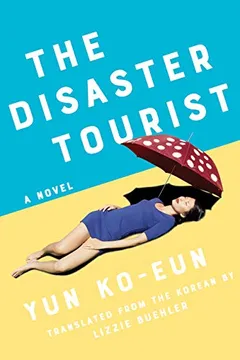
Reviews of The Disaster Tourist are mostly positive, averaging 3.34/5. Readers praise its original premise—a Korean travel agency specializing in disaster zone tourism—and its sharp critique of capitalism, dark tourism, and environmental exploitation. Many admire the mounting dread and satirical wit, with the protagonist Yona's moral complicity proving compelling. Common criticisms include underdeveloped themes (particularly the sexual harassment/MeToo framing used in marketing), occasional translation awkwardness, and a second half that doesn't fully deliver on the setup's promise.
Characters
Yona Ko
Disaster-package architectYona is a veteran programmer at Jungle, skilled at turning disasters into routes, schedules, and saleable experiences. Her curiosity began with questions about what vanishes after catastrophe, but years of work have taught her to approach loss through statistics and logistics. She is observant and capable, yet cautious about conflict, especially when her job and standing are at risk. Her fear of being discarded at work helps explain why she hesitates to challenge authority, even when she recognizes harm. Travel once promised her discovery; Jungle has made it an obligation. Yona’s central struggle is not a lack of moral perception, but whether perception can lead her beyond professional self-protection.
Luck
Mui's observant guideLuck is a young Mui resort employee who helps Yona explore the island and interpret what tourists cannot see. He is attentive to local stories, including the people who have been pushed away from visitor spaces, and he understands how economic rules shape ordinary movement. His quiet humor and curiosity contrast with Yona’s habit of evaluating places through work. Luck carries the memory of losing his parents in the collapse of their home, though he recounts their story with restraint. He is neither a guidebook nor a symbol of local innocence: he is a person making choices within a place where powerful outsiders control access, employment, and the terms of survival.
Junmo Hwang
Freelance disaster storytellerJunmo is a freelance screenwriter who supports himself through assorted jobs and observes travel with the instincts of a storyteller. He is quick, sociable, and confident in his ability to turn people and places into compelling material. His fluency with narrative gives him a sharp understanding of how audiences respond to images of suffering, but it can also distance him from the people represented. Junmo brings Yona into conversation and offers a version of Mui shaped by scripts and scenes. He is an artist whose work depends on other people’s experiences, a tension that makes his charm and professional detachment difficult to separate.
The resort manager
Mui's resort brokerThe manager runs Belle Époque and speaks for the resort’s dependence on outside investment and visitor spending. He can be gracious and accommodating, but his warmth is shaped by calculation: he must keep the resort, its workers, and its business partners afloat. He presents tourism as a route to local recovery, even as the benefits are unevenly distributed. His dealings with Yona reveal how economic desperation can turn moral limits into negotiable obstacles. He is not simply an outsider imposing a plan; he is a local authority acting within a system that rewards him for making Mui legible and profitable to outsiders.
Jo-gwang Kim
Predatory team leaderKim is Yona’s supervisor at Jungle, a competent subordinate who has learned to preserve his authority by weakening employees he dislikes. He uses demotion, workplace custom, and sexual harassment as instruments of control, while relying on colleagues’ fear of professional consequences to keep complaints contained. His abuse is not presented as a sudden aberration but as part of a workplace culture that converts human boundaries into risks employees must manage alone. Yona has worked under him for years, which makes her fear of retaliation as consequential as her anger. Kim represents a familiar form of institutional power: informal, deniable, and backed by rules.
Nam
Unda homestay hostNam is a local woman who guides visitors through the staged homestay and shares practical knowledge of the community. She is skilled with her hands and presents herself with composure, even when tourists bring cameras, assumptions, and expectations into her home. Her presence complicates the visitors’ belief that a purchased cultural experience gives them access to local life. Nam’s work is part of Mui’s tourism economy, but she remains more than the role assigned to her by the itinerary. She embodies the gap between what travelers are told they are seeing and what residents must navigate when their lives become attractions.
Lou
Jungle field guideLou is a Korean guide who spends much of the year leading travellers through Vietnam, Mui, and nearby destinations. Energetic and experienced, she manages the group’s logistics and knows the risks of their route, including the train’s split track. Her confidence in Jungle’s systems sometimes exceeds what those systems can guarantee, but she is not careless; she works within the assumptions and limits of the company she serves. Lou helps make the trip function as a coherent experience, while Yona’s separation from the group reveals how quickly the support built into tourism can disappear.
Choi
HR confidanteChoi is one of the few senior women at Jungle and works in human resources. She makes Yona feel listened to, but her advice is shaped by long exposure to Kim’s behavior and the company’s unequal power structure. Rather than encourage a fight she believes Yona is unlikely to win without lasting cost, Choi counsels her to move on. Her pragmatism is protective and limiting at once: she understands the system well enough to anticipate retaliation, yet her caution also helps that system continue.
The teacher
Traveling schoolteacherThe teacher brings her young daughter to Mui because she believes travel can expand a child’s abilities and understanding. She tries to turn the trip into an educational experience, but the island’s staged history and her daughter’s unpredictable reactions frustrate her expectations. Her effort to teach through travel reflects genuine care, while her moments of impatience show how quickly adults can mistake a child’s questions for disruption.
The teacher's daughter
Unfiltered young observerThe teacher’s five-year-old daughter responds to Mui without the interpretive rules adults bring to disaster tourism. She asks blunt questions, plays with the resort’s controls, and draws images that unsettle the other travellers. Her curiosity is neither wisdom nor cruelty; it is a child’s effort to understand what she sees using the stories adults have given her.
The college student
Idealistic young travellerThe student joins the trip after military service, hoping for an experience that feels more active and socially meaningful than conventional sightseeing. He talks about the trip’s costs and insurance with joking bravado, then becomes uncomfortable when the group’s actions intrude on local homes. His response exposes the distance between wanting ethical travel and knowing how to practice it.
The accordion player
Mui's remembered survivorThe elderly accordion player is presented to tourists as a survivor of Mui’s old violence, performing music despite the apparent limits of his body. His presence gives the visitors a human point of contact with the island’s history, while his later appearance outside that performance unsettles their assumptions about what is genuine.
Plot Devices
Disaster tourism
Packages suffering for saleJungle classifies disasters and assembles them into itineraries that combine viewing, volunteering, education, and adventure. The system gives Yona professional expertise and structures the novel’s journey from Jinhae to Mui. It also converts destruction into a product: travellers receive curated access, while local people become guides, performers, or scenery. The device exposes how tourism can make suffering visible while keeping its causes and ongoing costs out of view. It is not simply the novel’s setting; it is the economic mechanism through which Yona’s work, the visitors’ expectations, and Mui’s future become entangled.
The divided script
Distributes guilt by taskJunmo’s screenplay divides a planned catastrophe into roles, rehearsed lines, transport assignments, and separate work orders. Many participants know only their fragment, while the people in power preserve the larger design. The system makes the event feel less like a decision than a sequence of ordinary tasks, allowing each worker to disclaim responsibility for the whole. The script also blurs performance and reality: invented biographies can attach to real bodies, and Yona’s tourist package can become part of the event it is meant to describe. The device makes bureaucratic compartmentalization physically dangerous.
Crocodile roles
Hides residents in plain sightThe plan labels members of Mui’s unlicensed stilt-house community as crocodiles, assigning many of them silent parts without making clear that the roles entail death. The word turns a vulnerable population into a category that planners can discuss without naming individuals. Its menace is prepared earlier by warnings about crocodiles near the shore and by the community’s exclusion from tourist territory. When Yona receives one of these assignments herself, the label exposes how easily the system can erase even someone who understands its design.
Cameras and images
Turn people into evidenceYona’s camera records the journey, but photographs also shape what tourists believe they have seen and what later audiences seek to consume. The camera’s temporary disappearance brings the visitors into local homes, making the act of documenting part of their intrusion. Later, recovered images help connect Yona, Luck, and Junmo’s script, while visitors use them to press Luck for a story. The device asks who controls an image and whether recording a person preserves their experience or turns it into another attraction.
Paul's permits
Controls who may belongPaul is invoked as a shipping company, investor, employer, and authority able to issue residence permits. Its influence over Mui’s infrastructure and employment makes the residents’ right to remain conditional, even as the company’s plans depend on their labor and bodies. The permits appear to offer a route into formal recognition, which makes them a powerful means of directing people. Their bureaucratic appearance masks the coercion underneath: permission is granted by the same system that decides which lives count as obstacles, workers, or casualties.
Download PDF
Download EPUB
.epub digital book format is ideal for reading ebooks on phones, tablets, and e-readers.








