

Key Takeaways
In Gaza, war becomes the calendar by which ordinary life is measured.
Conflict marks the years. Abu Saif begins on the evening of July 6, 2014, among friends in Jabalia debating whether the first strikes mean war has begun. For people who have lived through repeated assaults, each war marks childhood, adolescence, and adulthood; calm is the interval between them. Jabalia itself has changed from tents to crowded apartment blocks while remaining a refugee camp. More than 100,000 people live there in just 1.4 square kilometers.
A familiar rhythm returns. The first attacks arrive amid Ramadan songs, shisha, and talk about the coming days. The radio shifts from an ordinary discussion to a nationalist song, and explosions replace the evening's familiar sounds. The war does not simply interrupt daily life. Its uncertainty becomes the timetable against which meals, sleep, and family plans are organized.
What's striking is how the diary makes historical repetition felt through domestic time. The opening scene is not a strategic briefing but friends noticing familiar signs and arguing over how serious they are. That gives the reader a way to understand chronic conflict as lived temporality, not just a sequence of dates. It also complicates the language of a sudden outbreak: the evening's uncertainty is real, but the surrounding history makes the danger recognizable. The pattern explains why a cease-fire can feel temporary even before it begins. Repetition shapes expectation without making any individual attack predictable.
Use familiar rituals to give fear a daily shape.
Routine restores a little order. During the bombardment, Abu Saif keeps walking to Jabalia Camp to see friends, share coffee or shisha, and listen to the news. The same people gather in the same rooms; conversation and jokes recur even as the attacks change. At home, family meals and cards fill hours that would otherwise be spent waiting. These routines are not a cure for fear. They make an unpredictable day feel briefly navigable.
Small anchors matter. A sycamore tree's scent tells him he is close to home. The familiar smell helps him complete the anxious walk between his apartment and the camp. Abu Saif also keeps a diary, a practice he has used during earlier wars. Writing gives the day a record and a sequence, even when the future feels impossible to plan.
The diary shows routine as a practical form of emotional regulation. Repeated actions reduce the number of decisions demanded by a frightening environment, while shared rituals preserve social connection when danger encourages isolation. The sycamore's scent adds a sensory anchor: home is not only an address but a bodily recognition. This resembles grounding practices used in trauma care, though the memoir presents it through lived experience rather than a clinical prescription. Rituals have limits. They cannot create physical safety, and routines may be disrupted by displacement or injury. Their value lies in helping people inhabit the time they actually have.
A casualty count hides entire biographies behind every digit.
Numbers compress human lives. As reports accumulate, the death toll rises from individual names to a growing total. By July 22, the radio reports 567 people killed. Abu Saif resists the way a single figure can eclipse the people inside it: children who played football, families preparing food, neighbors with private histories and unfinished plans. The four boys killed while playing on Gaza's beach are not merely a count of four; each had a life that cannot be reconstructed from a ticker.
Witnessing restores particulars. The diary records names, family relationships, favorite places, broken routines, and the aftermath for survivors. It does not argue that statistics are worthless. Counts show scale. But without individual stories, they can make mass death seem abstract, as if more reporting is the same as more understanding.
This tension between aggregate data and individual narrative is central to journalism, public health, and disaster response. Counts can reveal patterns and support accountability, yet human attention often struggles to imagine what a large number contains. Abu Saif's details resist that flattening without asking readers to treat one person's loss as more important than another's. The ethical challenge is not to choose between statistics and stories, but to keep them in view together. Narrative can restore particularity, but it cannot represent every victim or stand in for systematic evidence. It is a necessary correction to abstraction, not a complete record.
Plan carefully, but remember that Gaza offers no guaranteed refuge.
Safety becomes a series of guesses. Abu Saif and Hanna move their children from their apartment in Saftawi to relatives' home in Jabalia, which seems farther from danger. They sleep in a corridor away from outside walls, avoid unnecessary trips, and watch for signs of attacks. Yet schools used as shelters are hit, families are killed after relocating, and supposedly safer neighborhoods come under fire. People divide relatives among different rooms or homes, hoping one group may survive if another is struck.
No perfect route exists. Abu Saif describes people choosing where to shelter, when to travel, and whether to return home, but repeatedly finds that luck can undo sensible precautions. The diary's practical advice is limited to making choices under uncertainty, not discovering a reliably safe place.
The account sharply distinguishes preparedness from control. People can reduce some risks by sheltering away from windows or limiting travel, but they cannot calculate away danger when the threat is extensive and unpredictable. In decision science, this is a problem of acting with incomplete information, except here the cost of a wrong choice is extreme and the available options are constrained. The diary avoids the comforting fiction that survivors must have chosen better than those who died. That matters ethically: survival should not be mistaken for proof of superior judgment, and injury should not be read as evidence of a foolish decision.
Children learn war's rules before adults can explain its end.
Children adapt to what surrounds them. Abu Saif's sons remember earlier wars, ask whether school will reopen, and bargain for small pleasures such as ice cream or time at an Internet café. Their parents must decide what to explain and when. To help his toddler Jaffa manage the explosions, the family tells her they are doors being slammed. She begins calling out about the door whenever a blast sounds. The explanation offers a small foothold in a reality she cannot understand.
Reassurance has no guarantee. Abu Saif repeatedly tells his children that the war may end soon, while admitting privately that he cannot know. Their questions expose the limits of parental protection: a father can comfort, distract, and make plans, but cannot promise safety. Even when a cease-fire arrives, the children need time to trust that it is real.
The children's questions make visible a difficult developmental truth: adaptation is not the same as feeling safe. A child may learn the sounds and routines of danger while remaining frightened by them. The family's invented explanation for the blasts is a compassionate act of translation, not deception for its own sake; it turns an overwhelming noise into something a toddler can name. Yet the father's uncertain reassurances also show how care can require speaking beyond what anyone knows. That tension is familiar in medicine and caregiving: honesty matters, but so does offering steadiness when certainty is unavailable.
Water and electricity shortages turn each household into a logistics center.
Basic services become daily calculations. Electricity arrives unpredictably, sometimes for only a few hours and sometimes not for days. Families charge phones and torches, ration battery use, and try to run water pumps while power is available. Without reliable refrigeration, food spoils; without functioning water supplies, washing and cooking become harder. Abu Saif's father-in-law fills pots and bottles whenever water is available, while the family plans meals around what can be bought and stored safely.
Scarcity changes the work of living. In overcrowded homes and UNRWA schools, people queue for bread, bathrooms, food, and blankets. One shelter described in the diary houses about 2,450 people from 430 families. The effort to keep a household going continues alongside the immediate danger, making ordinary care an ongoing task of coordination.
The diary makes infrastructure legible through its consequences in kitchens, bathrooms, and queues. Electricity is not an abstract measure of capacity; it determines whether water can be pumped, food preserved, or a phone charged for an urgent call. This is a useful corrective to accounts of crisis that focus only on dramatic events. It also reveals how care work expands when public systems fail, often falling on family members and shelter organizers. The household's ingenuity is real, but celebrating resilience alone risks disguising the responsibility of institutions to restore reliable services.
Displacement carries 1948 into the present, one school shelter at a time.
Old displacement meets new flight. Jabalia Camp was established for Palestinians forced from their homes in 1948. In 2014, people again leave neighborhoods such as Beit Hanoun and Beit Lahia and seek shelter in Jabalia's UNRWA schools. The schools fill with families, belongings, and improvised sleeping spaces. Abu Saif's grandmother Aisha had fled Jaffa in 1948 and never returned. Her story gives the present exodus a family history, not only a political label.
The echo is powerful but not identical. Aisha refused to flee again when Israel occupied Gaza in 1967, and Abu Saif connects her decision to his own fear that his children might become refugees. The diary shows how historical memory informs present choices, while the crowded shelters make displacement visible in the ordinary details of the current war.
The return of displacement within a refugee camp creates a striking historical echo: a place formed as refuge becomes a refuge again. Family memory gives that pattern emotional depth, especially through Aisha's lost home in Jaffa. Historical analogy can clarify how displacement persists across generations, but it should not erase differences between particular events or individual decisions. Abu Saif's account keeps those distinctions alive by following specific people, places, and choices. The result is a view of history not as a closed past, but as something that shapes what families fear, what they risk, and what they hope their children will not inherit.
When buildings vanish, the city's memory loses its landmarks.
Destruction changes how Gaza can be remembered. During the war, homes, towers, government compounds, cafés, and cultural spaces are damaged or erased. Abu Saif sees familiar streets become difficult to recognize and worries that his children will not know what once stood there. The Italian Complex and the Zafir Four Tower are not simply structures; they held cafés, homes, work, and shared memories. Their loss removes places where ordinary social life happened.
A tree can hold a map. The scent of an old sycamore on al-Bahar Street guides Abu Saif home and connects him to a landscape that has largely disappeared beneath concrete. His grandmother also taught him to recognize sycamores as traces of Palestinian villages. The city survives in memory, but each destroyed landmark makes that memory harder to pass on.
Place is a form of shared memory. A café, a street corner, or a tree helps people locate their own histories within a city and recognize one another's routines. When those sites disappear, the loss is social as well as architectural. The diary's attention to the sycamore offers a counterpoint to rubble: living landmarks can carry orientation and inherited memory even when the built environment changes. Still, memory cannot replace homes, workplaces, or cultural institutions. The account is strongest when it holds both truths together: people preserve attachment to a place, while the material destruction of that place alters the conditions of belonging.
A cease-fire ends bombardment, not the work of surviving its aftermath.
The celebration is real, but incomplete. On August 26, after 51 days, Abu Saif's family hears that the war has ended. People fill the streets, and his children run out to celebrate. For a moment, survival itself feels like a future. The negotiations raise hopes of an airport, a seaport, open crossings, and reconstruction, but the diary does not treat these hopes as guarantees.
The aftermath exposes the gap. In the afterword, months later, many families remain displaced, destroyed homes are still unrepaired, and the promised aid has barely arrived. A cease-fire changes the immediate danger; it does not restore lost relatives, livelihoods, infrastructure, or trust in tomorrow. Abu Saif holds onto hope, but his account makes clear that rebuilding and support are material necessities, not symbols.
The ending resists the tidy structure of a crisis story in which violence stops and normal life resumes. A cease-fire is a decisive event, but recovery depends on housing, income, public services, and sustained assistance. The afterword also shows how international attention can fade while displacement continues, making the end of visible fighting a poor measure of whether a crisis has ended for those affected. Hope matters here because it keeps the future imaginable. It cannot substitute for reconstruction or accountability. The distinction helps readers understand why declarations of peace need to be judged alongside the conditions people actually live in.
Analysis
The book's achievement lies in its scale of attention. It follows the 2014 Gaza war through a single household, a refugee camp, and a shifting city, yet its subject is larger than one family's survival. Abu Saif shows how military violence reorganizes time, movement, food, sleep, parenting, and memory. His diary keeps returning from the aerial view of casualty totals to the person inside a damaged home, the child waiting for school, or the neighbor carrying water. That movement is not a rejection of political analysis. It demonstrates what political conditions mean in daily life.
The form matters. Dated entries preserve uncertainty as it is experienced, rather than arranging events into a story whose outcome was always known. The reader encounters rumors of truces, improvised judgments about safety, and promises that may or may not be kept. This creates a record of knowledge under pressure: people must act while the information available to them is incomplete and unstable. Abu Saif's recurring descriptions of drones and media coverage also raise questions about distance. A screen can transmit destruction while making the lives inside it seem remote; the diary's intimate details resist that flattening.
The memoir is not a neutral or comprehensive history of the conflict, and it does not claim to be one. It is a situated witness account, shaped by the author's family, neighborhood, political experience, and access to events. Its particularity is a strength, but it cannot stand in for every Gazan's experience or settle every historical dispute. Nor does testimony alone deliver material repair. The book's own afterword insists on this limit: surviving the bombardment is not the same as having a home, livelihood, or secure future restored.
The enduring insight is that ordinary life is not background to war. It is what war repeatedly interrupts and what people continue trying to protect. The diary asks readers to see the human detail behind statistics, and the political conditions behind domestic inconvenience. Its hope is neither easy optimism nor a promise of safety. It is the insistence that a future should still be made possible.
Review Summary
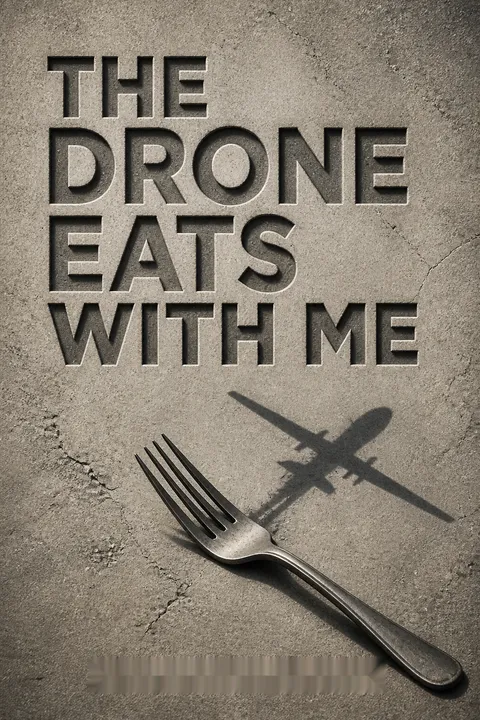
The Drone Eats With Me is a powerful, heartbreaking diary of life in Gaza during Israel's 2014 military operation. Atef Abu Saif's intimate account depicts the daily struggles of civilians amidst constant drone surveillance and bombings. Readers praise the author's raw, eloquent prose and his ability to humanize the conflict. While some criticize the lack of political context, most find it a necessary, eye-opening read that highlights the resilience of Gazans. The book's emotional impact and unique perspective on modern warfare make it a compelling, if difficult, experience for many readers.
Glossary
Zanana
Gazan word for droneA local Gazan dialect word for a drone, described as imitating its persistent buzzing sound. Abu Saif uses it for the aircraft whose noise accompanies daily life during the war, whether or not it is attacking. The word captures how a military technology becomes part of the sensory vocabulary of people living beneath it.
musaharati
Ramadan dawn callerA person who walks through a neighborhood during Ramadan, traditionally beating a drum and singing to wake people for the pre-dawn meal. In Abu Saif's account, each neighborhood has its own musaharati, and residents may offer money or food in thanks at the end of the month. During the bombardment, the familiar calls are disrupted.
suhoor
Pre-dawn Ramadan mealThe meal eaten before dawn during Ramadan, before the day's fast begins. In the diary, suhoor usually takes place around 3:30 a.m. The family tries to prepare and eat together even when explosions, power cuts, and fear disrupt the meal, making it a recurring marker of ordinary life under attack.
iftar
Sunset fast-breaking mealThe meal that ends the daily fast during Ramadan, eaten after sunset. Abu Saif's family prepares it amid attacks and shortages, and he often travels to the camp to share the meal with relatives and friends. The timing of iftar becomes a daily routine around which danger, food, and family gathering collide.
Nakba
Palestinian displacement of 1948Arabic for catastrophe, the term refers here to the 1948 war and the mass displacement of Palestinians from their homes. Abu Saif connects the refugee camps created after that displacement to the later exoduses of 2014, while recounting his grandmother's flight from Jaffa and her permanent loss of home.
First Intifada
Palestinian uprising, 1987-1993The Palestinian uprising against Israeli occupation that began in 1987 and lasted until 1993. Abu Saif recalls growing up in Jabalia during this period, including curfews, street protests, imprisonment, and being shot as a teenager. These memories shape his understanding of the renewed violence in 2014.
UNRWA
UN Palestinian refugee agencyThe United Nations Relief and Works Agency for Palestine Refugees in the Near East. In the diary, UNRWA schools become emergency shelters for people fleeing attacks. Staff organize crowded classrooms, food distribution, and basic rules, while the schools themselves struggle to serve far more displaced people than they were built to accommodate.
humanitarian truce
Temporary pause for reliefA limited pause in fighting described as humanitarian, often intended to let civilians move, obtain supplies, or receive assistance. Abu Saif distinguishes these short pauses from a lasting cease-fire: they offer brief relief, but people remain uncertain whether the attacks will resume. The difference in wording matters because it changes what residents believe they can safely do.
Download PDF
Download EPUB
.epub digital book format is ideal for reading ebooks on phones, tablets, and e-readers.








