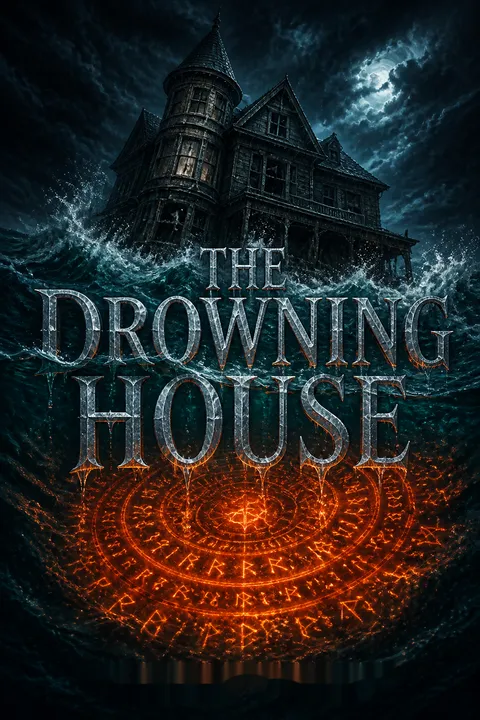


Plot Summary
A House Returns
During a violent storm, a ruined house appears on the beach beside Charlotte Culpepper’s home. Nearly a century old, Charlotte rushes outside without her cane, leaving her grandson Simon to follow. She knows the structure, though it should have been gone for decades, and tries to stop Simon from approaching it.
The old words she once used to command the earth and water have deserted her. As she collapses in the rain, Simon catches her and calls for help. Beyond them, the wreck seems to swallow the darkness around it, and a man moves inside. Charlotte’s terror is not simply fear of a strange building: she recognizes an old danger returning, while the knowledge that might stop it has failed her.
The opening makes memory itself a form of failing protection. Charlotte recognizes the danger, but recognition without the words or strength to act leaves Simon exposed. Her age is not presented as simple frailty: she has lived through an earlier confrontation and carries its cost in her body and mind. The returned house also unsettles ordinary ideas of place. It is not merely debris washed ashore; it has crossed the boundary between past and present, bringing an unfinished history back to the people who tried to bury it.
Leo Enters the Undertow
In 1985, seven-year-old Leo Torres spends a hot day on the beach with Simon and Melissa, both eleven. Melissa mocks Leo as a baby for obeying Charlotte’s warning about the cold, powerful current. Wanting to prove himself, Leo wades past his knees and is abruptly swept out. The frigid water steals his breath and strength, while Simon and Melissa can only shout from shore.
Charlotte runs into the surf carrying a curved horn and stands on a line of black rocks that Leo had never noticed. She hauls him from the water and brings him home coughing and alive. Melissa, who had urged him on, expects to be punished, but Leo’s rescue leaves the children with a mystery about Charlotte and a lasting debt between them.
The rescue establishes the novel’s moral pattern before its supernatural machinery is explained. Melissa’s teasing turns status anxiety into physical danger, while Leo’s wish to belong makes him vulnerable to a dare he knows is unwise. Charlotte’s intervention is both practical and impossible: she saves a child, yet does so using a horn and a path of stones that seem to answer her. The children’s guilt and gratitude become part of their shared history. Later, when they must act together, their childhood roles still matter, but they are no longer enough to define them.
The Shoreline Unanswered
In the present, graphic designer Melissa Toft mistakes Simon’s blank overnight voicemail for a misdial until she reads his email: Charlotte is dead, and something on the beach frightened her. A deputy tells Melissa that Simon’s phone was found inside the house and Simon himself is missing.
She drives from Seattle to Marrowstone, hoping to comfort him, and meets Leo, now a successful real-estate agent. Instead of Simon, they find an enormous, salt-encrusted house dragged onto the shore. Its broken porch and sloping rooms look as if they have endured years underwater.
Leo and Melissa step inside despite the danger, hear the structure crack around them, and glimpse a face near the staircase. They retreat without finding Simon, leaving them with a house that should not be there and a friend who has vanished.
The search begins with an emotional misreading: Melissa assumes Simon needs ordinary help with grief, while the message already hints that the death is connected to something he cannot explain. Her hope that Charlotte’s passing might finally bring Simon closer to the city exposes a private wish beneath her loyalty. Leo shares the urgency but approaches the wreck through his professional attention to buildings. Their distinct habits make them useful partners and unreliable interpreters: Melissa feels the danger before she can name it, while Leo studies its structure even when the structure is actively failing.
Corners Full of Boys
The summers before the storm left clues the children could not interpret. In 1986, Melissa spots a black mark behind basement shelves, but Charlotte redirects her and warns her not to pull anything apart.
A year later, Leo tells Melissa that two boys appear in a living-room corner, crying where no one else can see them; Charlotte accepts his account and treats the children as real. In 1988, Leo’s homemade slingshot brings him to the kitchen window, where he watches Charlotte make his gift rocks roll together without touching them.
She calls them obedient, then leaves them still. The children also spend summers firing fireworks and practicing with the slingshot. Their play, Charlotte’s warnings, and Leo’s sensitivity to the dead will all become important when the adults return to the house.
These memories show how children learn which perceptions adults will permit them to keep. Melissa is curious but easily diverted by Charlotte’s authority; Leo notices what others dismiss, yet lacks the confidence to trust his own account. Charlotte’s responses suggest that she is managing danger through concealment rather than explanation. The basement mark, the unseen boys, and the moving stones are not disconnected oddities. They are pieces of a history that the children are allowed to approach only indirectly. Ordinary play also leaves behind tools and skills that will later outlast the adults’ explanations.
Three Friends, Unevenly Close
As teenagers, Leo confides to Simon that classmates have learned he likes a boy. Simon supports him without making his attraction a reason to change their friendship, giving Leo the reassurance he cannot yet ask for directly. Melissa’s feelings for Simon are less settled.
In 1998, she asks him to leave the island and become her roommate in Seattle, but he refuses because Charlotte depends on him. He promises they can reconsider after Charlotte is gone, and Melissa hears a postponement rather than a promise.
Years later, Simon still keeps Charlotte close while trying to build a life beyond her care. Leo and Melissa remain attached to him, but each measures that attachment differently: Leo hides romantic longing, while Melissa resents being asked to wait for a future Simon may never choose.
The friendship is structured by asymmetry: Leo wants what he does not say, Melissa asks for a future Simon cannot offer, and Simon treats responsibility as a choice that requires no defense. His care for Charlotte is genuine, but it also narrows what his friends can imagine for him. The resulting tension is not a simple contest for his affection. Each friend fears being peripheral to a life that keeps unfolding elsewhere. Their later cooperation will require them to stop using Simon as the measure of their own importance and recognize the separate loyalties each of them has carried.
Charlotte Names the Hunger
By 2017, Simon is worried that Charlotte’s memory is deteriorating. She mistakes him for her dead husband, wanders toward the shore, and speaks as if she is watching for a man who intends to take the island. In 2018, Simon tells Melissa that Charlotte has been found in the basement, gesturing at the shelves and speaking of an unnamed threat.
She has used the old Norse word alaytha and warned that the man will begin with a house, then claim the island. Simon wonders whether illness has tangled her memories, but Melissa recognizes how frightened he is. These conversations establish that Charlotte’s fear predates the storm and that the basement, the shore, and the coming housewreck belong to a danger already pressing against the family.
The book refuses to let the characters cleanly separate dementia from supernatural knowledge. Simon’s care for Charlotte makes him protective, but also encourages him to translate her warnings into symptoms he can manage. Melissa, hearing the account secondhand, is left with a word and an image rather than a coherent explanation. Their uncertainty is psychologically credible: when an elder’s speech becomes fragmented, family members must decide whether to honor its meaning or protect themselves from it. The ominous language about appetite and taking the island also gives the threat a distinctive logic: it seeks expansion, not merely revenge.
A Search Without Simon
After their first look inside the wreck, Melissa and Leo search the woods, beach, and Culpepper home for Simon. The sheriff’s office confirms that he called emergency services after Charlotte collapsed, yet deputies found no sign of where he went.
His phone remains with the police, and the island lacks the resources for a large search operation. While Leo walks the wooded route, he hears someone breathing with difficulty among the trees, then finds no one.
At the house, he and Melissa discover ordinary signs of a life interrupted: Charlotte’s disturbed bed, Simon’s belongings, and unfamiliar bowling shoes and cologne. That night, Leo sees a black shape in a corner turn from quiet crying to a scream before vanishing. Their search has found no friend, but the dead are no longer merely childhood memories.
The failed search turns a missing-person case into a crisis of evidence. Simon is absent from every place where he should be, but each absence can still be explained away: grief, confusion, bad weather, or the limits of local policing. The house’s mundane details intensify that uncertainty because they imply an ordinary person might return at any moment. Leo’s experience complicates the investigators’ lack of evidence. He can perceive the dead, but that ability does not give him control or reliable information. The old haunting has changed in response to the present danger, making fear itself an early warning system.
Tidebury in the Archives
Melissa and Leo question island residents, who remember a house disappearing decades earlier but have largely forgotten the story. At Fort Flagler’s museum, they persuade Mrs. Hansen to open the local newspaper files.
A 1950 clipping identifies the beach house as Tidebury, built by Gunnar Lorentzen for his bride, Alcesta Ellingboe. A 1953 report says a storm washed the house away with the newlyweds, though Alcesta was found alive a week later, injured and silent.
At Charlotte’s burial, an elderly islander reveals that Charlotte, whose birth name was Otelia Ellingboe, had a twin sister named Alcesta. He says the sisters had not spoken since the house vanished. Melissa and Leo learn that Charlotte’s buried family history is directly tied to the wreck now lying beside her home.
The archive supplies facts, but the novel makes forgetting as important as discovery. Tidebury’s disappearance should have been a defining local disaster; instead, the story has thinned into rumor. The same pattern governs the wreck’s uncanny ability to slip from attention. The reveal of Charlotte’s birth name and twin sister also recasts the house as intimate history rather than an anonymous maritime oddity. Melissa and Leo are not simply solving a mystery about architecture. They are uncovering a family conflict that Charlotte kept outside Simon’s inheritance, even as its consequences occupied the ground beneath his home.
Alcesta Breaks Her Silence
Melissa and Leo track Alcesta to a care home near Port Townsend. Though she has scarcely spoken for decades, Alcesta responds when Melissa shows her the runes hidden in Charlotte’s basement. She identifies the design as a protective spell, not ordinary writing, and says Charlotte tried to drown Tidebury during the 1953 storm.
Alcesta reveals that she and Charlotte intended to stop Gunnar, her husband, after discovering he murdered boys and used them in a device called Aleyða. He needed three victims to reach something beyond their world.
One child’s death disrupted his earlier attempt, and the sisters’ magic sent him and the house into the sea, but did not end the danger. Alcesta warns that Gunnar has returned and that Charlotte’s defenses will fail. She dies before Melissa and Leo can ask more.
Alcesta’s account arrives as a damaged testimony, shaped by age, anger, and a lifetime of silence. Its instability does not make it harmless; the details align too closely with the children’s sightings and the strange house. Her accusation that Charlotte acted without her consent complicates the familiar image of a protective elder. The sisters shared a goal but not necessarily a method, and the earlier victory may have been both necessary and morally costly. Alcesta’s warning gives Melissa and Leo an actionable threat, but not a complete manual. They inherit responsibility without inheriting the old knowledge that once made resistance possible.
The Basement Seal Splinters
After returning to Charlotte’s home, Leo goes alone into Tidebury and climbs to its unstable upper floor. There he finds a threatening message and encounters a translucent boy struggling to breathe, who urges him away.
As Leo escapes, Melissa is trapped in a steamy bathroom by water that turns scalding and then freezing. Charlotte’s voice warns her to keep Gunnar out, and Melissa glimpses a man standing motionless outside. Leo admits he saw the ghost and the message.
Together they inspect the basement’s strange, undersized layout and uncover a vast circle of runes behind the shelves. The basement door outside is barred and padlocked, but the symbols are already breaking apart. Their assumption that the house itself can keep Gunnar out collapses with the seal.
The two friends’ separate encounters force them to trust experiences they would once have mocked or minimized. Leo’s ghost gives warning rather than explanation; Charlotte’s voice gives Melissa a command without enough context to obey confidently. The protective circle is a material boundary, yet its failure demonstrates that safety cannot be reduced to locks and walls. The house’s hidden architecture reveals how much of Charlotte’s ordinary home has been built over a prior catastrophe. Melissa and Leo are now inside a defense system they do not understand, with the person who made it gone and its adversary already testing its limits.
Three Victims, One Machine
Melissa finds an investigative article naming three boys who disappeared on Marrowstone in 1953. One, George Morrill, had asthma and was found dead on the driftwood tree; the other two vanished while fishing. Leo understands that Gunnar lacked the third victim needed for his ritual, until he took Simon.
Inside the basement, a grinding sound begins, and the runes rotate before two symbols vanish. Leo breaks through the weakened wall. Melissa follows him into a flooded room containing a crude machine, three examination tables, and jars of human remains.
The newest jars hold red hair and fresh fragments matching Simon. The machine still pulses, and the broken wall admits seawater. Melissa and Leo escape, finally understanding the cost of Gunnar’s work and why Alcesta ordered them to destroy both houses.
The revelation converts absence into evidence, but not into closure. Simon’s fate is strongly confirmed through the body fragments, while the machine’s continued activity means his disappearance has not ended the threat. The three sets of remains turn Alcesta’s metaphor of three dimes into brutal procedure: human beings have been reduced to components in another person’s attempt to reach beyond the world. Melissa’s habit of photographing what she cannot process gives her a way to act, but recording the evidence does not make it emotionally bearable. The friends now face a choice between preserving a home and preventing the machinery of harm from continuing.
Fire Against the Tide
A storm closes in as Melissa and Leo carry propane into Thornbury and pump heating oil into Tidebury. Gunnar raises a wave that flips the fuel truck, but Alcesta appears in ceremonial dress and holds the water back. George’s ghost guides Melissa and Leo to Charlotte’s house, already rotting as the wreck draws its life away.
They use Simon’s fireworks and a trail of gunpowder to ignite Thornbury; the house explodes. When Gunnar still presses the attack, Charlotte joins her sister and raises a giant figure from the beach stones.
As the creature crumbles under the struggle, Melissa loads Alcesta’s fire rune into Leo’s childhood slingshot and shoots it through Tidebury’s window. The resulting blast destroys the wreck, and Charlotte’s stone figure crushes what remains. The storm weakens, and the stones settle back into the shore.
The climax makes inherited knowledge useful only when joined to ordinary skill. The sisters supply supernatural force, but Melissa and Leo must improvise with a real-estate truck, propane, fireworks, and a childhood slingshot. Their tools do not erase the grief of Simon’s death; they let the living refuse to turn his remains into fuel for Gunnar’s ambition. The slingshot carries a particularly intimate charge: an object associated with childhood rivalry becomes the means of a shared act. The houses are not interchangeable symbols. One contains the old mechanism, the other the failed defense built over it, and both must be destroyed to stop the cycle.
Epilogue
In 1953, Otelia Charlotte Ellingboe waits in Alcesta’s house while the sisters argue over how to stop Gunnar. Alcesta has discovered that her husband is dangerous, but the two women disagree about whether their inherited magic can be trusted and how far they should go.
Gunnar’s basement remains locked, and the sisters suspect he is using it for something worse than ordinary murder. They know he wants to summon a force from beyond their world, and that another storm may give them their chance. Otelia takes up a horn, Alcesta retrieves her staff, and they head toward the beach together, united in purpose but not in trust.
The epilogue denies the comfort of a clean origin story. The sisters do not enter the past as a perfectly coordinated pair of heroines; they are already negotiating resentment, doubt, and competing claims to authority. Otelia’s confidence can look like resolve, but it also risks turning practical necessity into moral certainty. Alcesta’s hesitation reflects both fear and knowledge of the cost. Their decision to go to the beach is therefore not a triumphant beginning but a compromised choice under pressure. The reader now knows that the protection of later generations rests on an alliance that was always unstable.
Analysis
The novel builds horror from the unstable relationship between memory and responsibility. Marrowstone’s residents have not simply forgotten a disaster; the vanished house and its history seem to resist being remembered. Local archives preserve only fragments, the townspeople pass along half-remembered stories, and even Simon does not know that his grandmother has a twin. This pattern turns investigation into a struggle against a community’s habits of omission as much as against a supernatural force.
The three friends inherit different forms of knowledge. Leo sees ghosts but cannot make other people share his perception. Melissa can preserve images and connect details, yet she initially treats supernatural explanations as less plausible than ordinary ones. Simon’s absence exposes how much both friends have built their emotional lives around him, and forces them to confront the gap between loving someone and knowing every choice he makes. Their alliance becomes effective only when rivalry gives way to mutual reliance.
Charlotte and Alcesta embody the moral ambiguity of protection. Their earlier attempt to stop Gunnar may have saved others, but it also involved unilateral choices and left the danger sealed rather than ended. The sisters’ estrangement therefore mirrors the friends’ own conflict: shared affection cannot substitute for honest cooperation. Their inherited magic has rules, costs, and limits, but the younger generation receives no complete instruction manual.
The final destruction of both houses is deliberately unlike a tidy restoration. It does not recover Simon or return the island to its earlier innocence. Instead, Melissa and Leo use practical improvisation, remembered skills, and inherited clues to prevent the past from repeating itself. Fire becomes both a literal method and a refusal to preserve structures built around violence. The ending offers responsibility without certainty: the friends can act against what they understand, even though they cannot retrieve everyone the old disaster consumed.
Review Summary
The Drowning House received mixed reviews, with an average rating of 3.42 out of 5. Readers praised the atmospheric setting, creepy premise, and intriguing mystery. Many found the story slow-paced but appreciated the well-crafted characters and eerie vibes. Some readers were disappointed by the lack of resolution and found the supernatural elements confusing. Overall, the book was described as a unique blend of folk horror, mystery, and supernatural elements, appealing to those who enjoy atmospheric, slow-burn horror stories.
Characters
Melissa Toft
The stubborn childhood friendMelissa is a Seattle graphic designer who grew up spending summers on Marrowstone with Simon and Leo. Quick-witted, defensive, and often sharper with people than she intends, she uses humor and practical competence to hide how deeply she fears being left behind. Her attachment to Simon includes genuine loyalty, but also an old hope that he might choose a life nearer hers. She is more skeptical than Leo about supernatural claims, yet she can revise her assumptions when events demand it. Melissa notices images and records what she cannot explain, a habit that makes her a natural investigator. Her emotional challenge is to value friendship without treating another person’s choices as a verdict on her own worth.
Leo Torres
The careful ghost-seerLeo is a Bremerton real-estate agent, Simon’s friend since childhood, and a man who has long perceived ghosts others cannot see. As a boy he was younger, physically smaller, and eager to earn a place beside Simon and Melissa. As an adult he is observant, socially skilled, and keenly aware of how appearance shapes other people’s judgments. He uses professional knowledge of houses to steady himself, even when the buildings he studies defy reason. Leo’s affection for Simon is longstanding but complicated by feelings he struggled to name. His growing partnership with Melissa asks him to set aside old jealousy and trust her judgment as an equal.
Simon Culpepper
The island-bound grandsonSimon is Charlotte’s grandson and the emotional center of the childhood trio. Orphaned young, he grows up on Marrowstone under Charlotte’s care and later builds a career coordinating medical supplies for a nonprofit. He is generous and dependable, but his sense of responsibility can make his choices look like surrender to those who want him elsewhere. Simon is a quiet source of belonging for both Melissa and Leo: he supports Leo’s self-understanding and remains Melissa’s closest link to the summers they shared. He does not reveal every private hope or habit to his friends, which reminds them that intimacy is not the same as complete knowledge.
Charlotte Culpepper
The guarded island matriarchCharlotte raises Simon after the deaths of his parents and tolerates Melissa and Leo through the long, unruly summers of their childhood. She is disciplined, private, and more perceptive than her restrained manner suggests. Rather than explain every danger she recognizes, she controls access to parts of her home and redirects the children when their curiosity approaches what she has hidden. Her kindness is practical rather than sentimental: she gives the children room, but expects them to respect boundaries. Simon’s devotion to her shapes his adult life, while her guarded history leaves him and his friends with unanswered questions about the house and the shore.
Alcesta Ellingboe
The estranged twinAlcesta is Charlotte’s twin sister and the wife of Gunnar Lorentzen. A strong swimmer with a fierce sense of personal agency, she has spent much of her life apart from the sister who once shared her closest history. Her silence and guardedness make her difficult to read, but her anger has purpose: she remembers a danger others have forgotten and refuses to soften its consequences for the sake of politeness. Alcesta’s account is shaped by an old injury as well as by hard-won knowledge. She sees cooperation as essential, yet has little patience for those who mistake good intentions for sufficient preparation.
Gunnar Lorentzen
The vanished house’s masterGunnar is Alcesta’s husband and the builder of Tidebury, a man whose appetite for knowledge, power, and control places him in conflict with the people closest to him. The surviving records establish him as ambitious and difficult to know; Alcesta recalls a husband who kept his aims to himself and treated intimacy as another domain to govern. His interests extend beyond ordinary engineering or domestic life, though the exact reach of those ambitions is obscured by time and the family’s silence. Gunnar matters not only as an individual but as the source of a question the sisters cannot answer safely: what happens when someone believes every limit can be overcome?
George Morrill
The wheezing child ghostGeorge is one of three boys reported missing on Marrowstone in 1953. He had asthma, and Leo recognizes his difficult breathing in the ghost who appears inside Tidebury. George is vulnerable but not passive: he tries to warn Leo and later helps guide Melissa and Leo through danger. His presence connects the island’s old disappearances to the present without giving the living an easy explanation.
David Burton Jr.
A missing island boyDavid is an eight-year-old boy who disappears while fishing in Mystery Bay with his cousin Andrew. His case survives in local records and helps reveal that the island’s old missing-child stories may share a pattern.
Andrew Jansen
A missing fishing cousinAndrew is ten and fishing with his younger cousin David when both boys disappear. Their abandoned boat becomes part of the local history that Melissa and Leo uncover.
Deputy Dave Svenson
The understaffed investigatorSvenson is the Jefferson County deputy who responds to Charlotte’s death and Simon’s disappearance. He takes the friends’ concerns seriously enough to share what he knows, but the small department has few search resources. His practical limits frustrate Melissa and Leo and underline how isolated Marrowstone is from institutional help.
Mrs. Hansen
The local archive keeperMrs. Hansen works at Fort Flagler’s museum and maintains old newspaper clippings and island records. Warm and welcoming to Leo, she helps him and Melissa research the vanished house. Her memory and archives preserve facts that the wider community has allowed to fade.
Ed Nelson
The harbor-side witnessA longtime island resident, Ed remembers hearing that a house once disappeared near the Culpepper property. His fragment of local memory sends Melissa and Leo to search the museum archives.
Anna Alvarez
Leo’s generous auntAnna is Leo’s aunt and one of the adults who helps make his island summers possible. Her nursing work and care for family give Leo a stable home beyond the Culpepper household. She and her husband welcome him as an adult as well as a child.
Marco Alvarez
Leo’s practical uncleMarco is Leo’s uncle, a construction worker who teaches him practical skills and helps him make a slingshot. His steady presence gives Leo a model of hands-on competence and family care.
Dr. Helms
The first responderDr. Helms is a Geological Survey team member who reaches the Culpepper home after Leo’s near-drowning. He checks the boy and confirms that he is recovering, offering the children a calm adult presence amid the confusion.
Plot Devices
Tidebury and Thornbury
Houses that hold historyTidebury is Gunnar and Alcesta’s mid-century home, lost in the 1953 storm and later returned to the beach as a ruined structure. Charlotte’s Thornbury is built on the earlier property and conceals part of Tidebury’s basement. The paired houses make family history physical: the new home is not a clean replacement but a structure layered over an unresolved catastrophe. Their strange resistance to attention also explains why the island has forgotten what happened. In the present, each house becomes part of the danger, so preserving either one is less important than stopping what they contain.
The Runic Ward
A failing supernatural lockCharlotte hides a circle of runes behind basement shelves. Alcesta explains that the symbols work as a spell rather than a sentence, protecting the house through forces associated with earth and growth. The markings behave like a lock, and their gradual damage signals that the protection is failing. Melissa’s photographs let the friends compare the seal before and after it begins to break. The ward gives the story a visible measure of time: each lost symbol makes the hidden room more accessible and the house less safe.
Aleyða
A machine for reaching beyondAleyða is Gunnar’s makeshift device, assembled from electrical parts and marked tables in Tidebury’s hidden basement. Alcesta describes it as a way to contact a terrible place beyond the ordinary world, using three victims as components in its operation. The machine turns a vast supernatural threat into a physical process that Melissa and Leo can discover, document, and attempt to stop. Its rough, almost improvised construction contrasts with the precision of the runic ward and exposes Gunnar’s willingness to treat human bodies as equipment.
The Corner Boys
Ghosts as buried evidenceLeo sees and hears dead children that other people cannot perceive. As a boy, he calls them the boys in the corners; their presence intensifies when the old danger returns. The ghosts do not provide a complete account of the past, but their appearances connect the childhood summer, the 1953 disappearances, and the present search for Simon. Their changing sounds, from quiet crying to urgent screams, turn Leo’s sensitivity into an early warning while also reminding him that seeing the truth does not mean being able to repair it.
The Fire Rune
A small tool with a pastAlcesta leaves Melissa and Leo a rune associated with fire and deliberate use of power. Melissa recognizes its meaning only after studying the basement symbols and seeing Charlotte’s old horn and markings recur in memory. In the climax, she loads the rune into Leo’s childhood slingshot and sends it through Tidebury’s window. The device joins adult knowledge to the friends’ childhood history: the same homemade weapon once used for target practice becomes a means of acting when they cannot safely reach the house.

Download PDF
Download EPUB
.epub digital book format is ideal for reading ebooks on phones, tablets, and e-readers.








