

Key Takeaways
Make Christianity universal without pretending it began outside Judaism
A Jewish beginning. The first Christians were Jews who believed Jesus was Israel’s promised Messiah. They read his life through the Hebrew Scriptures, often in the Greek Septuagint, and initially saw their movement as fulfilling Judaism, not replacing it. Synagogues across the Mediterranean also introduced Gentile God-fearers to Jewish scripture and ethical teaching, giving Christian missionaries a natural first audience beyond Jewish communities.
A difficult widening. The Jerusalem council accepted Gentile converts without requiring circumcision, a decision Paul defended as a matter of equal membership. After Jerusalem’s destruction in 70 and the exclusion of Jews from the city in 135, Gentile churches gained influence. Yet Christianity’s break with Judaism was neither instant nor simple: Jewish Christians became increasingly isolated even as Christian belief continued to depend on Jewish scripture.
The founding tension is not simply between tradition and innovation. Christianity claims continuity with Israel while arguing that membership in God’s people no longer depends on ethnic boundary markers. That combination helps explain both its reach and its later conflicts over scripture and identity. Historically, religious movements often universalize a particular inheritance rather than discard it. The cost is that an expanding community can start treating its origins as someone else’s property. Chadwick’s account makes that danger visible in the marginalization of Jewish Christians.
When founders disappear, communities turn memory into institutions
A contest over truth. Gnosticism was a broad family of teachings that claimed secret insight into the soul’s divine origin and often treated the material world as alien to the highest God. Marcion went further, rejecting the Old Testament and arguing that its God differed from the Father proclaimed by Jesus. Such rivals forced Christians to ask who could authoritatively interpret scripture and preserve apostolic teaching.
Three anchors emerged. Churches increasingly relied on bishops whose authority was traced through apostolic succession, the claimed continuity of church leaders from the apostles. They gradually recognized a New Testament canon, or authoritative collection of writings, and used the Rule of Faith, a concise summary of core Christian teaching, to guide interpretation. These safeguards helped communities share a recognizable tradition, although disputes over which books and interpretations qualified did not disappear.
This is a classic problem of institutional memory: once eyewitnesses are gone, a group needs procedures for deciding which stories count and who may interpret them. The early church’s solutions resemble those of legal systems, which preserve precedent while authorizing interpreters. That architecture can restrain charismatic claims and protect a shared record. It also concentrates power. The important historical point is not that institutions simply defeated free thought, but that communities built them to answer real fragmentation, then had to negotiate the authority they had created.
Make care for vulnerable neighbors part of your public argument
Belief made visible. Christianity spread through many routes, including friendship, persuasion, and the example of martyrs. Its appeal included forgiveness, hope beyond death, and a moral community that asked for personal commitment. But its organized care for the poor, widows, orphans, prisoners, and travelers gave outsiders a practical reason to notice the faith. Christian charity drew on an established Jewish tradition while extending assistance beyond the congregation.
A substantial safety net. By 251, the church in Rome supported more than 1,500 widows and other people in need, alongside its clergy and staff. It also helped poorer churches in regions struck by invasion. This generosity could be exploited, as a satirist’s portrait of a self-serving Christian bishop suggests, but the risks did not erase the institution’s reputation for giving. Christian communities turned moral teaching into material support.
The social force of a moral idea depends partly on whether people can observe it in practice. In that sense, the church’s relief networks functioned as a public demonstration of its claims about human worth. Modern sociology similarly emphasizes that mutual aid can build trust and durable group identity, especially where public welfare is limited. Charity was not the only cause of conversion, and the surviving evidence is strongest for organized urban churches. Still, it complicates any account that treats Christian growth as persuasion alone or persecution as its sole engine.
Persecution was episodic; arguments over compromised leaders endured
Pressure from Rome. Christians rejected sacrifices to the traditional gods and the emperor cult, practices many Romans regarded as ordinary civic loyalty. Yet persecution was usually uneven, shaped by local governors and public pressure rather than a constant empire-wide campaign. When Pliny questioned Trajan around 112, he reported that Christians met, sang to Christ, and pledged to avoid wrongdoing. Trajan allowed trials after formal accusations but discouraged general investigations.
The harder aftermath. Decius required people to prove they had sacrificed, and many Christians complied or obtained certificates. The church then had to decide whether those who had lapsed could return. The later Diocletianic persecution sharpened the issue: some clergy surrendered books to authorities, while others called this betrayal. In North Africa, that conflict helped produce Donatism, a schism that insisted the church must remain pure of leaders compromised during persecution.
External pressure often strengthens group identity, but it can also leave a community arguing over what survival cost. The Donatist split shows how moral credibility can become a test of institutional legitimacy: if a leader failed under coercion, does that invalidate the community’s worship? Similar questions arise in organizations after political compromise or wartime collaboration. Chadwick’s account resists a simple heroic story. Some resisted, some yielded, and the church’s lasting challenge was how to make room for repentance without dismissing the integrity of those who suffered.
Imperial favor ended executions and made emperors church players
A new political bargain. Constantine’s victory in 312 brought Christian communities legal protection, restored property, church buildings, and imperial support. His conversion was entangled with military success and solar symbolism, rather than resembling a clean break from every older religious practice. He favored Christianity but did not make it the empire’s official religion. Theodosius did that near the end of the fourth century.
Nicaea’s unsettled formula. Constantine called bishops together in 325 to address the dispute over Arius, who argued that the Son was inferior to the Father. The council used the Greek term homoousios, meaning of the same substance, to affirm the Son’s full divinity. Most bishops signed, but they did not all understand the term identically. The creed therefore produced a decision without ending the argument. With emperors now intervening in church affairs, theological disagreement became bound up with access to political power.
State protection changes the incentives of religious life. It can safeguard communities from violence while making rulers arbiters of doctrine and church appointments. Nicaea shows why consensus language matters: an ambiguous term may enable agreement, but it can also defer the disagreement beneath it. The parallel to constitutional politics is useful, since durable settlements often depend on shared wording whose interpretation remains contested. Constantine’s role was consequential without being reducible to cynicism or pure religious conviction.
Translate philosophy without surrendering creation or incarnation
A bridge to Greek thought. Justin Martyr called Christianity the true philosophy and argued that truth could be found beyond Israel’s scriptures. He described the divine Logos, or Word and Reason, as active in creation, inspiring the prophets, and fully present in Jesus. Clement of Alexandria likewise treated Greek philosophy as a preparation for Christian understanding. Their approach allowed educated converts to engage classical learning without accepting pagan cults.
A boundary against escape. This engagement also challenged Gnostic accounts that treated matter as evil and Christ’s bodily life as an illusion. Irenaeus taught that salvation restores humanity through Christ, whom he understood as recapitulating, or gathering up and renewing, the human story begun in Adam. Origen used philosophical tools to interpret scripture and understand evil, but kept the Bible central. Together, these thinkers made intellectual adaptation compatible with a real creation and a real incarnation.
Intellectual translation is not passive borrowing. Justin and Clement make Greek concepts serve claims that those concepts could also challenge, especially the claim that God entered material history. This resembles a productive form of interdisciplinary work: imported tools clarify a tradition while the tradition sets limits on their use. The balance is difficult. Too much resistance can make a faith unintelligible to new audiences; too much accommodation can alter its central commitments. The early thinkers’ disagreements show that this was a continuing negotiation, not a finished synthesis.
Give spiritual intensity a community, a rule, and a public purpose
Withdrawal after success. As Christianity gained status and membership in the fourth century, some believers feared that ordinary church life had grown comfortable. Ascetics pursued prayer, self-discipline, and distance from wealth and social ambition. Antony became known for solitary desert life; Pachomius organized communities around work and strict obedience. These paths answered different needs, but solitary practice could become competitive or detached from care for others.
Discipline with neighbors in view. Basil of Caesarea rejected the idea that the monk’s private spiritual achievement was enough. He organized communal life around obedience, restraint, and service, including care for people outside the monastery. In the West, John Cassian carried Eastern monastic teaching to Gaul, while Benedict’s rule emphasized stable community, prayer, and work. The movement preserved ideals of renunciation, but its leaders had to keep it connected to local churches and ordinary human obligations.
Asceticism is often mistaken for simple rejection of society. This history shows a more complicated pattern: withdrawal can critique privilege, create demanding forms of mutual discipline, and provide care, but it can also become a route away from accountability. Sociologically, a rule and a stable community make intense commitments reproducible beyond one charismatic founder. They also constrain the founder’s successors. The recurring question is whether discipline serves shared life or turns spiritual distinction into its own status system.
Protect Christ’s full divinity and humanity without splitting him in two
Two dangers, one question. In the fifth century, theologians argued over how divine and human life were united in Christ. Apollinaris taught that the divine Word replaced Christ’s human mind, which seemed to diminish his humanity. Theodore of Mopsuestia and Nestorius stressed the distinction between the two natures, fearing that a stronger account of unity would make Christ’s human suffering unreal. The dispute involved theology, Greek terminology, popular devotion, and competition among major church centers.
A formula, not a ceasefire. The Council of Chalcedon in 451 described Christ as fully divine and fully human, with the two natures united without being confused or separated. Monophysite Christians rejected the council’s wording, believing it compromised unity; many did not understand themselves as denying Christ’s humanity. Imperial attempts to impose compromise formulas failed to settle the division. The dispute eventually weakened ties between the empire and important Christian communities in Egypt and Syria.
The controversy is not merely verbal. Its competing formulas protect different intuitions about salvation: a savior must truly share human life, yet cannot be merely a human exemplar. The terms also carry institutional weight because a council’s definition determines who belongs to communion. Modern readers should resist treating every opponent label as a fair description of a community’s own belief. The conflict shows how technical distinctions can express genuine concerns while becoming weapons in struggles over rank, jurisdiction, and political allegiance.
Grace debates expose competing accounts of human agency
Can people choose the good? Pelagius feared that appeals to grace could weaken moral responsibility. He argued that people inherit Adam’s bad example, not his sin, and that wrongdoing involves a real choice. Augustine disagreed. Reading human motives through his own experience of moral struggle, he argued that sin damages the will and that divine grace must enable the desire and ability to do good.
A lasting tension. Augustine’s position made grace prior to human merit and, in its strongest form, linked salvation to God’s election. Critics such as John Cassian accepted the need for grace but argued that human response also mattered. Their disagreement was not simply between moral seriousness and laziness. It concerned how responsibility works when desire, habit, and capacity are already shaped by forces beyond immediate choice. The Council of Orange in 529 affirmed the priority of grace without adopting every extreme conclusion associated with Augustine.
This debate anticipates a central problem in moral psychology: choices are real, but they emerge from dispositions and circumstances people did not fully choose. Pelagius protects accountability; Augustine takes seriously how compulsions and damaged desire can make exhortation insufficient. Neither insight cancels the other. Contemporary discussions of addiction, trauma, and social disadvantage face the same challenge: explain constrained agency without treating people as either fully self-made or merely acted upon. Chadwick’s account helps expose the assumptions beneath apparently simple claims about merit.
Treat imperial endorsement as protection and as a new dependency
Church and ruler entwined. Christian emperors could protect churches, but also pressure bishops, impose penalties on dissenters, and intervene in doctrine. Ambrose of Milan demonstrated that church leaders could resist rulers, including by confronting Theodosius after a massacre. Augustine, initially wary of coercion against Donatists, eventually accepted state pressure as a corrective tool. That choice helped justify religious penalties even when intended as pastoral discipline.
Different centers of authority. In the West, Rome’s links to Peter and Paul, and the collapse of imperial administration, strengthened the pope’s claims to wider jurisdiction. In the East, authority remained more closely tied to councils, patriarchs, and an emperor expected to defend orthodoxy. As Germanic kingdoms replaced Roman rule in the West, bishops helped organize local life and missionaries carried Christianity to new peoples. Gregory the Great’s mission to the Anglo-Saxons exemplified the church’s shift toward these emerging societies.
Institutional partnership can produce real public goods, such as protection, education, and organized relief, while making dissent look like disloyalty. Augustine’s reasoning is especially important because coercion appears not as cruelty for its own sake, but as a tool meant to restore people to truth. That benevolent rationale deserves scrutiny precisely because it can expand beyond its original limits. The East-West divergence also warns against assuming that one model of religious authority is historically inevitable: political geography helped shape both.
Build shared worship from inherited forms, then expect them to change
Ritual made belonging tangible. Early Christians gathered weekly for readings, prayer, and the Eucharist, a sacred meal of bread and wine understood in relation to Jesus. Baptism marked entry into the community. Worship drew on Jewish scripture and prayer, while calendars, fasts, hymns, and local customs developed over time. Churches did not begin with one uniform liturgy: regions differed, for example, over when to celebrate Easter.
Art acquired new meanings. Early Christians adapted familiar forms rather than inventing an entirely separate visual language. A shepherd, fish, anchor, or Roman-style basilica could take on Christian significance. After Constantine, public churches and lavish mosaics made the faith visible on a new scale. Images then raised old concerns about idolatry, culminating in the Byzantine icon controversy. Across worship and art, practices that first helped communities express belief could become sources of division.
Ritual and art do more than illustrate ideas. They coordinate attention, make a community’s beliefs memorable, and give people shared actions when doctrine is difficult to explain. Their adaptability helps a religion travel across languages and cultures, but reinterpretation also creates new disputes about what counts as faithful practice. This history resists two easy stories: that Christian worship was fixed from the beginning, or that it was simply copied from pagan society. The forms were inherited, revised, and argued over by communities seeking continuity.
Analysis
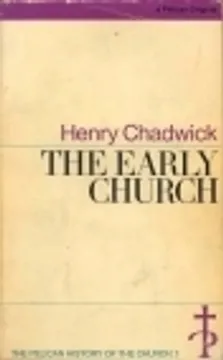
Chadwick presents early Christianity not as a smooth march from persecuted sect to imperial religion, but as a succession of problems created by growth. A Jewish movement had to decide whether Gentiles could join without becoming Jews. Once the first generation of leaders died, communities had to define reliable teaching, scripture, and ministry. Expansion brought charitable reach and intellectual influence, but it also forced choices about discipline, authority, and relations with the state. Each solution stabilized the church while opening another dispute.
The book’s strongest organizing insight is that doctrine and institutions develop together. The canon, episcopacy, creeds, and councils are not detached theological machinery. They answer questions made urgent by competing interpretations and communities separated by geography. Likewise, the disputes over the Trinity and Christ’s humanity were not simply abstract puzzles: they shaped worship, political alliances, and the boundaries of communion. Chadwick’s narrative makes technical theology legible by showing the people and pressures behind it.
The account also complicates easy celebration of Christian success. Charity and care offered an alternative social bond, but the church did not overthrow slavery or consistently protect dissent. Imperial favor ended legal vulnerability for Christians while giving rulers new leverage over religious life. Augustine’s defense of coercion shows how pastoral intentions can legitimize coercive institutions. These tensions are not incidental blemishes on an otherwise linear story. They are part of the history’s central pattern: ideals become institutions, and institutions acquire interests of their own.
As a synthesis first published in 1967, the book is unusually alert to uncertainty in its sources and to the divergence of East and West. Its broad narrative necessarily gives less space to ordinary believers, women’s varied roles, and local differences than to bishops and controversies. Still, its enduring value lies in refusing to reduce early Christianity either to pure spiritual inspiration or to political strategy. It portrays a tradition repeatedly remade through argument, social practice, and imperfect attempts to hold a diverse community together.
Review Summary
Reviews of The Early Church are mixed, averaging 3.94/5. Many praise it as a comprehensive, concise introduction to Christianity's first six centuries, commending Chadwick's clear prose and broad coverage of key controversies, councils, and figures. Critics argue the book adopts an uncritical orthodox perspective, marginalizes women and non-mainstream traditions, and presupposes significant background knowledge. Several reviewers suggest reading the conclusion first. While valued as a foundational survey, some feel it has been superseded by more nuanced, up-to-date scholarship.
People Also Read



Glossary
Gnosticism
Secret knowledge and cosmic escapeA label for diverse ancient religious movements that claimed special knowledge of humanity’s origin and destiny. Many taught that a divine element was trapped in the material world and needed release. Christian Gnostic groups interpreted Jesus and scripture through these systems, but differed widely in myth, ethics, and theology.
Rule of Faith
A summary of core teachingA compact outline of Christian belief used by writers such as Irenaeus and Tertullian to summarize the biblical story of creation, Christ, the Spirit, and resurrection. It served as a guide for interpreting scripture and a response to groups that offered rival accounts of Christian origins and authority.
Apostolic succession
Continuity of church leadershipThe claim that a church’s bishops inherit their teaching authority through an unbroken line of leaders reaching back to the apostles. Irenaeus used this idea against claims of secret teachings, arguing that churches founded by apostles preserved public teaching through successive bishops. The claim also strengthened the bishop’s role as a focus of local unity.
Homoousios
Of the same substanceThe Greek term adopted at the Council of Nicaea in 325 to affirm that the Son shares the same divine substance as the Father. It rejected the claim that the Son belonged to the created order or was inferior to the Father. The term’s meaning was not understood identically by every bishop who accepted it.
Recapitulation
Christ renews humanity’s storyIrenaeus’s account of salvation in which Christ takes up and renews the human story associated with Adam. Humanity’s likeness to God, damaged by sin, can be restored through Christ. This view treats creation as the work of the same God who redeems it, opposing accounts that regard matter as alien to divine goodness.
Donatism
North African church schismA long-running division in North Africa that intensified after the Diocletianic persecution. Donatists argued that church leaders who had surrendered scriptures or otherwise compromised could not validly serve a pure church. Catholics rejected the idea that a minister’s moral failure invalidated a sacrament, and the split endured for centuries.
Monophysitism
One-nature ChristologyA term used for positions that emphasized the unity of Christ’s divine and human nature, especially when rejecting the Council of Chalcedon’s language of two natures. The label covers differing views, and many Christians described as Monophysite believed they were defending Christ’s full divinity and humanity within a unified person.
Henoticon
Imperial formula for reunionA decree issued under Emperor Zeno in 482 to reconcile Chalcedonian and anti-Chalcedonian Christians. It condemned Nestorius and Eutyches and endorsed important Cyrillian language, while avoiding a direct statement about one or two natures in Christ. It briefly restored some unity in the East but failed to satisfy committed supporters of either position.
Filioque
And from the SonA Latin phrase meaning and from the Son, added in the Western tradition to the statement that the Holy Spirit proceeds from the Father. The addition developed in response to theological disputes and became a point of conflict because the Greek East objected that the West had altered the creed of the Council of Constantinople in 381.
Eucharist
Christian sacred mealThe central communal rite in which Christians bless and share bread and wine in remembrance of Jesus and in relation to his body and blood. Early communities treated participation as a defining act of membership. The service included readings, prayer, a sermon, and a meal, with forms and explanations that developed differently across regions.
Download PDF
Download EPUB
.epub digital book format is ideal for reading ebooks on phones, tablets, and e-readers.








