

Key Takeaways
Write so readers spend effort on your idea, not decoding your sentences.
Three tests for prose. Strunk frames effective writing around correct usage, clarity, and precision. He calls these purity, perspicuity, and precision: using accepted English, making meaning unmistakable, and expressing it exactly without waste. Grammar helps a reader follow the thought, but it cannot supply a thought the writer has not formed. The book's foreword urges beginners to write about familiar things before attempting subjects they do not know well.
Clarity serves the message. A large vocabulary is no advantage if readers must stop to interpret it. Choose words your audience understands, and make the sentence's logic easy to follow. The 2018 edition adds an important qualification: English usage changes, so not every rule in the original work remains current.
The book treats grammar as an aid to communication rather than a substitute for ideas, a useful distinction in an age when polished wording can make weak claims sound authoritative. Its three tests can also serve as a revision sequence: first check whether the sentence is intelligible, then whether it says exactly what is meant, and finally whether its conventions fit the audience. The term purity deserves particular care. Standards of correctness can help readers share a page, but they can also mistake a dominant convention for the only legitimate English.
Replace abstractions with details readers can picture and verify.
Specificity creates a scene. The book contrasts a vague report of bad weather with the more definite account of rain continuing through a week. It replaces a character's abstract satisfaction with visible action: a grin, a coin put away. The second versions give readers something to imagine instead of asking them to invent the evidence themselves.
Concrete does not mean exhaustive. Strunk points to Browning's poem about a duke's art collection, where a cherry branch, a white mule, and a bronze sea creature make a character and his world tangible. The point is not to pile on detail. Select the details that carry the meaning, and give examples even when explaining a general principle.
Specificity does double work: it makes prose more vivid and lets readers inspect the basis for a claim. In that sense, concrete writing resembles good data presentation. A broad label invites interpretation; an observable instance gives the audience something to test. The restraint matters as much as the detail. A page crowded with particulars can obscure the point just as easily as abstract language can, so the writer's task is to find the few details that change what the reader understands.
Cut words that add no meaning, while keeping details that sharpen the point.
Concision is selection. Strunk argues that a sentence should contain no unnecessary words and a paragraph no unnecessary sentences. He does not call for uniformly short sentences or skeletal description; each word should earn its place. His revision of a passage about Macbeth reduces 51 words to 26 while preserving the chain of ambition, prophecy, murder, and succession.
Compress the machinery. The book targets padded phrases that can be replaced by a single word, such as using a direct expression instead of a long phrase meaning because. It also warns against explaining one idea in a series of sentences when a clear sentence can carry it. The test is not word count by itself: remove what delays the meaning, not what makes it precise or memorable.
The Macbeth revision demonstrates that editing is not merely deletion. Compression works when it reveals the causal structure, so the reader can see how one event leads to another. This is close to the principle of information design: reduce friction while preserving what a person needs to understand the whole. A useful caution follows from the book's own distinction between concision and thinness. If cutting removes a qualification, an essential distinction, or the evidence behind a claim, the shorter version is not stronger; it is simply less complete.
Name the actor and action when passive wording hides them.
Give verbs real work. The active voice usually makes it clear who acts and what happens. Instead of reporting that a regional survey was conducted, the book's principle favors a sentence saying that someone surveyed the region. Replacing an empty opening such as there were with a concrete verb can make even description more immediate.
Use the passive deliberately. It remains useful when the receiver of an action is the subject that matters, or when the actor is unknown or unimportant. The question is not whether passive grammar is forbidden, but whether it hides the person responsible or weakens the sentence. The book also advises replacing evasive negatives with the definite claim intended, when that claim can be stated accurately.
Voice is more than a matter of energy; it distributes attention and responsibility. In a report about a decision, naming the decision-maker can clarify accountability, while a sentence focused on the affected person may rightly use passive structure. The book's advice is strongest as a diagnostic question: what should the reader notice here? A blanket preference for active sentences can make writers overstate agency when events have no clear actor, so grammatical directness should follow the facts rather than manufacture certainty.
Give each paragraph one job, then show how its evidence earns the claim.
Build around one thought. The paragraph is the book's basic unit of composition. A topic sentence, meaning a sentence that states the paragraph's main point, gives readers a guide to what follows. The remaining sentences can clarify the claim, support it with reasons or examples, and close on its consequence.
Watch the progression. In an example from Stevenson, a paragraph argues that walking alone makes a tour more rewarding. It develops the claim through freedom to choose a route and pace, openness to one's surroundings, and the quiet needed for reflection. The ending gathers those reasons into a larger effect. Narrative paragraphs can work differently, but breaks should still help readers recognize a shift or pause.
A paragraph is a small argument, even when it describes a scene: it establishes a focus, gives the reader material to understand it, and signals when the thought is complete. That structure supports both comprehension and revision. If a paragraph feels shapeless, the writer can ask whether its sentences all serve the same purpose. The topic-sentence rule is a dependable default, not a demand that every paragraph announce itself. Narrative suspense and discovery sometimes work better when the central point emerges through the details.
Put related words together and save the sentence's strongest point for last.
Order carries meaning. Readers infer relationships from where words appear. Keep modifiers beside the words they describe, place a relative clause near the noun it identifies, and avoid separating a subject from its main verb without good reason. This prevents ambiguity, such as a modifier seeming to describe the wrong person or object.
Make the structure visible. Parallel construction means expressing ideas with the same grammatical pattern when they serve the same function. Matching forms help readers recognize a list or contrast as a coherent set. Strunk also recommends placing the new or emphatic information near the sentence's end, where it can receive particular weight. These are choices, not formulas: vary sentence shapes when the thought or desired emphasis calls for it.
Sentence order acts like a visual layout for thought. Parallel forms make comparison easier, while misplaced modifiers force readers to revise their interpretation mid-sentence. Ending on the key point gives the reader a clear landing place, though it is not the only way to create emphasis. Writers can also foreground an idea at the beginning, especially when contrast or urgency matters. The deeper principle is control: syntax should guide attention rather than leave the reader guessing where the sentence is going.
Let punctuation show how ideas connect, not merely where you pause.
Mark the relationship. A comma can separate items in a series or set off an interrupting phrase, but it should not join two complete sentences by itself. A semicolon can link closely related independent clauses; a comma plus a coordinating conjunction can connect them in another way. The book also warns against sentence fragments caused by putting a period where a clause needs to remain attached.
Use commas with care. A nonessential clause adds information without identifying which person or thing is meant, so it is set apart with commas. An essential clause identifies the intended noun and stays connected to it. The 2018 editor notes that style guides disagree about the serial comma, the comma before the final item in a series, so consistency with the chosen guide matters.
Punctuation is a compact map of sentence logic. It tells readers whether information is an aside, a defining condition, or a separate claim, which is why punctuation errors can change meaning rather than merely appearance. The distinction between essential and supplementary information is especially consequential: commas can imply that a clause is optional. The serial-comma disagreement offers a useful reminder that some choices are conventions, not universal laws. Writers should distinguish those from punctuation that protects the sentence's actual structure.
Follow one style guide, but don't mistake inherited rules for grammar.
Conventions can differ. The 2018 edition combines Strunk's early twentieth-century handbook with editorial material on current style and usage. It notes that guides disagree about matters such as the serial comma and capitalization. It also updates older prohibitions: contemporary guides commonly accept beginning a sentence with a conjunction, splitting an infinitive, or ending with a preposition when the result is clear and natural.
Apply rules consistently. Style guides help settle recurring choices about numbers, capitalization, spelling, and wording. Pick the guide appropriate to the setting, then use its conventions throughout. But check whether a rule is genuinely grammatical, a house-style preference, or an older convention that has changed. The book itself repeatedly distinguishes enduring principles from guidance that modern editors would revise.
This edition is most useful when read as both a manual and a record of changing editorial standards. Its added notes prevent the classic's authority from turning every historical preference into a present-day command. Consistency helps readers because it removes distracting variation, but consistency alone does not make a choice correct for every audience. Academic work, journalism, and creative writing may follow different conventions. Good editing therefore requires two judgments: what the sentence needs, and what the publication expects.
Practice on familiar subjects, then learn style by studying skilled writers.
Writing is learned by doing. The foreword compares writing to learning to ride a bicycle: instruction matters, but practice is indispensable. It recommends beginning with things the writer knows firsthand, such as a scene or event recently observed, rather than pretending to know an unfamiliar place or subject.
Study craft, not wording. Strunk advises learning the rules well enough to produce clear everyday prose, then looking to accomplished writers for style. The foreword adds a useful boundary: imitate how strong writers handle language, not their exact sentences. The book is deliberately selective, concentrating on frequent problems rather than claiming to cover all of English grammar. Its rules are tools for drafting and revision, not a replacement for observation, thought, or practice.
The advice joins two kinds of learning that are often separated: deliberate practice and apprenticeship. Writing about familiar material reduces the burden of inventing facts while the writer works on sentence control; reading skilled prose then supplies models of how structure can carry tone and thought. Imitation becomes productive when it is analytical: notice what a writer's choices accomplish, then solve the new problem independently. Otherwise, copying a manner can produce imitation without understanding, the very distinction the foreword draws between learning from style and borrowing language.
Analysis
The book's durable contribution is not a catalog of corrections but a compact theory of readerly attention. Grammar, punctuation, paragraph structure, and word choice all shape how much effort a reader must spend reconstructing the writer's meaning. The most useful rules therefore converge on a single test: does this choice make the thought easier to follow, more exact, or more memorable? The advice to use concrete language, make actors visible, keep modifiers close, and organize paragraphs is not arbitrary polish. Each reduces uncertainty about what refers to what, who did what, and why a detail matters.
The 2018 edition also reveals a tension at the heart of style manuals. Writers need conventions because readers rely on shared patterns, yet those patterns vary by audience and change over time. An inherited prohibition may be repeated as grammar even when contemporary usage accepts the construction. The edition's editorial notes partly solve this problem by distinguishing dated rules from enduring principles, although its added guidance is itself situated in a particular editorial moment. The reader should treat the book's strongest advice as functional rather than ceremonial: choose the construction that communicates clearly, and follow the relevant house style where convention governs.
Its limitations are inseparable from its format. A short handbook can teach reliable defaults, but it cannot make every sentence obey one blueprint. Topic sentences can make exposition navigable and flatten a narrative if imposed mechanically. Active voice can clarify responsibility or falsely assign it. Concision can reveal a claim or strip away necessary qualification. The manual is most powerful not as a list of commandments but as a set of questions for revision: What am I saying? Which words carry it? Can readers identify the relationships among the ideas? What deserves emphasis? Those questions preserve the book's practical discipline while leaving room for judgment, voice, and the changing life of English.
Review Summary
The Elements of Style is widely regarded as an essential guide for writers, praised for its concise rules on grammar and composition. While some find it outdated or overly prescriptive, many appreciate its emphasis on clear, concise writing. Readers value its advice on omitting needless words, using active voice, and choosing precise language. The book's enduring popularity stems from its practical tips and witty examples. However, some critics argue it can be too rigid and may not suit all writing styles. Overall, it remains a influential resource for both novice and experienced writers.
People Also Read

Glossary
Perspicuity
Unmistakable expressionA quality of writing in which the intended thought is expressed clearly enough to avoid misunderstanding. In this book's account of effective prose, perspicuity depends on choosing language whose meaning is definite and not easily confused with another meaning.
Parenthetic expression
Interrupting supplementary materialA phrase or clause inserted into a sentence to add information that can usually be removed while leaving the main sentence complete. The book advises setting such material off with paired commas when the interruption is substantial, rather than placing only one comma.
Parallel construction
Matching grammatical formsThe practice of expressing ideas with similar grammatical structures when those ideas have similar content or function. Matching forms help readers recognize a comparison, contrast, or list as a set. The book applies the principle to series and paired constructions such as either-or.
Loose sentence
Main clause comes earlyA sentence whose main statement appears before additional coordinate material, often clauses joined by words such as and or but. The book accepts occasional loose sentences as natural, but warns that a repeated sequence can become monotonous and weaken a paragraph's rhythm.
Periodic sentence
Main clause comes lateA sentence that delays its principal statement until the end, often after introductory or qualifying material. This arrangement can create suspense and give the final assertion strong emphasis. The book treats it as one possible structure, not a pattern to use uniformly.
False subjects
Empty opening subjectsThe editor's term for opening constructions such as there is, there are, or it was when they displace the sentence's more informative subject. Rewriting the sentence to name the actual actor or subject can make the action clearer and reduce wordiness.
Serial comma
Comma before final list itemThe comma placed before the conjunction introducing the final item in a series of three or more terms. The book's original rule recommends it, while the 2018 editor notes that style guides differ. Writers should follow the convention appropriate to their publication and apply it consistently.
FAQ
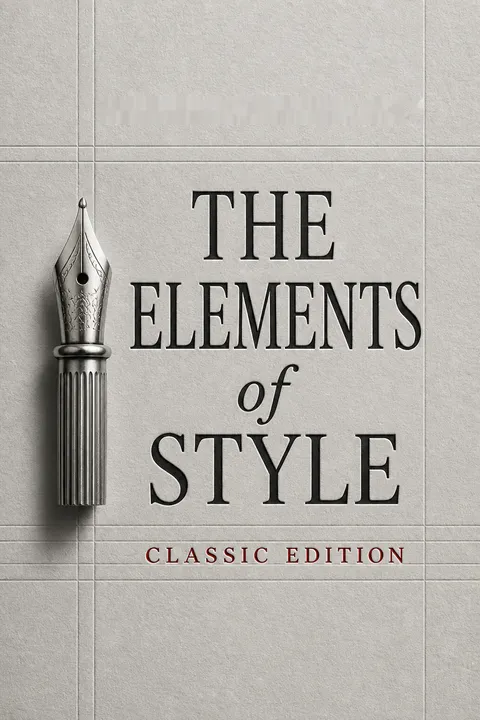
What's "The Elements of Style: Classic Edition (2018)" about?
- Grammar and Style Guide: This book is a comprehensive guide to English grammar and style, originally written by William Strunk Jr. and updated by Richard De A’Morelli.
- Historical Context: It includes the original text from Strunk's 1918 edition, recognized as one of the most influential books in English, with updates to reflect modern usage.
- New Additions: The 2018 edition features new chapters on capitalization and style rules for better writing, along with editor's notes on obsolete grammar rules.
- Practical Application: It serves as a practical resource for students, writers, and anyone looking to improve their writing skills.
Why should I read "The Elements of Style: Classic Edition (2018)"?
- Timeless Advice: The book offers timeless advice on writing clear and grammatically correct prose, which is essential for effective communication.
- Updated Content: The 2018 edition includes modern updates and new chapters that address current grammar and style issues.
- Comprehensive Resource: It covers a wide range of topics, from basic grammar rules to advanced style tips, making it a valuable resource for writers at any level.
- Endorsements: The book is highly recommended by notable authors like Stephen King and has been recognized by Time magazine as one of the most influential books.
What are the key takeaways of "The Elements of Style: Classic Edition (2018)"?
- Grammar Rules: The book outlines essential grammar rules, such as forming possessive nouns and using commas correctly.
- Composition Principles: It emphasizes the importance of clear and concise writing, advising on paragraph structure and active voice usage.
- Style Guidelines: New chapters provide guidance on capitalization and modern style rules, helping writers produce polished final drafts.
- Practical Tips: The book offers practical tips for avoiding common writing mistakes and improving overall writing quality.
What are the best quotes from "The Elements of Style: Classic Edition (2018)" and what do they mean?
- "Omit needless words." This quote emphasizes the importance of concise writing, encouraging writers to eliminate unnecessary words for clarity.
- "Use definite, specific, concrete language." It advises writers to choose precise and vivid language to engage readers and convey ideas effectively.
- "Make the paragraph the unit of composition." This highlights the role of paragraphs in organizing thoughts and ensuring coherence in writing.
- "Place the emphatic words of a sentence at the end." This suggests structuring sentences to emphasize key points, enhancing the impact of the writing.
How does "The Elements of Style: Classic Edition (2018)" address modern grammar issues?
- Editor's Notes: The book includes editor's notes that flag outdated grammar rules and provide updated usage guidelines.
- New Chapters: It features new chapters on capitalization and style rules, addressing common areas of confusion for modern writers.
- Practical Examples: The book offers practical examples and exercises to help readers apply modern grammar rules in their writing.
- Adaptation to Change: It acknowledges changes in the English language over the past century and adapts its advice accordingly.
What are the "Elementary Rules of Usage" in "The Elements of Style: Classic Edition (2018)"?
- Possessive Nouns: Form the possessive singular of nouns by adding 's, with exceptions for ancient names and certain expressions.
- Comma Usage: Use commas in a series of three or more terms and before conjunctions introducing coordinate clauses.
- Sentence Structure: Avoid joining independent clauses with a comma and do not break sentences in two.
- Participial Phrases: Ensure participial phrases at the beginning of a sentence refer to the grammatical subject.
What are the "Elementary Principles of Composition" in "The Elements of Style: Classic Edition (2018)"?
- Paragraph Structure: Make the paragraph the unit of composition, starting with a topic sentence and developing a single idea.
- Active Voice: Use the active voice for direct and vigorous writing, reserving passive voice for specific contexts.
- Positive Form: Put statements in positive form to make definite assertions and avoid weak, negative constructions.
- Concrete Language: Use definite, specific, and concrete language to engage readers and convey ideas clearly.
How does "The Elements of Style: Classic Edition (2018)" guide on capitalization?
- Proper Nouns: Capitalize names of people, places, holidays, and other proper nouns.
- Days and Months: Capitalize days of the week, months of the year, and historic eras.
- Titles and Headings: Capitalize most words in titles, including the first and last words, and significant words in between.
- Personified Nouns: Capitalize nouns when they are personified, such as "Day" or "Night" in poetic contexts.
What style rules does "The Elements of Style: Classic Edition (2018)" recommend for better writing?
- Sentence Starters: It's acceptable to start sentences with conjunctions like "And" or "But," but use sparingly for clarity.
- Split Infinitives: Modern usage allows for split infinitives when they add emphasis or clarity to a sentence.
- Ending Prepositions: Ending a sentence with a preposition is no longer considered incorrect, especially with phrasal verbs.
- Consistency: Maintain consistency in style, such as using digits or spelled-out numbers uniformly throughout a text.
How does "The Elements of Style: Classic Edition (2018)" help with word usage and common mistakes?
- Misused Words: The book lists words and expressions often misused, providing correct alternatives and usage tips.
- Redundancy: It advises against redundant expressions and encourages concise language.
- Adjective and Adverb Confusion: Clarifies the difference between adjectives and adverbs to avoid common errors.
- False Subjects: Warns against using false subjects like "it is" or "there are," suggesting more direct sentence constructions.
What is the significance of the "Study Guide" in "The Elements of Style: Classic Edition (2018)"?
- Overview: The study guide provides a concise overview of the book's content, summarizing key chapters and rules.
- Student Aid: It serves as a helpful tool for students who need to quickly grasp the essentials of English grammar and style.
- Chapter Summaries: Each chapter is briefly summarized, highlighting the main points and rules covered.
- Additional Resources: The guide suggests further reading and resources for those interested in deepening their understanding of grammar and style.
How does "The Elements of Style: Classic Edition (2018)" compare to other style guides?
- Historical Influence: It is one of the most influential style guides, with a legacy spanning over a century.
- Modern Updates: The 2018 edition includes updates that align with contemporary style guides like Chicago Manual of Style.
- Comprehensive Coverage: It covers a wide range of topics, from basic grammar to advanced style rules, making it a versatile resource.
- Practical Focus: The book emphasizes practical application, offering clear examples and exercises to help writers improve their skills.
Download PDF
Download EPUB
.epub digital book format is ideal for reading ebooks on phones, tablets, and e-readers.








