Key Takeaways
1. Cognitive Science's Foundational Circularity
Thus in reflection we find ourselves in a circle: we are in a world that seems to be there before reflection begins, but that world is not separate from us.
Inherent paradox. Cognitive science, in its quest to understand the mind, confronts a fundamental circularity: the very act of scientific inquiry is itself a product of the cognitive structures it seeks to explain. This means the observer is inextricably intertwined with the observed, creating an "entre-deux" or middle space between self and world, inner and outer, that traditional science often ignores. This paradox challenges the notion of a disembodied, objective observer.
Science's self-reflection. When cognitive science turns its gaze inward to study human cognition, it must acknowledge that its descriptions of biological or mental phenomena are themselves products of its own cognitive system. This recursive understanding implies that scientific knowledge is not a neutral, external truth, but a reflection of our embodied cognitive structure, shaped by biological, social, and cultural backgrounds. This layering of reflection can continue indefinitely, highlighting the concrete, particular nature of our own experience.
Beyond extremes. The book argues against two extreme responses to this circularity: either dismissing human self-understanding as false or denying science's ability to understand experience. Instead, it proposes a "circulation" where cognitive science and human experience mutually inform and transform each other. This requires enlarging cognitive science's horizon to include lived experience and developing a pragmatic, open-ended phenomenology of embodiment.
2. The "Self" is an Elusive Construct
For my part, when I enter most intimately into what I call myself, I always stumble on some particular perception or other, of heat or cold, light or shade, love or hatred, pain or pleasure.
Unfindable ego. Both Western philosophical reflection (e.g., Hume) and Buddhist mindfulness meditation consistently reveal that the "self" or "ego" we habitually cling to is not a fixed, independent, or unitary entity. Instead, experience is a rapidly shifting stream of momentary mental occurrences—perceptions, thoughts, feelings—without a constant, abiding experiencer. This insight, known as "selflessness" or "egolessness," directly contradicts our ingrained sense of a stable identity.
Cognitive science's view. Modern cognitive science, particularly cognitivism, reinforces this idea by postulating "sub-personal" mental processes that are inaccessible to consciousness. If cognition can proceed without a conscious, unified self, then the self is not even "needed" for cognition. This leads to a fragmented view of the cognizing subject, where consciousness is just one mental process among many, challenging our intuitive belief in a coherent "point of view."
The aggregates of grasping. Buddhist Abhidharma psychology analyzes experience into five "aggregates" (forms, feelings, perceptions, dispositional formations, consciousnesses). Through mindful examination, one finds no enduring self within any single aggregate or their combination. Our emotional conviction in a "real" ego-self is a deep-seated habit of "grasping" onto these impermanent aggregates, leading to suffering. The self is not absent, but rather an emergent, historical pattern of these momentary formations, devoid of inherent existence.
3. Emergence: Cognition from Self-Organizing Networks
The entire approach depends, then, on introducing the appropriate connections, which is usually done through a rule for the gradual change of connections starting from a fairly arbitrary initial state.
Beyond symbolic processing. Dissatisfaction with cognitivism's sequential, localized symbolic processing led to the "emergence" or "connectionist" approach. This alternative views cognition as arising from many simple, neuron-like components that dynamically connect and self-organize. Instead of explicit rules and symbols, global behaviors and cognitive capacities emerge from the collective activity of these distributed networks.
Self-organization in action. These networks operate without a central processor, with each component acting locally. Global coherence emerges spontaneously when the states of all participating "neurons" reach a mutually satisfactory state. This is exemplified by cellular automata, where simple local rules lead to complex, emergent patterns or "attractors" (e.g., stable configurations, spatiotemporal cycles, chaotic dynamics). This demonstrates how complex properties can arise from simple interactions.
Neuronal emergences. The brain itself is a highly cooperative, densely interconnected system where emergent properties are fundamental. Neuronal responses are context-sensitive and involve reciprocal connections across different brain regions, resembling a "cocktail party conversation" more than a chain of command. Visual perception, for instance, involves the emergence of global states among resonating neuronal ensembles, where individual neurons have multiple, changing responses. This "chunkiness" of transitory configurations aligns with the momentary nature of experience observed in mindfulness.
4. Enaction: Cognition as Embodied Action
In a nutshell, the enactive approach consists of two points: (1) perception consists in perceptually guided action and (2) cognitive structures emerge from the recurrent sensorimotor patterns that enable action to be perceptually guided.
Beyond representation. The enactive approach fundamentally challenges the idea that cognition is the representation of a pre-given world by a pre-given mind. Instead, it posits that cognition is the "enactment" or "bringing forth" of a world and a mind through a history of embodied action. This means the world is not "out there" to be recovered, nor "in here" to be projected, but mutually specified through our sensorimotor interactions.
Perception as guided action. Perception is not a passive reception of information but an active process of guiding action in a local situation. Studies like Held and Hein's kittens or Bach y Rita's tactile vision system demonstrate that active movement and interaction are crucial for meaningful perception. The perceiver's sensorimotor structure, rather than a pre-given world, determines how they can act and be modulated by environmental events, highlighting the inseparability of sensory and motor processes.
Emergent cognitive structures. Cognitive structures, such as categories (e.g., basic-level categories, kinesthetic image schemas), emerge from recurrent sensorimotor patterns. These patterns, rooted in biological embodiment and shaped by cultural context, provide a preconceptual structure to our experience. Color perception, for instance, is not about recovering objective surface reflectances but is enacted through complex, cooperative neuronal processes and cultural history, demonstrating how a cognitive domain is experiential and brought forth.
5. Evolution as Natural Drift, Not Optimal Adaptation
Our perceived world of color is, rather, a result of one possible and viable phylogenic pathway among many others realized in the evolutionary history of living beings.
Critique of adaptationism. The traditional neo-Darwinian view of evolution, which sees natural selection as optimizing fitness for pre-given environmental challenges, is challenged by the concept of "natural drift." This orthodox view, akin to representationism in cognitive science, struggles with issues like:
- Linkage and pleiotropy: Genes have multiple, intertwined effects, making isolated optimization difficult.
- Developmental constraints: Organismal development drastically limits possibilities for change.
- Random genetic drift: Significant genetic changes occur independently of selection.
- Stasis: Species persist with little change despite environmental shifts.
Viability over optimality. Evolution as natural drift shifts focus from prescriptive optimization to proscriptive viability. Natural selection discards what is incompatible with survival and reproduction, but it doesn't dictate an optimal design. Organisms and populations offer tremendous diversity, and evolution proceeds by "satisficing" (finding satisfactory, not necessarily optimal, solutions) through a "bricolage" of possible pathways.
Mutual specification of organism and environment. A core tenet of natural drift is that the organism and environment are not separate but mutually specify each other. The environment is not a pre-given landing pad; it is a "creation" of living beings, and environmental regularities are the result of a conjoint history of codetermination. This view dissolves the nature-nurture dichotomy, emphasizing "ecologically embedded genomes" and histories of structural coupling that enact diverse, viable worlds, rather than optimal adaptations.
6. The Cartesian Anxiety: Our Craving for Foundations
Either there is an absolute ground or foundation, or everything falls apart.
The dilemma of groundlessness. The "Cartesian anxiety" describes the deep-seated human craving for a fixed, stable foundation for knowledge and existence. This anxiety presents a dilemma: either we find an absolute ground (inner in the mind or outer in the world), or we face chaos and confusion. This oscillation between objectivism and subjectivism, driven by the desire for certainty, is a hallmark of Western thought.
Nihilism's root in objectivism. When the search for an absolute ground fails, the grasping mind often recoils into nihilism—the conviction that our highest values are untenable, yet we cannot abandon them. This is not a true letting go, but a reification of absence into an "objective groundlessness," still clinging to the idea of an ultimate reference point. Thus, objectivism and nihilism are deeply connected, both stemming from the same fundamental craving for a stable foundation.
Science's predicament. Cognitive science, by uncovering the non-unity of the self and the enacted nature of the world, inadvertently contributes to this nihilistic predicament. If science reveals no objective self or pre-given world, yet offers no way to embody this realization, individuals are left with a theoretical discovery that clashes with lived experience. This creates a "divided stance" where scientific truth is detached from personal meaning, leading to a sense of gloominess and an inability to live authentically without foundations.
7. Madhyamaka's Middle Way: Embracing Groundlessness
Nothing is found that is not dependently arisen. For that reason, nothing is found that is not empty.
Beyond extremes. The Madhyamaka ("middle way") tradition of Buddhism, particularly through Nagarjuna's philosophy, directly confronts the Cartesian anxiety by offering a path to embrace groundlessness (sunyata, or emptiness) without falling into the extremes of absolutism or nihilism. It argues that all phenomena—subjects, objects, things, attributes, causes, effects—are "codependently originated," meaning they lack any independent, intrinsic existence.
The logic of emptiness. Nagarjuna's arguments demonstrate that any attempt to assert independent existence for a seer, a sight, or the act of seeing leads to logical contradictions. If they existed independently, they wouldn't need each other; if they didn't exist, they couldn't interact. Therefore, they are empty of inherent existence, arising only in mutual dependence. This is not a denial of existence, but a profound insight into the relational nature of reality.
Experiential realization. This philosophical insight is not abstract but deeply experiential, cultivated through mindfulness/awareness meditation. The realization of emptiness is not a negative void but an "openness" and "lack of fixation" that arises when the grasping mind lets go of its craving for foundations. This transformative experience is said to be "natural but shocking," leading to a direct, personal understanding that mind and world are not separate, but mutually revealed.
8. The Two Truths: Conventional Reality and Emptiness
Those who do not discern the distinction between these two truths, do not understand the profound nature of the Buddha’s teaching.
Phenomenal world and ultimate reality. Madhyamaka introduces the "two truths": relative (or conventional) truth and ultimate (or supreme) truth. Relative truth is the phenomenal world as it appears—with people, objects, and coherent laws (like karma). Ultimate truth is the emptiness of that very same phenomenal world, meaning its lack of independent, intrinsic existence. These are not two separate realities, but two ways of understanding the same reality.
Convention is not arbitrary. "Relative" or "conventional" does not imply subjective, arbitrary, or culturally relative in a superficial sense. The phenomenal world operates by clear, lawful principles (e.g., karmic cause and effect), regardless of individual or societal conventions. The "conventional" aspect refers to the fact that things are "nominally designated"—they exist as we designate them, but without an underlying, independently existing referent.
Science in a groundless world. This framework allows for perfectly functional science and daily life. Just as color can be rigorously analyzed scientifically despite having no absolute ground in the physical world or the observer, so too can the world be studied and navigated without clinging to ultimate foundations. Enactive cognitive science and the concept of natural drift align with this, offering a scientific approach that embraces groundlessness without devolving into nihilism or abandoning empirical inquiry.
9. Ethics of Compassion in a Groundless World
The realization of groundlessness as nonegocentric responsiveness, however, requires that we acknowledge the other with whom we dependently cooriginate.
Beyond self-interest. The "Tragedy of the Commons" parable highlights the social science view of the "economic man" driven by self-interest. Mindfulness/awareness reveals that this self-interest is a "business-deal mentality" rooted in the struggle to maintain a separate self. However, the self is always "codependent with other," meaning self-interest is inherently other-directed. True freedom and well-being arise not from satisfying egoistic desires, but from letting go of this grasping.
Emptiness full of compassion. In Mahayana Buddhism, groundlessness (sunyata) is inseparable from compassion (karuna). As practitioners realize the emptiness of ego-self, a natural warmth and inclusiveness emerge, replacing anxiety and irritation. This "absolute bodhicitta" is the fundamental, unconditional goodness of the natural, awake state, manifesting as spontaneous, fearless, and ruthless compassion that is not bound by rules or the need for feedback.
Skillful means and responsiveness. Compassionate action, or "skillful means," is not derived from axiomatic ethical systems but is completely responsive to the needs of the particular situation. It is a "know-how" based on recognizing oneself and others as sentient beings who suffer from ego-grasping. This ethical action is not about self-improvement but about removing egocentric habits to allow wisdom and spontaneous compassion to arise, transforming the aggregates of existence into "five wisdoms."
10. Planetary Thinking for a Transformed Future
When these two planetary forces, science and Buddhism, come genuinely together, what might not happen?
Groundlessness as opportunity. The pervasive sense of groundlessness in contemporary culture, often leading to alienation and nihilism, can be transformed from a negative loss into a positive opportunity. The mindfulness/awareness tradition demonstrates that embracing groundlessness, rather than seeking new foundations, leads to an unconditional sense of intrinsic goodness and spontaneous compassion. This requires a "disciplined and genuine means to pursue groundlessness."
Beyond Western ethnocentrism. The challenge of living without foundations necessitates "planetary thinking," moving beyond the "imaginative geography of 'West' and 'East'." Traditions like Madhyamaka offer rigorous distinctions between nihilistic groundlessness and the liberating groundlessness of the middle way. Integrating these insights with science, as exemplified by Nishitani Keiji, allows for a truly transformative, embodied reflection.
Embodying compassion in science. Science, deeply embedded in our culture, must be involved in this pursuit. The enactive approach in cognitive science, by reconceptualizing science beyond objectivist foundations, provides a framework for this. The goal is to foster an attitude of all-encompassing, decentered, responsive, compassionate concern, not through mere rules or concepts, but through sustained, disciplined practice that releases the grasping mind and its desire for an absolute ground. This convergence of science and Buddhism holds the potential for building and dwelling in "worlds without ground."
Last updated:
Review Summary
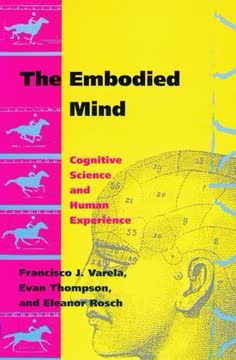
The Embodied Mind receives mixed but generally positive reviews (4.14/5). Readers praise its groundbreaking integration of cognitive science, phenomenology, and Buddhist philosophy, particularly its "enactive" approach rejecting representational models of cognition. Many appreciate its critique of computationalism and connectionism, though some find the Buddhist elements unconvincing or poorly justified. Common criticisms include dense academic writing, incomplete arguments, and inadequate explanations of consciousness. Several reviewers note its historical importance in establishing embodied cognition as a research paradigm, despite finding the book challenging. The meditation/mindfulness framework divides readers—some see it as innovative, others as insufficiently rigorous or "shoehorned in."