

Plot Summary
Prologue
Persia, 358 BC. The dying King Xerxes summons Nebrus, a physician trained by Hippocrates, and recognizes in him the proof that a mysterious elixir once cured a frail young man and allowed him to live for more than a century. Nebrus brings the only tablet describing the discovery.
Both men fear what the cure could mean in the hands of an ambitious ruler. Xerxes decides not to use it. Instead, he and Nebrus begin hiding the knowledge, leaving behind a dangerous trail that will test anyone who tries to follow it.
The opening gives the adventure a moral problem before it gives it a treasure hunt. Xerxes has spent a lifetime exercising power, yet his final choice is whether to extend his own life with a discovery he cannot control. Nebrus’s age makes the elixir’s promise tangible, but neither man treats proof as permission. Their decision to conceal the knowledge transforms the ancient past into an ethical test for Harry: finding the prize will not by itself establish that he, or anyone else, deserves to use it.
The Statue That Wasn't
In Athens, Harry Fox poses as a wealthy buyer of a stolen statue of Zeus. The purchase is a cover for his real purpose: tracing the antiquities sting that ruined his father, Fred, and left him jailed before Vincent Morello hired him.
The Greek sellers spring a robbery, but Harry knocks them down and discovers their promised statue is missing. In its place is a Persian tablet, which he buys at a discount rather than simply stealing it. One seller admits the statue came from American smugglers who vanished after a police informant exposed them.
Harry leaves with the tablet and a lead toward the people who framed Fred. A call from Egyptologist Sara Hamed, who is researching Harry’s inherited amulet, waits unanswered as the new mystery takes over.
The failed transaction gives Harry two motives that are hard to separate: recovering a stolen past and repairing his father’s reputation. His choice to pay the Greeks after they tried to rob him is not innocence; it is professional self-command. He knows that violence could secure the tablet, but a negotiated purchase preserves his access to information. The artifact also shifts the story’s scale. Harry enters Athens seeking evidence in a modern crime, then leaves carrying a message that may connect medicine, kingship, and a centuries-old secret.
Fred Fox's Unfinished Case
Back in Brooklyn, Harry translates enough of the tablet to recognize a tale about Xerxes, a Greek physician, a perilous journey, and a warning against choosing wrongly. The reverse carries a second version with a crucially altered final clue.
Vincent Morello explains how Fred was framed by an informant, then saved Vincent’s life in prison; Vincent later gave Fred work and protection. Harry’s mother died while Fred was imprisoned, making the old case part of Harry’s family history as well as his father’s ruined career.
Vincent promises to ask his police contacts about the forgotten sting. Harry decides the tablet deserves investigation too. Meanwhile, he asks Vincent to look into a buyer for the artifact and chooses to seek an expert who can explain its strange story.
Harry inherits no clean legacy. Fred’s courage binds him to Vincent, while Fred’s wrongful conviction binds him to a justice system that may never correct itself. The tablet offers a second kind of inheritance: a problem that cannot be solved by loyalty alone. Vincent’s affection is genuine, but it comes from a criminal world whose protection also limits Harry’s choices. The competing clues on the stone make interpretation itself a test. Harry must decide whether to treat the past as evidence, myth, or both, while his desire to vindicate his father keeps him moving.
Nora's Crooked Invitation
Manhattan anti-trafficking agent Nora Doyle hears about the tablet from a trafficker she has just arrested. She uses Stefan Rudovic, an Albanian underboss and her compromised informant, to locate the Greek sellers in Toronto.
Their arrest validates her lead, but Stefan passes the tablet story to his boss, Altin Cana, who sees a chance to undermine Vincent Morello. Nora tracks Harry down and offers him protection in exchange for information. Harry refuses to identify himself as a Morello associate or become her source, though he understands the danger of a Cana-Morello conflict.
At the same time, pharmaceutical executive Guy Joyce and his security chief brother Brian force their way into Nora’s investigation. Guy wants the tablet for its possible medical secret, while Brian quietly begins pursuing Harry.
Nora and Stefan both use compromised alliances to reach a larger target, but their motives differ. She accepts moral ambiguity as a cost of recovering stolen history; he treats information as currency that can strengthen his own faction. Harry’s refusal keeps him outside Nora’s legal structure, yet it cannot keep him outside the investigation. Guy’s money adds another kind of pressure: institutions meant to serve the public become access points for private ambition. By placing law enforcement, organized crime, and a corporation on the same trail, the story makes trust less a matter of labels than of what each person is willing to risk.
The Professor's Last Clue
Harry brings the tablet to Columbia scholar Manan Khalidi, who confirms its Old Persian writing and identifies the buried general Megabyzus as the trail’s first destination: his tomb lies at Saqqara, Egypt. Khalidi also recognizes a legend about a sickly Greek physician healed by an elixir.
Soon afterward, Stefan visits the professor under a false name to extract the same information, then pushes him onto subway tracks. Harry, unaware of the murder, is attacked at home by a masked gunman demanding the tablet. He escapes the shooting and hides the stone.
Vincent offers a safe place to stay and supports Harry’s trip to Egypt. Harry also asks Vincent to help Ahmed, whose restaurant is losing customers because it sits between Morello and Cana territory; Vincent refuses to signal weakness by intervening.
Khalidi turns Harry’s vague fascination into a geographical route, but the price of knowledge becomes visible almost immediately. Stefan kills the person best equipped to interpret the evidence, revealing that scholarship is not a neutral refuge from power. The attack on Harry makes the tablet’s value concrete without explaining it. Vincent’s refusal to help Ahmed offers a smaller but revealing counterpoint: his care for Harry coexists with a political code that treats a struggling neighbor as expendable. Harry’s journey therefore begins under two pressures, the danger attached to discovery and the cost of belonging to Vincent’s world.
Saqqara Opens Below
In Egypt, Harry learns from Rose Leroux that Khalidi has died in a subway fall that may not have been an accident. Nora, meanwhile, finds a marked map of Saqqara among the professor’s papers and follows the same clue. At Megabyzus’s tomb, Harry spots four unusual symbols matching the tablet’s unexplained marks.
Turning a carved shield the correct way releases a concealed floor, dropping him into an undiscovered chamber containing bones and a second tablet. He takes the stone, leaves water for the Egyptian officer who falls into the chamber after him, and escapes on a borrowed motorcycle. As Harry tries to leave, Nora runs him down, mistaking him for a threat before explaining that Brian Joyce’s men are also searching the site.
The first physical breakthrough depends on Harry noticing the gap between repeated writing and an unmarked shield. His skill is not simply decoding ancient symbols; it is treating an apparently finished monument as a mechanism with a concealed purpose. The human bones warn that the hiding place may have demanded a terrible price, while Harry’s water for the fallen officer shows that danger has not erased his regard for other people. Nora’s arrival turns a solitary expedition into a contest among hunters. She has followed the same evidence, but cannot yet tell whether Harry is a suspect, an ally, or both.
An Uneasy Alliance
Nora convinces Harry to cooperate by securing an immunity agreement, though he insists on calling Sara, the Egyptologist he trusts, to interpret the new tablet. Sara identifies Persepolis as the next destination, where five royal palaces fit Xerxes’s clues.
She insists on joining them, and Nora agrees that her expertise is essential. Before they leave, Rose arranges for the pair to enter Iran hidden in a cargo plane; Sara travels separately and meets them in Shiraz.
Their uneasy partnership grows more personal as Nora shares the family history behind her drive to serve, while Harry struggles to tell Sara the truth about his work for the Morellos. Meanwhile, Stefan abandons his own attempt to steal the tablet and turns to a more immediate plan against Joey Morello.
The alliance is built less on trust than on a negotiated recognition of dependence. Harry needs Sara’s knowledge, Nora needs Harry’s field experience, and both need a way past the dangers created by Brian Joyce. Sara’s insistence on joining refuses the familiar assumption that expertise should remain safely at a distance. Harry’s concealment of his criminal work complicates the intimacy of their reunion: he trusts Sara with the artifact, but not yet with the truth about himself. Their route into Iran makes that imbalance dangerous, since each person’s choices now expose the others.
A Shot at Joey
Back in Brooklyn, Altin Cana learns that Vincent Morello is gravely ill and orders Stefan to strike at Vincent’s heir, Joey. Stefan tails Joey to Ahmed’s restaurant, then arranges a nighttime ambush disguised as a robbery. He boxes Joey’s car between two hired drivers near a park and moves in with another gunman. The plan collapses when Joey’s men spot a weapon and open fire.
Several attackers fall, and Stefan is nearly trapped until an elderly neighbor, Mrs. Reyna, comes out with a shotgun and drives him from the street. Joey survives, but the violence confirms that Vincent’s health has left the Morellos vulnerable. Stefan escapes without exposing Altin directly, and the family’s coming conflict remains unresolved.
Stefan’s plan depends on controlling appearances: a murder should look like a robbery, and hired outsiders should conceal Cana involvement. The scene dismantles that calculation through the unpredictable presence of a neighbor who refuses to let violence pass as ordinary street trouble. Mrs. Reyna’s intervention also complicates the organized-crime hierarchy. The family’s real protection is not only its weapons or reputation, but a neighborhood whose residents recognize who belongs and who threatens them. Joey’s survival does not resolve the succession crisis; it sharpens it, because Altin has shown that Vincent’s illness can be converted into an attack.
Range Rovers in Iran
On the road to Persepolis, black Range Rovers strike Harry, Nora, and Sara’s car in a planned collision. The attackers are Brian Joyce’s security men, who have followed their trail from Egypt. Harry and Nora free themselves from the wreck, disable the surviving gunman, and escape before the leaking fuel can ignite. Sara is unharmed.
They buy two motorcycles from a village farmer and continue to Persepolis, switching off their phones to frustrate tracking. At the ruins, Sara leads them to Xerxes’s tomb, where a newly installed gate blocks the entrance. Harry squeezes between its bars, then Nora and Sara follow. The three enter the dark tomb together, knowing Joyce’s men may still be close behind.
The ambush strips away the illusion that the expedition is merely a race to an artifact. Guy and Brian’s resources can reach across borders, and their pursuit turns the travelers’ bodies into the immediate stakes of the search. The village farmer’s sale of his motorcycles is a brief exchange of necessity and trust, not a heroic rescue; Harry offers money, and the farmer chooses to help himself. At the tomb, the gate’s flaw rewards physical improvisation rather than authority. The three move forward not because the route is safe, but because standing still would leave them exposed.
The King’s Hidden Cave
Inside Xerxes’s tomb, Sara rejects the upward passage toward the empty burial room and finds Greek writing down a lower tunnel. It names five beacons and points toward the Greek physician Hippocrates. At the tunnel’s end, the travelers recognize an inverted carving of Osiris and a Persian sword.
Harry interprets the carved grooves as instructions: they pull the sword down, then rotate Osiris upright. The floor gives way, revealing a natural cavern hidden beneath the tomb. Rows of rising stone columns cross the cave, with a gold object on the highest pedestal. Before they can inspect it, Brian Joyce arrives with Clay, puts Nora in handcuffs, and aims his gun at Harry and Sara.
The tomb requires the group to combine kinds of knowledge that no single protagonist possesses. Sara reads languages and religious imagery, Harry recognizes a mechanical clue, and Nora’s presence keeps the search tied to the living institutions it has escaped. The inverted Osiris is not a decorative symbol but a command, so interpretation becomes physical action with immediate risk. The newly revealed cavern changes the scale of Xerxes’s concealment: the tomb is a threshold, not the destination. Brian’s arrival interrupts their discovery and converts the final stage from a puzzle into a struggle over who gets to decide what the knowledge is for.
The Emerald Trap
Brian demands the tablet’s meaning, and Sara explains that the clues lead to the king’s wealth. Harry identifies Athena, carved on one line of columns, as a Greek treasure; on the other, he recognizes the Persian king’s image. Clay climbs toward a golden tablet, but pulling it releases a suspended rock that smashes the columns and kills him.
Brian threatens Harry, then Nora strikes him while still handcuffed. As more boulders roll through the cave, she shoots Brian when he aims at Harry. Nora and Sara leap through a breach in the mountain. Harry tears the final tablet from its pedestal and jumps after them as the column breaks apart. They escape Iran with the emerald artifact, while Brian and Clay remain behind.
The climax punishes the attempt to seize the prize without understanding the system that protects it. Brian sees a golden object and treats it as loot; Harry and Sara have learned that each apparent treasure is also an instruction. Nora’s violence is no longer an abstract badge of authority but a desperate act of protection that leaves her responsible for killing Brian. Harry’s final choice to return for the tablet is both courage and the old compulsion to finish the hunt. The escape offers no clean victory: the object survives, but its promised power has not yet been judged.
Epilogue
A week later, Harry finds Vincent transformed by treatment for lymphoma and receives a file on the case that framed Fred, though it does not name the informant. Joey believes Altin Cana arranged the recent attack on him, but Vincent insists on proof before retaliating.
Joey reveals that the gunman who attacked Harry in Brooklyn was Ciro, a gambler whose debt had been bought by an unknown party. Harry explains that the last tablet contains the elixir’s formula, but one ingredient comes from an extinct Aegean frog, making the recipe unusable.
He declines to dwell on the failure and asks Joey to visit Ahmed’s restaurant, now kept open by Albanian partners. Then Sara calls: an authenticated Antony-and-Cleopatra scarab contains a hidden message linked to Harry’s amulet, and she has deciphered it.
The ending gives Harry two kinds of inheritance and denies him a complete answer to either. Vincent’s recovery restores the old center of the Morello family, but the attack on Joey leaves its political future unstable. Harry’s father’s case finally becomes investigable, although the file offers no instant vindication. The elixir’s lost ingredient frustrates the fantasy that historical knowledge can simply be recovered and applied. Meanwhile, Sara’s discovery redirects attention from the emerald formula to Harry’s personal amulet. The adventure closes its immediate pursuit while leaving the deeper family mystery active, so knowledge remains both a gift and a source of obligation.
Analysis
The novel makes historical recovery inseparable from the question of ownership. Harry earns a living moving artifacts through a criminal network, yet he is drawn to objects as records of human choices rather than trophies alone. Nora’s law-enforcement mission is more public-minded, but she too bends rules and relies on compromised partners when official structures fail. Guy treats the same past as intellectual property with commercial potential. Their conflict is not simply between good and evil; it is between competing claims about who may control knowledge and what responsibility follows from finding it.
The tablets make interpretation an action, not an academic exercise. Reading a symbol correctly opens a chamber; reading a clue carelessly can release a trap. Sara’s languages, Harry’s field instincts, and Nora’s practical judgment become complementary forms of intelligence. The story therefore resists the lone-genius model of adventure. Survival depends on collaboration, even when the collaborators mistrust one another or conceal parts of their identities.
The ancient and modern plots mirror each other through leadership under pressure. Xerxes must decide whether his own survival justifies possessing a dangerous cure. Vincent’s illness tests whether Joey can inherit authority without provoking a violent contest. Harry, meanwhile, must decide whether curiosity gives him the right to keep what he finds. The extinct frog prevents the elixir from becoming a simple fantasy of limitless restoration, while the recovered formula still leaves its ethical question alive.
Family legacies shape the search at every scale. Harry pursues Fred’s vindication, carries his father’s amulet, and measures himself against Vincent’s expectations. Yet inheritance is not destiny: Harry’s compassion for Ahmed and his willingness to trust Sara and Nora distinguish his choices from the institutions that raised him. The ending resolves the expedition but not the larger mysteries. Fred’s case remains open, the Morello-Cana conflict threatens to worsen, and the amulet’s message points toward another concealed history.
Review Summary
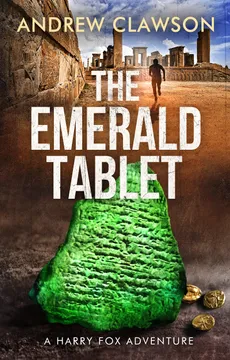
The Emerald Tablet is a thrilling archaeological adventure featuring Harry Fox, a Pakistani-American artifact hunter working for the Italian mob. Readers praise Clawson's blend of historical facts and fast-paced action, likening it to Indiana Jones. The story follows Harry's quest to uncover the secrets of an ancient Persian tablet, facing dangers from rival hunters and authorities. Most reviewers found it engaging and hard to put down, appreciating the well-researched historical elements and complex characters. Some critics felt the plot relied too heavily on improbable events.
Characters
Harry Fox
Reluctant antiquities hunterHarry is a Brooklyn-based artifact hunter who works for Vincent Morello and inherited the role from his father, Fred. His Pakistani heritage and close ties to an Italian crime family make him practiced at navigating rooms where others decide he does not belong. Curiosity drives him as strongly as profit: he pursues the Xerxes tablets because their story feels unfinished, and because his father’s conviction still shadows his family. He is observant, physically resourceful, and protective of people he trusts, though he often keeps them at a distance to spare them danger. His challenge is not simply to find what the tablets conceal, but to decide what obligations come with possessing it.
Nora Doyle
Stubborn recovery agentNora is a Manhattan district attorney’s agent specializing in stolen antiquities. Her father’s work as a prosecutor shaped her belief that recovering cultural objects is a public duty, but she is willing to use informants and personal favors when official channels fail. That pragmatism gives her reach and leaves her vulnerable to manipulation by people with more money or authority. Nora is direct, competitive, and quick to challenge anyone who underestimates her. Her growing cooperation with Harry forces her to work outside the comfortable boundaries of a conventional investigation, while her own sense of responsibility prevents her from treating him as merely a useful source.
Sara Hamed
Persian and Egyptian scholarSara is an Egyptologist at a German university and a longtime friend of Harry’s. She helped interpret the markings on the amulet inherited from his father, and her knowledge of ancient languages, history, and religious iconography makes her essential to the tablet investigation. Sara combines scholarly patience with a willingness to act; she has confronted bullies before and does not accept Harry’s assumption that he must protect her by keeping her uninformed. Their closeness is complicated by what Harry chooses not to tell her about his work. She values evidence, but she also understands that reading an artifact often requires imagining the worldview of the person who made it.
Vincent Morello
Protective crime patriarchVincent is the influential head of the Morello family and the man who gave Fred Fox a place in his organization after Fred saved his life in prison. He treats Harry with paternal warmth, recognizing the same appetite for history that drew Fred into the trade. His generosity is real, but it operates within a rigid code in which strength and reputation protect the family. Vincent can offer Harry resources and shelter while refusing to intervene for someone whose predicament would weaken his standing. He understands power as something maintained through restraint as well as force, and he expects those close to him to think beyond the impulse to retaliate.
Joey Morello
Heir under pressureJoey is Vincent’s son and the expected next leader of the Morello family. Unlike some of the men around him, he has formal business training as well as experience in the family’s operations. His friendship with Harry has grown from guarded acceptance into practical trust, and he helps coordinate the search for the man who attacked Harry. Joey wants to protect the organization his father built, but the transition of power around him makes every decision public evidence of his strength or weakness. He is sociable and capable of humor, though family duty keeps narrowing the room in which he can act freely.
Rose Leroux
The city's trusted fenceRose is a veteran broker of antiquities and other goods with uncertain provenance, trusted across New York’s criminal world. She has known Harry since childhood and worked closely with his father, giving her advice an intimacy that neither Harry nor the reader can take lightly. Rose prizes profit and discretion, yet she also forms loyalties that complicate her strictly commercial reputation. Her connections can secure experts, information, and dangerous travel arrangements. She rarely explains her past or motives, preferring to keep others from believing they can predict her. Harry’s trust in her rests partly on Fred’s judgment and partly on a relationship Rose has helped sustain.
Stefan Rudovic
Informant with divided loyaltiesStefan is an underboss in Altin Cana’s Albanian organization and Nora’s paid source on the antiquities trade. A refugee who grew up without a stable family, he has learned to treat information as protection, leverage, and a route to advancement. He is patient enough to build elaborate schemes and pragmatic enough to cooperate with people he does not trust. Stefan’s exchanges with Nora are never purely civic: he expects favors and uses arrests to weaken competitors. His ambitions place him between Altin’s authority, Rose’s influence, and the Morello family, a position that rewards caution but steadily tempts him to overreach.
Guy Joyce
Pharmaceutical empire builderGuy is the chief executive of Bergen Pharmaceuticals, a company he built through relentless expansion. He sees ancient medicine as a possible path to a discovery with enormous commercial consequences, not merely as an object of historical interest. He is polished, patient, and skilled at turning political donations into access. Guy’s certainty that a major prize may lie behind the tablets gives his pursuit an air of rational investment, even when the evidence remains speculative. His belief that extraordinary knowledge should be acquired and developed reveals how easily a public-facing humanitarian rationale can serve private ambition.
Brian Joyce
Forceful security chiefBrian is Guy’s brother and Bergen’s security consultant, a former Marine whose military identity still shapes how he sees himself. He favors direct action and has little patience for legal or institutional limits when they obstruct a mission. His loyalty to Guy is fierce, but it also makes him an instrument of his brother’s ambitions. Brian’s strength and tactical confidence can make him seem formidable; his need to prove his value, especially beside Guy’s success, can also cloud his judgment. He approaches the tablet trail as an operation to control, rather than a puzzle that may require humility.
Altin Cana
Expansion-minded rival bossAltin leads the Albanian crime family whose Brooklyn territory borders the Morellos’. He resents Vincent’s dominance and interprets signs of weakness as invitations to expand. Rather than act impulsively, he delegates strategy to Stefan and values the distance that deniable violence can provide. His ambition is not only financial; he wants recognition as a power equal to the established Italian families. Altin’s willingness to exploit Vincent’s illness makes the neighborhood’s private rivalries part of the novel’s larger struggle over who gets to define authority.
Fred Fox
Harry's wronged fatherFred was an academic and antiquities expert whose career ended after he was framed in a stolen-artifact sting. Prison brought him into Vincent Morello’s orbit, and his intervention during an assassination attempt created a lasting bond between them. After his wife died, Fred raised Harry while working for Vincent, passing on both a love of history and a habit of noticing what others overlook. Harry remembers him as a model of courage and curiosity, but the circumstances around his conviction remain unfinished in Harry’s mind. Fred’s absence still determines what his son pursues.
Manan Khalidi
Expert on ancient PersiaKhalidi is a Columbia scholar whose expertise in the Achaemenid empire allows him to translate the first tablet and identify Saqqara as Harry’s next destination. He is perceptive enough to infer that Harry sees the artifact as a map rather than a collectible. His academic curiosity is paired with caution: he warns that a plausible historical account is not proof that the promised discovery is real. Khalidi represents the patient work of scholarship, but his knowledge also makes him valuable to people willing to use violence to control the search.
Ahmed
Struggling restaurant ownerAhmed runs Sanna, a Middle Eastern restaurant on the contested edge between Morello and Cana territory. His customers disappear as neighborhood families avoid one another, leaving his business exposed to the rival organizations’ pressure. Harry wants to help him, but Ahmed understands how political boundaries can make ordinary friendship costly. He is proud, hospitable, and reluctant to ask for more than he can repay.
Nebrus
Physician carrying ancient knowledgeNebrus is a Greek physician trained by Hippocrates who travels to the Persian court when Xerxes is dying. His medical knowledge gives him influence, but he approaches the discovery with restraint rather than certainty. The king trusts him as a friend and asks him to help decide what should happen to a dangerous piece of knowledge.
Mrs. Reyna
Neighborhood defenderMrs. Reyna is an elderly neighbor whose home faces the street where Joey’s ambush takes place. She is not part of the gang hierarchy, but she knows how to defend her block when violence arrives. Her watchfulness gives neighborhood loyalty a force the criminals do not anticipate.
Ciro
Debt-bound outsiderCiro is the half-brother of Gio, a bouncer connected to the Morello social world. Gambling debts leave him vulnerable to people who can buy what he owes. His position shows how a person with only a distant tie to the families can still be drawn into their conflicts.
Luke
Greek antiquities traffickerLuke is one of the Greek dealers Harry meets in Athens. He takes part in the attempted robbery, but he also supplies information about the missing Zeus statue and the tablet’s uncertain history. His decisions are governed by survival and the hope of salvaging a failed deal.
Plot Devices
The Xerxes Tablets
A branching ancient mapThe first tablet presents two nearly identical stories with different final instructions; the second confirms that the text describes a staged journey. Each inscription combines historical references with physical clues, requiring Harry, Sara, and Nora to interpret the intended sequence rather than simply translate words. The tablets also attract rival claimants because they may lead to a medical discovery. Their form makes the plot’s central question practical: how can anyone distinguish a true path from a tempting but dangerous alternative?
The Emerald Elixir
A cure with a costThe elixir links the ancient physician’s legend to Guy Joyce’s hope for a modern medical breakthrough. Its reputed ability to restore health gives the tablets value beyond antiquities, while Xerxes’s fear of its power makes the search an ethical problem. The story treats the promise as uncertain until the final tablet explains the formula. Even then, the knowledge cannot be applied because one required ingredient comes from an extinct frog. The cure becomes a measure of human ambition as much as a scientific prize.
Harry's Egyptian Amulet
A family mystery in reserveHarry wears an amulet inherited from his father, and Sara’s Egyptological research has linked its markings to scarabs associated with Mark Antony and Cleopatra. This thread runs beside the Xerxes investigation, giving Harry a personal object that predates his professional life and may contain its own encoded history. Sara’s final discovery, that an authenticated scarab has hidden writing related to the amulet, leaves the immediate adventure complete while opening a new question about what Harry’s father carried.
Tombs as Mechanisms
Architecture that tests interpretationThe trail is built into physical structures. A carved shield in Megabyzus’s tomb turns to reveal a hidden chamber, while the inverted Osiris in Xerxes’s tomb conceals instructions for releasing the floor. Later, the cavern’s columns and suspended boulders turn the search into a lethal mechanical puzzle. These devices reward careful attention to orientation, symbols, and cultural context, but they also make mistaken interpretation immediately dangerous. The ancient builders have hidden knowledge in plain sight by making it appear to be decoration.
Download PDF
Download EPUB
.epub digital book format is ideal for reading ebooks on phones, tablets, and e-readers.








