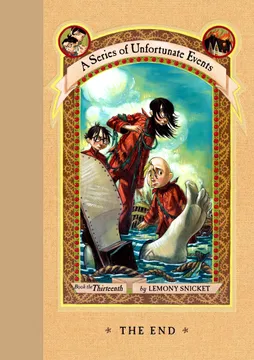


Plot Summary
The Boat Without Wind
After escaping the burning Hotel Denouement, Violet, Klaus, and Sunny drift across the sea with Count Olaf, the enemy who has pursued them for years. The children are wanted for crimes committed during the hotel disaster, while Olaf boasts that he has finally won and claims their fortune will be his.
With no wind, little food, and no way to navigate, the siblings consider pushing him overboard, but hesitate over whether killing him would make them like him. Then a violent storm batters their damaged boat, sweeps its supplies away, and tears the figurehead loose. By morning, the siblings have survived, but their boat is stranded amid wreckage on a vast, shallow coastal shelf.
The opening traps pursuer and pursued in the same fragile vessel, making their usual power arrangement suddenly unstable. Olaf can command the children only while they need one another to survive, and the Baudelaires briefly confront the possibility that their own moral limits may be changing. The storm removes the practical tools that might have restored control, leaving them dependent on chance. Their survival is not a triumph over danger so much as an arrival in a new landscape where every object, and every person, may have washed up from an older disaster.
Friday's Island
Walking west across the wreck-strewn shelf, the siblings find Count Olaf alive and still demanding service. A barefoot island girl named Friday guides them toward her colony, where the castaways wear white robes, drink fermented coconut milk, and let a facilitator named Ishmael decide which salvaged objects are worth keeping.
Ishmael receives the Baudelaires kindly, but insists they surrender their soaked clothes and follow local customs. The children secretly keep Violet's hair ribbon, Klaus's notebook, and Sunny's whisk, which Friday has given her.
Friday explains that the colony sends rejected salvage to an arboretum and that an annual Decision Day offers the only chance to leave. The island promises safety, but its rules already make curiosity feel like disobedience.
Friday's kindness gives the children a first experience of welcome without an immediate threat, yet the welcome is conditional on conformity. Ishmael's repeated claim that he does not force anyone disguises the social pressure built into his authority: the colonists learn to treat his preferences as their own. The Baudelaires respond by preserving small pieces of themselves in secret. Their ribbon, notebook, and whisk are not weapons, but they protect the habits through which each sibling understands the world. The island's apparent peace therefore begins with a quiet tension between belonging and self-erasure.
A Raft of Books
The Baudelaires settle into the colony's bland routine, with Violet assigned laundry, Klaus tending Ishmael, and Sunny helping prepare simple meals. After another storm, they discover a huge raft made from books, with Kit Snicket unconscious on top and the Incredibly Deadly Viper nearby. Count Olaf has reached the shelf too, disguised as a pregnant Kit, but Friday recognizes him and the islanders lock him in a birdcage.
The children identify the real Kit as their injured friend. Ishmael then turns on the Baudelaires when their hidden keepsakes are exposed. He takes the colony away, leaving them beside Kit's raft, their pet snake, and the caged Olaf. The supposedly safe community has judged them without hearing their history.
The raft gathers several strands of the children's past into one startling image: Kit, their old companion, lies atop a makeshift library while Olaf tries to wear her identity. Friday's recognition matters because the islanders do not simply accept the most confident story. Yet their resistance to Olaf does not make their judgment of the Baudelaires just. Ishmael treats concealed keepsakes as proof of unkindness, showing how a community organized around safety can turn rules into moral verdicts. The children lose shelter precisely because they tried to preserve the intellectual and creative selves that the island discourages.
The Cage Holds a Secret
Stranded with an unconscious Kit, the siblings realize they cannot stay on the coastal shelf once the tide rises. Count Olaf offers a plan from inside his cage, then reveals that his pregnant disguise conceals the diving helmet containing the deadly Medusoid Mycelium.
He proposes using its spores to control the colony, but the children refuse to release him. Kit wakes and confirms that she needs help, while two sympathetic islanders secretly bring the exiles food.
They also reveal that a mutiny against Ishmael is planned for breakfast and ask the Baudelaires to find weapons among the discarded salvage. The children agree because Kit needs protection and the shelf is no refuge, though they remain unsure whether the revolt will make anything safer.
Olaf's offer is dangerous partly because it is true: the children have no secure way to survive the rising tide, and he possesses a weapon powerful enough to terrify the colony. Refusing him means accepting risk without pretending that risk can be eliminated. The mutiny repeats the island's central contradiction. Its organizers oppose Ishmael's coercion, yet they plan to use weapons and force against him. The Baudelaires enter the conflict not from loyalty to a faction, but because their injured friend needs shelter. Their choice is pragmatic and uneasy, shaped by responsibility rather than confidence in the rebels.
The Tree's Hidden Library
Following the Viper across the arboretum, the siblings find a concealed room beneath the apple tree. It contains books, rescued documents, a kitchen, and a periscope Ishmael uses to watch for storms. Their parents' handwriting fills the island's record, and Ishmael explains that they once helped build this refuge.
Before Violet was born, they tried to make the colony more open to knowledge and the wider world. Ishmael says he helped drive them away when other castaways feared those changes. He later hid the library, useful tools, fresh water, and varied food from the colonists, using coconut cordial to keep them compliant. He urges the children to abandon their difficult past, then leads them back toward the colony.
The hidden room turns the island's discarded objects into evidence that the colony's simplicity was designed, not natural. Ishmael preserves the very knowledge he denies the other castaways, placing himself in the role of both censor and archivist. His account of the Baudelaire parents complicates the children's longing for safety: their parents once faced the same conflict between shelter and engagement with the world. Ishmael's offer of protection is psychologically persuasive because it speaks to the children's exhaustion. It is also self-serving, since he asks them to accept a society whose comforts depend on other people's ignorance.
Breakfast Becomes Mutiny
When the Baudelaires return, the colony has split into a shouting argument over Ishmael's rules, hidden books, secret lessons, and discarded inventions. In the confusion, mutineers release Count Olaf, who emerges in his costume with the Medusoid Mycelium concealed beneath it and tries to seize control. Ishmael counters with the harpoon gun he had secretly kept rather than sending it to the arboretum.
He fires at Olaf's bulging disguise. The harpoon shatters the helmet, releasing the fungus's spores into the tent, and everyone inhales them. Olaf, Ishmael, the islanders, and the Baudelaires are suddenly poisoned together. The argument over who should rule ends in a shared emergency that no faction can escape.
The mutiny exposes how little distance separates Ishmael's paternal control from Olaf's openly violent ambition. Both men offer the colony a version of safety secured by authority, secrecy, and the threat of punishment. The harpoon shot is meant to end Olaf's control, but it releases the danger Ishmael had spent years trying to contain. The consequence is collective rather than selective: every side is caught in the same poisoned air. This collapse refuses the comforting idea that good intentions or righteous opposition can keep a community untouched by the costs of its choices.
The Bitter Apple Cure
As the spores begin choking them, Ishmael tells the islanders to drink more cordial and wait, but the Baudelaires know the poison acts too quickly. They race to the hidden kitchen beneath the apple tree, searching for horseradish or wasabi, the known antidotes. When neither is among the spices, Klaus searches the enormous record their parents left behind.
Their notes reveal that they had bred horseradish into the roots of the apple tree, making its fruit a remedy. The Incredibly Deadly Viper brings them an apple, and each sibling takes a bite. Their breathing clears as the fungal growth recedes. The discovery saves the children, but the poisoned colonists remain at risk, so Violet, Klaus, and Sunny gather a pot of apples and rush back.
The cure depends on the same qualities the island tried to suppress: close observation, research, invention, and a willingness to consult a complicated record. The parents' notes do not offer an easy escape from the past; they make the past useful at the moment the children need it most. The Viper's unexplained act of bringing an apple also places trust outside human authority, though the siblings cannot know what the animal understands. Their survival immediately becomes a responsibility to others. The remedy changes the question from how to save themselves to whether anyone else will accept help.
The Outrigger Leaves
The children reach the flooded shelf and find Ishmael leading the poisoned colonists away on the outrigger. He tells them the island is no longer safe, while the others blame the Baudelaires and refuse the apples.
Friday chooses to leave with her mother, despite the children's warning that the fruit could save her. As the boat pulls away, the Viper slips off with an apple, the only apparent chance for the departing group. Kit, still on the book raft, tells the siblings that her companions vanished after a mysterious shape rose from the sea.
She confirms Dewey Denouement is dead and that she cannot find the Quagmires. Exhausted and in labor, she gives Violet a family ring and asks the children to care for her baby. They turn back toward shore with Kit.
The departing outrigger is a painful image of people choosing familiar authority over a remedy they distrust. Ishmael's version of safety still persuades the colonists, even after his concealments have been exposed, because fear makes certainty attractive. Friday's departure gives that choice a personal cost: she leaves the first friends she has made outside the island to remain with her mother. Kit's account adds another kind of uncertainty, as the Baudelaires learn that some companions may be lost without proof of what happened to them. The ring and the coming birth redirect the children's attention toward care that can still be given.
Olaf's Last Good Deed
Unable to carry Kit safely from the raft, the Baudelaires ask Count Olaf for help. He first refuses, grieving his own losses and still demanding the fortune he has pursued for years. Then he takes a bitter apple, which clears the fungus from his lungs, and carries Kit through the water to shore. He gives her one final kiss, but neither Kit nor the children mistake this act for a full apology.
Olaf dies on the beach soon after. Kit gives birth to a daughter, then dies from the poison and the strain of labor. The siblings name the baby Beatrice and begin caring for her. Their grief includes Dewey, Kit, their parents, and the uncertain fate of the Quagmires, yet the infant gives them an immediate task beyond mourning.
Olaf's final choice does not erase his history, and the children do not grant him forgiveness simply because he acts bravely once. Still, the act matters: he uses the remedy to become capable of carrying Kit, a person he has harmed, toward help. The ending distinguishes moral change from moral absolution. Kit's death leaves the siblings with grief and an obligation they did not seek, but also with a child whose needs require practical tenderness. They become caregivers not because the world has become safe, but because someone vulnerable has arrived within their reach.
Epilogue
A year later, the Baudelaires are raising Beatrice among the island's salvaged books and tools. Reading their parents' final entry, they learn that their parents chose to leave the island rather than raise children in isolation. Violet decides they should follow that example.
The siblings repair the boat that first brought them there, remove Olaf's nameplate, and prepare to enter the world again. Beatrice approaches the boat and reads its hidden name, though the narrative leaves the moment open to more than one interpretation. The children set out with maps, provisions, and their adopted daughter, ending the chronicle without claiming to know what awaits them.
The final departure refuses to treat survival as a permanent escape from danger. The Baudelaires have built a workable home, but they choose not to confuse shelter with a life fully lived. Their parents' last note reframes protection as preparation: children cannot be kept outside history forever, and a safe enclosure can become another form of confinement. The hidden name on the boat links inheritance with uncertainty. Beatrice enters a story already crowded with secrets, but the siblings carry forward both knowledge and care, not a promise that every mystery will be solved.
Analysis
The novel's final movement tests the Baudelaire siblings' long pursuit of safety by placing them in a community that appears to offer it. Ishmael's island is not simply a haven corrupted by one bad leader. Its customs arise from a recognizable fear of violence and loss, but they transform that fear into restrictions on reading, invention, food, and choice. The cordial and the discarded salvage make the cost of that arrangement tangible: the colonists are protected partly by being kept passive and uninformed.
The Baudelaires have also changed. Earlier, their skills helped them escape immediate threats; here, those same skills preserve other people. Violet's inventiveness, Klaus's research, and Sunny's practical intelligence work together to uncover the remedy their parents left behind. The parents' records do not deliver complete certainty about family history or the fate of the children's friends. Instead, knowledge becomes useful without becoming total. The siblings can act on what they know while accepting what remains unresolved.
Olaf's final assistance complicates the moral pattern without cancelling it. He performs one necessary act of care, but the children do not mistake it for a history repaired. That distinction gives the ending more ethical weight than either simple punishment or easy redemption would allow. The same is true of the departing islanders: they may have a chance at survival, but the story does not grant the siblings control over their choice.
The book closes by shifting the children from orphans to caregivers and then, in the final coda, back toward the wider world. Their decision to leave the island rejects both Olaf's domination and Ishmael's protective enclosure. The title's promise of an ending remains deliberately incomplete: mysteries persist, grief persists, and the next generation begins anyway. What the siblings inherit is not a guarantee of safety, but the tools and relationships needed to meet uncertainty together.
Review Summary
The End receives mixed reviews from readers. Many feel disappointed by the lack of answers to long-standing mysteries and the open-ended conclusion. Some appreciate the philosophical themes and character development, while others find it anticlimactic. The book's dark tone and exploration of moral dilemmas are praised. Fans express sadness at the series' conclusion but fondness for the Baudelaire orphans' journey. Overall, readers are divided on whether the ending is a fitting conclusion to the beloved series.
People Also Read


Characters
Violet Baudelaire
The resourceful inventorThe eldest Baudelaire sibling approaches danger by studying what is available and building a way through it. Her inventiveness is practical, not ornamental: she notices how materials might be repurposed and accepts responsibility when others depend on her ideas. Violet often tries to protect her younger siblings, but the island's rules test whether protection means obedience or independent judgment. Her attachment to her hair ribbon, like her habit of tying up her hair before concentrating, reflects how personal identity and skilled work remain linked for her. She values loyalty, yet she is willing to question leaders whose version of safety requires silence.
Klaus Baudelaire
The careful researcherKlaus is the middle Baudelaire child, whose memory and reading turn scattered facts into usable knowledge. He keeps a commonplace book because recording information gives him a way to resist confusion and preserve what others might overlook. On the island, the absence of books weighs on him as much as the limits on his freedom. Klaus is cautious about violence and skeptical of easy claims, but his caution does not prevent him from acting when his siblings or friends need help. His curiosity is more than an appetite for facts: it is a form of care, a way to understand what danger is and what response might actually work.
Sunny Baudelaire
The inventive young chefThe youngest Baudelaire has grown beyond infancy, though her speech remains distinctive and often compresses a sharp judgment into a single word. Sunny's unusually strong teeth and emerging skill in the kitchen make her a resourceful partner to her older siblings. She notices possibilities that others miss, including how a simple utensil or ingredient might change a meal. Her fierce loyalty is paired with a clear moral instinct; she can recognize when an argument is disguising selfishness. Sunny is not merely protected by Violet and Klaus. Her observations and practical abilities repeatedly help shape what the three of them do next.
Count Olaf
The relentless pursuerCount Olaf is a theatrical, manipulative man who has spent years pursuing the Baudelaire fortune through disguises, threats, and elaborate schemes. He treats other people as instruments, and his confidence depends on making them believe he has more control than he does. His contempt for the children coexists with a shrewd understanding of how fear and ambition move people. Olaf's presence forces the Baudelaires to consider not only how to escape him, but what it means to resist cruelty without becoming cruel themselves. His recurring disguises make identity a weapon: he uses appearance to exploit other people's assumptions.
Ishmael
The island's facilitatorIshmael presents himself as a gentle mediator whose customs protect a colony of castaways from the world's dangers. His apparent physical limitations and calm manner encourage others to defer to him, while his repeated insistence that he does not force anyone disguises the pressure his authority exerts. He believes that limiting knowledge and choice can prevent conflict, a paternal logic that grows from fear rather than simple malice. Yet he preserves the books, tools, food, and history he denies to others. Ishmael's contradictions make him a revealing counterpart to the Baudelaires: he, too, wants safety, but he is willing to purchase it by deciding what other people are allowed to know.
Kit Snicket
The injured volunteerKit is a volunteer and an ally of the Baudelaire children, driven by a sense of duty to help others and pursue justice. She arrives at the island injured, pregnant, and carrying the weight of failed plans involving the children and their associates. Her willingness to admit uncertainty distinguishes her from leaders who promise safety through control. Kit has deep ties to V.F.D. and to the Snicket family, but she is not defined solely by its secrets. She is a determined, imperfect person whose responsibilities often exceed her ability to protect everyone she cares about.
Friday
The island's questioning girlFriday is the first islander to welcome the Baudelaires, and her courtesy contrasts with Count Olaf's demands. She has spent her life within the colony's customs, yet she is curious about books, cooking, and experiences Ishmael discourages. Her small acts of independence show how questioning can begin before someone has the language or confidence to openly resist a system. Friday cares deeply for her mother and wants to believe the island is safe, which makes her choices more complicated than simple rebellion. She is both a guide to the colony and a young person beginning to notice its limits.
Mrs. Caliban
Friday's protective motherMrs. Caliban is Friday's mother and one of the colony's cooks. Her wish to protect her daughter comes from a life shaped by loss and isolation, so the island's distance from the world feels to her like a necessary defense. She helps care for newcomers, but also supports customs that restrict what Friday can learn. Her care is sincere, even when fear makes it limiting. Through her relationship with Friday, the story shows how protection can become a form of control when a parent mistakes keeping a child uninformed for keeping her safe.
Beatrice
The new family memberBeatrice is a baby whose arrival binds the Baudelaire and Snicket families through an inherited naming custom. She is curious and eager to explore, requiring the siblings to turn their skills toward the daily work of care. Her presence gives the older children a responsibility that is not based on solving a mystery or defeating an enemy. Beatrice also represents a new life entering a world whose history remains unfinished. The Baudelaires cannot spare her every danger, but they can give her attention, knowledge, and companionship as she grows.
The Incredibly Deadly Viper
The loyal reptileThe Viper is a remarkably gentle snake once befriended by the Baudelaires. Its misleading name invites fear, but the creature behaves with unusual loyalty and repeatedly stays close to the siblings. Its journey to the island makes it a living link to their earlier experiences and to people they miss. The Viper cannot explain its motives, and the story does not turn it into a human substitute; its significance lies in the trust the children share with an animal whose actions sometimes help when human systems fail.
Dewey Denouement
The lost volunteerDewey is a volunteer associated with the Hotel Denouement and a figure whose fate weighs on both Kit and the Baudelaires. He belongs to the network of people who attempt to oppose the world's dangers through coded work and mutual aid. His absence from the island becomes a painful uncertainty for the children, who must face the difference between hoping for someone and knowing what happened to them.
The Quagmire triplets
The missing alliesDuncan, Isadora, and Quigley Quagmire are friends of the Baudelaires who travel with a self-sustaining airborne home. Their intelligence, resourcefulness, and shared history make them important allies, even when distance keeps them apart. Kit's account leaves their immediate fate uncertain, preserving the emotional reality of the siblings' continuing hope for them.
Captain Widdershins
The submarine captainCaptain Widdershins is a volunteer whose submarine and crew are connected to Kit's final sea voyage. He represents the practical, often improvised side of V.F.D.'s work, where rescue depends on machines and people willing to take risks.
Fiona
The conflicted volunteerFiona is a young volunteer with a talent for mycology and a personal connection to Klaus. Her divided loyalties make her difficult for him to understand, while her knowledge of fungi becomes part of the dangers surrounding the children.
Plot Devices
Medusoid Mycelium
The airborne poisonThe Medusoid Mycelium is a deadly fungus carried in a diving helmet, with spores that poison anyone who breathes them. Its danger is introduced before the island conflict, when the Baudelaires recognize the helmet as something Olaf might use to threaten them. Olaf hides it beneath his disguise, and Ishmael's decision to fire a harpoon at him shatters the helmet. The fungus then turns the colony's argument into an immediate collective crisis. Its plot function is to make old suspicions physically urgent and to force characters who disagree about authority to confront a danger they cannot solve separately.
The Bitter Apple Tree
The parents' hidden remedyThe apple tree shelters the island's forbidden arboretum and the archive beneath its roots. The Baudelaires' parents bred horseradish into the tree, making its bitter fruit capable of countering the Medusoid Mycelium. The siblings discover this remedy by reading their parents' records when familiar spices fail. The apples connect botanical knowledge to family history: the parents prepared for a danger the children had not known was waiting. The fruit can save the siblings, but the islanders' refusal to accept it shows that possessing a remedy is not enough when fear has already shaped what people trust.
Coconut Cordial
Comfort that dulls resistanceThe islanders drink fermented coconut milk at every meal and offer it to newcomers as part of their customs. The cordial is sweet and intoxicating, and Ishmael relies on its drowsy effect to discourage complaints and difficult questions. At first it seems merely like an odd local drink, but its role in maintaining the colony's passivity becomes clear when the Baudelaires learn more about Ishmael's rule. The cordial embodies the island's bargain: comfort and belonging are available, but they come at the cost of alertness and independent judgment.
The Island Archive
History hidden beneath rootsThe concealed library beneath the apple tree contains salvaged books, documents, tools, a kitchen, and a periscope. It exposes the gap between Ishmael's public account of the island and the private knowledge he has kept for himself. The archive also preserves the Baudelaire parents' handwriting, allowing their children to uncover both family history and the apple tree's protective properties. It functions as a material record of everything the colony tries to discard. For Klaus especially, the room transforms research from a solitary habit into a means of survival.
Storm Scavenging
The island's discarded historyAfter storms, the colonists search the coastal shelf for wreckage and bring what they find to Ishmael for judgment. He routinely sends books, mechanical objects, and other useful items to the arboretum, where sheep haul them away. The practice creates the island's distinctive economy of salvage while revealing how authority controls what the community may keep. The shelf also brings new castaways and objects into the plot, including Kit's book raft and Olaf's disguised return. Each storm makes the supposedly isolated island a meeting point for histories that have not been resolved.
Download PDF
Download EPUB
.epub digital book format is ideal for reading ebooks on phones, tablets, and e-readers.








