Key Takeaways
1. The Oneness of All Life and Purposeful Existence
All glory, all honor then, is due that creative force that may be manifested in our experiences as individuals through the manner in which we deal with our fellow man!
God is One. Edgar Cayce's philosophy begins with the foundational premise that God is, and all life is an expression of this one, continuous, eternal creative force. This underlying unity of all things, often termed mysticism, means that distinctions like inner/outer or good/bad are superficial compared to the deeper reality of oneness. Our lives as spiritual beings are continuous and eternal, extending beyond physical death.
Life is purposeful. Each soul is created with a divine plan to bring the creative, spiritual world into daily material existence, fulfilling a unique "soul-purpose." This purpose is all-inclusive, embracing physical, mental, and spiritual aspects of self, and is primarily realized through our interactions and relationships with others. Suffering, disappointments, and trials are not merely punishments but opportunities for growth, testing our openness to divine grace and fostering a deeper understanding of our values.
Responsibility to others. The essential issue of life is how we treat our fellow human beings, recognizing that we are responsible to each other, not for each other. This social dimension is where we best fulfill our soul's purpose, becoming aware of our relationship to God by seeing the divine qualities in every person we encounter. This perspective transforms everyday interactions into profound spiritual opportunities, making compassion and service central to our existence.
2. Mind as the Builder: Shaping Reality with Ideals and Free Will
The spirit is the life, mind is the builder, and the physical is the result.
Creative power of mind. Cayce's core model for reality states that spirit is the fundamental life-force, mind is the creative faculty that gives this force vibration and pattern, and the physical world is the tangible manifestation of these mental creations. Our life circumstances, health, and future are directly shaped by our attitudes, emotions, and thoughts, emphasizing our inherent creative capacity. This means we are active co-creators of our own reality.
Ideals guide creation. To initiate change and direct our creative power constructively, we must first establish a clear ideal—a purpose or core value that motivates us. These ideals are not logically figured out but intuit from deep within the soul, calling to us and transforming our intentionality. Once an ideal is set, it shifts our perception, allowing us to see opportunities where we once saw obstacles, and focusing our attention on purposeful expression.
Free will in action. The awakening and application of free will is crucial for soul growth, enabling us to act on our ideals rather than merely reacting to external triggers. While God has foreknowledge, He does not prevent our choices, allowing us to learn from the consequences of misusing our free will. This freedom to choose, to say "yea" or "nay," is the hallmark of our individuality and the primary agent by which we align with the divine plan, making our spiritual journey a conscious, active endeavor.
3. Personality vs. Individuality: The Path to Authentic Self
PERSONALITY is certainly something NOT to be paraded or boasted of! Well to have, and necessary! if used properly! WITHOUT INDIVIDUALITY, you are nothing!
The two selves. Cayce distinguishes between personality, the familiar self we present to the world (our habits, ego, and conditioned responses), and individuality, our authentic, higher self that has continuity across lifetimes. Personality, while necessary for navigating the material world, can become an obstacle when it operates unconsciously or seeks self-aggrandizement, obscuring our true spiritual identity.
Awakening individuality. Individuality is the self awakened in meditation, a state where habitual thoughts and emotions quiet, revealing a deeper connection to universal consciousness. This authentic self is characterized by its capacity for growth and an impetus toward spiritual development, unlike the personality which often clings to the status quo. Connecting with individuality brings a sense of safety, security, and a natural impulse to serve others.
Perspective shift. The fundamental difference between personality and individuality lies in their motives and worldview. Personality-driven actions are often self-centered, seeking personal recognition or gratification. Individuality, however, operates from a concern for the greater good, honoring the needs of others and embodying the Golden Rule. Recognizing this distinction allows us to consciously choose actions that align with our soul's purpose, fostering genuine spiritual awakening rather than mere self-improvement.
4. Dreams as a Mirror to the Soul: Self-Understanding and Guidance
Dreams are an avenue to self-knowledge, but not every dream provides guidance about what we should do.
Unadulterated truth. Edgar Cayce viewed dreams as a direct, unadulterated window into one's interior life, often more real than waking experience because they reveal honest insights into our subconscious and superconscious minds. Dreams offer self-knowledge and information that can inform better conscious decisions, with the "authentic interpretation" being the new action the insight inspires.
Inductive reasoning. Unlike the conscious mind's deductive reasoning, dreams operate through inductive reasoning, collecting scattered details of life experiences to uncover underlying truths. Cayce employed various strategies for dream interpretation, moving beyond simple wish fulfillment to explore deeper meanings. These strategies include:
- Fitting the theme: Identifying the dream's core plot and applying it to waking life patterns.
- Compensatory dreams: Dreams that re-create equilibrium by presenting an opposite extreme to our waking behaviors, calling for balance.
- Fear-induced dreams: Manifestations of conscious or unconscious fears, serving as an invitation to address those fears rather than predictions of future events.
- Psychic dreams: Instances of extrasensory perception, offering warnings or telepathic information about others.
- Physical body dreams: Warnings and advice about health issues, revealing the body's unconscious wisdom.
Personal interpretation. Cayce emphasized that the dreamer is their own best interpreter, encouraging individuals to develop sensitivity to their inner lives and apply dream insights practically. The goal is not merely to decipher symbols but to use the understanding gained to make conscious changes and guide the soul's progress.
5. Holistic Health: Balancing Body, Mind, and Spirit
For healing to be total and lasting, we need to work to integrate all three aspects of ourselves.
Interconnected systems. Cayce's holistic healing approach emphasizes the profound interconnectedness of the physical body's systems—nervous, circulatory, endocrine, and all internal organs. A disturbance in one system can manifest symptoms in another, and conversely, achieving balance in one area positively impacts the others. This perspective foreshadowed modern fields like psychoneuroimmunology, highlighting the mind-body connection.
Beyond symptoms. Many ailments are seen as "reflexes" or reactions to imbalances elsewhere in the body, rather than isolated problems. Effective healing requires addressing the root causes, which often involve attitudes, motivations, and emotions. Cayce frequently recommended osteopathy or chiropractic adjustments to correct spinal misalignments that impact nerve impulses and organ function, alongside hydrotherapy and electrical treatments to stimulate circulation and balance.
Mind-body-spirit integration. True healing demands the integration of body, mind, and spirit. This involves not only physical remedies but also transforming negative attitudes and emotions, and maintaining a clear focus on spiritual ideals. For instance, chronic fatigue might stem from disappointment in ideals, requiring a re-evaluation of values and the cultivation of purposeful, joyful activity. Cayce's "CARE" model for self-care—Circulation, Assimilation, Relaxation, Elimination—underscores the practical steps for maintaining this holistic balance.
6. Reincarnation and Karma: The Soul's Continuous Journey
Reincarnation was always presented by Cayce as a series of human lives, not different species, as with some Eastern religions.
Soul memory and growth. Cayce's understanding of reincarnation posits a succession of human lifetimes, allowing the soul to evolve towards oneness with God. Karma is not merely retributive debt but a matter of soul memory, where past patterns of thinking, feeling, and acting are replayed until free will consciously chooses new, constructive paths. The focus is not on remembering specific past lives, but on understanding how past influences shape present challenges and opportunities.
Grace and free will. While karma operates as a law of cause and effect, Cayce emphasized the complementary law of grace—God's merciful love that reconciles and heals, offering a way to transform "stumbling blocks into stepping-stones." This means that while we make incremental progress through our efforts, true enlightenment and the cessation of the reincarnation cycle ultimately come through a willingness to surrender to the divine spark within.
Soul's mission and talents. Each lifetime presents the soul with a unique mission, involving both self-transformation and contributing to the betterment of the world. Discovering and utilizing one's innate talents is key to fulfilling this purpose. Cayce's readings often revealed how talents, even psychic abilities, can be a "two-edged sword," carrying temptations for misuse. The challenge is to apply these gifts constructively, aligning them with spiritual ideals, and learning from mistakes to foster genuine soul growth.
7. Spiritual Growth Through Practical Application: The "Search for God" Principles
Soul development involves maturing into a certain way of being in life: present, patient, helpful, loving.
A curriculum for the soul. Cayce's "A Search for God" series provides a structured curriculum for spiritual growth, emphasizing practical application over esoteric knowledge. It outlines fundamental principles for awakening higher consciousness, rooted in the idea that true spiritual progress comes from living out what one knows in daily life. This demanding program focuses on character development and conscious living.
Key lessons for living: The series covers essential qualities for soul development, including:
- Cooperation: Offering oneself as a channel of blessings, dropping feelings of superiority.
- Know Thyself: Honest self-appraisal, observing one's inner world objectively.
- What is My Ideal?: Identifying spiritual ideals (e.g., wholeness, oneness) that arise from the soul, not man-made ideas.
- Faith: Experiencing the unseen reality of life, moving beyond belief and doubt.
- Virtue and Understanding: Maintaining integrity of purpose and intention, allowing understanding to blossom.
- Fellowship: Cultivating a personal relationship with God, distinct from brotherhood with man.
- Patience: A fundamental dimension of life, enabling us to see the purposefulness behind events and put others first.
- The Open Door: Using free will to allow Christ Consciousness to enter, bridging the finite and infinite.
- In His Presence: Releasing worries and nurturing joy to experience God's abiding presence.
- The Cross and the Crown: Surrendering fears and personal plans to embrace a new consciousness.
- The Lord Thy God Is One: Integrating all aspects of life—work, marriage, health—into a harmonious whole.
- Love: The capstone, an entire way of life manifested through kindness, friendship, and selfless service.
Application is paramount. Cayce consistently stressed that knowledge without application is insufficient. The true measure of spiritual growth lies in our willingness to practice these teachings, transforming our way of being in the world. This practical, experiential approach ensures that soul development is grounded in everyday reality, making us better citizens, family members, and neighbors.
8. Esoteric Christianity: Jesus as Pattern, Christ as Consciousness
Jesus, the Christ, is the mediator. And in Him, and in the study of His examples in the earth, is life—and that ye may have it more abundantly.
Jesus as the pattern. Cayce's esoteric Christianity distinguishes between Jesus, the man and soul who lived many lifetimes, and the universal Christ Consciousness, a spiritual power and awareness of oneness. Jesus is presented as "our elder brother," a soul who completed the journey of spiritual evolution, providing a life pattern for us to emulate. His teachings and life demonstrate the path to immortality and at-onement with God.
Christ as consciousness. The Christ Consciousness is an inherent awareness within each soul, waiting to be awakened by free will. It is a universal principle, not confined to a single religion, representing the ultimate state of unity with the Father Spirit. This consciousness is invoked to guide and heal us, becoming accessible through attunement—a state of wholeness where body, mind, and free will harmonize with the spirit.
Practical attunement. Achieving attunement involves cultivating faith in Christ's direct communication, surrendering fear, and actively aligning one's will with divine will. This means letting our deeds reflect our beliefs, being present for others, and investing quality in all our efforts. Cayce also revealed esoteric meanings in traditional Christian practices, such as the Lord's Prayer, which he described as a mantra keyed to the seven spiritual centers, capable of awakening spiritual potential when experienced deeply.
9. Social Vision: Collective Karma and the Evolution of Nations
For, the prayer, and the living of same by those sixty and four who are here gathered, may even save America from being invaded—if that is what ye desire.
Purposeful change. Cayce's social vision posits that the world is a meaningful place where spiritual principles can be applied to social and political dimensions. He foresaw periods of global upheaval, not as predetermined fate, but as prophecies—warnings of what could happen if humanity fails to awaken to a deeper sense of unity and continues selfish or disrespectful actions. These prophecies empower individuals to influence the future through conscious choice and collective action.
The spirit of nations. Nations, like individuals, possess a collective consciousness shaped by their aspirations and karmic patterns. Cayce described the "spirit" of various nations, highlighting their strengths and shortcomings:
- America: Freedom, but vulnerable to misuse of free will and forgetting "In God We Trust."
- England: Idea of superiority.
- France: Overindulgence of bodily desires.
- Italy: Dissension and enforcing servitude.
- China: Quietude, self-satisfaction, but destined to be a "cradle of Christianity" in application.
- Russia: Hope for the world, embodying freedom and living for fellow man, despite initial communist forms.
- India: Knowledge not applied, self-centeredness.
Leveling and oneness. Cayce predicted a "leveling" in world affairs, a greater comprehension of the need for each individual to be their "brother's keeper." This means overcoming hate, prejudice, selfishness, and other divisive forces. The "new order of peace," potentially based on principles of brotherhood (like those in the Masonic Order), would emerge from this understanding. His long-term perspective, extending to the 22nd century, suggests a gradual evolution towards global harmony, contingent on humanity's willingness to embrace oneness.
Last updated:
Review Summary
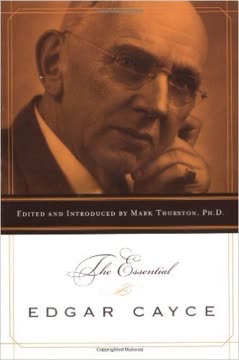
The Essential Edgar Cayce receives mixed reviews with a 3.9/5 rating. Readers praise Dr. Thurston's comprehensive overview and clarification of Cayce's difficult readings, calling it an excellent introduction to the Christian mystic philosopher's 14,000+ readings. Critics note the challenging presentation style and abstruse content. Some question Cayce's legitimacy, suggesting unconscious plagiarism, while others value his sincere desire to help. Several reviewers appreciate Thurston's distillation of complex material, though a few found it unengaging or repetitive.