

Key Takeaways
Ma's life challenges the idea that spiritual authority requires credentials or a conventional path.
An unlikely beginning. Born in rural Bengal in 1896, Nirmala Sundari attended school for less than two years. Married as a child, she became known for her cheerful temperament and skill at household work. The biography presents her not as someone who steadily accumulated religious knowledge, but as a woman whose spiritual practices appeared spontaneously and whose public reputation grew through people who encountered her. Her husband, Bholanath, eventually accepted her unconventional life and became her disciple.
A life in motion. During the 1920s, visitors gathered around her in Dacca, where devotional singing, periods of silence, and reports of ecstatic states drew attention. After 1932, she traveled widely, offering counsel and meeting people from many religious and social backgrounds. The book interprets her life as a divine play, not a ladder of spiritual achievement.
What's striking is how this account separates spiritual authority from institutional markers such as education, office, or formal initiation. That offers a useful challenge to the assumption that expertise always travels through credentials. Yet the biography is also devotional: reports of extraordinary powers and states are presented through admirers, not independent verification. The strongest historical claim is therefore not that every supernatural account is established fact, but that people across social ranks experienced Ma as a compelling spiritual presence.
Look for the One beneath changing forms, rather than demanding a perfect world.
One reality, many appearances. Ma's central teaching is that the ultimate reality, called God, Brahman, or the Self, is not separate from the world's many forms. In ordinary perception, people and things seem divided. Spiritual realization, in her account, reveals that difference arises within an underlying unity. She used images such as water taking the forms of ice and waves: appearances change, while their substance remains one.
The world is not the destination. She described worldly life as constant change, where pleasure and loss repeatedly alternate. The point is not to make every circumstance comfortable, but to discover the reality she believed exists beneath change. She also held that the One appears both as the many and beyond them, so devotion to a personal deity and contemplation of a formless absolute need not be enemies.
This non-dual view resembles a family of philosophical positions that distinguish changing experience from the conditions that make experience possible. Its practical force is relational: if others are not ultimately separate, contempt and possessiveness lose their justification. Still, metaphysical unity does not automatically settle ethical questions. People can affirm that all beings share a deeper reality while continuing to treat them unequally. The value of the idea depends partly on whether it changes conduct, not merely how elegantly it explains existence.
Build a daily spiritual practice before waiting to feel inspired.
Practice precedes appetite. Ma urged seekers to make time for spiritual attention even when the mind resisted. Sādhanā is spiritual practice intended to prepare a person for realization. She recommended options including meditation, devotional singing, reading sacred texts, service, and japa, the repeated recitation of a divine name or mantra. Her advice was practical: choose a time, begin with a manageable commitment, and steadily make the practice more regular.
Let repetition reshape attention. In one example, she compared recurring instruction to water slowly wearing through stone. A short period of listening or practice may seem to change little, yet repetition can create the conditions for deeper understanding. She also advised that a householder who could not meditate for long should still claim a definite daily period, even if it began with five minutes.
The underlying principle is familiar from skill learning: reliable repetition builds capacity before motivation becomes dependable. A small daily ritual can also act as an attentional anchor, returning the mind to a chosen concern amid competing demands. Ma's approach is notably plural, offering practices suited to different temperaments rather than one universal technique. Its limitation is that discipline alone cannot resolve every obstacle. Illness, care responsibilities, or unsafe living conditions can make even a brief routine difficult, so practice should be adapted rather than turned into a measure of moral worth.
Commit to one spiritual path without claiming every other path is false.
Different doors, shared destination. Ma accepted devotion, philosophical inquiry, ritual worship, and the practices of other religions as possible approaches to the same ultimate reality. She encouraged a seeker to choose the form or method that genuinely drew them, then pursue it with steadiness. In her account, sustained devotion to one chosen deity could expand until the devotee perceived that sacred presence throughout the world, not only in a shrine.
Pluralism is not indifference. Ma did not suggest that all methods feel identical or that a seeker should keep switching whenever practice becomes difficult. She taught that paths have distinct demands and can appear to conflict while people are still on them. Their differences need not justify hostility or claims that only one tradition can lead to truth. She welcomed Muslim prayer and Christian hymns while continuing to teach within Hindu traditions.
This is a demanding form of pluralism: it asks for depth within a tradition without turning commitment into a license for religious superiority. That distinction is useful in a culture where openness can become superficial sampling and conviction can become exclusion. The claim that all paths converge is a theological commitment, not a neutral conclusion shared by every religion. Its strongest ethical use is narrower: disagreement about ultimate truth need not erase respect, and serious practice need not depend on declaring neighbors spiritually mistaken.
Stay alert during spiritual ecstasy; intensity alone does not prove insight.
Awareness matters. Ma warned seekers not to treat visions, tears, bodily movements, or loss of consciousness as proof of realization. A young man once reported visions of Krishna teaching Arjuna and described remaining bowed for hours. Ma cautioned that unusual experiences can mix insight with imagination, become a source of vanity, or distract from steady practice. She emphasized remaining conscious and observant rather than being swept away by an experience.
Do not confuse a glimpse with a lasting change. The book distinguishes temporary states of bliss from realization that transforms a person's understanding more durably. Ma also warned that repeatedly seeking a pleasurable trance can stall practice. Experiences may matter, but their significance should be judged by whether they deepen clarity and reduce self-absorption, not simply by how intense or extraordinary they feel.
This caution has a modern psychological resonance: intense experiences can feel self-validating, while the interpretation attached to them remains uncertain. Ma's emphasis on awareness offers a useful check against treating unusual perception as automatic authority. The distinction between temporary state and lasting change also resembles the difference between an episode and a stable capacity. Still, intense states are not necessarily meaningless or harmful. The relevant test is their context, their effects on daily functioning, and whether they encourage humility rather than special status.
Treat ordinary work as worship by releasing ownership of its results.
Work can become practice. Ma called selfless action karmayoga: work undertaken as service, without clinging to personal reward or recognition. A person can serve God, in her understanding, by serving people as expressions of the same reality. This does not mean neglecting practical responsibilities. She encouraged people to feed the hungry, care for the sick, and help others, while examining the motives that accompany such acts.
Notice the demand for credit. Ma asked whether work is truly detached when someone resents another person receiving recognition for finishing a task. That reaction reveals how easily service becomes a vehicle for status. The aim is to act wholeheartedly while accepting that the result, praise, or failure may not belong to the worker. She distinguished this effortful discipline from full realization, where the sense of a separate doer has itself dissolved.
This teaching speaks to a problem found in professions built around care: service can be generous and still entangled with identity, praise, or control. Examining resentment can reveal motives more clearly than rehearsing virtuous intentions. At the same time, detachment from credit should not mean accepting exploitation or refusing fair recognition. Institutions need accountability and equitable reward even when individuals cultivate humility. Ma's inward discipline is most constructive when it reduces ego without making people easier to take advantage of.
Let hardship loosen attachment, but never mistake suffering for a moral good.
Loss can expose dependence. Ma taught that illness, bereavement, and disappointment may turn attention toward what she regarded as lasting spiritual reality. The biography recounts her consoling people after losses by placing grief within a larger view of the Self and the continuity of life. She also urged mourners not to let sorrow immobilize them, and condemned suicide as an attempt to escape rather than address suffering.
Detachment is not numbness. Her teaching asks people to see worldly happiness as fragile because it depends on changing conditions. Yet she also encouraged practical care: serving the sick, feeding the poor, and helping those in need. In her framework, hardship may become material for spiritual growth, but the response should include compassion, not indifference to another person's pain.
Reframing adversity can help some people recover agency when events cannot be reversed. Meaning-making is different from denying pain, and Ma's account contains both acceptance and concrete service. The distinction matters because spiritual language about suffering can be misused to silence people facing preventable harm or injustice. No claim that pain is spiritually useful should override a duty to reduce it where possible. Her view is most humane when applied to one's own unavoidable losses, and least defensible when imposed on someone else's.
Seek guidance, but judge a teacher by whether practice loosens ego.
A guide can help. Ma regarded a genuine spiritual teacher as someone able to direct a seeker toward truth, not merely command loyalty. She advised finding an experienced guide, while also saying that the deepest teacher is the reality within. Until a seeker finds a trustworthy teacher, she recommended choosing a divine name or form that inspires them and practicing sincerely.
Initiation is not a guarantee. Ma described initiation as potentially transmitting instruction, a mantra, or spiritual influence, with its effect depending on both the teacher's capacity and the student's receptivity. She warned against attachment to a teacher's personality and associated self-promotion with false spiritual authority. Her own story complicates the usual model: the biography says she practiced without a human guru and later initiated her husband, Bholanath.
The balance between external guidance and inner judgment is important because spiritual communities can offer real support while also creating opportunities for dependency. A useful test is whether a teacher strengthens discernment, responsibility, and care for others, rather than demanding unquestioned access or obedience. Ma's emphasis on receptivity also recognizes that teaching is relational, not simply delivered like information. Still, claims of special transmission are difficult to verify from outside a tradition, making transparent conduct and safeguards essential.
Use brief periods of self-restraint to make spiritual practice tangible.
A retreat for ordinary lives. Ma did not require every follower to abandon family and work. She treated household life as a possible setting for practice, provided duties were carried out in a spirit of service. In 1952, she began the Samyam Vratas, annual periods in which lay devotees spent a week in spiritual discipline. Participants ate simply, limited distractions, and devoted time to prayer, singing, meditation, and religious talks.
Restraint creates room. The week included restrictions on activities such as gossip, quarrelling, smoking, and sexual relations. The point was not to display austerity but to interrupt familiar habits long enough to redirect attention. Ma's model makes renunciation a temporary experiment available to householders, while she cautioned that adopting the outward identity of a renunciant without inward readiness could become another form of self-deception.
A bounded retreat can make abstract intentions observable: participants can notice which habits consume attention and what emerges when those habits pause. This resembles a behavioral experiment more than a permanent escape from ordinary life. Its value depends on what happens after the retreat, including whether participants return with greater care and steadiness. The model also assumes people can step away from work and family obligations, a privilege not equally available. Temporary discipline is most useful when designed with those constraints in view.
Ma's universalism crossed religious boundaries, but left caste conventions largely intact.
An expansive spiritual family. Ma welcomed Hindus, Muslims, Christians, and visitors from abroad. She joined in Muslim prayer, appreciated Christian hymns, and taught that religious differences could lead toward one reality. She also challenged some gendered religious boundaries: the biography describes her arranging sacred-thread ceremonies for women and supporting a woman renunciant's ritual worship.
A real tension remains. At her ashrams, caste-based rules still shaped food and living arrangements. Foreign visitors could be treated as outside caste and kept apart from kitchens or shared meals. The biography also records Ma's traditional views on marriage and discusses sati, the practice of a widow dying on her husband's funeral pyre, while stating that she did not advocate it in her own era. Her spiritual inclusiveness did not amount to a wholesale rejection of inherited social customs.
This tension matters because universal claims are tested in institutions, not only in metaphysical language. Ma's cross-religious openness and support for women's ritual participation were meaningful departures from some boundaries, while the accommodation of caste rules preserved other exclusions. Historical context helps explain why reform may be partial, but it does not erase the consequences for people subject to those rules. Readers can value the spiritual vision while asking which inherited practices deserve preservation and which require direct challenge.
Analysis
This book combines a devotional biography with a collection of recorded teachings, so its argument arrives in two different registers. The life narrative makes Ma's authority vivid through episodes: a poorly schooled village woman becomes a focus for scholars, officials, householders, Muslims, and foreign seekers. The discourses then offer a flexible spiritual map built around non-duality, disciplined attention, devotion, service, and surrender. The central claim is not simply that the world is unreal. It is that the apparent separation between self, other, and God can be overcome through sustained practice, and that many religious forms can serve that transformation.
The book's most useful practical insight is its refusal to equate spiritual life with one technique. Meditation, repetition of a divine name, ritual, study, and service are presented as different routes, with the individual temperament helping determine the fit. Its warning against confusing dramatic states with realization adds valuable restraint to a text otherwise surrounded by accounts of ecstasy and unusual powers. Together, these ideas favor steadiness and ethical self-scrutiny over spectacle.
The source also demands critical reading. The biography is openly admiring, and many remarkable episodes come through devotees or are interpreted within the book's theological assumptions. The collection preserves translated oral responses, not a systematic treatise, so apparent contradictions may reflect context, translation, or editorial selection. Most consequentially, the language of universal oneness coexists with acceptance of caste practices and traditional gender norms. That friction is not incidental: it shows that transcendent equality does not automatically dismantle social hierarchy. A modern reader can take the book's invitation to examine ego, attention, and religious narrowness seriously while judging its social conclusions by their effects on actual people. Its lasting value lies less in requiring belief in every miracle than in presenting a demanding question: what would change if the deepest reality were not separate from the people one serves, resents, or excludes?
Review Summary
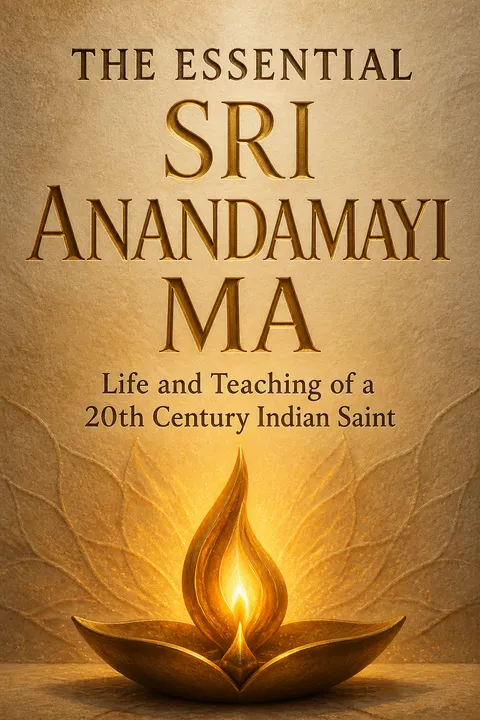
Reviews for The Essential Sri Anandamayi Ma are predominantly positive, averaging 4.53 out of 5. Many readers praise the book's structure, combining biography and teachings, along with its beautiful photographs. Readers drawn to spirituality find Ma's words deeply moving and transformative. Some criticisms include the author's interpretive narrative overshadowing Ma's direct quotes, overuse of Sanskrit terminology, and controversial stances on social issues like caste and widow remarriage. Overall, most consider it an excellent introduction to Ma's life and Hindu spirituality.
Glossary
Līlā
Divine playLīlā means play, especially the freely unfolding activity of the Divine in the world. In Ma's teaching, life and creation are not merely mechanical processes but expressions of the One appearing as many forms. She uses the idea to describe her own outward activities without treating them as a conventional story of spiritual achievement.
Kheyāla
Spontaneous divine promptingKheyāla ordinarily refers to a sudden thought, desire, or impulse. Ma used it for the spontaneous prompting that shaped her actions, such as where she traveled or whom she helped. In her account, this prompting was not ordinary whim or deliberation, but an expression of divine will beyond usual cause and effect.
Sādhanā
Spiritual practiceSādhanā is disciplined spiritual practice undertaken to prepare for realization of the Self or ultimate reality. The book includes meditation, repetition of a divine name, ritual worship, study, devotional singing, and selfless service. Ma presents practices as varied and suited to different seekers, while emphasizing regularity and sincere effort.
Japa
Repeated sacred nameJapa is the repeated recitation of a divine name or mantra, often according to instructions from a spiritual teacher. Ma presents it as a practical way to steady attention and keep remembrance of God active during daily life. The repetition may be spoken, whispered, or mental, depending on the practitioner's tradition and instruction.
Samādhi
Absorption in contemplationSamādhi refers to a state of deep meditative absorption. The book describes it as a condition in which the distinction between meditator and object of contemplation may fade, or the mind may cease its ordinary activity. Ma cautions that unconsciousness or pleasurable trance alone should not be mistaken for final realization.
Vairāgya
Detachment from worldly fixationVairāgya is detachment from dependence on changing worldly objects and pleasures. In Ma's teaching, it does not mean hatred or contempt for the world. It is a shift in which temporary attractions lose their hold because the seeker turns toward what they understand as lasting reality.
Karmayoga
Selfless actionKarmayoga is action performed as service, without attachment to personal reward or recognition. Ma teaches that work can become a spiritual practice when it is offered to God and undertaken for the good of others. She distinguishes this from work pursued mainly for prestige, possession, or satisfaction of the ego.
Iṣṭa
Chosen form of devotionIṣṭa, meaning the beloved or chosen deity, is the particular divine form toward which a person directs devotion. Ma advises seekers to follow the form that genuinely draws them, rather than assuming one form suits everyone. In her non-dual framework, the chosen deity can ultimately be understood as the same reality present in all forms.
Samyam Vratas
Week of spiritual restraintSamyam Vratas are annual periods of self-restraint begun by Ma for lay devotees. For a week, participants simplify food and daily life, abstain from selected habits, and devote themselves to spiritual practices such as meditation, singing, and religious discussion. The program offers householders a temporary experience of concentrated discipline without requiring permanent renunciation.
Satsaṅga
Gathering for spiritual truthSatsaṅga means fellowship with truth, and commonly refers to a gathering of seekers, teachers, or devotees for spiritual discussion and practice. In the book, such gatherings include questions and answers, devotional singing, and shared reflection. Ma treats good company as a support for practice, while warning against fault-finding that turns discussion into hostility.
Download PDF
Download EPUB
.epub digital book format is ideal for reading ebooks on phones, tablets, and e-readers.








