

Key Takeaways
Treat school as work you own, not a service delivered to you
Take responsibility early. The book’s central idea is that school success grows from deliberate effort, not from being naturally gifted. The student’s job includes arriving prepared, doing the assigned work, learning how each class is evaluated, and asking for help instead of waiting for adults to intervene. A syllabus is the course map: it states goals, rules, deadlines, and how attendance, homework, tests, and participation affect grades. Read it, listen for expectations the teacher adds aloud, and track what each class requires.
Aim for your best. The author cautions against treating straight As as the only measure of success. A grade that reflects a student’s real effort and ability can be an achievement. Choices still matter: studying instead of drifting into distractions, or seeking support after a disappointing result, can widen future options.
The job metaphor makes school obligations concrete, especially for students who feel that classes simply happen to them. It also connects to self-regulated learning, the capacity to set goals, monitor progress, and adjust strategy. Yet a student is not merely an employee pleasing a supervisor. Teachers can be mistaken, and students should ask for fair treatment and clear feedback. The strongest version of the book’s message is not obedience, but agency: understand the system, do the work, and speak up when the system fails.
Learn each teacher's expectations, then build trust through consistent effort
Make yourself known. In a school day, one teacher may teach many students. Arriving on time, participating thoughtfully, and visiting office hours gives the teacher a clearer picture of the person behind the grade. Office hours are scheduled times when students can meet a teacher outside class. Bring a specific question about an assignment, test, or confusing idea rather than arriving empty-handed. If a grade disappoints you, ask what went wrong and what would improve the work. Taking responsibility yourself is more constructive than having a parent make the first call.
Build a lasting connection. Teachers can advise students about future courses, provide academic guidance, and write recommendations. A teacher can describe a student more meaningfully when they have seen sustained effort, curiosity, and follow-through. The book’s example of a student approaching a difficult instructor privately captures the point: learn what the teacher values, then communicate respectfully rather than guessing or complaining.
A teacher relationship is a form of social capital: trust and familiarity can make advice, feedback, and opportunities easier to access. This is not just a tactic for better recommendations. It gives students practice communicating with adults and repairing misunderstandings. The advice needs one boundary: relationship-building should not mean flattering teachers or accepting unfairness. Respectful questions and documented concerns can coexist. Students who are shy, disabled, or wary of authority may need different routes to connection, such as email, a counselor, or a trusted advocate.
Turn classroom attendance into active listening, useful questions, and focused notes
Choose attention deliberately. Sitting near the front can make it easier to see the teacher, hear the lesson, and resist distractions. The author recommends putting phones away, bringing the right supplies, and arriving ready to learn. More important than simply hearing words is active listening: concentrating on the speaker, noticing emphasis and repetition, and returning attention when the mind wanders. A lecture is not a dictation exercise. Listen for the ideas a teacher stresses and the connections among them.
Participate with purpose. Talking often is not the same as contributing. A specific question that identifies what is understood and what remains unclear shows more engagement than a vague request to explain everything again. If speaking in a large class is difficult, the student can raise that privately with the teacher and use office hours or smaller discussions to participate. A relevant comment, question, or connection to another subject is better than repeating what someone else just said.
The shift from hearing to listening is a useful distinction because attention is an activity, not a guarantee supplied by physical presence. The guidance also anticipates a central finding in learning science: students learn more when they actively work with information rather than only receive it. Still, front-row seating is not a universal solution. Some students concentrate better elsewhere, and inaccessible room layouts can make proximity impractical. The durable principle is to choose a seat and participation method that improve attention, not to perform attentiveness for approval.
Process notes and readings soon, while ideas can still connect
Capture the structure. During a lecture, write down unfamiliar key terms, brief explanations, the main topics, and recurring themes. Trying to record every sentence can make a student miss the next idea. Simple shorthand and quick diagrams can preserve relationships without creating a private code. After class, review the notes while the lecture is still familiar, mark gaps, and add explanations from the textbook, a classmate, or another reliable source. Notes are working material, not a finished transcript.
Read actively, too. Before reading, identify the chapter’s subject and why it matters to the course. Make a rough outline of headings and key terms, then write a reading response: a short reflection that records questions, reactions, and connections rather than merely summarizing the text. This makes reading a conversation with the material. If time is limited, selective skimming can offer an overview, but it is not a substitute for careful reading when deep understanding is needed.
This process makes learning cumulative. Reviewing soon after class helps expose confusion before it becomes an exam-week emergency, while questions and personal explanations turn information into something the student can retrieve and use. The approach resembles elaborative learning, in which new material is connected to existing knowledge. One caution is that elaborate note-making can become busywork. Rewriting everything neatly is not the goal; the test is whether the learner can explain the idea, see its structure, and identify what remains unclear.
Plan a flexible week that protects study time, sleep, and recovery
Schedule the anchors. A rigid timetable that assigns every minute can collapse as soon as a deadline or activity changes. Instead, block recurring commitments such as classes, practices, and work, then use the open time to address the week’s actual tasks. Keep a running to-do list, rank work by deadline and difficulty, and break large assignments into smaller steps. Free periods can become useful study time, a visit to office hours, or a genuine break, depending on what the week demands.
Make starting easier. The author recommends beginning exam preparation about five to seven days ahead, using short work intervals and modest rewards to overcome procrastination. A calendar deadline moved a few days earlier can provide a buffer. But the plan must include sleep and time away from work. Extracurricular commitments may need adjustment when they crowd out schoolwork, though activities that matter should not be discarded automatically.
The flexible schedule is more realistic than the fantasy of perfect control. It treats time as a limited resource while allowing estimates to change as tasks reveal their true size. Breaking work into smaller steps also reduces the psychological barrier of beginning. The book’s emphasis on personal discipline is useful, but it should not turn every unfilled hour into a productivity test. Rest, family duties, illness, and unequal access to quiet study space shape what is possible. A schedule should help a student function, not become another source of guilt.
Build exam readiness from three master lists, then practice retrieving ideas
Condense before reviewing. The book calls its exam-preparation summaries master lists. They reorganize a course into three views: key terms, recurring themes, and groups of related concepts. Key terms support factual questions. Themes help students anticipate broad essay topics. Related concepts show connections such as causes and effects, examples and principles, or similarities and contrasts. Creating the lists requires sorting and interpreting notes, so the preparation itself is part of the learning.
Test what you know. Quiz yourself by defining terms without looking, and explain major themes aloud as if teaching them. This reveals gaps that rereading can hide. Flash cards can help with facts, while a small study group can provide structure and let students explain ideas to one another. Keep the group small and focused; the author warns that anxious classmates, uneven preparation, and socializing can waste time. Begin several days before the exam, rather than relying on an all-night cram session.
The three-list method is valuable because it separates kinds of knowledge that exams often test in different ways: recall, synthesis, and relationships. Speaking answers aloud makes a student demonstrate understanding instead of relying on the feeling of familiarity that rereading can create. Modern learning research strongly supports retrieval practice and spacing, although the book’s suggested timing should not be treated as a universal formula. Some courses require repeated problem solving or writing, not just verbal review. The lists are best used as a map for practice, not as a replacement for it.
Treat test-taking as timed reasoning, not a verdict on ability
Manage the paper. Before answering, scan the exam, read the directions, note point values, and budget time across sections. Read each question carefully, especially words such as “not,” “always,” or “except.” Answer easier questions first, mark difficult ones, and return if time remains. In multiple-choice questions, eliminate options that conflict with the question or contain an incorrect claim. For an essay, spend a brief moment listing the main points and examples, then leave time for a conclusion.
Manage your state. Panic makes it harder to use knowledge already learned. The author advises arriving early, avoiding last-minute conversations that amplify anxiety, taking short breaks, and getting adequate sleep rather than pulling an all-nighter. After the exam, review mistakes and ask the teacher how to improve. A poor result is information about preparation or test strategy, not a final measure of intelligence or worth.
This takeaway reframes an exam as both a knowledge task and a performance under constraints. Time allocation, question wording, and emotional regulation can affect what a student is able to show. That is a useful correction to the belief that grades measure ability in a pure or complete way. At the same time, test strategy cannot compensate for inaccessible testing conditions, severe anxiety, or an assessment that poorly matches what was taught. Reviewing errors is most useful when it leads to a specific change, not simply more hours of studying.
Make every essay argue one clear claim, supported by evidence you can trace
Build from an idea. A thesis statement is the essay’s central claim, expressed in a focused sentence. It differs from a topic: “the Cold War” names a subject, while a thesis makes a debatable point about it. Choose a manageable question, research enough to refine the claim, and organize evidence so each section supports that claim. Primary sources are the works or documents being examined; secondary sources are commentary by other writers. Record source details as you research, and cite both quotations and paraphrases to avoid plagiarism.
Draft, then improve. Brainstorm, outline, and write a rough first draft without demanding perfect sentences at the start. Revise the argument and structure before proofreading grammar, spelling, and citations. The basic essay shape is an introduction that presents the claim, body paragraphs that support it, and a conclusion that explains what the evidence establishes. Strong writing is not just polished language. It is a clear argument a reader can follow.
The process separates idea-making from sentence polishing, which lowers the pressure that often prevents students from starting. It also teaches intellectual honesty: a claim must be supported, and borrowed ideas must remain traceable to their sources. This is closely related to how scholarly arguments become verifiable and open to challenge. The five-paragraph structure is a useful training scaffold, not a universal model. As students gain skill, the argument should determine the form. A tidy template cannot rescue a claim that is too broad or evidence that does not actually support it.
Choose challenging courses and commitments that deepen genuine interests
Stretch with judgment. The book advises students to take the most demanding classes they can reasonably handle, especially in subjects where they have shown strength. Admissions readers consider course difficulty and grades in the context of what a school offers, as well as patterns in a transcript. If advanced classes are unavailable, a student can investigate community college, online courses, or independent study. The aim is challenge and learning, not choosing the hardest label at any cost.
Show depth beyond class. A club matters more when a student contributes than when they merely attend. Jobs teach responsibility, and volunteering is more sustainable when connected to a real interest. The author’s example of persuading classmates to enroll in an art history course that was about to be canceled shows initiative rooted in curiosity. Summer work, study, service, or creative practice can extend that curiosity. Keep records of activities, but choose them for their substance, not just appearance on an application.
This guidance resists two familiar distortions: coasting to protect grades and collecting activities as application decorations. A challenging course or sustained project can reveal how a student responds to complexity, not just what they have achieved. The example of reviving an art history class is memorable because the student solves a real problem around an interest. Still, opportunity is uneven. Work, caregiving, health, and finances constrain students’ choices, so admissions signals should not be mistaken for character itself. The sound principle is to pursue growth within the circumstances available.
In online or campus learning, take initiative before confusion becomes a crisis
Close the distance. Online classes can be synchronous, meaning teacher and students meet at the same time, or asynchronous, meaning students participate at different times through posts, messages, or course materials. Flexible timing can help students with work or family responsibilities, but it shifts more responsibility onto the learner. Read the syllabus and grading rubric, learn the course platform before deadlines arrive, check class discussions, and contact the instructor when questions arise. Reliable internet and technical support matter, but technical problems should be reported promptly.
Choose with care. Before enrolling in an online program, check its accreditation, the qualifications of instructors, student experiences, and whether its courses or credentials meet relevant requirements. Online study cannot reproduce every feature of an in-person campus, and it is not automatically easier. The broader lesson applies in any school: investigate what is offered, ask for help, and use available resources rather than assuming the institution will guide every step.
Online learning makes the book’s larger argument unusually visible: without the rhythms of a physical classroom, organization and initiative become part of the curriculum. Written discussion can also give students more time to formulate a contribution than a fast-moving lecture does. But flexibility is not free. It depends on stable technology, accessible course design, and enough control over one’s schedule. Evaluating accreditation and fit is therefore not merely consumer savvy; it protects students from investing time and money in a credential that may not serve their goals.
Analysis
This is a practical handbook rather than a single argument developed through a continuous story. Its chapters move from classroom conduct and teacher relationships to notes, reading, exams, writing, online learning, extracurricular life, and educational choice. The unifying claim is that learning improves when students stop treating school as a sequence of demands and begin managing it as an active, interconnected process.
The book’s most valuable thread is continuity. A lecture becomes useful notes; notes become questions and organized themes; themes become practice for an exam or evidence for an essay. This prevents the common trap of mistaking exposure for learning. The student is not asked to absorb a semester in one heroic night, but to revisit, connect, test, and revise understanding over time. The same ethic appears in relationships with teachers: seek feedback before a small difficulty becomes a crisis, and take responsibility for the next step.
The handbook also joins academic performance to a larger education. Course choices, work, service, summer plans, and personal interests matter because they help students discover what they value and how they act when given responsibility. Its account of a student organizing peers to restore an art history class captures this well: agency can shape the educational environment, not merely navigate it.
Some advice reflects the book’s 2011 setting, and its language of pleasing a teacher or impressing admissions readers can make education sound like compliance or marketing. That is a tension, not a reason to discard its practical guidance. Students do need to understand evaluation systems, but grades and applications are imperfect proxies for learning, opportunity, and character. Read most constructively, the book asks students to combine strategic awareness with curiosity: know the rules, ask questions, seek help, and choose work that builds genuine competence. Its deepest lesson is not that effort guarantees success, but that deliberate habits give students more control over what they can influence.
Review Summary
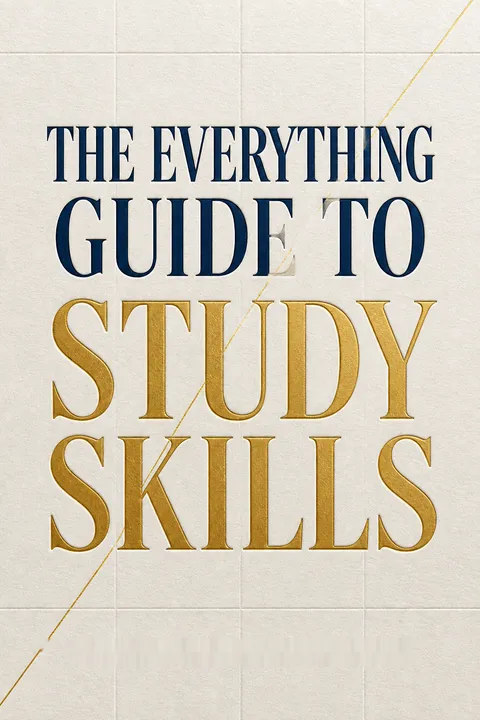
The Everything Guide to Study Skills receives generally positive reviews, with an average rating of 3.85 out of 5 based on 109 reviews. Readers find the book offers basic but useful advice on identifying learning styles, implementing effective study strategies, utilizing school resources, seeking help when needed, setting realistic goals, and managing stress. The content is described as well-organized and practical, providing tools to determine learning styles and maximize study efficiency. Some reviewers note that while the advice is fundamental, it is presented in a helpful manner.
Glossary
Master lists
Three exam-preparation summariesA set of condensed study sheets created by reorganizing course notes into three categories: key terms, general themes, and related concepts. The categories prepare students for factual questions, broad essay prompts, and questions that ask them to identify relationships. Making the lists is itself part of studying because it requires selecting, grouping, and connecting course material.
Reading response
Reflection after assigned readingA brief written reaction to a text, created after reading rather than as a simple chapter summary. Students can record what they found important, what confused them, questions they still have, and connections to other course ideas or personal knowledge. Revisiting these responses helps track how understanding changes across a course.
Brag sheet
Record of activities and achievementsA student-maintained record of activities, jobs, service, awards, interests, and other accomplishments outside class. The book recommends recording time commitments and updating the document over the school years. Students can share it with teachers who are writing recommendations, helping them recall details beyond grades in a particular course.
Student blurb
Class-specific achievement notesA short list of a student’s contributions and reflections about a particular class. It may recall a project, discussion, question, challenge, or office-hour visit. Shared with a teacher alongside a broader activity record, it gives the teacher concrete details to draw on when writing a personal recommendation.
Cram card
Last-minute fact reviewA small card prepared shortly before an exam with terms, facts, phrases, or formulas that remain difficult to remember. The book suggests reviewing it immediately before the test and, once the exam begins and notes are put away, writing down remembered information when permitted. It is a short-term aid, not a substitute for studying across several days.
Synchronous format of learning
Online learning at shared timesAn online course format in which the instructor and students participate at the same time, often through live video, audio, or chat sessions. It can create direct dialogue but may be difficult for students in different time zones or with work and family commitments.
Asynchronous learning
Online learning at separate timesAn online course format in which students participate at different times through written posts, course materials, messages, or recorded instruction. It offers scheduling flexibility, but students must monitor course activity, manage deadlines, and contribute without relying on a live classroom meeting.
About the Author
Other books by Cynthia Clumeck Muchnick
Download PDF
Download EPUB
.epub digital book format is ideal for reading ebooks on phones, tablets, and e-readers.








